
Electronic Control Weapons –
AELE Case Summaries
Click here for a listing of online articles and resources about Electronic Control Weapons.
Click here to view a glossary of ECW terms.
See also Injuries to Applicants, Trainees, Participants & Observers.
View a map of U.S. appellate circuits
Note: As a precaution, AELE editors have added the word RESTRICTIVE before selected case summaries, because a court has determined, a jury has found, or a settlement has indicated, that the quantum of force used either was, or may have been, unreasonable.
Case classifications: Some ECW experts prefer to categorize ECW applications by event descriptions, such as their use on juveniles, the disabled, elderly persons, pregnant women, or individuals who are perched on ledges, etc. This is a law library, not a policy or training site. Litigants and policymakers are bound by the case law of their federal circuit. However, policymakers may want to prohibit the deployment of ECWs based on situational events.
Keywords: You can search for cases using keywords in your browser. The keywords for this document are: asphyxia, cardiac, criminal, delirium, disabled, elderly, experts, extraction, flee, handcuffed, intoxicated, juvenile, mental, pointing (an ECW), pregnant, products liability, and suicidal.
- U.S. Supreme Court Cases
- 1st Circuit Cases [ME, MA, NH., RI., and PR]
- 2nd Circuit Cases [CT, NY, and VT]
- 3rd Circuit Cases [DE, NJ, PA, and VI].
- 4th Circuit Cases [MD, NC, SC, VA, and WV]
- 5th Circuit Cases [LA, MS, and TX]
- 6th Circuit Cases [KY, MI, OH, and TN]
- 7th Circuit Cases [IL, IN, and WI]
- 8th Circuit Cases [AR, IA, MN, MO, NE, ND, and SD]
- 9th Circuit Cases [AK, AZ, CA, HI, ID, MT,
NV, OR, WA, plus GU and MP].
- 10th Circuit Cases [CO, KS, NM, OK, UT, and WY]
- 11th Circuit Cases [AL, FL, and GA]
- D.C. Circuit Cases [District of Columbia]
- Fed Circuit Cases
- International Cases
- Weapon Confusion Cases
- Purpose:
This listing was created to assist state, municipal and county
legislators; city and county managers; police chiefs, sheriffs and
correctional administrators; law enforcement and correctional supervisors,
trainers and officers; lawyers who advise or defend police or correctional
agencies and officers; counsel who represent inmates, other claimants, or
community and civil liberties organizations; risk managers; criminal
justice professors, researchers and students; and criminal justice
journalists.
Sign up for monthly e-mails, when AELE's free online library is updated.
U.S. Supreme Court Cases
Dart Mode Cases
RESTRICTIVE: An officer was entitled to qualified immunity in a case where a man was subjected to eight applications of a Taser (seven stun mode applications and one unintended dart mode application) during an arrest. Subsequently, the man died. Prior rulings in the Fifth Circuit did not put the officer on notice that using the Taser under these circumstances would constitute excessive force. There was no evidence that the officer intended to have the Taser fire in the dart mode, and, unlike dart mode, the stun mode causes only temporary, localized pain. The decedent was arrested under a valid active felony warrant, tried to evade arrest, and ultimately was only subdued through threat of deadly force at the end of a foot chase. He did not comply with repeated requests to cooperate with the process of the arrest. Even though he was handcuffed, he refused to cooperating, telling the officers to "just drag me," and refusing to get up and walk more than a few feet before going down again and refusing to get up, which caused the officer to use the Taser again. He had sickle cell anemia, which the officers did not know, and an autopsy revealed that his red blood cells had sickled before his death. Thomas v. Nugent, #12-30527, 2013 U.S. App. Lexis 17951 (5th Cir.). Subsequently, the U.S. Supreme Court granted a writ of certiorari, vacated the judgment, and remanded the case for further consideration in light of Tolan v. Cotton, #13-551, 2014 U.S. Lexis 3112. Thomas v. Nugent, #13-862, 2014 U.S. Lexis 3518. This had the effect of reinstating the case, and the appeals court must now take a new look at whether it should have viewed the case from the perspective of the facts alleged by the plaintiffs. In Tolan, a unanimous U.S. Supreme Court ordered further proceedings in an excessive force lawsuit brought by a unarmed man who a police officer fired three shots at, with one of the bullets puncturing his right lung. At the time, the plaintiff was approximately 15 to 20 feet away from the officer on the front porch of his parents' home. The Court found that the appeals court, in upholding summary judgment on the basis of qualified immunity for the officer, had erred by failing to view the evidence on summary judgment in the light most favorable to the plaintiff on the facts. Instead, the appeals court improperly resolved disputed issues concerning the lighting present, the demeanor of the plaintiff's mother, the plaintiff's positioning during the shooting, and whether he had shouted a direct threat, in favor of the officer, the moving party on the summary judgment motion. Keyword: handcuffed.
Stun Mode Cases
RESTRICTIVE: The U.S. Supreme Court has vacated and remanded a federal appeals court decision rejecting liability for the use of a Taser in the stun mode and other force against a detainee. In the case, a jail detainee claimed that jailers used excessive force against him when they moved him to a different cell after he refused orders to take down a yellow sheet of paper covering the light in his cell. The prisoner refused to cooperate with the move, lying face down on his bunk and refusing to get up. He was forcibly removed and handcuffed and placed on a bunk. When the officers tried to remove the handcuffs, he allegedly resisted, which he later denied. The officers then allegedly smashed his head into the concrete bunk, which they later denied. A Taser was then applied to the detainee's back in stun mode for five seconds. He declined the attentions of a nurse. The trial court noted the case law that held that it was reasonable to use force against an inmate who refused to comply with orders but concluded that the issue in the case was "whether [the] defendants' response to plaintiff's obstinance was reasonable under the circumstances or whether it was excessive and was intended to cause [the] plaintiff harm." The court also concluded that, because a jury could find that the defendants had acted with malice, qualified immunity was not available. Later, a jury returned a verdict for the defendants, which was upheld on appeal. The Fourteenth Amendment governed the plaintiff's claims as a pretrial detainee. The federal appeals court held that the jury was adequately instructed on the elements of that claim. The jury instructions, the court said, properly required them to find, in order to impose liability, that the defendants knew that their use of force posed a risk of harm to the plaintiff, but that they recklessly disregarded his safety. Kingsley v. Hendrickson, #12-3639, 744 F.3d 443, 2014 U.S. App. Lexis 3972, 2014 WL 806956 (7th Cir. 2014). In reversing by a 5-4 vote, the U.S. Supreme Court found that the detainee only had to show that the force purposefully or knowing used was objectively unreasonable, as that standard adequately protected an officer who acted in good faith. The jury instructions were erroneous because they suggested that the jury should weigh the officers' subjective reasons for using force, whether the officers actually intended to violate, or recklessly disregarded the detainee's rights, and the issue of whether that error was harmless would depend in part on the detailed specifics of the case. This determination must be made from the perspective of a reasonable officer on the scene, including what the officer knew at the time, and must account for the "legitimate interests [stemming from the government's] need to manage the facility in which the individual is detained," appropriately deferring to "policies and practices that in th[e] judgment" of jail officials "are needed to preserve internal order and discipline and to maintain institutional security." Kingsley v. Hendrickson, #14-6368, 2015 U.S. Lexis 4073. On remand, the federal appeals court vacated the district court's judgment and ordered a new trial, as the plaintiff urged them to. "We have undertaken the required scrutiny of the record and are convinced that the error in this case cannot be characterized as harmless. True, many of the factors to which the district court invited the jury's attention were the same factors that a jury would assess under the objective standard now mandated by the Supreme Court. Nevertheless, those factors were suggested to the jury not in the context of applying them to an objective test but as circumstantial evidence from which an inference of reckless or malicious intent might be drawn. Moreover, given the evidence of record, the jurors might well have decided that, although the officers had acted in an objectively unreasonable manner, they did not have the subjective intent required by the erroneous instruction. That is, the jurors might well have concluded that the officers acted in an objectively unreasonable manner in their effort to handle a manacled prisoner, a conclusion supported by the testimony of Mr. Kingsley's expert. Nevertheless, the jury also might have concluded that the officers, while unreasonable in their approach, did not have a reckless or malicious intent." Under the law as stated by the U.S. Supreme Court, the appeals court reasoned, the plaintiff should prevail if he is able to show that the officers acted in an unreasonable manner "without regard to their subjective intent. "The evidence of record would have supported a finding for him under that theory, but the jury was told that it also had to find the officers had a proscribed intent. This last requirement increased, significantly, his burden of proof. The error was not harmless." The appeals court rejected the defendants' argument that they should be entitled to qualified immunity since the U.S. Supreme Court's decision resolved a circuit split on the law, altering the law on liability, and thus the standard adopted was not "clearly established law" prior to the Supreme Court's ruling. The appeals court noted that the Supreme Court's instructions to it did not mention returning to the issue of qualified immunity. The appeals court also stated that it did not think a qualified immunity defense was viable in this case, as "the scope of the right in issue must be drawn more narrowly than the right of a pretrial detainee to be free from excessive force during his detention; instead, we must examine whether the law clearly established that the use of a Taser on a non-resisting detainee, lying prone and handcuffed behind his back, was constitutionally excessive." On that specific issue, the appeals court believed, the law was clearly established at the time of the incident, if the plaintiff was not resisting at the time the Taser was used. Kingsley v. Hendrickson, #12-3639, 2015 U.S. App. Lexis 15963 (7th Cir.). Keyword: handcuffed.
RESTRICTIVE: An officer was entitled to qualified immunity in a case where a man was subjected to eight applications of a Taser (seven stun mode applications and one unintended dart mode application) during an arrest. Subsequently, the man died. Prior rulings in the Fifth Circuit did not put the officer on notice that using the Taser under these circumstances would constitute excessive force. There was no evidence that the officer intended to have the Taser fire in the dart mode, and, unlike dart mode, the stun mode causes only temporary, localized pain. The decedent was arrested under a valid active felony warrant, tried to evade arrest, and ultimately was only subdued through threat of deadly force at the end of a foot chase. He did not comply with repeated requests to cooperate with the process of the arrest. Even though he was handcuffed, he refused to cooperating, telling the officers to "just drag me," and refusing to get up and walk more than a few feet before going down again and refusing to get up, which caused the officer to use the Taser again. He had sickle cell anemia, which the officers did not know, and an autopsy revealed that his red blood cells had sickled before his death. Thomas v. Nugent, #12-30527, 2013 U.S. App. Lexis 17951 (5th Cir.). Subsequently, the U.S. Supreme Court granted a writ of certiorari, vacated the judgment, and remanded the case for further consideration in light of Tolan v. Cotton, #13-551, 2014 U.S. Lexis 3112. Thomas v. Nugent, #13-862, 2014 U.S. Lexis 3518. This had the effect of reinstating the case, and the appeals court must now take a new look at whether it should have viewed the case from the perspective of the facts alleged by the plaintiffs. In Tolan, a unanimous U.S. Supreme Court ordered further proceedings in an excessive force lawsuit brought by a unarmed man who a police officer fired three shots at, with one of the bullets puncturing his right lung. At the time, the plaintiff was approximately 15 to 20 feet away from the officer on the front porch of his parents' home. The Court found that the appeals court, in upholding summary judgment on the basis of qualified immunity for the officer, had erred by failing to view the evidence on summary judgment in the light most favorable to the plaintiff on the facts. Instead, the appeals court improperly resolved disputed issues concerning the lighting present, the demeanor of the plaintiff's mother, the plaintiff's positioning during the shooting, and whether he had shouted a direct threat, in favor of the officer, the moving party on the summary judgment motion. Keyword: handcuffed.
Corrections and Confinement
RESTRICTIVE: The U.S. Supreme Court has vacated and remanded a federal appeals court decision rejecting liability for the use of a Taser in the stun mode and other force against a detainee. In the case, a jail detainee claimed that jailers used excessive force against him when they moved him to a different cell after he refused orders to take down a yellow sheet of paper covering the light in his cell. The prisoner refused to cooperate with the move, lying face down on his bunk and refusing to get up. He was forcibly removed and handcuffed and placed on a bunk. When the officers tried to remove the handcuffs, he allegedly resisted, which he later denied. The officers then allegedly smashed his head into the concrete bunk, which they later denied. A Taser was then applied to the detainee's back in stun mode for five seconds. He declined the attentions of a nurse. The trial court noted the case law that held that it was reasonable to use force against an inmate who refused to comply with orders but concluded that the issue in the case was "whether [the] defendants' response to plaintiff's obstinance was reasonable under the circumstances or whether it was excessive and was intended to cause [the] plaintiff harm." The court also concluded that, because a jury could find that the defendants had acted with malice, qualified immunity was not available. Later, a jury returned a verdict for the defendants, which was upheld on appeal. The Fourteenth Amendment governed the plaintiff's claims as a pretrial detainee. The federal appeals court held that the jury was adequately instructed on the elements of that claim. The jury instructions, the court said, properly required them to find, in order to impose liability, that the defendants knew that their use of force posed a risk of harm to the plaintiff, but that they recklessly disregarded his safety. Kingsley v. Hendrickson, #12-3639, 744 F.3d 443, 2014 U.S. App. Lexis 3972, 2014 WL 806956 (7th Cir. 2014). In reversing by a 5-4 vote, the U.S. Supreme Court found that the detainee only had to show that the force purposefully or knowing used was objectively unreasonable, as that standard adequately protected an officer who acted in good faith. The jury instructions were erroneous because they suggested that the jury should weigh the officers' subjective reasons for using force, whether the officers actually intended to violate, or recklessly disregarded the detainee's rights, and the issue of whether that error was harmless would depend in part on the detailed specifics of the case. This determination must be made from the perspective of a reasonable officer on the scene, including what the officer knew at the time, and must account for the "legitimate interests [stemming from the government's] need to manage the facility in which the individual is detained," appropriately deferring to "policies and practices that in th[e] judgment" of jail officials "are needed to preserve internal order and discipline and to maintain institutional security." Kingsley v. Hendrickson, #14-6368, 2015 U.S. Lexis 4073. On remand, the federal appeals court vacated the district court's judgment and ordered a new trial, as the plaintiff urged them to. "We have undertaken the required scrutiny of the record and are convinced that the error in this case cannot be characterized as harmless. True, many of the factors to which the district court invited the jury's attention were the same factors that a jury would assess under the objective standard now mandated by the Supreme Court. Nevertheless, those factors were suggested to the jury not in the context of applying them to an objective test but as circumstantial evidence from which an inference of reckless or malicious intent might be drawn. Moreover, given the evidence of record, the jurors might well have decided that, although the officers had acted in an objectively unreasonable manner, they did not have the subjective intent required by the erroneous instruction. That is, the jurors might well have concluded that the officers acted in an objectively unreasonable manner in their effort to handle a manacled prisoner, a conclusion supported by the testimony of Mr. Kingsley's expert. Nevertheless, the jury also might have concluded that the officers, while unreasonable in their approach, did not have a reckless or malicious intent." Under the law as stated by the U.S. Supreme Court, the appeals court reasoned, the plaintiff should prevail if he is able to show that the officers acted in an unreasonable manner "without regard to their subjective intent. "The evidence of record would have supported a finding for him under that theory, but the jury was told that it also had to find the officers had a proscribed intent. This last requirement increased, significantly, his burden of proof. The error was not harmless." The appeals court rejected the defendants' argument that they should be entitled to qualified immunity since the U.S. Supreme Court's decision resolved a circuit split on the law, altering the law on liability, and thus the standard adopted was not "clearly established law" prior to the Supreme Court's ruling. The appeals court noted that the Supreme Court's instructions to it did not mention returning to the issue of qualified immunity. The appeals court also stated that it did not think a qualified immunity defense was viable in this case, as "the scope of the right in issue must be drawn more narrowly than the right of a pretrial detainee to be free from excessive force during his detention; instead, we must examine whether the law clearly established that the use of a Taser on a non-resisting detainee, lying prone and handcuffed behind his back, was constitutionally excessive." On that specific issue, the appeals court believed, the law was clearly established at the time of the incident, if the plaintiff was not resisting at the time the Taser was used. Kingsley v. Hendrickson, #12-3639, 2015 U.S. App. Lexis 15963 (7th Cir.). Keyword: handcuffed.
Second Amendment Issues
The highest court in Massachusetts upheld a state statute prohibiting the private possession of stun guns against a constitutional Second Amendment challenge, on the basis that stun guns were not in common use at the time of the Second Amendment's enactment and therefore were not protected by it. The court also reasoned that stun guns were "dangerous per se at common law and unusual" because they were a modern invention, and that "nothing in the record to suggest that [stun guns] are readily adaptable to use in the military." The U.S. Supreme Court vacated that decision, stating that "the Second Amendment extends, prima facie, to all instruments that constitute bearable arms, even those that were not in existence at the time of the founding," and that it had previously rejected the argument that "only those weapons useful in warfare are protected" by the Second Amendment. The case involved a woman with an abusive boyfriend who found that protective orders she obtained proved futile so she accepted a stun gun from a friend to protect herself and when she brandished it, the ex-boyfriend got scared and left her alone. She was then convicted of violating the state law that barred private possession of stun guns. Caetano v. Massachusetts, #14-10078, 194 L. Ed. 2d 99, 2016 U.S. Lexis 1862.
1st
Circuit Cases
Dart Mode Cases
An officer observed a man fleeing from the scene where he allegedly had broken into a parked car. The man was seen on a bicycle heading towards a factory and the officer pursued in his car. Upon arriving at the factory, the officer was informed that the man had climbed under a fence and was running along a nearby river. He found the man and shouted at him to stop, but he kept running. The suspect climbed onto a metal staircase attached to a building at the bottom of which was a landing that overlooked a 50-foot drop to a fast flowing river below and its rocky bed. The officer warned the suspect to stop or a Taser would be fired at him. The man ignored this, and the officer fired the Taser at him in the dart mode. He was concerned that the suspect, who he suspected of being under the influence of drugs, might jump in the river. Two warnings were given before the officer fired. While he aimed at the suspect's back, the probes hit him in the head and arm. Summary judgment was entered for the defendant officer on an excessive force claim on the basis of qualified immunity. The court found that on the date of the incident in October of 2011, "it was not clearly established that it was unconstitutional to shoot a seemingly impaired suspect fleeing on foot with a Taser to prevent that suspect from engaging in further flight that appeared to pose a high risk of serious injury." Dixon v. City of Somersworth, #14-cv-397, 2015 U.S. Dist. Lexis 136181 (D.N.H.). Keywords: flee.
RESTRICTIVE: A man was reported to the police for engaging in erratic behavior, apparently due to use of "bath salts." When an officer arrived at the second floor of the building, the man screamed and jumped over a banister in the third floor hallway, landing below on the stairway, putting his body through a stairway wall, causing a hole, and throwing a beer bottle. He then ran past the officer and exited the building. Backup was summoned and the officers attempted to talk to the man. A person at the building informed an officer that the man was a bath salts user. The man continued yelling profanities at the officers and challenged them to chase him. A decision was made to take him into protective custody for evaluation for mental impairment possibly threatening harm to himself or others. The man fled from the scene and an additional officer responding to the scene had to stop his car to avoid hitting him when the man ran in front of the vehicle. Officers repeatedly asked the man to give them his hands, but he refused, swore at them, placed his hands under his body on the ground, and threatened to kill them. An officer placed his finger on a pressure point under the man's nose to try to gain pain compliance, but this had no effect. Striking the man's arm several times also had little effect. An officer placed herself on the man's legs because he was kicking. During the encounter, he was warned that a Taser would be used if he did not stop resisting, and it was used in a combination of the dart mode and the stun mode for a five second cycle. Officers kept him in a face-down, prone position until he was securely secured in a five-point restraint. He was subsequently unresponsive and died. The officers had at least a reasonable basis to try to detain the man, but there were factual issues as to whether force was used after he stopped actively resisting them. The decision does not discuss in any detail whether or not the use of the Taser was excessive at the time it was used, but refers to a more general issue of whether force was improperly used after resistance had effectively ended. The court rejected a claim that the defendants delayed in providing medical assistance after it became clear that there was a need for it, and rejected municipal liability claims. McCue v. City of Bangor, #1:14-cv-0098, 2015 U.S. Dist. Lexis 127210 (D. Me.). Keywords: flee, mental.
RESTRICTIVE: A police officer asked a motorist who was suspected of intoxication to take a field sobriety test. After several attempts, during which the driver was unable to follow directions, he began to walk away towards his truck. The officer told him that he was not free to leave, but the driver started to run. The officer yelled at him to stop, and then fired his Taser in the dart mode at him, with the prongs striking him in the back. He fell to the ground, injuring his right elbow. The officer allegedly deployed the Taser once more when the driver tried to get on his hands and knees and then placed him under arrest. The court found that a factual dispute precluded summary judgment for the officer on an excessive force claim. Because the suspected crime was DUI, the motorist could not have posed an immediate threat to the safety of others while on the ground after the initial use of the Taser. If he was not trying to resist arrest at that time, a jury could find that the alleged second use of the Taser was excessive force. The officer was not entitled to qualified immunity on a second use of the Taser. The court also found that the plaintiff could continue with a state law battery claim against the officer, but certified to the New Hampshire Supreme Court the issue of whether the municipality was statutorily immune from vicarious liability for the alleged battery, or whether the statute granting that immunity violated the state constitution. Huckins v. McSweeney, #11-cv-106, 2012 DNH 137, 2012 U.S. Dist. Lexis 113682 (Unpub. D.N.H.). Keywords: flee, intoxicated.
RESTRICTIVE: Motorist subjected to Taser during his arrest for intoxicated driving, causing him to fall to the ground and suffer injuries, was properly awarded $111,000 in damages when he had not attempted to escape or to assault the officers, although he had made certain defiant gestures or statements. Parker v. Gerrish, #081045, 547 F.3d 1, 2008 U.S. App. Lexis 23079 (1st Cir.). Keywords: intoxicated.
Stun Mode Cases
CAUTION: A federal appeals court upheld summary judgment for the defendant officers in an excessive force lawsuit, holding that an objectively reasonable police officer in May 2013 could have concluded that a single use of a Taser in stun mode to quell a nonviolent, mentally ill person who was resisting arrest did not violate the Fourth amendment. It further ruled that, in any case, the officer here was shielded by qualified immunity. The plaintiff, a mentally ill person with bipolar disorder who was tased after fleeing from the hospital to which she had been involuntarily committed, sued the officer and the town that employed him, asserting claims under 42 U.S.C. 1983 and Title II of the Americans with Disabilities Act (ADA), 42 U.S.C. 12131-65, along with state-law claims for assault and battery and malicious prosecution. The plaintiff had not complied with the officer’s orders and could not be handcuffed until after the Taser was used. The magistrate judge found no violation of the Fourth Amendment under section 1983 and no viable state-law claims, that the officer was entitled to qualified immunity, and that there was no violation of the ADA. The federal appeals court affirmed, holding that the plaintiff presented sufficient evidence to make out a jury question as to whether the officer used excessive force, but the officer was entitled to qualified immunity, and that the plaintiff was not entitled to relief on any of her remaining claims. Gray v. Cummings, #18-1303, 917 F.3d 1 (1st Cir. 2019). Keywords: flee, mental.
RESTRICTIVE: A man was reported to the police for engaging in erratic behavior, apparently due to use of "bath salts." When an officer arrived at the second floor of the building, the man screamed and jumped over a banister in the third floor hallway, landing below on the stairway, putting his body through a stairway wall, causing a hole, and throwing a beer bottle. He then ran past the officer and exited the building. Backup was summoned and the officers attempted to talk to the man. A person at the building informed an officer that the man was a bath salts user. The man continued yelling profanities at the officers and challenged them to chase him. A decision was made to take him into protective custody for evaluation for mental impairment possibly threatening harm to himself or others. The man fled from the scene and an additional officer responding to the scene had to stop his car to avoid hitting him when the man ran in front of the vehicle. Officers repeatedly asked the man to give them his hands, but he refused, swore at them, placed his hands under his body on the ground, and threatened to kill them. An officer placed his finger on a pressure point under the man's nose to try to gain pain compliance, but this had no effect. Striking the man's arm several times also had little effect. An officer placed herself on the man's legs because he was kicking. During the encounter, he was warned that a Taser would be used if he did not stop resisting, and it was used in a combination of the dart mode and the stun mode for a five second cycle. Officers kept him in a face-down, prone position until he was securely secured in a five-point restraint. He was subsequently unresponsive and died. The officers had at least a reasonable basis to try to detain the man, but there were factual issues as to whether force was used after he stopped actively resisting them. The decision does not discuss in any detail whether or not the use of the Taser was excessive at the time it was used, but refers to a more general issue of whether force was improperly used after resistance had effectively ended. The court rejected a claim that the defendants delayed in providing medical assistance after it became clear that there was a need for it, and rejected municipal liability claims. McCue v. City of Bangor, #1:14-cv-0098, 2015 U.S. Dist. Lexis 127210 (D. Me.). Keywords: flee, mental.
Corrections and Confinement
Employment Related
A medical center terminated a registered nurse after several reports of inappropriate behavior, including possessing an illegal weapon, a Taser, at work. She denied bringing the weapon to work, but posted on her Facebook page that "I think it should be legal for nurses on duty to carry Tasers . . . many animals out there these days." Three other employees reported observing her with the Taser at the nurses' station. Rhode Island law makes possession or use of such a weapon by non-law enforcement personnel unlawful. The trial court found that she was properly terminated for inappropriate conduct, possessing the weapon in violation of state law and hospital policy, not, as she claimed, because of her lesbian sexual orientation or because of unlawful retaliation. The court also rejected her defamation claims against a co-worker who told the employer and union that she brought the weapon to work. Even if the statement was allegedly false, they were entitled to qualified privilege under Rhode Island law when made in good faith, based on a duty to ensure the safety of the hospital grounds for the public and patients. Bellisle v. Landmark Med. Center, #14-266, 2016 U.S. Dist. Lexis 130392 (D.R.I).
Second Amendment Issues
A Massachusetts state statute constituting an absolute prohibition against civilian possession of stun guns violates the Second Amendment to the United States Constitution. The highest court in Massachusetts issued the ruling in a case in which a man was criminally charged with stun gun possession. The court overruled the trial court’s refusal to dismiss that charge and ordered that the motion be granted. Stun guns are “arms” within the protection of the Second Amendment and therefore may be regulated but not absolutely banned. Consequently, the absolute prohibition in state law that bars all civilians from possessing or carrying stun guns, even in their home, violates the Second Amendment, and the section of the law containing the prohibition in its current form is facially invalid. Ramirez v. Commonwealth, #SJC-12340, 479 Mass. 331, 94 N.E.3d 809 (Mass. 2018). Keywords: criminal
The highest court in Massachusetts upheld a state statute prohibiting the private possession of stun guns against a constitutional Second Amendment challenge, on the basis that stun guns were not in common use at the time of the Second Amendment's enactment and therefore were not protected by it. The court also reasoned that stun guns were "dangerous per se at common law and unusual" because they were a modern invention, and that "nothing in the record to suggest that [stun guns] are readily adaptable to use in the military." The U.S. Supreme Court vacated that decision, stating that "the Second Amendment extends, prima facie, to all instruments that constitute bearable arms, even those that were not in existence at the time of the founding," and that it had previously rejected the argument that "only those weapons useful in warfare are protected" by the Second Amendment. The case involved a woman with an abusive boyfriend who found that protective orders she obtained proved futile so she accepted a stun gun from a friend to protect herself and when she brandished it, the ex-boyfriend got scared and left her alone. She was then convicted of violating the state law that barred private possession of stun guns. Caetano v. Massachusetts, #14-10078, 194 L. Ed. 2d 99, 2016 U.S. Lexis 1862.
2nd
Circuit Cases
Dart Mode Cases
A police officer used a Taser twice in the dart mode on a 12-year-old student at a school for the deaf after giving him warnings that he would do so if he did not follow the officer’s instructions to put down a large rock. A federal appeals court held that the officer was entitled to qualified immunity because it was objectively reasonable for him to believe that, given the undisputed facts, his conduct complied with clearly established law. In this case, the student was a threat to himself and others, and the officer had a reasonable basis to believe that his instructions and warnings were being conveyed to the student by faculty in American Sign Language (ASL) and the student was ignoring them. The student got into a confrontation over a takeout food order with a teacher at his school, became angry, ran from the dorm, and entered a nearby, fenced-off construction area. The teacher followed, and the student picked up a stick and hit him, and then commenced throwing rocks, also hitting the teacher at least once. The school reported in a 911 call that the student was “out of control” and “making the situation dangerous.” Muschette v. Gionfriddo, #17-3817, 910 F.3d 65 (2nd Cir. 2018). Keyword: juvenile.
RESTRICTIVE: An officer tried to stop a vehicle which turned without signaling and without illuminated headlights at night. The vehicle drove on and later passed another officer's vehicle. That officer observed the car going fast and reported that something had been thrown out of the car window. The pursued car later stopped and several individuals were seen exiting it. An officer hit one of the fleeing men, who was running, with his car. This man stood up and resumed running, ignoring orders to stop, so the officer fired his Taser in the dart mode, striking him and causing him to fall to the ground. Two other officers also fired their Tasers in the dart mode after they thought that the first officer's Taser cycle had ended and was no longer effective. The man was lying face down with blood coming from his head or face area. He was treated for a fractured skull and severe traumatic brain injury. The brain injury was allegedly permanent, rendering the man incapable of communicating. Summary judgment was denied to the officers on excessive force claims involving the use of the Tasers. Depending on the degree of force sustained by the plaintiff when he was struck on the officer's car, he may not have had the capacity to pose such a threat of flight and resistance that it required the first officer's immediate and without warning Taser deployment, and this was a question of fact to be determined. Similarly, the court could not rely without question upon the other two officers' defendant reports that they then deployed their Tasers without knowledge of each other's actions when they both observed the plaintiff pushing up off the ground. "Questions of fact remain relative to whether plaintiff presented a threat or resistance when he was lying face down on the ground after having been hit by a car and [Tasered] in the back," and whether either of these two officers perceived one another's conduct prior to resolving to deploy a Taser. Claims against the municipality for inadequate training and deliberate indifference to excessive force were allowed to proceed. Soto v. Gaudette, #3:10-cv-106, 205 U.S. Dist. Lexis 144129 (D. Conn.). Keywords: flee.
NYPD officers were sent to a couple's home after the wife called 911 to report that her husband was suffering an emotional breakdown and was armed with a knife. The husband interrupted the call by grabbing the phone and announcing that he had a pistol. When the officers arrived, a struggle ensued, during which the man repeatedly threatened them with a knife, during what was described as a "chaotic melee," the officers used Tasers several times in the dart mode, rubber bullets, and finally live ammunition. The final bullet entered the man's head, killing him. Claims for municipal liability and negligent screening, hiring, retention, training, and supervision were dismissed as unsupported. The trial court granted qualified immunity to the officers for all uses of force prior to the firing of the final bullet. The plaintiffs failed to create a triable issue of fact as to the reasonableness of all prior force, including the use of the Tasers. The decedent had been actively attempting to stab the officers. The plaintiff's sole expert, who proposed to testify as to the man's psychological state, law enforcement techniques, ballistics, and forensic psychology, had been barred from testifying. The "expert's" proposed testimony was largely based on "common sense" rather than any "methodology, scientific research, or testing. Largely consisting of "conclusory interpretations of the autopsy report and deposition testimony," his testimony fell short of the "qualification, reliability, and helpfulness" required to be admitted. As to the final shot however, there was a triable issue, as the decedent had already been shot in the abdomen, back, and right hand, was on the ground, but allegedly retained possession of his knife and was in the process of pushing up from the ground. Estate of Jaquez v. City of New York, #10-Civ.-2881, 2015 U.S. Dist. Lexis 60734 (S.D.N.Y.). Keywords: experts
RESTRICTIVE: State police received a report from a medical center that an unidentified man had called and stated that he wanted to slit his throat in the back yard. A reverse phone check identified the caller, who suffered from a seizure disorder due to a traumatic brain injury as well as several other diagnosed mental disorders. He had previously reported suicidal ideas to his case worker. Three state troopers were dispatched to the residence to do a welfare check on the man. The woman who owned the home was asked to come home and she said no one should be in the house and that there were no guns there. When she arrived, she informed the troopers of the man's seizure the day before and said that he needed to be left alone. Later, a trooper saw the man walking out of some nearby woods, and approached him with a rifle aimed at him, asking him to show his hands and lie on the ground. While the man at first complied, he then stood up and asked the trooper "Why don't you just go ahead and shoot me?" The trooper claimed that the man walked towards him, with one fist clinched and the other hand "flipping him off." The homeowner and her son claimed the man actually walked forward with his hands in the air. The trooper fired a Taser in the dart mode in his chest. He collapsed and was handcuffed, but the cuffs were removed shortly to perform CPR on him. He died after being taken to a hospital. In addition to other claims, the plaintiff asserted a disability discrimination claim, arguing that the troopers failed to reasonably accommodate the decedent's disabling condition when they failed to leave the area and leave him alone as they had been requested to do. The court found that the troopers knew of the decedent's disability and could have accommodated the request to leave him alone as he did not have a weapon and the perimeter was secured. There was therefore arguably no exigency to approach him. A request to dismiss the disability discrimination claims was therefore denied. Official capacity claims against the troopers as agents of the state of Vermont were rejected on the basis of Eleventh Amendment immunity. Taylor v. Schaffer, #1:14-cv-123, 2015 U.S. Dist. Lexis 16119 (D. Vt.). Keywords: disabled, mental, suicidal.
A woman claimed that the use of a Taser to subdue her son during an arrest caused his death, that no effort was made to render first aid to her son for his injuries and that her son had suffered a gunshot wound years earlier and still had a bullet in his head on the night of the incident. State law negligence and assault claims were made, as well as federal civil rights claims for excessive force. Claims against a city police department and a county sheriff's department were dismissed, as they were not separate entities that could be sued and the plaintiff had also sued the city and county, which remained defendants. State law claims were dismissed because the plaintiff had not properly filed a notice of claim within 90 days of the incident. On the Fourth Amendment excessive force claim, the court found that the officer's use of his Taser was reasonable despite some factual disputes about the circumstances of the evening. The plaintiff's only eyewitness gave a statement on the night of the incident indicating that the decedent had been yelling at the officer that "you ain't going to Tase me," and then continued yelling and "going crazy" walking towards the officer in a threatening manner until the officer fired the Taser in the dart mode when he got within three feet. This eyewitness later claimed that his first statement had been "inaccurate," but then admitted, in the same deposition, that the statement was in fact true, particularly "the most relevant" assertions. Considering all the evidence, the court found that the decedent had evaded and resisted attempts to subdue him, and had been throwing objects and otherwise acting in a manner that an officer could reasonably interpret as being dangerous to officers or others. Further, the officer tried to resolve the situation peacefully before resorting to the Taser, even backing away at one point. He repeatedly warned the man that a Taser would be used if he did not stop advancing on the officer, but he failed to comply. The court also found that the plaintiff had cited no legal authority holding that the application of a Taser "against a physically or mentally disabled person is presumptively unreasonable or excessive. Gordon v. County of Onondaga, #5:09-CV-1182, 2014 U.S. Dist. Lexis 160871 (N.D.N.Y.). Keywords: disabled, mental.
In a high-crime area, a deputy conducted a nighttime traffic stop of a vehicle that had dark tinted windows. While the vehicle initially pulled over, it sped away when the deputy exited his patrol car. A high speed pursuit then ensued that included travel the wrong way on a one-way street, and that stopped at the edge of a housing complex's parking lot. Both the driver and a passenger exited, but the passenger fled on foot, pursued by the deputy, and ignoring commands to stop or be subjected to the deployment of a Taser. The Taser was fired in the dart mode, striking the passenger in the center of his upper back and upper right buttock and causing him to fall to the concrete sidewalk, where he was incapacitated for the Taser's five second cycle. He then began resisting the efforts of several officers to arrest him. The deputy then activated the Taser in the dart mode a second time, and the passenger was placed in handcuffs. The trial court rejected the plaintiff's equal protection claim. He asserted that all the defendant officers were white and used force sadistically and maliciously to inflict severe physical injuries on him based on racially invidious discriminatory motives against him as an African-American. But the plaintiff failed to identify any similarly situated individual or to explain how he was treated differently from anyone else. Even assuming that one or more of the individual defendants stated a racial term verbally abusing the plaintiff, this was not enough to show an equal protection violation. Claims against six defendants were dismissed for lack of personal involvement, as the record showed that they were not present at the time of the complained of use of force. The court also found that the initial decision to use the Taser against the fleeing plaintiff was undoubtedly reasonable. The plaintiff could, however, continue with his claim against three defendants that he was punched and kicked in the head while rendered helpless by the use of the Taser and in the period before he was finally handcuffed. Because of factual disputes as to exactly what was occurring at that time, qualified immunity was not available. Fudge v. Jones, #5:11-CV-00525, 2014 U.S. Dist. Lexis 131487 (N.D.N.Y.). Keywords: flee.
RESTRICTIVE: An intoxicated man at a bar intervened after a second male patron made a profane remark to his sister. As the argument continued, a bouncer asked the intoxicated man to leave. He did, but waited outside until the other male patron emerged with a group of friends and challenged him to a fight. Two officers were on the opposite side of the street from a park where the fight took place. One of them saw the intoxicated man knock the other man down, and then flee the scene. The fleeing man feared that he was being chased by one of his opponent's friends, but actually it was an officer. The officers believed the man was fleeing from them, knew they were officers, and was reacting to a command to come towards them. The pursuing officer claimed that the fleeing man turned towards him in an aggressive manner, posing a threat of violence. A Taser was fired in the dart mode, allegedly when the man turned to run again. One of the probes hit the man in the head, causing him to lose consciousness, fall to the ground, and hit the pavement face first, suffering injuries. The officer claimed to have aimed for the center of the man's back, but contended that the probe may have hit his head because his body was in a semi-crouched stance as he turned to run. The plaintiff disputed ever stopping or getting in a semi-crouched position. For purposes of summary judgment, the trial court viewed the facts from the posture most favorable to the plaintiff-that he thought he was only fleeing from one of his fight opponents friends, ran continuously before being shot with the Taser and did not turn aggressively towards the officer or assume a semi-crouched position. He had allegedly committed a misdemeanor assault, a violent, although moderate crime. It was disputed whether the officer gave a warning of using the Taser. Under the plaintiff's version of the facts, he could be viewed as fleeing to avoid further violence, and to not be posing a threat of harm to the officer, making the force used unreasonable. Shooting a Taser at a "non-aggressive, running suspect in the back of the head" was discouraged by Taser training materials which warned of an elevated risk of harm when shooting a running suspect. The officer who fired the Taser was not entitled to summary judgment as a matter of law on the excessive force claim. Qualified immunity was also denied, based on disputes of material fact. The police department was granted summary judgment on the claims against it, as it lacked the capacity to be sued as an entity under Vermont state law. The court granted a motion to bifurcate the trial of claims against the officer and the city, with municipal liability claims to be tried only if the jury first found that the officer had violated the plaintiff's rights. Bombard v. Volp, #2:13-cv-58, 2014 U.S. Dist. Lexis 124940 (D. Vt.). Keywords: flee, intoxicated.
RESTRICTIVE: A man claimed that a police officer had approached him and questioned why he was at a particular address while he was attempting to visit a family member's residence in the evening. After he attempted to enter the home after informing the officer of the purpose of his presence, the officer allegedly without provocation fired a Taser in the dart mode and placed the plaintiff under arrest, causing him physical injuries. The officer asserted that he approached the plaintiff because his vehicle was missing a front plate and was parking in a manner that obstructed the sidewalk, and that the plaintiff was uncooperative, used profanity, and ignored the request to produce identification in excess of five times. The Taser was used when the plaintiff attempted to flee by entering the residence, according to the officer. The officer claimed that the Taser was used for less than 5 seconds, while the plaintiff claimed that it extended for 15 seconds. Summary judgment was denied on an assault and battery claim because of factual disputes about the specifics of the use of force, as well as on a false arrest claim, also based on factual disputes. The defendants' motions for qualified and governmental immunity under state law were denied. The court also denied summary judgment on the question of whether the city had to indemnify the officer on the plaintiff's claims for assault and battery, false arrest, and negligence. Walters v. Abouchacra, #CV126028561S, 2014 Conn. Super. Lexis 826 (Unpub.). Keywords: flee.
RESTRICTIVE: A 68-year-old man with serious health problems accidentally triggered his medical alert device, and the alert company called police after he did not respond to an operator on the communication device. Officers and an ambulance were dispatched. A computer check revealed several prior calls regarding an "emotionally disturbed" person at that address. The man refused entry to the officers and paramedics, saying he needed no help. When the officers continued to insist that he open the door so that they could visually confirm that he was OK, he again refused. A tactical police unit was dispatched and they obtained a master key for the building which was operated by a municipal agency. They were unable to open the door fully because of a door chain. The man inside grew increasingly delusional, accusing the officers of having kidnapped his wife and grandchildren and raped his daughter, while they allegedly made threatening and mocking statements to him and used a racial slur. He also told them to shoot him but that he was also "gonna get one of you." The man got a big knife and stuck it out the door. Ultimately, officers broke down the door, and he refused to drop the knife, A Taser was fired in the dart mode, but did not incapacitate the man as only one of two barbs entered his body. The Taser was activated a second time. Beanbag rounds were fired, and then two rounds from a handgun, with one bullet fatally wounding him. The officers' warrantless entry was justified by the emergency aid doctrine. Additionally, some of the man's remarks suggested that there could have been a second person present who could be in danger or that the man was hallucinating and could be a danger to himself. The "first discharge of the Taser was not excessive as a matter of law. After an hour-long standoff with an armed, emotionally disturbed individual who repeatedly threatened to kill the first officer through the door, it was reasonable to use a Taser to attempt to incapacitate" him. The officer was not entitled to qualified immunity on activating the Taser a second time, as doing so with only one barb in his body could only cause pain without incapacitating. Qualified immunity was granted for the use of the beanbag rounds, but not the handgun. Chamberlain v. City of White Plains, #12-cv-5142, 2013 U.S. Dist. Lexis 174745 (S.D.N.Y.). Keywords: elderly, mental
RESTRICTIVE: An officer who fired a Taser in the dart mode against a naked man who subsequently fell from an elevated position and died was not entitled to qualified immunity from an excessive force claim, nor was the lieutenant who ordered him to do so. A reasonable fact-finder could conclude that the risk of the suspect suffering a serious injury under these circumstances was substantial and outweighed the interest in subduing him. The officers should have known that using the Taser in this manner under these circumstances was unreasonable despite the lack of prior precedent that was the same. The decedent was a man suffering from a schizoaffective disorder who was having a psychotic episode. He had been diagnosed with HIV, had stopped taking his medication, and was ten feet above the ground standing on a security gate over a store front. No warning was given before the Taser was fired. Negron v. City of New York, #09-Civ-0944, 2013 U.S. Dist. Lexis 144064 (E.D. N.Y.). In an earlier decision, the court rejected municipal liability claims, a substantive due process claim, and a state law claim for negligent infliction of emotional distress. Negron v. City of New York, #09-Civ-0944, 2012 U.S. Dist. Lexis 19906 (E.D. N.Y.). Note: The lieutenant fatally shot himself eight days after the incident. Keywords: mental.
RESTRICTIVE: A DUI arrestee was being processed at a police station. While handcuffed and sitting in a chair, he kicked an adjacent chair, and then stood up and lifted up that chair. He let go of the chair and began to sit back down again, but before he was completely seated, an officer shot him with a Taser in the dart mode, causing him to fall to the floor. He later pled guilty to menacing in the second degree. The trial judge denied the officer's motion for summary judgment on the basis of qualified immunity. There was a genuine issue of material fact as to whether the force used was reasonable when there was no physical contact between the plaintiff and the officer. He was in the process of sitting down again, and was handcuffed and leg shackled to the wall; he did not struggle with the officer. Further, a video of the incident appeared to show a delay of time between when the plaintiff put down the chair he had picked up and the time the Taser was fired. The plaintiff was not precluded from asserting his excessive force claim by his guilty plea to the menacing charge, as the issue of whether the force used by the officer was reasonable was not considered by the court in the criminal case. No basis was found for municipal liability claims against the city. Dudley v. City of Glens Falls, #9:12-cv-00429, 2013 U.S. Dist. Lexis 1355426 (N.D.N.Y.). For additional discussion of the facts of the case, see the earlier magistrate's report and recommendations, which were adopted in whole by the trial judge. Dudley v. City of Glens Falls, #9:12-cv-00429, 2013 U.S. Dist. Lexis 136157 (N.D.N.Y.). Keywords: handcuffed.
Officers stopped a man who fit the description of a suspect in a domestic tire-slashing incident. Before he could be patted down, he removed his hands from the hood of a car, ignoring police orders, and started running away. Multiple times, officers fired Tasers in the dart mode, and one also shot him with a gun when the Taser did not seem to stop him. The officer who shot the plaintiff claimed that he was brandishing a knife, but the plaintiff claimed he was only holding a cell phone and attempting to record the incident. There was a genuine issue of material fact as to whether the use of deadly force was justified. The initial use of the Tasers during the pursuit, however, was objectively reasonable, regardless of whether or not the plaintiff was brandishing a knife, as the officers were aware that he had a knife, he was argumentative, he fled, and he disobeyed orders to stop. The court did find that if some of the deployments of the Taser occurred after the plaintiff had been subdued (after being shot twice), summary judgment was not appropriate on those excessive force claims. Arnold v. Buck, #3:11-cv-1343, 2013 U.S. Dist. Lexis 108629 (D. Ct.). Keywords: flee.
RESTRICTIVE: A man had a seizure, fell, and injured himself just outside his home. Police arrived and summoned an ambulance, as the man was covered with blood. He stood up and started walking away, appearing disoriented. He did not respond to requests that he stop, and told the officers that he was OK. A Taser was fired at his chest in the dart mode and activated twice. While the plaintiff contended that he had not tried to resist the officers, they claimed that he unexpectedly lunged at them, flailing his arms and trying to kick and spit. They also said that he got up and lunged at the officers a second time after the first Taser cycle, and that the Taser was then activated in dart mode a second time, followed by an application of the Taser in the stun mode. He was then handcuffed and taken to a hospital. The trial court rejected the officers' motion for summary judgment, finding that there were material issues of fact as to whether the use of force was reasonable under these circumstances. The court also said that the fact that the plaintiff may not have felt any pain at the time the Taser was used on him was irrelevant to the question of whether he had been injured, as a number of physical injuries did occur. Doonan v. Vill. of Spring Valley, #10-CV-7139, 2013 U.S. Dist. Lexis 94221 (S.D.N.Y.).
A speeding motorist who had fled from the police exited his vehicle when finally stopped, and appeared to be confused and unsteady on his feet. He repeatedly ignored orders to get on the ground. After approximately 17 seconds, an officer yelled "Taser" three times and then fired it in the dart mode, with one probe hitting the man in the left abdomen and the other in his left chest area. At the end of a five-second cycle, an officer pulled him to the ground and handcuffed him. He was taken to a hospital for removal of the probes by medical personnel and claimed that this caused him significant pain. Both the officer and the town were granted summary judgment on state law excessive force claims. The court rejected the plaintiff's argument that he was only engaging in "passive resistance" as a matter of law when the Taser was fired. The officer could, in exercising professional judgment, believe that the plaintiff was actively resisting and that the Taser was needed to immobilize him. The man had already led police on a high speed chase, and he and his passenger could both be considered potentially armed and under the influence of alcohol or drugs or both. Earlier, he had endangered an officer who first stopped him by speeding off in close proximity to the officer's body. Officers could have believed that he might have responded violently if they had tried to take him into custody. The officer was entitled to qualified immunity, and the town was entitled to sovereign immunity. MacLeod v. Town of Brattleboro, #5:10-cv-286, 2012 U.S. Dist. Lexis 168499 (D.Vt.). In an earlier decision, the court dismissed the plaintiff's federal civil rights claims, saying that considering the totality of the circumstances, "not from hindsight but as they appeared to the officers on the scene," the use of the Taser was reasonable under the circumstances." Because the officer did not violate the plaintiff's rights, there could also be no liability for the town on allegations of unconstitutional policies or inadequate training. MacLeod v. Town of Brattleboro, #5:10-cv-286, 2012 U.S. Dist. Lexis 73481 (D. Vt.).
RESTRICTIVE: Police officers responded to a domestic disturbance call and found the plaintiff in the basement, armed with a knife. He refused to drop the knife, and advanced on an officer, who discharged a Taser in the dart mode, causing him to fall. Officers claimed that the man had continued to struggle, and that he received another jolt in the stun mode. The plaintiff claimed, however, that an officer had stated, "Look at that black nigger, jumping like a fish out of water." The plaintiff was convicted of brandishing a knife. In the lawsuit that followed, the Magistrate Judge concluded that as a matter of law, the initial use of the Taser " was a reasonable application of force, made in response to an immediate threat of potentially serious physical harm." However, even though the plaintiff was not in handcuffs when the Taser was used a second time, a reasonable jury could conclude that he offered no resistance, and that it was objectively unreasonable to Taser him a second time. As for the second officer, he had "an affirmative duty to intercede on the behalf of a citizen whose constitutional rights are being violated in his presence" by another officer. Moreover, there was a genuine issue of material fact as to whether the officers were laughing and joking during the second application of the Taser. If established, a jury could reasonably conclude that such behavior supports a finding of liability for failure to intercede. Greenfield v. Tomaine, #09 Civ 8102, 2011 U.S. Dist. Lexis 74697 (S.D.N.Y.). Later, the District Judge adopted the Magistrate's recommendations. Greenfield v. Tomaine, #09 Civ 8102, 2011 U.S. Dist. Lexis 74695 (S.D.N.Y).
RESTRICTIVE: A community corrections officer asked for police assistance to apprehend a parolee who was abusing drugs. One officer confronted the man, displaying his Taser. The parolee responded by telling the officer not to "hit" him "with that fucking gun," referring to the Taser. He then said he would take the Taser and "shove it up [his] ass." The Taser was deployed in the dart mode. He went or fell through a window, landing on the concrete sidewalk one story below. As a result of the fall he suffered a fracture of his left hip socket. He was again Tasered in the dart mode. In his lawsuit, the plaintiff claimed that the Taser barbs struck him in the chest, causing him to fall backwards into the window, through which he fell onto the sidewalk below. The officer contended that the plaintiff intentionally jumped out of the window and the Taser failed to stop him. The Judge noted that the defendant had confronted a suspect with a history of violence who was under the influence of drugs, and who was verbally combative with the officers. The officer knew that the Taser would likely force the plaintiff into an uncontrolled fall and "it is not reasonable to charge him with knowing that [the plaintiff] would be propelled through a glass pane and a storm window." The officer had a reasonable belief that Tasering the plaintiff would merely cause him to fall to the floor, and would not force him through the window in the absence of any contributing efforts. The officer acted reasonably under the circumstances when he deployed his Taser inside the apartment, he did not violate the plaintiff's Fourth Amendment rights, and was entitled to a summary judgment. As for the second use of the Taser, if the plaintiff's version is true, "using significant force in the form of a Taser against a suspect who is neither resisting nor fleeing arrest, and who may be seriously injured, serves no legitimate government interest and therefore satisfies Graham's excessive force standard." The Judge refused the grant the officer a summary judgment for the second application of the Taser, because "if a jury agrees with [the plaintiff's] version of the facts, it could also find that [the] use of force was gratuitous and therefore a violation [of the plaintiff's] clearly established constitutional rights. Towsley v. Frank, #5:09-cv-23, 2010 U.S. Dist. Lexis 137005 (D. Vt.).
Stun Mode Cases
RESTRICTIVE: A woman called 911 at 1:30 a.m. because she was concerned about her live-in boyfriend, who was the father of her children. She reported that he was "ranting" to himself and running back and forth through the house but that she did not believe he possessed any weapons. Five officers went to the residence, with two arriving together first, finding him standing in the kitchen. The girlfriend said she was afraid of him overdosing on drug or having a heart attack. He had also made strange statements about money and knives, opening kitchen drawers but not retrieving any knives. The other officers arrived and an ambulance was summoned to take the man to a hospital, but it was determined that he would not leave voluntarily, so he was told to put his hands behind his back. He then started pulling away and became combative. A struggle ensued when some of the officers approached to try to restrain him. They took him to the floor and tried to handcuff him, and at one point four officers were either standing or on top of the man, trying to bring both is arms to his back. Another officer, before the man was handcuffed, applied a Taser in the stun mode for five seconds to the back of his right thigh, then applied it there again for another five seconds after a two second pause. The man was then handcuffed and was face down and not breathing. He was pronounced dead at the hospital and an autopsy listed several causes of death: "cardiac arrhythmia due to acute cocaine intoxication during altercation with police"; "morbid obesity"; and "restraint in prone position and application of TASER x 2." The federal trial court held that the officer who used the Taser twice was not entitled to summary judgment because of disputed issues of material fact. The use of the Taser in the stun mode was found to be a significant degree of force that can be very painful. Balanced against that was a record that the court found could offer only "meager support" for the use of the Taser, as the officers were trying to take the man into custody for non-criminal conduct that a jury could reasonably conclude posed no threat to others. They were doing so largely for the man's own safety. A jury could also reasonably conclude that the man did not pose an immediate threat to the officers when the Taser was used. He was then on the floor and was not in possession of a weapon. A jury could also reasonably conclude that he was not actively but only passively resisting arrest at the time. The court also pointed to the officer's failure to give a warning before using the Taser and failure to give the man any time to recover before applying the Taser for the second time. The court further held that the officer was not entitled to qualified immunity as it was "clearly established on March 10, 2010 that in effectuating a lawful arrest, an officer used excessive force by firing a Taser in stun mode against an individual not suspected of a crime and who no longer actively resisted arrest." Disputed factual issues as to the cause of the decedent's death also precluded summary judgment on a state law wrongful death claim. Garcia v. Dutchess County, #11-cv-1466, 2014 U.S. Dist. Lexis 116756 (S.D.N.Y.). Keywords: mental.
RESTRICTIVE: Officers arrived at the scene of a party where they suspected underage drinking and there had been an altercation with people attending another event across the street. A man, who one officer claimed had hit him with a door, allegedly resisted efforts to arrest and handcuff him, so a Taser was used in the stun mode three times in order to subdue him. A second man at the party claimed that he felt "electrical pinches" from an officer's Taser, but officers said that the Taser was only pointed at the man and "spark tested" some 6 to 12 inches away from him and that there was no contact between him and the Taser. As to the first man, there was a genuine issue of material fact as to whether the force used had been excessive. He claimed that, prior to the Taser being used, his arms were pinned under his body, rendering him unable to comply with directions to put his hands behind him to submit to being handcuffed. As to the second man, there was a factual issue as to whether the Taser was actually used on him or not, and whether he was being compliant at the time. Accordingly, summary judgment was denied on excessive force claims. Piper v. City of Elmira, #10-CV-6005P, 2014 U.S. Dist. Lexis 42519 (W.D.N.Y.). Keywords: pointing.
RESTRICTIVE: A man who had been drinking with friends to celebrate his birthday came into an emergency room, seeking treatment for a cut hand. While waiting, he attempted to go outside for a cigarette, and a nurse grabbed him by the back of his T-shirt to prevent him from going through some sliding doors, since he had not been released. The nurse was concerned for his safety in his intoxicated condition, and his light clothing because of the cold weather outside and the snow and ice on the ground. Police were asked to assist because it was not clear how long security would take to get there. Officers yelled at the man to stop, but he kept walking away through the parking lot. The man spun around and freed his arm from an officer's grasp. The officers claimed that he fought with them, ignored orders, and was taken to the ground. The man later claimed that he had not been fighting the officers. It was disputed whether the man resisted the officers and their attempts to restrain and handcuff him while he was on the ground. A Taser was fired in the stun mode on the man's upper right back and then activated several more times, allegedly including after he was handcuffed. Factual disputes prevented the court from determining on summary judgment whether excessive force was used, as it was disputed whether the plaintiff had been resisting the officers, and whether force, including the Taser, had been used when he was non-resistant and handcuffed. Qualified immunity was also denied to one of the officers based on the disputed facts. Bryans v. Cossette, #3:11-CV-01263, 2013 U.S. Dist. Lexis 125094 (D. Conn.). Keywords: handcuffed, intoxicated.
RESTRICTIVE: A man had a seizure, fell, and injured himself just outside his home. Police arrived and summoned an ambulance, as the man was covered with blood. He stood up and started walking away, appearing disoriented. He did not respond to requests that he stop, and told the officers that he was OK. A Taser was fired at his chest in the dart mode and activated twice. While the plaintiff contended that he had not tried to resist the officers, they claimed that he unexpectedly lunged at them, flailing his arms and trying to kick and spit. They also said that he got up and lunged at the officers a second time after the first Taser cycle, and that the Taser was then activated in dart mode a second time, followed by an application of the Taser in the stun mode. He was then handcuffed and taken to a hospital. The trial court rejected the officers' motion for summary judgment, finding that there were material issues of fact as to whether the use of force was reasonable under these circumstances. The court also said that the fact that the plaintiff may not have felt any pain at the time the Taser was used on him was irrelevant to the question of whether he had been injured, as a number of physical injuries did occur. Doonan v. Vill. of Spring Valley, #10-CV-7139, 2013 U.S. Dist. Lexis 94221 (S.D.N.Y.).
RESTRICTIVE: A woman's husband called 911 because he believed that she was having a seizure. Emergency medical personnel determined that she was not having a seizure but suspected drug abuse. She cursed at the medical personnel and flailed her arms. They concluded that she needed to be taken to a hospital for medical treatment and summoned police to assist. The woman would not comply with an officer's orders to get on a stretcher and screamed profanities. The officer claimed that the woman had kicked her and grabbed her duty belt, but the woman denied this. A Taser was used in the stun mode against the woman twice for two five-second periods, when the woman continued to be uncooperative and flailed her arms at the officer. The woman then stuck the officer in the face, cutting her lip. She was subsequently handcuffed, moved to the stretcher and taken to the hospital. Summary judgment was denied to the officer on the excessive force claim. Based on the plaintiff's version of events, in which she claimed that she was not actively resisting the officer or medical personnel, the Taser use could be found to be excessive force. "Second, a reasonable jury could find that, in the absence of a need to arrest plaintiff or any suspicion that plaintiff had committed a crime, defendant's use of her Taser to effectuate plaintiff's transportation to the hospital was not objectively reasonable." Qualified immunity was denied on the basis of disputed issues of material fact. Orell v. Muckle, #11-cv-00097, 2012 U.S. Dist. Lexis 115077 (D. Conn.).
In a case where a Taser was used in stun mode against a schizophrenic man with a long history of drug abuse, a federal court granted a motion to exclude the testimony of the plaintiff's expert witness, a forensic pathologist, seeking to establish that the man's subsequent death was caused by the application of the Taser. The cause of the death, according to the witness, was positional asphyxia augmented by repeated Taser discharges, causing severe muscle contractions, which increased and accelerated the man's preexisting metabolic acidosis and contributed to his death. Taser argued that the metabolic acidosis theory, that is, that Taser applications cause strong muscle contractions that create lactic acid that affects pH balance and causes sudden death, is entirely dependent on whether the Taser caused significant muscle contractions, which, according to Taser, cannot occur in stun mode as opposed to dart deployment of the Taser. The court ruled that the witness's proposed testimony was unreliable and unacceptable. Glowczenski v. Taser International, Inc., #CV04-4052, 2012 U.S. Dist. Lexis 39438, 2012 WL 976050 (E.D.N.Y., March 22, 2012). Keywords: asphyxia, mental, experts, products liability.
RESTRICTIVE: Use of a Taser in stun mode on a suspect's shoulder to get him to open his mouth to provide a buccal swab for DNA evidence was an unreasonable use of force. He had no prior notice that he had to comply or else be Tasered, and there were no exigent circumstances, such as the possibility of the imminent destruction of evidence, as the DNA evidence would remain the same at a later time. There was no claim that the suspect physically resisted, fought with, or threatened the officers. He merely refused to open his mouth to provide the DNA sample when asked to do so for the first time. Officers could have attempted to use a less intrusive alternative to the use of the Taser, such as arresting the suspect for contempt and applying for a judicial order compelling him to cooperate. People v. Smith, #09-02654, 940 N.Y.S.2d 373, 2012 N.Y. App. Div. Lexis 1983, 2012 NY Slip Op 1896 (4th Dept.). Keywords: criminal.
RESTRICTIVE: Police officers responded to a domestic disturbance call and found the plaintiff in the basement, armed with a knife. He refused to drop the knife, and advanced on an officer, who discharged a Taser in the dart mode, causing him to fall. Officers claimed that the man had continued to struggle, and that he received another jolt in the stun mode. The plaintiff claimed, however, that an officer had stated, "Look at that black nigger, jumping like a fish out of water." The plaintiff was convicted of brandishing a knife. In the lawsuit that followed, the Magistrate Judge concluded that as a matter of law, the initial use of the Taser "was a reasonable application of force, made in response to an immediate threat of potentially serious physical harm." However, even though the plaintiff was not in handcuffs when the Taser was used a second time, a reasonable jury could conclude that he offered no resistance, and that it was objectively unreasonable to Taser him a second time. As for the second officer, he had "an affirmative duty to intercede on the behalf of a citizen whose constitutional rights are being violated in his presence" by another officer. Moreover, there was a genuine issue of material fact as to whether the officers were laughing and joking during the second application of the Taser. If established, a jury could reasonably conclude that such behavior supports a finding of liability for failure to intercede. Greenfield v. Tomaine, #09 Civ 8102, 2011 U.S. Dist. Lexis 74697 (S.D.N.Y.). Later, the District Judge adopted the Magistrate's recommendations. Greenfield v. Tomaine, #09 Civ 8102, 2011 U.S. Dist. Lexis 74695 (S.D.N.Y).
A motorist pulled over for driving while intoxicated claimed that officers used their Taser on him in stun mode three times after he was subdued and handcuffed. He sought to restrain the municipality's officers from continuing to use Tasers. Because the plaintiff could not show that he would suffer the same injury in the future, he could not pursue his lawsuit. MacIssac v. Town of Poughkeepsie, #09-02828, 770 F.Supp.2d 587 (S.D.N.Y. 2011). Keywords: handcuffed, intoxicated.
Officers' use of Tasers against protestor arrestees who had chained themselves to a several-hundred-pound barrel drum and refused to free themselves was objectively reasonable even though their arrest was for relatively minor crimes of trespass and resisting arrest. The plaintiffs admitted that officers at the scene considered and attempted several alternate means of removing them from the property before resorting to use of their Tasers, that the officers expressly warned them that they would be Tasered and that it would be painful, and that the officers gave them another opportunity to release themselves from the barrel after this warning. Finally, both plaintiffs were given opportunities again to release themselves from the barrel prior to the subsequent uses of the Tasers. Crowell v. Kirkpatrick, #09-4100, 400 Fed. Appx. 592, 2010 U.S. App. Lexis 23518 (Unpub.2nd Cir.).
Training Injury Cases
A deputy sheriff suffered vertebral compression fractures during a training exercise in which he was voluntarily exposed to an ECW. He sued Taser International alleging the firm had failed to adequately warn him of the risk of compression fractures. The District Court found, as a matter of law, the warnings were adequate. The Court of Appeals affirmed, finding that the manufacturer's warning regarding potential vertebral fractures was accurate, clear, consistent, and sufficiently forceful. Kandt v. Taser Int'l, Inc., #12-3041-cv, 2013 U.S. App. Lexis 11143, 2013 WL 2395999 (2nd Cir.). For more on the facts of the case, see the peior decision Kandt v. Taser Int'l, Inc., #5:09-CV-0507, 2012 U.S. Dist. Lexis 96024 (N.D.N.Y.). Keywords: products liability.
A tactical narcotics officer was ordered to attend a Taser training and certification exercise. He and other officers were notified that they would have to be shot with a Taser in the dart mode to appreciate the effects it might have on officers, should one be used against them. He and three other officers complained about this, and agreed that it was "stupid." The officer also was concerned about his preexisting health problems and how the use of the Taser might affect them. The officer was shot in the back with a Taser in the dart mode while being held by two officers. He pulled his groin and experienced several days of pain. Untrained officers also removed the probes from his back. Two other officers allegedly were never Tasered or disciplined for their refusal. He and four officers requested a meeting with the police chief to discuss conflicting information they had received about whether being Tasered was voluntary, and their concerns that a deputy chief who had attended the training session might retaliate against them for their complaints. He was subsequently disciplined for allegedly failing to respond to motor vehicle stops and calls from other officers while on duty and received a written reprimand for saying that the threat of discipline on that was retaliatory and that the Taser training had been a "debacle." He sued for unlawful retaliation. Summary judgment was granted to the defendants, as the officer failed to show that he faced retaliation for speech made as a citizen and protected by the First Amendment. His complaints were exclusively about the conditions of his employment and were made solely as an employee. Iamartino v. City of Bridgeport, #3:10cv824, 2012 U.S. Dist. Lexis 89517 (D. Ct.).
Pointing an ECW
RESTRICTIVE: Officers arrived at the scene of a party where they suspected underage drinking and there had been an altercation with people attending another event across the street. A man, who one officer claimed had hit him with a door, allegedly resisted efforts to arrest and handcuff him, so a Taser was used in the stun mode three times in order to subdue him. A second man at the party claimed that he felt "electrical pinches" from an officer's Taser, but officers said that the Taser was only pointed at the man and "spark tested" some 6 to 12 inches away from him and that there was no contact between him and the Taser. As to the first man, there was a genuine issue of material fact as to whether the force used had been excessive. He claimed that, prior to the Taser being used, his arms were pinned under his body, rendering him unable to comply with directions to put his hands behind him to submit to being handcuffed. As to the second man, there was a factual issue as to whether the Taser was actually used on him or not, and whether he was being compliant at the time. Accordingly, summary judgment was denied on excessive force claims. Piper v. City of Elmira, #10-CV-6005P, 2014 U.S. Dist. Lexis 42519 (W.D.N.Y.). Keywords: pointing.
Threatening to Use an ECW
After police stopped a vehicle, they detained a passenger who failed to present identification and who they believed furnished them with a false identity. In the course of questioning him and investigating his identity, an officer allegedly told him that a Taser would be used to stop him if he attempted to walk away. He did not walk away, and no actual Taser use occurred. The court found that the mere verbal threat to use the Taser, under these circumstances, did not violate either the Fourth of Fourteenth Amendment. Cantey v. Cnty. of Albany, #1:16-CV-14, 2016 U.S. Dist. Lexis 3703 (N.D.N.Y Jan. 11, 2016).
Corrections and Confinement
RESTRICTIVE:
A DUI arrestee was being processed at a police station. While handcuffed
and sitting in a chair, he kicked an adjacent chair, and then stood up and
lifted up that chair. He let go of the chair and began to sit back down again,
but before he was completely seated, an officer shot him with a Taser in the
dart mode, causing him to fall to the floor. He later pled guilty to menacing
in the second degree. The trial judge denied the officer's motion for summary
judgment on the basis of qualified immunity. There was a genuine issue of
material fact as to whether the force used was reasonable when there was no
physical contact between the plaintiff and the officer. He was in the process
of sitting down again, and was handcuffed and leg shackled to the wall; he did
not struggle with the officer. Further, a video of the incident appeared to
show a delay of time between when the plaintiff put down the chair he had
picked up and the time the Taser was fired. The plaintiff was not precluded
from asserting his excessive force claim by his guilty plea to the menacing
charge, as the issue of whether the force used by the officer was reasonable
was not considered by the court in the criminal case. No basis was found for
municipal liability claims against the city. Dudley
v. City of Glens Falls, #9:12-cv-00429, 2013 U.S. Dist. Lexis 1355426
(N.D.N.Y.). For additional discussion of the facts of the case, see the earlier
magistrate's report and recommendations, which were adopted in whole by the
trial judge. Dudley
v. City of Glens Falls, #9:12-cv-00429, 2013 U.S. Dist. Lexis 136157
(N.D.N.Y.). Keywords: handcuffed.
3rd
Circuit Cases
Dart Mode Cases
An officer encountered a man standing naked in the street outside a residence, high on PCP and flailing his arms. Without waiting for backup, the officer asked him to approach. Instead, he screamed obscenities and fled inside the house. He then reemerged, still naked and without any weapon. He started running towards the officer, according to the officer's account. He fired his Taser in the dart mode into the man's chest, but the man kept coming, pulled the dart's barbs from his own chest, grabbed the officer's shirt, slammed him into parked cars, and struck him in the head multiple times, then reaching for the officer's gun. The officer fired two rounds into the man's chest from a distance of two inches. The man reached again for the gun, and the officer shot him a third time in the chest. The man reached again for the gun, and the officer shot him a fourth time, causing him to collapse and die. The plaintiff claimed that the initial use of the Taser was excessive because the man was simply walking towards the officer in compliance with his commands when the Taser was used, and that this led to the circumstances that caused the man's death. While whether the man was walking or running towards the officer was disputed, the appeals court found that there was lacking any causal connection between the use of the Taser and the later use of deadly force which was clearly justified when the decedent was striking the officer and attempting to get his gun. Even construing all the evidence in the plaintiff's favor, no reasonable juror could conclude that the decedent's subsequent physical attack on the officer was an involuntary or foreseeable defensive response to the Taser strike. Unrebutted testimony from three witnesses showed that the decedent rushed at the officer, and that the Taser did not slow him down. Johnson v. City of Philadelphia, #15-2346, 2016 U.S. App. Lexis 17138 (3rd Cir.). Keywords: mental.
RESTRICTIVE: After a man on a motorcycle made an illegal U-turn, police pursued him. They followed him to his home, where he was found hiding in a bedroom closet. The plaintiff claimed that he immediately put his hands in the air and did not attempt to escape or resist arrest. He also claimed that despite his compliance, one officer fired a Taser in the dart mode at him, while another hit him in the neck with a metal object. He claimed that the Taser was activated twice more after he was handcuffed and placed into a police patrol car, evidently after he complained that his handcuffs were too tight. The officers stated that the Taser was initially used because the plaintiff was resisting arrest by raising his hands in an "aggressive posture" and refusing to exit the closet. Based on the factual dispute, the court could not determine whether the initial use of the Taser was excessive. The plaintiff's versions of events in the patrol car, if true, could support a claim of excessive force for further activations of the Taser when he was allegedly handcuffed and not physically resisting, as well as claims against some officers for failure to intervene. Qualified immunity was denied to the individual officers. The court rejected municipal liability claims for excessive force and inadequate training, finding no clear evidence of any unconstitutional municipal policy or custom. Rosembert v. Borough of E. Lansdowne, #13-2826, 2016 U.S. Dist. Lexis 4627 (E.D. Pa.). Keywords: flee, handcuffed.
A vehicle was stopped at night at a DUI checkpoint. An officer detected an odor of alcohol when the car window was rolled down. The female driver did not have her license with her, and a male passenger admitted that he had been drinking. He was very loud and yelling. The driver was directed to move her vehicle to a pull-off area. An officer said he would run a check to see if she had a valid license, and would be let go with a verbal warning if it checked out. The male passenger continued loudly making vulgar statements and would not stop despite orders to do so. His hand movements also allegedly became agitated and violent. He was ordered out of the vehicle. It was disputed whether he was repeatedly ordered or only told once and whether or not he was told that he was under arrest or warned that a Taser would be used if he did not comply. A Taser was used on him first in the stun mode and then in the dart mode, with two activations. On a failure to intervene claim against two officers, the court found that there was no evidence that they had an opportunity to intervene before the Taser was used. Ward v. Noonan, #3:11-CV-945. 2015 U.S. Dist. Lexis 158959 (M.D. Pa.).
RESTRICTIVE: A man who stole a car led police on a chase, crashed the car, and started running into lanes of traffic on an elevated bypass. An officer verbally warned him to stop or a Taser would be used. The officer fired the Taser in the dart mode. The officer claimed that the Taser darts did not connect, while the plaintiff argued that the Taser immobilized him and caused him to fall 40 feet, suffering serious and permanent injuries. Given the factual disputes over what occurred, summary judgment on excessive force and state law assault and battery claims against the officer was denied. If the facts were as the plaintiff claimed, a jury could find that the officer's use of the Taser in circumstances where it was apparent that the plaintiff faced a serious risk of falling from a height was unreasonable. Martin v. City of Reading, #5:12-CV-03665, 2015 U.S. Dist. Lexis 100122 (E.D. Pa.). In a subsequent decision, the trial court addressed the plaintiff's motion to exclude a defendant's expert witness from testifying. The witness had a scientific specialty of bioelectricity or the interaction of electricity and the body. His expert report contained opinions on whether the Taser immobilized the plaintiff, how far the plaintiff was from the edge of the bypass when he was struck by the Taser, and whether the Taser caused him to fall from the bypass. The court ruled that the expert could testify. The plaintiff 's objections did not call into question the expert's ability to testify as an expert but essentially amounted to disagreements with his opinion and the basis of it, which were proper subjects for cross-examination. The court also addressed a defendant's motion to try to exclude testimony by the plaintiff's expert witness on the scientific operation and effect of how a Taser works and its impact on the body. This expert had 43 years of experience in law enforcement. The court found that while his training and experience with the use of Tasers in connection with his employment "may provide him" with a sufficient basis to present opinions about certain capabilities of a Taser and the effects a Taser may have, it found that it required more information about the "nature and extent" of his training and experience to determine whether he was sufficiently qualified to render each of the opinions included in his expert report. A hearing to examine this was ordered. Martin v. City of Reading, #5:12-CV-03665, 2015 U.S. Dist. Lexis 103634 (E.D. Pa.). Keywords: experts.
RESTRICTIVE: Officers in a police car approached a man as he stood on the sidewalk with others. One of the officers allegedly yelled out, "there they are right there." The plaintiff began to run, and the officers pursued him. He tried to climb over a six foot high fence, but when he reached the top, one of the officers fire a Taser in the dart mode at him, allegedly without a warning. He fell from the fence onto concrete, suffering facial fractures and dental injuries. The officers approached him, screamed at him to stop moving, and activated the Taser once more. The trial court declined to dismiss claims for excessive use of force by the officer, failure to train by the city (based on specific allegations about the inadequacy of Taser training), and state law claims for assault and battery. The motion to dismiss did not challenge the claims for unconstitutionally excessive use of force by the officers. Joyner v. City of Wilmington, #14-975, 2015 U.S. Dist. Lexis 104191 (D. Del.). Keywords: flee.
On New Year's Eve, police encountered a man whose use of marijuana laced with PCP caused him to engage in a streak of vandalism to automobiles in a residential neighborhood. He ultimately faced off with police as he jumped on the roof of a car. Plaintiff refused to comply with officers' commands, and against a backdrop of uncertainty as to whether he was armed, an officer crept behind him and discharged a Taser in the dart mode, causing Plaintiff to fall to the ground. That fall, in turn, led to a spinal injury and paraplegia. The court found that no jury could reasonably find the force used to be excessive, given the man's drugged condition, the possibility that he was armed (there had been earlier reports of gunshots fired), and the fact that he kept his hands in his pockets and if in fact he had been armed, was well within range of discharging a weapon at or into homes on both sides of the street. The officer admitted that he violated a departmental directive against using his Taser against a suspect in an elevated position, but the violation of a departmental directive is not necessarily a constitutional violation. Even if the force used were ruled to be excessive, the court added, the officer would be entitled to qualified immunity in these circumstances, as he violated no clearly established case law. Rodriguez v. Panarello, #13-7632, 2015 U.S. Dist. Lexis 104282 (E.D. Pa.).
CAUTION: A man sued a number of officers for excessive use of force, claiming that they shot him with a Taser in the dart mode multiple times at a tavern, and then handcuffed him, dragged him outside, and proceeded to beat him with their hands and feet, causing him physical and mental injuries, including a concussion. Claims against two police departments were rejected, as the municipalities were the proper parties to sue. Claims against a borough and a township were rejected, because the allegations of failing to adopted constitutional policies on the use of Tasers and related matters were "bare allegations" that were conclusory and therefore not entitled to the assumption of truth. Claims of inadequate training failed to show deliberate indifference and were also rejected, and the plaintiff did not show how such alleged lack of training caused his injuries. The plaintiff also failed to show how two defendant police chiefs directly caused his injuries. The court found that a claim that the officers did not adequately document their actions was not a valid claim, as that, even if true, did not cause the plaintiff's injuries. Remaining claims are for excessive force against the officers, for bystander liability, and for state law assault and battery as well as infliction of emotional distress. Hill v. Borough of Doylestown, #14-2975, 2015 U.S. Dist. Lexis 53829 (E.D. Pa.).
An officer was dispatched to a residence to investigate reports that a woman there was acting strangely by throwing things into the parking lot of an adjacent convenience store, creating a general commotion, and bothering the store's customers. The officer had been sent to disturbances at the same residence ten times before and was aware that the woman, who was then in the home's yard, was "in some way mentally unstable." She found the woman walking back in the yard yelling in what she believed to be Polish. The woman was unreceptive, uncooperative, and greeted the officer with obscenities. She grabbed the swinging gate and repeatedly blocked the officer's attempts to enter the yard, striking her with the gate several times. She was warned to back away from the gate or a Taser would be used, but refused to comply. The Taser was fired in the dart mode, striking the woman in the abdomen, after which she was handcuffed. The court placed little credence in the woman's claims of a broken rib or liver damage from the incident, as there was no supporting medical evidence, and the plaintiff seemed to testify at her deposition that doctors had "hid" these injuries from her. The plaintiff's characterization of her actions as "pacing in her backyard and speaking Polish to herself was termed a "rather benign and charitable description" by the court, which found it starkly contradicted by several witnesses and even by some of her own admissions. The court did not agree that the officer acted unreasonably in using her Taser rather than waiting for backup to arrive while trying to diffuse the situation. In this case, "a solitary officer confronted by a highly agitated, obviously volatile and aggressive person, who refused to accede to repeated commands to stop her tumultuous behavior, had to make a difficult decision regarding the degree of force to be used. Adding complexity to the situation was the presence of the suspect's adult daughter." Under the circumstances, the decision to use the Taser was objectively reasonable. Additionally, under these circumstances, the officer would have been entitled to qualified immunity even if the use of the Taser had been found to be unreasonable, as it violated no clearly established law. Kalinowski v. Kotowski, #3:13-CV-2291, 2014 U.S. Dist. Lexis 154015 (M.D. Pa.). Keywords: mental.
RESTRICTIVE: Officers stopped a motorist at 3 A.M. as his rear window was covered by a black plastic bag, obstructing his rear view and because the light on his license plate was non-functioning. The motorist began yelling at the officers and he was told to get out of his vehicle. He was very irate and kept yelling and swearing, and seemed intoxicated. He allegedly failed field sobriety tests, and agreed to take a portable breathalyzer test. He claimed that an officer punched him in the face without provocation and that he then yelled for help, after which an officer yelled "Taser," and he was then paralyzed by the Taser, fired in the dart mode, and fell to the ground, where he was allegedly punched and kicked, and the Taser was again applied to his left butt cheek. The officers claimed that the man had refused to take the breathalyzer and kept making a disturbance in the street, trying to walk away when informed that he was being arrested for DUI and swinging at an officer, as well as kicking another. The Taser was fired, but had no effect, an officer stated, because it hit only his belt and baggy shirt. An officer who had just arrived on the scene allegedly called for a second use of the Taser. There was probable cause for the plaintiff's arrest. A sergeant who arrived on the scene after the use of force was entitled to summary judgment. An officer who allegedly called for a second use of the Taser after the plaintiff was supposedly already on the ground paralyzed from the first use was not entitled to qualified immunity, based on disputed issues of fact. The excessive force claims will continue to be litigated against three officers. Stroud v. Boorstein, #10-3355, 2014 U.S. Dist. Lexis 69525 (E.D. Pa.). Keywords: intoxicated.
RESTRICTIVE: A car passenger suffered a traumatic brain injury when he fell after a Taser was used against him in the dart mode during a traffic stop, striking his head. An officer suspected him of carrying drugs, based on a tip. He had consented to a search and agreed to walk to a nearby police station unrestrained, but an officer accompanying him had his Taser out, ready to fire. Closer to the station, he started to run away, so the officer fired his Taser in the dart mode, striking him in the back. His fall left him totally and permanently incapacitated. The trial court declined to dismiss excessive force claims against another officer present who did not fire the Taser, finding sufficient allegations that he "orchestrated" a "pretense of" a voluntary search and the circumstances in which the suspect was not restrained and would be fired on with a Taser if he tried to flee. A claim for failure to intervene was also stated. Consideration of qualified immunity was deferred pending the development of more facts. The court also declined to dismiss claims against the municipality for failure to train and supervise. The complaint adequately alleged that the municipality failed to adequately train its officers on supervision when requesting assistance from officers from other jurisdictions. The officer who fired the Taser was called in to assist the officer who made the traffic stop and failed to adequately investigate the qualifications and training of officers from those other jurisdictions. The complaint adequately alleged that the municipality had a policy or custom of failing to adequately supervise officers, including those borrowed from other jurisdictions, on the proper use of force. A punitive damages claim was dismissed against the municipality but allowed to continue against the officer who asked the officer from another jurisdiction to take the suspect to the police station. Estep v. Mackey, #3:11-207, 2013 U.S. Dist. Lexis 174578 (W.D. Pa.). Keywords: flee.
The trial court did not abuse its discretion in barring portions of the plaintiff's expert witness's testimony that stated an opinion about the ultimate legal issue in the case-whether the force used had been excessive. The use of a Taser in the dart mode by the deputy against the plaintiff, who was suspecting of the serious crime of robbing a bank, had used crack, heroine and methadone in the day preceding the crime, and was non-compliant and running away to resist arrest was not an excessive use of force. It was in accord with the county's Taser policy, as there was no risk of the suspect falling from a significant height or into oncoming traffic or water. While the policy warned against aiming a Taser at a suspect's head, there was no evidence that the deputy aimed at the suspect's head, despite the fact that one probe struck the back of his head and the second his back. The deputy was entitled to qualified immunity as his actions did not violate the plaintiff's constitutional rights, since they were reasonable. Patrick v. Moorman, #12-2128, 2013 U.S. App. Lexis 17846 (Unpub. 3rd Cir.). Keywords: flee.
Officers came to a storekeeper's business to arrest him on a bench warrant for failing to appear in court. The storekeeper argued, was agitated, and said that the warrant was not valid. He was noncompliant with orders to put his hands behind his back. He told the officers that he had a gun. While it was not visible, it was on his right side under his clothes. A Taser was deployed in the dart mode, allegedly as soon as he put his hands up and stated that he had a gun, although the officers claimed that he had pulled the gun out and was holding it in his hand. The storekeeper claimed that he only took out the gun and set it on the floor after he was Tasered and falling down. Another Taser was fired in the dart mode, and then used in the stun mode against him. He was then handcuffed and arrested. The officers were entitled to qualified immunity from liability for excessive force because, at the time of this incident, not every reasonable officer would find "beyond debate" that using the Taser in this case was excessive force, as he was actively resisting. Municipal liability claims also were rejected. Bello v. Lebanon City Police Dep't, #1:11-CV-0639, 2013 U.S. Dist. Lexis 631 (M.D. Pa.).
RESTRICTIVE: A state trooper attempted to stop a man riding a motor scooter on an expressway with no license plates and without wearing a helmet or protective eyewear. A pursuit ensued, with the driver running a red light, crossing the center line of the road, and making a U-turn to evade the officer. When the driver turned into an apartment complex, he was knocked off the scooter by a cable blocking the entrance. Fuel from the scooter spilled onto the ground and the driver. Officers arriving on the scene told the driver to stay down, but he got up and ran towards his overturned motor scooter. An officer took him to the ground and tried to handcuff him, but he resisted. After a warning, a Taser was used in the stun mode several times and in the dart mode at least once, but the suspect continued to resist being handcuffed. Another officer deployed his Taser in the dart mode as the man again got to his feet near the motor scooter, and then activated it a second time. Flames then engulfed the man. A subsequent investigation found no evidence of damage to the wiring or battery cables of the scooter or signs that the scooter had overheated. The precise cause of the fire could not be determined, but it was possible that either the exhaust system of the scooter caused it or that the use of a Taser in proximity to the spilled gasoline caused it. The flames were extinguished and the driver started making threats to the officers. A Taser was used on him at least once more. The trial court barred an expert witness from offering an opinion as to the cause of the fire, as he was not qualified to do so. The expert would be permitted to offer an opinion as to whether the driver was an immediate threat and whether the officers had other options besides the use of their Tasers to subdue him. He would not be allowed to testify as to whether the use of force in the case was excessive or unreasonable. Summary judgment was denied to the troopers on an excessive force claim. The court said that a reasonable jury could find that an objectively reasonable officer presented with these circumstances "would have been cognizant of the risk of a gasoline spill or checked for a spill before using a Taser." Brown v. Burghart, #10-3374, 2012 U.S. Dist. Lexis 73543, 88 Fed. R. Evid. Serv. 647 (E.D. Pa.). Related order. After the filing of an amended complaint, the plaintiff clarified that the claim against one officer was that he had failed to prevent another officer from using excessive force by firing his Taser in a manner that purportedly caused the fire. Factual disputes barred summary judgment and qualified immunity was denied in this claim also. Brown v. Burghart, #10-3374, 2013 U.S. Dist. Lexis 48054 (E.D. Pa.). Keywords: experts.
Two National Park Service rangers, investigating reports of a disturbance, stopped two men at night. After they looked at their identification, they contacted a dispatcher and learned that one man was wanted for a probation violation and unpaid parking tickets; they decided to take him into custody. The suspect ignored orders not to move, backed away, turned away, and started to walk away quickly. One of the rangers shot the suspect with his Taser in the dart mode, causing him to fall to the ground and strike his face. The court found that no reasonable jury could find the use of the Taser excessive in these circumstances, and that the defendant was, in any event, entitled to qualified immunity. Andrews v. Seales, #11-CV-1967, 2012 U.S. Dist. Lexis 99811 (E.D. Pa.) Keywords: flee.
A financially distraught man went into the woods with a .357 magnum and sent his wife a text message that he might kill himself. Police were summoned and set up a perimeter while one officer went to the home. They encountered the man, who refused to remove his hands from his jacket. An officer deployed his Taser in the dart mode for five cycles over a 32-second period. Despite having been Tasered, the man remained standing, and his body tensed up. Another officer fired his Taser in the dart mode and the man went down. He required no medical attention at the scene, but was taken to a hospital, where he was involuntarily committed to the psychiatric unit and was observed for several days. Aside from minor puncture wounds from the barbs of the Taser, he required no medical treatment from the hospital staff. The couple filed suit, alleging excessive force. The court concluded that "no reasonable jury could conclude that the initial use of the Taser ... constituted an excessive use of force." Moreover, no reasonable jury could conclude that that the continued use of the Taser after the initial discharge was unreasonable. "Viewed through the eyes of a reasonable officer at the scene, [he] was confronted with an armed, non-compliant suspect, and thus it was reasonable to continue to use non-lethal force. ... This case is one in which non-lethal force was used to combat a belligerent, suicidal man armed with a gun." Moreover, even if the man had dropped his gun as he alleged, the force employed used was still reasonable. Similarly, the final two cycles of a Taser was reasonable because the plaintiff had not yet been subdued. Wargo v. Municipality of Monroeville, #2:07-cv-01371, 646 F. Supp. 2d 777, 2009 U.S. Dist. Lexis 64452 (W.D. Pa.). Keywords: suicidal.
Stun Mode Cases
A vehicle was stopped at night at a DUI checkpoint. An officer detected an odor of alcohol when the car window was rolled down. The female driver did not have her license with her, and a male passenger admitted that he had been drinking. He was very loud and yelling. The driver was directed to move her vehicle to a pull-off area. An officer said he would run a check to see if she had a valid license, and would be let go with a verbal warning if it checked out. The male passenger continued loudly making vulgar statements and would not stop despite orders to do so. His hand movements also allegedly became agitated and violent. He was ordered out of the vehicle. It was disputed whether he was repeatedly ordered or only told once and whether or not he was told that he was under arrest or warned that a Taser would be used if he did not comply. A Taser was used on him first in the stun mode and then in the dart mode, with two activations. On a failure to intervene claim against two officers, the court found that there was no evidence that they had an opportunity to intervene before the Taser was used. Ward v. Noonan, #3:11-CV-945. 2015 U.S. Dist. Lexis 158959 (M.D. Pa.).
An officer on patrol observed a woman driving a car. He had knowledge that a bench warrant existed for her arrest, and saw her make a turn without using a turn signal, so he pulled the car over. He asked the driver to step out of the car after confirming that the warrant was still in effect. A male passenger questioned the reason for the stop. After the driver was handcuffed and placed in the police car, the officer observed the passenger repeatedly turning his head and moving about, and that he appeared to be making reaching movements. The officer approached the passenger side of the vehicle, but the passenger disappeared for a second or two and the officer could not see his hands as he approached. The passenger complied with orders to step out of the car and put his hands on the car trunk. A pat-down search found no weapons, and identification was provided. The officer attempted to put the passenger into handcuffs, but he refused to cooperate. The passenger later claimed that the officer used racial epithets and threatened to use a Taser on him and kill him if he did not comply. The passenger, who claimed to have suffered sexual abuse from the police chief when they were both children, heard the chief's voice over the police radio saying to be cautious of him and that the chief was on the way to the scene. The passenger was therefore fearful for his safety. The officer believed that his own safety was at risk, and that the passenger appeared to be going towards the passenger side of the car, and he feared that there might be a weapon inside. After the passenger repeatedly refused to be handcuffed, the officer used the Taser in the area of the passenger's torso in the stun mode twice, but neither attempt apparently had any effect, possibly not working properly. The officer accidentally shocked himself with the Taser. The officer chased the passenger and struck him with a baton. The passenger got into the car and tried to drive away, but collided with the police chief's arriving vehicle. Shots were then fired by both the police chief and the officer, but the passenger drove away, turning himself in later. The trial court, ruling on an excessive force claim, held that the officer's use of the Taser, which had no effect on him, could not constitute excessive force. Even had the Taser worked, the court commented, the force used was proportional to the perceived threat as the officer had seen the passenger reaching for something and had not yet searched the vehicle, and the passenger repeatedly refused to be handcuffed. As the plaintiff admitted that he suffered no physical injury from the attempted use of the Taser, no reasonable jury could find its use excessive. The officer was granted qualified immunity and summary judgment. Thompson v. Howard, #9-1416, 2015 U.S. Dist. Lexis 113034 (W.D. Pa.).
RESTRICTIVE: A man was arrested for public drunkenness while walking home late at night. Five officers were involved in the arrest and the man sat on the back seat of a patrol car with his legs hanging out the door and his feet on the street. He was having trouble getting his entire body into the patrol car because he was a "large" man and his hands were handcuffed behind his back. An officer tried to push his legs into the car and one of his legs struck the officer, inadvertently, the arrestee claimed. He further claimed that another officer then, without warning, "savagely" used a Taser in the stun mode on his testicles and about his thighs and groin. He further claimed that three other officers were then in the immediate vicinity but did and said nothing to stop this. He also claimed that he was then attempting to comply with orders to get his entire body in the car. He said that officers were trained not to use the Taser in the testicles, groin, or thighs, and knew they had a duty to intervene to prevent this. He claimed to have suffered severe burns without medical attention. The trial court rejected municipal liability claims against four municipalities, finding no evidence of a policy or custom causing misconduct or of inadequate training. The court also rejected a negligence claim against one municipality based on a vehicle exception to governmental immunity. Even if he was injured while in the patrol car, it was not moving and the use of the car to confine him did not fit within the intended scope of the vehicle exception. The court rejected the failure to intervene claims against three officers, but found that the claim could continue against the fourth officer, based on evidence of where he was when the Taser was deployed. Conspiracy claims against the individual defendants were also rejected. Brown v. Ridley Township, #14-5874, 2015 U.S. Dist. Lexis 16428 (E.D. Pa.). Keywords: handcuffed, intoxicated.
A motorist convicted of DUI, escape, fleeing or attempting to flee an officer, resisting arrest, and recklessly endangering another person appealed his conviction while he was incarcerated and filed an excessive force lawsuit. The plaintiff's criminal convictions were affirmed on appeal, barring his false arrest claim, but not his excessive force claim. A Taser was used against the motorist arrestee in the stun mode on his leg while he was seated in his car, allegedly reaching towards the ignition. He allegedly slapped the officer in "self-defense" after this, telling him to "get off" him, after which he reached for the gear shift and she stunned him again. He then drove away while the officer's arms, shoulders, and head were still in the car. She was able to extricate herself. After a chase, he again refused to exit the car voluntarily, and he slapped, smacked, and grabbed the officers' hands and arms as they tried to get him out of the vehicle. He claimed that a Taser was again used on him in the stun mode before he was removed from his vehicle. Under these circumstances, the court found, no reasonable jury could find that the force used was excessive. Wisneski v. Denning, #12-864, 2014 U.S. Dist. Lexis 59776 (W.D. Pa.). Keywords: intoxicated.
RESTRICTIVE: Police confronted an intoxicated man lying on the ground in a cemetery. After he was handcuffed, he refused to keep walking towards a police vehicle, or to sit in the back of the car. Because he kept actively resisting, according to the officers, a Taser was used in the stun mode on his stomach, after which he became compliant. The officer who used the Taser was not entitled to qualified immunity. The arrestee was handcuffed at the time, and charges of resisting arrest were dropped, with the arrestee only convicted of misdemeanor disorderly conduct, and he claimed that any resistance on his part was merely verbal rather than physical. Boyden v. Twp. of Upper Darby, #13-5434, 2014 U.S. Dist. Lexis 38964 (E.D.Pa.), Keywords: handcuffed, intoxicated.
RESTRICTIVE: A former police officer was sentenced to one year and one day in prison, followed by three years of supervised release, for having punched a man and repeatedly used a Taser in the stun mode on him while he was in handcuffs in the back of a police vehicle after the officer had arrested him for driving under the influence and driving with a suspended license. The incident occurred on Dec. 17, 2011. The charge was deprivation of civil rights. U.S. v. Thom, #2:13-cr-00031, (W.D. Pa. 2014). U.S. Attorney's Office press release (Jan. 16, 2014). A lawsuit against the police department and the since retired police chief concerning the incident asserted that they failed to properly train or supervise the officer or another officer who was present who failed to intervene. The city's insurer settled the claim for $225,000. Cahill v. Springdale Borough, #2:13-cv-00940, (W.D. Pa.), reported at WTAE.com (Oct. 6, 2013). Keywords: criminal.
RESTRICTIVE: Officials at a county jail were scanning all detainee's fingerprints for biometric access to the commissary. One prisoner refused on the basis that he had a religious objection and did not have commissary privileges. He was sent to a disciplinary housing unit where a chemical spray was allegedly used on him to get him to submit. He was placed in a restraint chair, and when he would not release his fingers from a closed fist position so his fingerprints could be obtained, a Taser was used in the stun mode three times until his fingerprints were scanned. As there was no evidence that the prisoner was acting in a violent manner, allegations that the officers threatened him, and that he was restrained when the Taser was used against him, the court found that there was a genuine issue of material fact whether force was applied in a good-faith effort to maintain or restore discipline, or maliciously and sadistically to cause harm. Summary judgment was denied on the excessive force claims, while no evidence was found for a claim of a denial of medical care after the Taser was used. Everett v. Nort, #13-1864, 2013 U.S. App. Lexis 23451 (Unpub. 3rd Cir.).
Officers came to a storekeeper's business to arrest him on a bench warrant for failing to appear in court. The storekeeper argued, was agitated, and said that the warrant was not valid. He was noncompliant with orders to put his hands behind his back. He told the officers that he had a gun. While it was not visible, it was on his right side under his clothes. A Taser was deployed in the dart mode, allegedly as soon as he put his hands up and stated that he had a gun, although the officers claimed that he had pulled the gun out and was holding it in his hand. The storekeeper claimed that he only took out the gun and set it on the floor after he was Tasered and falling down. Another Taser was fired in the dart mode, and then used in the stun mode against him. He was then handcuffed and arrested. The officers were entitled to qualified immunity from liability for excessive force because, at the time of this incident, not every reasonable officer would find "beyond debate" that using the Taser in this case was excessive force, as he was actively resisting. Municipal liability claims also were rejected. Bello v. Lebanon City Police Dep't, #1:11-CV-0639, 2013 U.S. Dist. Lexis 631 (M.D. Pa.).
RESTRICTIVE: A state trooper attempted to stop a man riding a motor scooter on an expressway with no license plates and without wearing a helmet or protective eyewear. A pursuit ensued, with the driver running a red light, crossing the center line of the road, and making a U-turn to evade the officer. When the driver turned into an apartment complex, he was knocked off his vehicle by a cable blocking the entrance. Fuel from the scooter spilled onto the ground and the driver. Officers arriving on the scene told the driver to stay down, but he got up and ran towards his overturned motor scooter. An officer took him to the ground and tried to handcuff him, but he resisted. After a warning, a Taser was used in the stun mode several times and in the dart mode at least once, but the suspect continued to resist being handcuffed. Another officer deployed his Taser in the dart mode as the man again got to his feet near the motor scooter, and then activated it a second time. Flames then engulfed the man. A subsequent investigation found no evidence of damage to the wiring or battery cables of the scooter or signs that the scooter had overheated. The precise cause of the fire could not be determined, but it was possible that either the exhaust system of the scooter caused it or that the use of a Taser in proximity to the spilled gasoline caused it. The flames were extinguished and the driver started making threats to the officers. A Taser was used on him at least once more. The trial court barred an expert witness from offering an opinion as to the cause of the fire, as he was not qualified to do so. He would be permitted to offer an opinion as to whether the driver was an immediate threat and whether the officers had other options besides the use of their Tasers to subdue him. He would not be allowed to testify as to whether the use of force in the case was excessive or unreasonable. Summary judgment was denied to the troopers on an excessive force claim. The court said that a reasonable jury could find that an objectively reasonable officer presented with these circumstances "would have been cognizant of the risk of a gasoline spill or checked for a spill before using a Taser." Brown v. Burghart, #10-3374, 2012 U.S. Dist. Lexis 73543, 88 Fed. R. Evid. Serv. (Callaghan) 647 (E.D. Pa.). Related order. Keywords: experts.
RESTRICTIVE: An arrestee was Tasered in the stun mode twice by local police after being pulled out of the back seat of the vehicle. Officers claimed that they did so because he had tried to smash the windows of the vehicle with his feet and head and had tried to open the car door and the plastic partition inside the vehicle. Unknown to the officers, a state police vehicle parked behind their recorded the incident on videotape from a dash camera. An excessive force lawsuit claimed that the use of the Taser was without provocation, and that the videotape supported the plaintiff's version of events. The plaintiff claimed that, just prior to being Tasered, he was handcuffed, and posed no threat to the officers, as well as not attempting to fight or injure anyone. The trial court denied the officers' motion for qualified immunity, since, if the facts were as the plaintiff alleged, the force used would have been unreasonable. The court also declined to dismiss claims against the municipality for failed to properly train the officers in how to properly place a prisoner in custody in a police car without resorting to use of a Taser when that suspect is already handcuffed, in a police car, and poses no physical threat. The court also rejected a motion to bar a punitive damages claim against the officers. Garey v. Borough of Quakertown, #12-799, 2012 U.S. Dist. Lexis 117059 (E.D. Pa.). Keywords: handcuffed.
Officers observed what they believed was a hand-to-hand drug transaction taking place. One suspect, when ordered to "come here," abandoned a pill bottle and started to run. Several blocks later, a pursuing officer tackled him to the ground, and was soon joined by another officer assisting him. While the officers attempted to handcuff the suspect, they observed him place a clear plastic bag into his mouth which they believed contained drugs. Other officers arrived to assist, but they were unable to get the man's left hand out from under his body to handcuff him. An officer grabbed his neck to try to get him to spit out the bag. A Taser was used in the stun mode on the man's neck four times in forty-three seconds with each trigger pull lasting five seconds, to try to get the man to give up his left arm. The officer using the Taser was aware that the suspect had something inside his mouth. The suspect was then handcuffed and rolled over, first on his side and then on his back. He was then not breathing. Various attempts were made to revive him, both on the scene and later at a hospital, but he suffered irreversible anoxic brain damage because the plastic bag in his mouth blocked his airway passage. The court declined to grant the plaintiff summary judgment on an excessive force claim because a reasonable jury could find that the officers' actions were justified under the circumstances. The Taser was used before the suspect stopped breathing, "and the testimony suggests that he was struggling and potentially a threat." The officers were granted qualified immunity on an inadequate medical assistance claim. Municipal liability claims for excessive force were rejected, as there was inadequate allegation of a municipal policy or custom. Snowden v. City of Philadelphia, #11-5041, 2012 U.S. Dist. Lexis 143615 (E.D. Pa.). Related court order of the same date. Keywords: flee.
An officer's use of a Taser in stun mode against the back of a 73-year-old man who was being uncooperative about placing his hands behind his back to be handcuffed was proportionate and reasonable. The officer was also entitled to qualified immunity since, at the time, multiple courts of appeals had "approved of the use of Taser guns to subdue individuals who resist arrest or refuse to comply with police orders." The man was arrested after he became disruptive in an eyeglass store, and as he attempted to drive away, ignoring an officer's statement that he was not free to leave. Two earlier applications of the Taser in stun mode to the man's left tricep failed to subdue him, and he was finally Tasered in the back after he attempted to struggle with several officers. Brown v. Cwynar, #11-1948, 2012 U.S. App. Lexis 11466 (Unpub. 3rd Cir.). Keywords: elderly, handcuffed.
Officers' actions in using a Taser in stun mode twice on the back of the thighs of an uncooperative intoxicated arrestee to get her to go into a squad car was objectively reasonable. The Taser was only used after "repeated entreaties and warnings by the officers, and after the arrestee's "continued verbal and physical refusals." The force was used for the sole purpose of placing the arrestee into the police car, and succeeded in gaining her compliance. It was the minimal amount of force needed under the circumstances. Gorman v. Warwick Tp., #10-CV-6760, 2012 U.S. Dist. Lexis 58415, 2012 WL 1439076 (E.D.Pa.). Keywords: intoxicated.
RESTRICTIVE: Officers who used a Taser in stun mode against a suspect believed to be under the influence of cocaine were not entitled to qualified immunity. The court believed that they should not have used the Taser against him, as the four officers present were sufficient to restrain the suspect without use of the Taser. Additionally, while the officers claimed that they had used the Taser twice, 5 to 7 more Taser marks were found on the dead body of the suspect. The plaintiff argued that if the officers had been adequately trained to deal with an arrestee who was overdosing on cocaine, they would not have Tasered him or allegedly broken his neck. Nykiel v. Borough of Sharpsburg, #08-0813, 778 F. Supp. 2d 573 (W.D. Pa. 2011).
RESTRICTIVE: There were genuine issues of fact as to whether a police officer's use of a Taser twice against an arrestee was reasonable, when the arrestee claimed that he was not resisting and lying on the hood of a police car at the time. Additionally, prior to the officer's second use of the Taser, a state trooper on the scene allegedly urged the officer, "Don't do it." Money damage claims against the State of Delaware and the state trooper in his official capacity were barred by the Eleventh Amendment. Yarnall v. Mendez, #05-527, 509 F.Supp.2d 421, 2007 U.S. Dist. Lexis 66639 (D. Del.).
RESTRICTIVE: An officer allegedly used a Taser repeatedly against the head and neck of a handcuffed arrestee after he was removed from his car, and placed on the road face down. The arrestee claimed that he had not been resisting the arresting officers at the time. The court found that the arrestee's allegedly involuntary motions after the first application of the Taser could have been interpreted as continued resistance. The plaintiff was only allowed to proceed with his claim concerning the first use of the Taser, based on his assertion that it was deployed after he was handcuffed and before he engaged in any movements which could be interpreted as resistance. Armbruster v. Marguccio, #3:2005cv00344, (W.D. Pa. 2006) (magistrate's report and recommendations), adopted by Armbruster v.Marguccio, #3:2005cv00344, 2006 U.S. Dist. Lexis 87559, 2006 WL 3488969 (W.D. Pa.). Keywords: handcuffed.
Retaliation
RESTRICTIVE: A bar/restaurant owner talked to two officers about his female employees' complaints about their alleged sexual harassment, and threatened to file a formal complaint if it did not cease. The officers allegedly then began a campaign of harassment against the business and its patrons in retaliation, including an officer aggressively and without provocation deploying a Taser on a patron who was on the ground. The plaintiff publically criticized the police for this misconduct, and approached the police chief with this information regarding the officer misconduct and the chief allegedl informed him that he failed to complete the appropriate forms and rejected his report. Later, after he complained to the Borough Council and threatened a lawsuit, the two officers were disciplined, but the harassment allegedly continued, damaging the business. The court found that the plaintiff stated a claim for violation of substantive due process, as well as a First Amendment retaliation claim. . "That members of a police force would use the police power bestowed upon and entrusted to them by the public to quell a business owner's free speech criticizing police officers' conduct is sufficiently egregious to rise to the level of shocking the conscious. There is no legitimate state interest in abusing police powers." Cole v. Encapera, # 15-104, 2015 U.S. Dist. Lexis 166396 (W.D. Pa.).
Corrections and Confinement
RESTRICTIVE: Officials at a county jail were scanning all detainee's fingerprints for biometric access to the commissary. One prisoner refused on the basis that he had a religious objection and did not have commissary privileges. He was sent to a disciplinary housing unit where a chemical spray was allegedly used on him to get him to submit. He was placed in a restraint chair, and when he would not release his fingers from a closed fist position so his fingerprints could be obtained, a Taser was used in the stun mode three times until his fingerprints were scanned. As there was no evidence that the prisoner was acting in a violent manner, allegations that the officers threatened him, and that he was restrained when the Taser was used against him, the court found that there was a genuine issue of material fact whether force was applied in a good-faith effort to maintain or restore discipline, or maliciously and sadistically to cause harm. Summary judgment was denied on the excessive force claims, while no evidence was found for a claim of a denial of medical care after the Taser was used. Everett v. Nort, #13-1864, 2013 U.S. App. Lexis 23451 (Unpub. 3rd Cir.).
A team of five to six prison guards forcibly extracted a Pennsylvania prisoner from his cell, where he had been exhibiting erratic and threatening behavior. He was handcuffed and led by the guards towards an observation cell. On the way, he placed his feet against a door and pushed off, causing the group to stumble off balance, and the prisoner either fell or was pushed to the floor. While he was on the ground, one of the officers applied an EBID (Electronic Barring Immobilization Device) or stun gun to the prisoner at least once. The brief use of the stun gun and other force used during a twenty second confrontation when the prisoner refused to walk through a doorway and therefore created a confrontation was not excessive, but reasonably necessary to regain control of the prisoner. Camp v. Brennan, #02-2003, 54 Fed. Appx. 78 (3rd Cir. 2002). [2003 JB Apr] Keywords: extraction.
Patent Infringement Cases
Pointing or Threatening to Use an ECW
RESTRICTIVE: In rejecting a motion for qualified immunity, the court characterized this as "a case where, if the allegations are true, a petty complaint from a neighbor led to a grossly disproportionate response by police, culminating in officers entering a family's home and arresting its owner for doing nothing more than attempting to videotape the officers' over-reaction on her own property." Two officers went to a woman's home in response to a neighbor's complaint that a guest in her home had parked a car so that the front tire was on the curb in front of the neighbor's house. One of the officers, upon arrival, allegedly started yelling at the woman and her family, who were about to leave for a family outing. There was also allegedly an issue of the neighbor having accused a member of the family of spitting at her, which the family denied. The yelling officer then allegedly approached the woman's husband "aggressively," placing his face within inches of the husband's face. The woman started recording the incident with her cell phone. She retreated inside her home, while continuing to record. The officer ordered her to stop recording, stating that recording violated a state wiretapping law. The officer threatened to enter her home and arrest her, but first grabbed and handcuffed her daughter, who was outside, arresting her and threatening to use is Taser against her. He entered the home and the woman and her husband stated that they did not consent to his entry. He allegedly pushed the woman against a wall, held his Taser to her chest, and placed her under arrest. Disorderly conduct charges against the woman and her daughter were later dismissed. The court found that there was no credible argument that the video recording, conducted publically where the officers had no reasonable expectation of privacy, violated any law. "It is the combination of factors that make this case compelling to the court on the facts alleged: the frivolous nature of the neighbor's initial complaint; the absence of lurking risks inherent in other police activities, such as traffic stops; the alleged aggressiveness of the responding officers; the purported threat to deploy Tasers against a family on the premises of their own home; the overall disproportionate response of law enforcement; the protective instincts of a wife and mother seeking only to record what was occurring; the makeweight nature of the criminal charges brought; and finally, the contorted nature of the qualified immunity defense raised." While the court acknowledged that the defendants might yet disprove the plaintiffs' version of events, at the present time, qualified immunity was not a viable defense. Gaymon v. Borough of Collingdale, #14-5454, 2015 U.S. Dist. Lexis 93014 (E.D. Pa.). Keywords: pointing (an ECW).
Discipline and Employment Cases
Use as an Impact Weapon
An arrestee claimed that one arresting officer used excessive force against him in the course of the arrest during a traffic stop by striking him with a Taser or metal object several times to the side of his head. He also claimed that two other officers present at the scene violated his rights by failing to intervene to prevent him from being struck. He further claimed that he was denied medical care for his injuries, including a concussion, which was only treated at a hospital after his release from jail. A magistrate judge recommended that the complaint be dismissed as untimely, as the lawsuit was filed eleven months after the expiration of an applicable two year statute of limitations. The claim for excessive force accrued on the date that the force was used, and the court rejected the plaintiff's argument that he could not file his lawsuit until after the criminal charges arising from his arrest were adjudicated. Buxton v. Hill, #2:15-CV-00646, 2016 U.S. Dist. Lexis 82402 (W.D. Pa.). The trial judge subsequently accepted the magistrate judge's recommendation and dismissed the case with prejudice. Buxton v. Hill, #2:15-CV-00646, U.S. District Court (W.D. Pa. July 22, 2016).
Dart Mode Cases
RESTRICTIVE: A motorist pulled over for a traffic stop claimed that an officer fired a Taser in the dart mode at him for no apparent reason, activating it three times. He was charged with an excessive noise violation, not having a driver's license in his possession, and disorderly conduct, with all charges later dropped. A federal appeals court denied qualified immunity to the officer on an excessive force claim. It noted that the plaintiff's alleged offenses were nonviolent minor traffic offenses, there was no evidence establishing that he was a danger to the officer at any time during the incident, and he was not attempting to flee or resist. Prior precedent put the officer on fair notice that the force he used against the arrestee under the alleged facts of the case was unconstitutionally excessive. Yates v. Terry, #15-1555, 2016 U.S. App. Lexis 5903 (4th Cir.).
An officer stopped a motorist for a non-functioning brake light, and the incident escalated when he exited his truck and refused several commands to get back inside. A verbal argument ensued, and the driver claimed that the officer fired his Taser in the dart mode at him without a warning, causing him to fall to the ground. The officer claimed that the driver had exited his vehicle in an aggressive manner, with his fist balled, advancing towards the officer's car yelling, and telling him that he was under arrest, pointing his Taser at him when he disobeyed orders to return to his truck. The driver, told he was arrested, then turned back to his truck telling the officer that he couldn't "do hit [sic] shit to me, whereupon the Taser was fired. Backup officers arrived, and the driver was handcuffed. The trial court found that the officer could reasonably arrest the driver for the equipment violation and for obstruction of justice. The trial court also found that the use of the Taser was not an unreasonable use of force under the circumstances, and violated no clearly established law, entitling the officer to qualified immunity. The officer could reasonably fear, when the driver turned back towards his truck when told he was under arrest that he might retrieve a weapon or flee the scene, with the fear supported by the driver's continuing challenge to the officer's authority, even while turning away. Under these circumstances "a single five-second shock from his Taser" by the officer "was the least amount of force reasonably available." Carter v. Khan, #1:15-cv-00572, 2015 U.S. Dist. Lexis 149955 (E.D. Va.).
A South Carolina prisoner claimed that when he and another prisoner were engaged in a fight, a correctional officer fired a Taser in the dart mode at him, causing him to fall to the ground. He further alleged that another correctional officer then fired a Taser at him in the dart mode while he was "already on the ground fighting for [his] life in a pool of water." The second officer allegedly told him that he had been trying to fire the Taser at the other prisoner. The plaintiff prisoner argued that there was no reason for the second officer to use his Taser on the other inmate who was unconscious and lying at least five feet away from him. He further claimed that the officers were later heard talking about "how they got them a man with the new Tasers," and that the second officer stated that he could not pass up an opportunity to test out the new Tasers. Claims against the county sheriff's office, considered a state agency under South Carolina law, were dismissed on the basis of Eleventh Amendment immunity. Claims against a third correctional officer, who was not factually alleged to have specifically doing anything wrong, were also dismissed. Miller v. Colleton County Sheriff's Office, #1:15-1253, 2015 U.S. Dist. Lexis 60606 (D.S.C.).(Magistrate's report and recommendations). Miller v. Colleton County Sheriff's Office, #1:15-1253, 2015 U.S. Dist. Lexis 60898 (D.S.C.). (Trial judgment's order adopting magistrate's report and recommendations).
Deputy sheriffs late at night approached a vehicle in the parking lot of a bar that had left an area known for drug distribution activity. A male bar patron, who was admittedly drunk, came outside to get cigarettes, said that he was probably incoherent at the time and could recall few details of the encounter, and also stated that he "might" have "cussed" the officers. The next thing he knew, he woke up in the hospital. The officers said that the patron yelled at them to turn off their "damn lights," continued to walk towards them when instructed to mind his own business, and stated that "I'll kick your ass!" One of the officers believed that this conduct threatened the officer's safety by distracting their attention from the approached vehicle and its occupant. The patron was told several times to stop and told that he was under arrest. The patron started and then stopped walking away, turned around, and assumed what the officers described as a "bladed stance" with his non-dominant foot to the rear, his hands at his side, which was characterized as a fighting stance. He disobeyed orders to stop, and walked forward towards the officers. One fired a Taser in the dart mode at him from five or six feet away, after warning him to place his hand behind his back or get Tasered. The Taser misfired, so a second officer drew his Taser and also fired in the dart mode, hitting his middle to upper back area and activating it for five seconds. The man fell and suffered a serious head injury. The officers' version of the incident was undisputed, as the plaintiff did not recall what happened. Based on the officers' version of the incident, they were entitled to qualified immunity as their use of force was not unreasonable. The plaintiff was noncompliant with orders, was verbally combative, was grossly intoxicated, and was advancing towards the officers while they were engaged in investigating a vehicle and its occupant at night in a poorly lit area of town known for drug activity. Gilyard v. Benson, #3:12-1336, 2013 U.S. Dist. Lexis 142510 (D. S.C.). A federal appeals court affirmed this result. It rejected as without merit and unsupported by the evidence the plaintiff's argument that the use of the Taser to effectuate his arrest was unreasonable because the officers supposedly had other options available to capture or subdue him. The appeals court also found that one of the officer's receipt, almost a year before, of a letter of guidance from the county sheriff's department concerning his use of a Taser in a separate incident had no bearing on the constitutionality of the force used in the immediate case. Gilyard v. Benson, #14-1007, 2014 U.S. App. Lexis 18571, 2014 WL 4801465 (Unpub. 4th Cir.). Keywords: intoxicated.
CAUTION: A lawsuit claimed that a man was killed by a police officer who fired his Taser in the dart mode without just cause, striking the man's center mass, causing cardiac capture and death. The lawsuit also claimed that the officer targeted the man's center mass despite knowledge by the city that employed him that a person's center mass should not be targeted in this manner and that the city failed to properly train its officers in the use of the Taser. The city argued that its training program taught officers not to target a person's center mass with a Taser. The trial court adopted a magistrate's recommendation that claims against the police chief be dismissed based on "threadbare facts" as to any basis for his liability, as well as a claim for injunctive relief against the continued use of Tasers, but allowed discovery to move forward on claims against the city for inadequate supervision and training, allowing more facts to be developed, with the issue of municipal liability to be revisited on summary judgment. McCarthy v. Taser International, Inc., #3:12-cv-00838, 2013 U.S. Dist. Lexis 136657 (W.D. N.C.). McCarthy v. Taser International, Inc., #3:12-cv-00838, 2013 U.S. Dist. Lexis 136690 (W.D. N.C.). In a subsequent decision, the court found that the plaintiff's theory for imposing municipal liability for inadequate training was unsound as it amounted to arguing that the city was not just under a constitutional duty to change its training to instruct officers to avoid center mass, they were under a constitutional duty to provide officers with better training by providing a medical explanation to officers concerning why they should avoid deploying a Taser to the chest area. This relied completely on hindsight, as there was no showing that policymakers were on actual or constructive notice "at the time of this tragic incident" that a particular omission in their training program caused the office to allegedly violate the decedent's rights and that with such knowledge they chose to retain the allegedly deficient program anyway. The fact that the city subsequently changed its training program could not be a basis for retroactively imposing liability on it. The plaintiffs also failed to show a pattern of deaths resulting from the supposed inadequate training. The defendant officer in this case was the first trained officer in the city whose actions resulted in the death of a suspect when a Taser was deployed to the suspect's chest. While it is possible to establish a failure-to-train case based on a single incident, "this action does not present circumstances which would support a finding of a deficient training program based on one incident." Summary judgment was therefore awarded to the city on municipal liability issues concerning training. On claims against the officer, qualified immunity was granted as to the first use of the Taser, but was denied without prejudice as to his second and a possible third application of the Taser as it appeared that there was a genuine issue of material fact as to whether the decedent was immobilized at those points in time. Williams v. Forbes, #3:12-cv-00838, 2014 U.S. Dist. Lexis 97882 (W.D.N.C.). Keywords: cardiac.
RESTRICTIVE: Officers claimed that a pretrial detainee refused to comply with orders to get dressed and ready for a court appearance. The detainee claimed that he only backed up into his cell in a non-threatening manner and asked if he could brush his teeth. He was shot with a Taser in the dart mode, given medical attention, and then taken to court. Claims against the officer who shot the Taser in her individual capacity remain, but claims against her and other defendants in their official capacities were dismissed as there was no showing of an improper policy or custom, and a failure to intervene claim against one officer, who had no opportunity to intervene, was also rejected. Weber v. Jones, #8:12-3349, 2014 U.S. Dist. Lexis 39786 (D.S.C.).
A deputy ordered three men who were fighting to show their hands and get on the ground. One continued to stand and concealed his hands in the front of his pants. The deputy believed the man posed a threat to himself and others near him. He felt unsafe getting too close to him, and used his Taser in dart mode when the man repeatedly defied orders. The man fell to the ground on his stomach landing with his hands underneath him. The deputy ordered the man to pull his hands out, believing that he might be hiding a weapon under him or in his pants or pocket. He did not move or otherwise respond. The Taser was discharged a second time. He was handcuffed and became unresponsive and subsequently died. A lawsuit claimed that the use of the Taser was excessive and caused the decedent's death. At the time of his death, he was under restraint and had alcohol in his blood. A jury found that the use of the Taser had not been excessive, that the deputy's actions had not caused the decedent's death, and that no damages should be awarded to the plaintiffs. The trial court rejected a motion for a new trial, disagreeing with arguments that the jury's verdict was against the weight of the evidence, or at odds with applicable law. Gray v. Frederick County, Civ #08-1380, 2012 U.S. Dist. Lexis 96222 (D. Md.). A federal appeals court upheld the trial court's opinion, rejecting arguments that there were errors in the jury instructions, that the jury's verdict was against the weight of the evidence, and that the verdict form was internally inconsistent and suggested that the jury was not unanimous in its decision. Gray v. Frederick County, #12-1994, 2014 U.S. App. Lexis 318, 2014 WL 57518 (Unpub. 4th Cir.).Keywords: intoxicated.
RESTRICTIVE: A 17-year-old boy died after being struck in the chest with a Taser dart. A jury awarded about $10 million against the manufacturer of the Taser. The plaintiffs asserted a products liability claim against Taser, arguing that the current of an X26 captures the heart rhythm of those subjected to it, speeding up and disorganizing the rhythm of their son's heart, and causing a ventricular fibrillation, a lethal arrhythmia which caused his death. The plaintiffs claimed that Taser failed to provide adequate warnings or instructions. The jury's award was ruled excessive by the court, which initially reduced it to $4,372,399, but subsequently amended that reduction to $5,491,503.65. The plaintiff also received a settlement of $625,000 from the city on an excessive force claim, as well as $40,000 from a workers' compensation award. The teenager was Tasered by the officer at the store he refused to leave after being fired for insubordination. Fontenot v. Taser International, #3:10-CV-125, 2011 U.S. Dist. Lexis 68761; CCH Prod. Liab Rep. P18,667, motion denied by, motion for new trial denied by, remittitur granted, Fontenot v. Taser Int'l, Inc., #3:10-CV-125, 2012 U.S. Dist. Lexis 41474 (W.D.N.C.), substituted opinion at Fontenot v. Taser Int'l, Inc., #3:10-CV-125, 2012 U.S. Dist. Lexis 55699 (W.D.N.C.). In a more recent development, a federal appeals court ruled that judgment was properly entered for the plaintiff on the liability aspect of the case based on the jury's verdict on a failure to warn product liability claim. The manufacturer's motion for judgment as a matter of law was properly denied as there was evidence from which it could be found that a failure to warn caused the death and that the warnings provided were inadequate. But the damages awarded were not adequately supported by the evidence so further proceedings were ordered on that aspect of the case. Fontenot v. Taser Int'l, Inc., #12-1617, 2013 U.S. App. Lexis 23510, 2013 WL 6136389 (4th Cir.). Keywords: cardiac, juvenile, products liability.
An officer saw a man standing or walking in a turning lane in the street in the early morning hours carrying a twelve-pack of beer. He appeared to be intoxicated, and the officer decided to take him into custody for his own safety. The officer started to restrain the suspect with handcuffs but answered no to the question whether he was under arrest. The man then ran away, and the officer fired a Taser in the dart mode into the man's back, causing him to fall down, hit his face on the concrete and break his nose and jaw. He was later found guilty of impeding traffic. The officer had probable cause to arrest the man for drunk and disorderly conduct and resisting an officer, so a malicious prosecution claim was rejected. The officer was entitled to public official immunity under state law on assault and battery and excessive force claims. Summary judgment was also properly granted on state constitutional claims since the plaintiff had adequate specific remedies under state law and therefore could not bring a direct state constitutional claim. Debaun v. Kuszaj, #COA12-1520, 2013 N.C. App. Lexis 795 (Unpub.). Keywords: flee.
Two officers were entitled to qualified immunity on an excessive force claim and public officer immunity on a North Carolina state law claim. One officer acted in an objectively reasonable manner in firing a Taser in the dart mode, after a warning, and activating it three times, and then pepper-spraying an arrestee who posed an immediate safety threat and resisted arrest. His crime of property destruction of an address sign was more than a minor crime. Before the force was used, the plaintiff had approached the officer three times, ignoring orders to get back, while saying "Sir, I have lost my mind." A second officer's action in activating his Taser three times in dart mode while the arrestee lay prone and unarmed on the ground while an officer sitting on his back in control was not clearly established as unlawful, as the plaintiff was not then "effectively secured." The Taser was also used several times in the stun mode before the arrestee was fully handcuffed. Two other officer were properly denied immunity on both federal and state claims when they allegedly punched and struck the arrestee because he did not pose an immediate safety threat and was not resisting, and they inflicted severe injury. All officers who were bystanders to the incident were granted qualified immunity as they did not have a reasonable time in which to intervene to prevent harm. Thomas v. Holly, #12-2076, 533 Fed. Appx. 208, 2013 U.S. App. Lexis 14437 (4th Cir.), cert. denied, #13-582, 2014 U.S. Lexis 558. . Keywords: mental.
A mentally ill man arrested for trespassing was brought to a county detention center, where he became involved in a dispute with several employees, one of whom fired a Taser at him in the dart mode, causing him to fall to the concrete floor and suffer severe injuries from which he died the next day. Because he was being booked into the detention center, his arrest had been completed, and the excessive force claim must be analyzed under the Fourteenth Amendment's due process clause rather than the Fourth Amendment. The court noted that a video of the incident clearly showed that the decedent resisted efforts to get him into a cell or get him to remain in one, and lunged at the detention center employees. He was fighting the officers, throwing punches, and grabbed an officer's shirt collar and refused to let go, ignoring orders to do so. Under these circumstances, the use of the Taser was not excessive force. There was "no evidence adequate to establish that the Taser was used maliciously and sadistically for the very purpose of causing harm" and not "in a good faith effort to maintain and restore discipline." Madison v. Harford County, #12-1120, 2013 U.S. Dist. Lexis 108738, 2013 WL 4008859 (D. Md.), reconsideration denied by Madison v. Harford County, #12-1120, 2013 U.S. Dist. Lexis 120645 (D. Md.). Keywords: mental.
A man's family called police, reporting that he was in the backyard of their home with a gun and a beer, threatening suicide. They mentioned that he had psychological problems and was taking medication. Two officers entered the backyard, ordering the man to drop his gun, and almost immediately both fired their Tasers in the dart mode against him. Both attempts were unsuccessful, failing to hit him, and the man ran towards a door in the rear of the house. He appeared to have a gun in his left hand and looked back in the direction of the officers, raising his left hand towards them. Believing that he was about to shoot, one officer fired his gun, striking him three times and killing him. Other witnesses to the incident claimed that the officers only ordered the man to drop his gun after firing their Tasers and that he was shot immediately after being ordered to drop the gun, and had not had time to glance, turn his body or raise his arm in the officers' direction. In an excessive force lawsuit, the actions prior to the shooting were found to be discretionary tactical decisions that were reasonable under the circumstances. The trial judge set aside a jury award of $267,000 in compensatory damages against the shooting officer, finding that the officer was entitled to qualified immunity because the jury specifically found that he had a reasonable belief that the man posed an imminent threat of death or serious bodily injury to the officers or to others present. The appeals court upheld the ruling that the use of the Tasers was not excessive force. Since the Taser darts had not hit the man, there was no Fourth Amendment seizure, and therefore no rights violation was possible. It also rejected the argument that a plan to Taser the man without first trying to calm him down by communicating or trying "less drastic measures" was unreasonable. On the shooting, the appeals court found the jury instructions adequate in addressing what was reasonably believed about the man's threat at the time of the shooting, rejecting arguments that the instructions failed to sufficiently emphasize that the belief had to be objectively, as opposed to subjectively, reasonable. The court found that the instructions overall conveyed the idea that the standard was an objective one. The appeals court ordered a new trial on the excessive force shooting claim, however, because of the jury's inconsistent answers to questions as to whether excessive force had been used and whether there had been a reasonable belief that the man posed an imminent threat. Gandy v. Robey, #11-2248, 2013 U.S. App. Lexis 6817 (Unpub. 4th Cir.). Keywords: mental, suicidal.
Officers pursued a motorist suspected of involvement in a fight. When they pulled him over, he exited his truck and started walking towards the officers. The officers later stated that they could not tell if the man was armed because they could not see his waistband or the small of his back. When the man ignored orders to stop and get down on the ground, a Taser was fired at him in the dart mode, striking him in the chest. He subsequently went into cardiac arrest and later died, following a six-month coma. At the time of the incident, the man was legally intoxicated and had marijuana in his system. The court found that the deputy who fired the Taser was entitled to qualified immunity from liability, based, in part, of a video of the incident. The deputies, the court found, were responding to a fluid and potentially dangerous situation, given that they were responding to a report of violence and were "confronted with a suspect who refused to obey multiple commands." Russell v. Wright (In re Estate of Russell), #3:11-cv-00075, 2013 U.S. Dist. Lexis 1421 (W.D. Va.). In a subsequent opinion, the defendant manufacturer moved to exclude the testimony of a plaintiff's expert witness on product warnings and instructions because he failed to review all of the training materials and warnings at issue in the case, including explicit warnings concerning the potential dangers of chest shots. The court agreed that the witness could not testify as to the overall effectiveness of the warnings, giving his failure to review much relevant material, but ruled that he would be allowed to testify as to the materials he actually reviewed and what effect they might have had on a user. That testimony was limited, however, and "does not extend to their impact on someone who was also exposed to the later warnings." The court granted the manufacturer's motion to exclude an expert witness on police tactics, since, in light of an earlier ruling dismissing claims against a deputy sheriff; his testimony was no longer relevant to the product liability claims remaining against the manufacturer. The court declined to grant the plaintiff's motion to bar what he claimed was "duplicative expert witness testimony," noting that the mere fact that an expert witness's reports were offered did not mean that they would all testify, or that they would testify to the same matters. Russell v. Wright (In re Estate of Russell), #3:11-cv-00075, 2013 U.S. Dist. Lexis 21489 (W.D. Va.). In another subsequent decision, Russell v. Wright (In re Estate of Russell), #3:11-cv-00075, 2013 U.S. Dist. Lexis 52922 CCH Prod. Liab. Rep. P19,084, the court rejected Taser's renewed motion for summary judgment, based on its position "that because the plaintiff's expert is not qualified to testify regarding the entirety of the information provided by Taser to the users of the product at issue in this case, the plaintiff cannot prevail under the theory of liability demanded in the court's initial opinion denying summary judgment." The court found that the plaintiff's expert would be "will be able to testify regarding the materials with which he is sufficiently familiar, particularly the interim communications, and offer his opinion as to what effect those documents would have had on a user who viewed them or was trained using them. That is, whether Taser's actions created a situation where users would never be concerned with the actual risks associated with the product regardless of any additional training they also received. The expert will be allowed to offer an opinion as to whether remediation could ever be successful. However, as per the court's earlier ruling, Dr. Laughery is not qualified to offer an opinion as to whether Taser's actual remediation efforts were ultimately reasonable or successful. While admittedly a close issue, the court maintains its position that the expected testimony is sufficient to create a genuine issue of fact as to the reasonableness of Taser's actions." Keywords: cardiac, experts, intoxicated, products liability.
RESTRICTIVE: A retired correctional officer stopped his vehicle to assist a pedestrian who had been hit by a car. When emergency responders arrived, he stepped back to watch events transpire. When he questioned, from a distance, what an EMS worker was doing, an officer told him to move back, and he moved five feet back. He was then told to move further back or a Taser would be used on him. An officer tried to grab his arm, but he moved it away. He was then shot with a Taser in the dart mode which was activated three times, and he was then arrested for obstruction. Charges were later dropped. Because the plaintiff claimed that he had not threatened anyone or violently resisted, and had been moving away when the Taser was used, the officer was not entitled to qualified immunity on an excessive force claim. Lenard v. Scott, #3:11-1574, 2013 U.S. Dist. Lexis 1223 (D. S.C.).
RESTRICTIVE: Officers who entered a residence in response to a report of domestic violence attempted to arrest a man suffering from bipolar disorder who was fighting with his brother. During the arrest, the man initially resisted and was armed with a baseball bat. An officer used a Taser three times in the dart mode after he was ordered to drop the bat. The second use of the Taser caused him to drop the bat, and the third caused him to fall to the ground. Two officers then sat on his back. The officer with the Taser then activated it in the dart mode a fourth time, and then used the Taser in the stun mode against the arrestee six more times. After the tenth use of the Taser, the arrestee appeared to be unconscious, went into cardiac arrest and died. Some officers claimed that the arrestee was continuing to resist efforts to put him in handcuffs during the last seven deployments of the Taser, that he was able to regain possession of the bat, and that he tried to bite officers when he again lost possession of the bat. One officer, however, testified in her deposition that the arrestee had stopped resisting, that officers were then sitting on his upper , lower, and middle body, and that he was rigid and kept his hand underneath his body. Rejecting the claim of the officer who deployed the Taser for summary judgment, the court stated that, "[i]t is an excessive and unreasonable use of force for a police officer repeatedly to administer electrical shocks with a Taser on an individual who no longer is armed, has been brought to the ground, has been restrained physically by several other officers, and no longer is resisting arrest." Since officers using "unnecessary, gratuitous, and disproportionate force" do not act in an objectively reasonable manner, qualified immunity was not available as a defense for the last seven uses of the Taser. Qualified immunity was granted, however, for the first three uses of the Taser and for the warrantless entry into the residence, which was supported by probable cause. Meyers v. Baltimore County, #11-2191, 2013 U.S. App. Lexis 2282, 2013 WL 388125 (4th Circuit). Keywords: cardiac, mental.
RESTRICTIVE: A man claimed that four police officers unlawfully entered his home without his consent after he called 911 because he said his wife was threatening him with a knife and then withdrew his request because she gave up the knife. Once inside, he claimed that one of the officers pushed him and that an officer used a Taser against him in dart mode without a warning -- although he only protested verbally and did not actively resist or threaten the officers. The officers claimed that the man had fought with them and was "getting the better" of one officer when the Taser was used. Because of these disputed facts, summary judgment for the officers on the basis of qualified immunity was denied. Mial v. Sherin, #1:11cv921, 2012 U.S. Dist. Lexis 95545 (E.D. Va.).
After a prisoner threw a cup of urine on a correctional officer who was giving him medication, he refused to follow instructions so that officers could restrain him while they cleared his cell. He approached an officer with his hands in the air, and the officer used his Taser against the prisoner in the dart mode. He activated it a second time, and then used it in the stun mode against the prisoner's ankle, uncertain whether both prongs of the Taser had made contact with the prisoner. The prisoner was then subdued and forcibly dragged from his cell. The prisoner was subsequently criminally convicted of throwing bodily fluids on the officer. The court in his civil suit rejected his excessive force claim, finding that the undisputed facts would not allow a jury to find for the plaintiff, despite his argument that the officer continued to use the Taser against him after he was handcuffed, or that he was allegedly dragged through a puddle of the urine he had thrown as he was being taken out of his cell. The "indisputable evidence shows that [the prisoner]--standing 6' 4" and weighing nearly 300 pounds--was out of control, having just assaulted a corrections officer by throwing bodily fluids on him. Even viewed in the light most favorable to [him], the totality of the circumstances compels the conclusion that the force utilized by the defendants was applied in a good faith effort to maintain and restore discipline and was not an unnecessary and wanton infliction of pain." Barnes v. Dedmondt, #4:08-0002, 2009 U.S. Dist. Lexis 91841, 2009 WL 3166576 (D.S.C.) (magistrate's report and recommendations), adopted by Barnes v. Dedmondt, #4:08-0002, 2009 U.S. Dist. Lexis 91845 (D.S.C.), affirmed by Barnes v. Dedmondt, #09-8243, 2010 U.S. App. Lexis 19729 (Unpub. 4th Cir.), cert. denied, Barnes v. Dedmondt, #10-9116, 131 S. Ct. 2154 (2011). In a subsequent lawsuit, the prisoner claimed that the Taser cam video of the incident was altered and that the unaltered version would have shown that he fully cooperated with the officers. That claim was rejected. Barnes v. Seigler, #5:11-01156, 2012 U.S. Dist. Lexis 140708 (D.S.C.), affirmed, Barnes v. Keesley, #12-7460, 2012 U.S. App. Lexis 23656 (Unpub. 4th Cir.). Keywords: handcuffed.
RESTRICTIVE: A motorist wearing only his underwear came out of his truck, approaching a police vehicle and yelling that someone was trying to kill his son at a nearby Burger King, before running into a convenience store. Subsequently, the man tried to flee from an officer, running back to his vehicle. The motorist drove his truck into a police vehicle. He then ran away on foot again. An officer ordered him to show his hands, and when he did not comply, fired his Taser in the dart mode. While the Taser was activated four times within a 52-second period, the man remained non-compliant. He was then subdued and handcuffed by a number of officers. Once placed in a police vehicle, he fled from it when an officer opened the car door to attempt to put on his seat belt. He would not obey orders to get back in the vehicle, and started to run away, even though he had leg irons on. A Taser was then used twice in stun mode, causing him to fall. While he was ordered to stay on the ground, he proceeded to get up. Two officers then used their Tasers in the stun mode and this finally caused him to drop to the ground. The court found that the plaintiff was posing a substantial risk of harm to others through his erratic behavior and the use of his truck. He also actively resisted being taken into custody, and remained non-compliant even after being initially Tasered. The uses of the Taser in this case to effect his arrest were not excessive under the circumstances, so the magistrate judge recommended that the plaintiff's Fourth Amendment claim be rejected. The magistrate did state, however, that the use of the Taser in stun mode against the arrestee after he was on the ground and surrounded by several officers could be found, by a reasonable jury, to be excessive. He could have again been restrained by the officers when he attempted to get up. The officers were therefore not entitled to summary judgment on a Fourteenth Amendment excessive force claim based on the use of the Tasers in the Stun mode after he was on the ground. The magistrate recommended that he be allowed to proceed with that claim. The trial judge largely adopted the magistrate's report and recommendation, but found that, under prior applicable Fourth Circuit precedent, the use of force against the arrestee after he exited the car was to be analyzed under the Fourth Amendment's "objective reasonableness standard" rather than under a more subjective Fourteenth Amendment standard of whether the force used was applied in a good-faith effort to maintain or restore discipline--rather than maliciously or sadistically to cause harm. The trial judge concluded, however, that the excessive force claim concerning the use of force after the arrestee exited the car could still continue, since, at the time the Taser was applied, there was a factual issue as to whether the arrestee presented an immediate threat to the safety of the officers or others, and whether he was resisting arrest or attempting to flee. Summers v. County of Charleston, #2:10-3291, 2012 U.S. Dist. Lexis 133595 (D. S.C.) (magistrate's report and recommendation), Summers v. County of Charleston, #1:10-3291, 2012 U.S. Dist. Lexis 132648 (D. S.C.). Order adopting in part and modifying in part magistrate's report and recommendation, Keywords: flee, handcuffed.
RESTRICTIVE: A defendant was convicted of a weapons charge after his motion to suppress was denied. A Taser in the dart mode was used to stop him when he attempted to flee an investigatory Terry stop. The trial court ruled that the attempted Terry stop became a custodial interrogation and de facto arrest after the Taser was deployed, but that his statement made before receiving Miranda warnings was admissible under the public safety exception. The Maryland Court of Appeals did not agree, and ruled that the public safety exception did not apply because the defendant was arrested through the use of physical force--the Taser darts which lodged in his back and had to be medically removed. Additionally, there was not probable cause for his arrest. The motion to suppress should have been granted. Reid v. State, #113, 428 Md. 289, 51 A.3d 597 (2012). Keywords: flee.
RESTRICTIVE: An officer had an encounter with a pedestrian and attempted to arrest him for disturbing the peace, but he got away. He later stopped a vehicle that the man was riding in as a passenger. When the passenger opened the car door, it struck the Taser in the officer's hand. When the passenger exited the vehicle, the officer used the Taser Model X26 in dart mode against him. It was disputed whether the man was then complying with the officer's orders or being combative. The officer said he deployed the Taser a second time when the suspect was on the ground because he was not complying with orders to place his hands behind his back. The arrestee was found guilty of resisting, delaying or obstructing an officer. The trial court rejected the argument that the plaintiff's excessive force complaint was barred by his conviction. The resisting charge could have been based on the first encounter with the officer, rather than the second, during which the Taser was used. The officer was not entitled to qualified immunity, since, based on the plaintiff's version of events, he was not actively resisting arrest when the Taser was used. The car door touching the Taser was based on the closeness of the officer's arm. The second use of the Taser could also be found to be excessive if the arrestee was then, as he claimed, only asking the officer "where do you want my hands at." The court did, however, find insufficient evidence for municipal liability claims, as there was no evidence of an official policy or custom causing the alleged excessive use of force. Boswell v. Bullock, #5:11-CV-94, 2012 U.S. Dist. Lexis 98904 (E.D. N.C.).
Officers seeking to subdue an uncooperative bipolar man armed with a bat used a Taser in the dart mode against him three times, reapplied the Taser in the dart mode once more and then in the stun mode six times. He subsequently died from cardiac arrest. The defendants were entitled to summary judgment on the excessive force claims as they had probable cause both to arrest him on the basis of an assault report and to seize him for a mental health evaluation. The first three cycles of the Taser in the dart mode were clearly reasonable to disarm and incapacitate the decedent. Even if the subsequent uses of the Taser were excessive, the officers were entitled to qualified immunity as no clearly established law indicated that their conduct was unlawful. The man had continued to struggle against the officers' attempts to handcuff him, and even, at one point, had regained control of the bat. The court said that its research revealed "no authority, and certainly not a clearly established legal principle, offering guidance as to the point at which continued" use of the Taser becomes "excessive when the suspect is actively resisting." Meyers v. Baltimore County, #10-549, 814 F. Supp. 2d 552 (D. Md. 2011). Keywords: cardiac, mental.
Family members called police to report that a man was in a troublesome mental state and requested assistance. He had not been taking his medication, was acting erratically, and he believed that the rapture had occurred. Local police knew that the man suffered from mental health issues, and that he could be unstable and sometimes violent. When officers responded, the man fled into a nearby river. He ultimately remained in the Potomac River for approximately two hours. During that time his behavior was erratic. He was often aggressive and angry. When a sergeant approached in a fire department boat, he told him that he was evil and threatened to kill him. Eventually, the man did leave the water and an altercation occurred. The sergeant shot the man with his Taser in the dart mode. He fell to the ground, struck his head, fractured his skull and suffered brain trauma that left him with long-term injuries. In the excessive suit that followed, the Judge noted that the plaintiff had been behaving erratically and at times violently in the river for approximately two hours, and that he wasn't going to go with law enforcement officers or EMTs peacefully. He had raised his arms, balled his fists, assumed a "bladed" stance, made a noise that sounded "like a growl," and had a look of anger on his face. The Judge wrote that even if the responders had misinterpreted his intentions and misjudged the risk of violence he posed, it was largely irrelevant. What is dispositive is the reasonableness of a perceived need to utilize force. The Court found that a reasonable officer could have perceived that the plaintiff represented a threat and that using a Taser to counter that threat was a reasonable countermeasure. The law entitled the sergeant to qualified immunity, "which protects him from liability for bad guesses in grey areas." Keller v. Hood, #3:07CV433, 2008 U.S. Dist. Lexis 17783 (E.D. Va.). Keywords: mental.
Police officers who came to a home in response to a 911 call reporting a disturbance there did not violate a man's rights by entering the residence, using a Taser in dart mode to subdue him when they found him naked in an attic-like storage area armed with a handgun, and taking him to a hospital where he was involuntarily committed for a psychiatric evaluation. Testimony indicated that the officers believed that they were entering a home where there was a potentially violent situation and where they might need to aid a potentially injured occupant, so that the officers were entitled to qualified immunity. The court said that the plaintiff, "with knowledge of his own secret intentions on that night, may be sincerely aggrieved and consider the officers' response unnecessary and excessive. Nonetheless, police officers cannot be expected to read minds. They can only be required to act reasonably based on the information available to them." Nero v. Baltimore County, Md., Civil #06-1687, 512 F.Supp.2d 407, 2007 U.S. Dist. Lexis 74710 (D. Md.). Keywords: mental.
Stun Mode Cases
RESTRICTIVE: A mentally ill man being seized for his own protection under an involuntary commitment order was seated on the ground, was hugging a post to ensure his immobility, was surrounded by three police officers and two hospital security guards, and had failed to submit to a lawful seizure for only 30 seconds. He suffered from bipolar disorder and paranoid schizophrenia and had been poking holes in his own leg "to let the air out." Under these circumstances, the federal appeals court stated, "A reasonable officer would have perceived a static stalemate with few, if any, exigencies -- not an immediate danger so severe that the officer must beget the exact harm the seizure was intended to avoid." An officer used a Taser five separate times in the stun mode, seeking compliance with orders. The use of the Taser appeared to increase the man's resistance rather than to gain compliance, so he was then physically subdued. He subsequently ceased breathing and died. The record, viewed in the light most favorable to plaintiff, established that the officers used unreasonably excessive force in violation of the Fourth Amendment because he had not committed any crime, the justification for the seizure was to prevent a mentally ill man from harming himself, and immediately tasing a non-criminal, mentally ill individual, who seconds before had been conversational, was not a proportional response. At the same time, the appeals court found that the individual officers were entitled to qualified immunity on an excessive force claim since the right of the decedent not to be subjected to the Taser while offering stationary and non-violent resistance to a lawful seizure was not then clearly established. "Where, during the course of seizing an out-numbered mentally ill individual who is a danger only to himself, police officers choose to deploy a Taser in the face of stationary and non-violent resistance to being handcuffed, those officers use unreasonably excessive force. While qualified immunity shields the officers in this case from liability, law enforcement officers should now be on notice that such Taser use violates the Fourth Amendment." In other words, "Taser use is unreasonable force in response to resistance that does not raise a risk of immediate danger." The court also stated that "At bottom, 'physical resistance' is not synonymous with 'risk of immediate danger.'" Further, "Even noncompliance with police directives and non-violent physical resistance do not necessarily create 'a continuing threat to the officers' safety.'" Estate of Armstrong v. Village of Pinehurst, #15-1191, 2016 U.S. App. Lexis 380 (4th Cir.). Keywords: mental.
Two officers were entitled to qualified immunity on an excessive force claim and public officer immunity on a North Carolina state law claim. One officer acted in an objectively reasonable manner in firing a Taser in the dart mode, after a warning, and activating it three times, and then pepper-spraying an arrestee who posed an immediate safety threat and resisted arrest. His crime of property destruction of an address sign was more than a minor crime. Before the force was used, the plaintiff had approached the officer three times, ignoring orders to get back, while saying "Sir, I have lost my mind." A second officer's action in activating his Taser three times in dart mode while the arrestee lay prone and unarmed on the ground while an officer sitting on his back in control was not clearly established as unlawful, as the plaintiff was not then "effectively secured." The Taser was also used several times in the stun mode before the arrestee was fully handcuffed. Two other officer were properly denied immunity on both federal and state claims when they allegedly punched and struck the arrestee because he did not pose an immediate safety threat and was not resisting, and they inflicted severe injury. All officers who were bystanders to the incident were granted qualified immunity as they did not have a reasonable time in which to intervene to prevent harm. Thomas v. Holly, #12-2076, 533 Fed. Appx. 208, 2013 U.S. App. Lexis 14437 (4th Cir.), cert. denied, #13-582, 2014 U.S. Lexis 558. . Keywords: mental.
RESTRICTIVE: Officers who entered a residence in response to a report of domestic violence attempted to arrest a man suffering from bipolar disorder who was fighting with his brother. During the arrest, the man initially resisted and was armed with a baseball bat. An officer used a Taser three times in the dart mode after he was ordered to drop the bat. The second use of the Taser caused him to drop the bat, and the third caused him to fall to the ground. Two officers then sat on his back. The officer with the Taser then activated it in the dart mode a fourth time, and then used the Taser in the stun mode against the arrestee six more times. After the tenth use of the Taser, the arrestee appeared to be unconscious, went into cardiac arrest and died. Some officers claimed that the arrestee was continuing to resist efforts to put him in handcuffs during the last seven deployments of the Taser, that he was able to regain possession of the bat, and that he tried to bite officers when he again lost possession of the bat. One officer, however, testified in her deposition that the arrestee had stopped resisting, that officers were then sitting on his upper , lower, and middle body, and that he was rigid and kept his hand underneath his body. Rejecting the claim of the officer who deployed the Taser for summary judgment, the court stated that, "[i]t is an excessive and unreasonable use of force for a police officer repeatedly to administer electrical shocks with a Taser on an individual who no longer is armed, has been brought to the ground, has been restrained physically by several other officers, and no longer is resisting arrest." Since officers using "unnecessary, gratuitous, and disproportionate force" do not act in an objectively reasonable manner, qualified immunity was not available as a defense for the last seven uses of the Taser. Qualified immunity was granted, however, for the first three uses of the Taser and for the warrantless entry into the residence, which was supported by probable cause. Meyers v. Baltimore County, #11-2191, 2013 U.S. App. Lexis 2282, 2013 WL 388125 (4th Circuit). Keywords: cardiac, mental.
After a prisoner threw a cup of urine on a correctional officer who was giving him medication, he refused to follow instructions so that officers could restrain him while they cleared his cell. He approached an officer with his hands in the air, and the officer used his Taser against the prisoner in the dart mode. He activated it a second time, and then used it in the stun mode against the prisoner's ankle, uncertain whether both prongs of the Taser had made contact with the prisoner. The prisoner was then subdued and forcibly dragged from his cell. The prisoner was subsequently criminally convicted of throwing bodily fluids on the officer. The court in his civil suit rejected his excessive force claim, finding that the undisputed facts would not allow a jury to find for the plaintiff, despite his argument that the officer continued to use the Taser against him after he was handcuffed, or that he was allegedly dragged through a puddle of the urine he had thrown as he was being taken out of his cell. The "indisputable evidence shows that [the prisoner]--standing 6' 4" and weighing nearly 300 pounds--was out of control, having just assaulted a corrections officer by throwing bodily fluids on him. Even viewed in the light most favorable to [him], the totality of the circumstances compels the conclusion that the force utilized by the defendants was applied in a good faith effort to maintain and restore discipline and was not an unnecessary and wanton infliction of pain." Barnes v. Dedmondt, #4:08-0002, 2009 U.S. Dist. Lexis 91841, 2009 WL 3166576 (D.S.C.) (magistrate's report and recommendations), adopted by Barnes v. Dedmondt, #4:08-0002, 2009 U.S. Dist. Lexis 91845 (D.S.C.), affirmed by Barnes v. Dedmondt, #09-8243, 2010 U.S. App. Lexis 19729 (Unpub. 4th Cir.), cert. denied, Barnes v. Dedmondt, #10-9116, 131 S. Ct. 2154 (2011). In a subsequent lawsuit, the prisoner claimed that the Taser cam video of the incident was altered and that the unaltered version would have shown that he fully cooperated with the officers. That claim was rejected. Barnes v. Seigler, #5:11-01156, 2012 U.S. Dist. Lexis 140708 (D.S.C.), affirmed, Barnes v. Keesley, #12-7460, 2012 U.S. App. Lexis 23656 (Unpub. 4th Cir.). Keywords: handcuffed.
RESTRICTIVE: A motorist wearing only his underwear came out of his truck, approaching a police vehicle and yelling that someone was trying to kill his son at a nearby Burger King, before running into a convenience store. Subsequently, the man tried to flee from an officer, running back to his vehicle. The motorist drove his truck into a police vehicle. He then ran away on foot again. An officer ordered him to show his hands, and when he did not comply, fired his Taser in the dart mode. While the Taser was activated four times within a 52-second period, the man remained non-compliant. He was then subdued and handcuffed by a number of officers. Once placed in a police vehicle, he fled from it when an officer opened the car door to attempt to put on his seat belt. He would not obey orders to get back in the vehicle, and started to run away, even though he had leg irons on. A Taser was then used twice in stun mode, causing him to fall. While he was ordered to stay on the ground, he proceeded to get up. Two officers then used their Tasers in the stun mode and this finally caused him to drop to the ground. The court found that the plaintiff was posing a substantial risk of harm to others through his erratic behavior and the use of his truck. He also actively resisted being taken into custody, and remained non-compliant even after being initially Tasered. The uses of the Taser in this case to effect his arrest were not excessive under the circumstances, so the magistrate judge recommended that the plaintiff's Fourth Amendment claim be rejected. The magistrate did state, however, that the use of the Taser in stun mode against the arrestee after he was on the ground and surrounded by several officers could be found, by a reasonable jury, to be excessive. He could have again been restrained by the officers when he attempted to get up. The officers were therefore not entitled to summary judgment on a Fourteenth Amendment excessive force claim based on the use of the Tasers in the Stun mode after he was on the ground. The magistrate recommended that he be allowed to proceed with that claim. Summers v. County of Charleston, #2:10-3291, 2012 U.S. Dist. Lexis 133595 (D. S.C.). Keywords: flee, handcuffed.
Officers seeking to subdue an uncooperative bipolar man armed with a bat used a Taser in the dart mode against him three times, reapplied the Taser in the dart mode once more and then in the stun mode six times. He subsequently died from cardiac arrest. The defendants were entitled to summary judgment on the excessive force claims as they had probable cause both to arrest him on the basis of an assault report and to seize him for a mental health evaluation. The first three cycles of the Taser in the dart mode were clearly reasonable to disarm and incapacitate the decedent. Even if the subsequent uses of the Taser were excessive, the officers were entitled to qualified immunity as no clearly established law indicated that their conduct was unlawful. The man had continued to struggle against the officers' attempts to handcuff him, and even, at one point, had regained control of the bat. The court said that its research revealed "no authority, and certainly not a clearly established legal principle, offering guidance as to the point at which continued" use of the Taser becomes "excessive when the suspect is actively resisting." Meyers v. Baltimore County, #10-549, 814 F. Supp. 2d 552 (D. Md. 2011). Keywords: cardiac, mental.
RESTRICTIVE: A deputy's use of a Taser against an arrestee when she was handcuffed and in foot restraints was unnecessary and excessive if the arrestee's version of the incident was true. While the Taser was only applied for 1.5 seconds, it was allegedly applied in a wanton and sadistic manner, and not as part of a good faith effort to restore discipline. The use of the Taser caused the plaintiff to experience pain and electric shock, and to develop a scar. Use of a Taser to intimidate or punish an arrestee is not objectively reasonable and violates clearly established law, so that the deputy was not entitled to qualified immunity. Orem v. Rephann, #07-1696, 523 F.3d 442, 2008 U.S. App. Lexis 9178 (4th Cir.). Keywords: handcuffed.
RESTRICTIVE: Police officers were summoned to a convenience store based on a call reporting that two men there had been drinking and might be intoxicated. They struggled with the men, who were holding unidentifiable brown bottles, and placed them under arrest, handcuffing them. After one of the men was handcuffed, but before he was placed in the squad car, Tasers in the stun mode were used against him against him approximately 15 to 20 times. The second arrestee said that he was hard of hearing, and could not hear an officer's orders to get back when he got close to an officer. The officer considered him a threat and used a Taser in stun mode against him. After his arrest and handcuffing, he was allegedly repeatedly stunned with a Taser "excessively." While the officers had received training on the use of the Taser, this was their first time using it in the field. The trial court dismissed claims against the city which appeared to be based solely on vicarious liability for the officers' actions, with no claim of inadequate policy or training. Motions to dismiss excessive force claims against the officers were denied. The court noted that there was a disputed issue of fact as to whether the plaintiffs had continued to resist the officers. "If the facts later demonstrate that plaintiffs were actively struggling and resisting arrest, then the officers may be entitled to a qualified immunity defense." Crihfield v. City of Danville, #4:07CV00010, 2007 U.S. Dist. Lexis 79182 (W.D. Va.). Keywords: disabled, handcuffed, intoxicated.
Corrections and Confinement
RESTRICTIVE: A correctional officer shocked an inmate three times in the dart mode when the inmate refused to hold still for an identification photograph, using aggressive language and threatened to sue over anything he did not like. The first shock caused the prisoner to fall to the ground and kick and writhe for five seconds before lying still. He was then picked up and shocked two more times. The entire incident was recorded on video. The inmate sued, asserting a claim for excessive force. A federal appeals court overturned a grant of summary judgment on the basis of qualified immunity against the plaintiff and ruled that a reasonable jury could find that the officer used multiple shocks not to induce the plaintiff’s cooperation, but to punish him for his intransigence through the wanton infliction of pain. The inmate’s allegations constituted “clearly established” violations of his Eighth Amendment rights. Brooks v. Jacumin, #17-7261, 924 F.3d 104 (4th Cir. 2019).
A South Carolina prisoner claimed that when he and another prisoner were engaged in a fight, a correctional officer fired a Taser in the dart mode at him, causing him to fall to the ground. He further alleged that another correctional officer then fired a Taser at him in the dart mode while he was "already on the ground fighting for [his] life in a pool of water." The second officer allegedly told him that he had been trying to fire the Taser at the other prisoner. The plaintiff prisoner argued that there was no reason for the second officer to use his Taser on the other inmate who was unconscious and lying at least five feet away from him. He further claimed that the officers were later heard talking about "how they got them a man with the new Tasers," and that the second officer stated that he could not pass up an opportunity to test out the new Tasers. Claims against the county sheriff's office, considered a state agency under South Carolina law, were dismissed on the basis of Eleventh Amendment immunity. Claims against a third correctional officer, who was not factually alleged to have specifically doing anything wrong, were also dismissed. Miller v. Colleton County Sheriff's Office, #1:15-1253, 2015 U.S. Dist. Lexis 60606 (D.S.C.).(Magistrate's report and recommendations). Miller v. Colleton County Sheriff's Office, #1:15-1253, 2015 U.S. Dist. Lexis 60898 (D.S.C.). (Trial judgment's order adopting magistrate's report and recommendations).
RESTRICTIVE: Officers claimed that a pretrial detainee refused to comply with orders to get dressed and ready for a court appearance. The detainee claimed that he only backed up into his cell in a non-threatening manner and asked if he could brush his teeth. He was shot with a Taser in the dart mode, given medical attention, and then taken to court. Claims against the officer who shot the Taser in her individual capacity remain, but claims against her and other defendants in their official capacities were dismissed as there was no showing of an improper policy or custom, and a failure to intervene claim against one officer, who had no opportunity to intervene, was also rejected. Weber v. Jones, #8:12-3349, 2014 U.S. Dist. Lexis 39786 (D.S.C.).
A mentally ill man arrested for trespassing was brought to a county detention center, where he became involved in a dispute with several employees, one of whom fired a Taser at him in the dart mode, causing him to fall to the concrete floor and suffer severe injuries from which he died the next day. Because he was being booked into the detention center, his arrest had been completed, and the excessive force claim must be analyzed under the Fourteenth Amendment's due process clause rather than the Fourth Amendment. The court noted that a video of the incident clearly showed that the decedent resisted efforts to get him into a cell or get him to remain in one, and lunged at the detention center employees. He was fighting the officers, throwing punches, and grabbed an officer's shirt collar and refused to let go, ignoring orders to do so. Under these circumstances, the use of the Taser was not excessive force. There was "no evidence adequate to establish that the Taser was used maliciously and sadistically for the very purpose of causing harm" and not "in a good faith effort to maintain and restore discipline." Madison v. Harford County, #12-1120, 2013 U.S. Dist. Lexis 108738, 2013 WL 4008859 (D. Md.), reconsideration denied by Madison v. Harford County, #12-1120, 2013 U.S. Dist. Lexis 120645 (D. Md.). Keywords: mental.
After a prisoner threw a cup of urine on a correctional officer who was giving him medication, he refused to follow instructions so that officers could restrain him while they cleared his cell. He approached an officer with his hands in the air, and the officer used his Taser against the prisoner in the dart mode. He activated it a second time, and then used it in the stun mode against the prisoner's ankle, uncertain whether both prongs of the Taser had made contact with the prisoner. The prisoner was then subdued and forcibly dragged from his cell. The prisoner was subsequently criminally convicted of throwing bodily fluids on the officer. The court in his civil suit rejected his excessive force claim, finding that the undisputed facts would not allow a jury to find for the plaintiff, despite his argument that the officer continued to use the Taser against him after he was handcuffed, or that he was allegedly dragged through a puddle of the urine he had thrown as he was being taken out of his cell. The "indisputable evidence shows that [the prisoner]--standing 6' 4" and weighing nearly 300 pounds--was out of control, having just assaulted a corrections officer by throwing bodily fluids on him. Even viewed in the light most favorable to [him], the totality of the circumstances compels the conclusion that the force utilized by the defendants was applied in a good faith effort to maintain and restore discipline and was not an unnecessary and wanton infliction of pain." Barnes v. Dedmondt, #4:08-0002, 2009 U.S. Dist. Lexis 91841, 2009 WL 3166576 (D.S.C.) (magistrate's report and recommendations), adopted by Barnes v. Dedmondt, #4:08-0002, 2009 U.S. Dist. Lexis 91845 (D.S.C.), affirmed by Barnes v. Dedmondt, #09-8243, 2010 U.S. App. Lexis 19729 (Unpub. 4th Cir.), cert. denied, Barnes v. Dedmondt, #10-9116, 131 S. Ct. 2154 (2011). In a subsequent lawsuit, the prisoner claimed that the Taser cam video of the incident was altered and that the unaltered version would have shown that he fully cooperated with the officers. That claim was rejected. Barnes v. Seigler, #5:11-01156, 2012 U.S. Dist. Lexis 140708 (D.S.C.), affirmed, Barnes v. Keesley, #12-7460, 2012 U.S. App. Lexis 23656 (Unpub. 4th Cir.). Keywords: handcuffed.
A lawsuit was brought over the death of an arrestee being processed into a county jail who was subjected to multiple uses of a Taser in both dart mode and stun mode, The arrestee at least passively resisted by refusing to walk or support his own weight, and then attempted to run down a hallway, and it was disputed whether his resistance further escalated. Once restrained, he was sent to a hospital for medical clearance before being admitted to the facility. At the hospital, he was breathing, but unresponsive, and died thirty hours later. The cause of death was determined to be complications from excited delirium. State law claims of gross negligence and trespass by an officer survived summary judgment, while direct claims under the North Carolina state Constitution were ruled inapplicable in light of other state remedies. Claims were also made against the county sheriff, in his official capacity, and the city, for failing to adequately train officers to handle mentally ill arrestees and in the proper use of Tasers, as well as in handling persons diagnosed with "excited delirium." There was no evidence of inadequate training or that departmental norms deviated from policies prohibiting the use of a Taser on a handcuffed prisoner in the absence of assaultive behavior. Summary judgment was therefore granted to the sheriff and city. Davidson v. City of Statesville, #5:10-cv-00182, 2012 U.S. Dist. Lexis 58303 (W.D.N.C.). Keywords: delirium, handcuffed, mental.
RESTRICTIVE: A Polk County, North Carolina deputy sheriff was convicted of criminal charges of assault for using a Taser to shock a woman when she was in custody. The woman was arrested on larceny and other charges, and became disruptive at the county jail, so that the deputy Tasered her several times. The criminal charges related to his action of shocking her with the Taser again after she was handcuffed to a chair and subdued. The deputy, who is no longer employed by the sheriff's department, received a 30-day suspended jail sentence and a $500 fine. State of North Carolina v. Joshua Denton, as reported in the Asheville Citizen Times, August 20, 2009. Keywords: criminal, handcuffed.
RESTRICTIVE: A deputy's use of a Taser against an arrestee when she was handcuffed and in foot restraints was unnecessary and excessive if the arrestee's version of the incident was true. While the Taser was only applied for 1.5 seconds, it was allegedly applied in a wanton and sadistic manner, and not as part of a good faith effort to restore discipline. The use of the Taser caused the plaintiff to experience pain and electric shock, and to develop a scar. Use of a Taser to intimidate or punish an arrestee is not objectively reasonable and violates clearly established law, so that the deputy was not entitled to qualified immunity. Orem v. Rephann, #07-1696, 523 F.3d 442, 2008 U.S. App. Lexis 9178 (4th Cir.). Keywords: handcuffed.
5th
Circuit Cases
Dart Mode Cases
RESTRICTIVE: Two police officers arrested an obese man at his residence while executing a no-knock warrant for cocaine. In the course of the arrest, the officers allegedly threw him to the ground, twice activated a Taser in the dart mode, choked him, punched and kicked him in the face, pushed him into a face-down position, pressed his face into the ground, and pulled his hands behind his back to handcuff him. He had a heart attack during the arrest and died. A federal appeals court held that there were genuine issues of material fact as to whether the decedent was actively resisting arrest and whether the force used was excessive and unreasonable, so the officers were not entitled to qualified immunity. If the decedent was not actively resisting arrest when he was thrown to the ground and the Taser was used, the force used would have been excessive. Darden v. City of Fort Worth, #16-11244, 866 F.3d 698 (5th Cir. 2017). The appeals court subsequently denied the petition for panel rehearing and denied the petition for rehearing en banc. The court withdrew the previous opinion and issued a new one at Darden v. City of Fort Worth, Texas, #16-11244, 880 F.3d 722 (5th Cir. 2018), cert. denied, City of Fort Worth, Texas v. Darden, #17-4692, 139 S. Ct. 69 (2018). The court stated that the plaintiff “has adequately alleged facts that make out violations of a clearly established constitutional right. Therefore, we vacate the district court's dismissal of the claims against the city and remand the case for further consideration of municipal liability.” On remand, the trial court granted summary judgment of claims against the city, finding no basis for municipal liability on the basis of an official policy or custom related to either training or supervision. A single incident of alleged misconduct was insufficient to prove a policy or custom. Darden v. Fort Worth, Texas, #4:15-cv-221, 2018 U.S. Lexis 208069, 2018 WL 6488000 (N.D. Tex.). Keywords: cardiac.
Two deputy sheriffs responded to a report about a disoriented man on the street. He claimed that, while he posed no danger to the deputies, one of them fired a Taser in the dart mode at him, causing him to fall to the pavement and suffer a serious head injury. The plaintiff claimed that the county sheriff and a former sheriff were responsible for his injuries because they failed to have or enforce adequate policies for use of Tasers, and failed to train or supervise their officers. He further alleged that these defendants exhibited deliberate indifference to his Constitutional rights by sanctioning the use of Tasers against non-threatening individuals under the influence of drugs, and failing to discipline officers for such excessive force. The trial court found that the plaintiff failed to allege facts to support his "conclusory allegation" that an official county policy or custom was the "moving force behind his injury." He failed to show any pattern or practice of deliberate indifference. He also showed no possible liability of the deputy who did not Taser him. The plaintiff did not currently state a claim for federal civil rights liability, but would be allowed to amend his complaint to attempt to do so before the case was dismissed. The defendants in their official capacities were all immune from state law negligence claims under the Texas Tort Claims Act, and the plaintiff's decision to file these claims against the county constituted an irrevocable election not to proceed against individual county employees regarding the same subject matter. Samples v. Harris County, #16-0829, 2016 U.S. Dist. Lexis 127851 (S.D. Tex.).
Officers responding to a call reporting a disturbance at the scene of a minor traffic accident found a vehicle with front end damage in a ditch and a man running in circles "imitating a boxer." He did not respond to their attempts to interact with him, but instead started to walk away. When he ignored orders to stop, a Taser was fired in the dart mode at him, but was ineffective in stopping him. The Taser was cycled two more times in the next forty seconds, which still did not stop him. More officers arrived. A second officer fired his Taser in the dart mode, causing the man to fall to the ground. He resisted efforts to handcuff him. The second Taser was then cycled two more times. He was subdued and handcuffed and was being taken to a police vehicle when he again resisted and broke free. When taken to the ground he kicked two officers, including one in the groin. He was placed in a hobble restraint and a Taser was applied to him in the stun mode. He was then hog-tied. He ceased breathing, did not have a pulse, and died. Contributing factors in the death were found to be Taser use, dilated/hypertrophic cardiomyopathy, obesity, and chronic drug use. The plaintiff failed to show that the officers violated the decedent's Fourth Amendment rights by using the Taser excessively. Additionally, it was not unreasonable to hog-tie him given his "on again, off again" resistance, his recurring violence, and the threat he posed when unrestrained. Pratt v. Harris County, TX, #15-20080, 2016 U.S. App. Lexis 8049 (5th Cir.). Keywords: flee, handcuffed.
Two officers responded to a call about a suspicious male wearing a black trench coat banging on the back door of a fire station. The suspect turned out to be female, and a third officer arrived on the scene. As two officers were engaging the woman in conversation, the third officer noticed that she put her right hand in the pocket of her jacket. The woman removed her hand from the pocket when asked to do, and the third officer observed that she had a knife and informed the other two officers of this. Asked to drop the knife, she instead placed it to her wrist and began making a cutting motion. An EMS unit was requested, and a fourth officer arrived. The woman did not obey a command to remove the knife from her request, and stated that she needed to throw up and wanted to enter the fire station to use the restroom. She was told she could not do so while still armed. She began to walk towards a dark area on the side of the building that had multiple hazards due to physical objects present such as rebar, fire hoses, and heavy equipment. It was believed that allowing her to go there would put the officers at a tactical disadvantage because there were obstacles and it was dark. One officer grabbed the woman' upper arms as she turned away, in an effort to try to get her to move the knife away from her body. He was able to pull the knife away from her body, but lost his own balance slipping on rebar. Another officer, unable to see where the knife was, feared that this officer could get cut or stabbed so he fired his Taser in the dart mode, striking the woman in the abdomen and on her left thigh. This caused her to drop the knife, and one officer secured it while a second caught the woman as she fell and controlled her descent to the ground, preventing her from striking the pavement with her head and shoulders. The woman was then handcuffed and later taken to a hospital by her mother for psychiatric evaluation, with the officers releasing the woman to her mother for that purpose. The woman later sued the officers and the city for excessive use of force, failure to reasonably accommodate her alleged mental illness disability under the Americans with Disabilities Act (ADA) and failure to adequately train the officers on how to handle a mental health crisis situation. The trial court found all these claims meritless. The plaintiff was clearly overtly suicidal and was armed with a knife. She was uncooperative, and refused to drop the knife. The force used was not unreasonable, and there was evidence that all the officers on the scene actually had training in responding to mental health crises at the time of the incident. The court also found that the ADA's "requirement of reasonable accommodation is not implicated by the actions an officer takes to secure an armed, potentially violent suspect." The defendants were granted summary judgment on all claims. Robertson v. City of Bastrop, #A-14-cv-0839, 2015 U.S. Dist. Lexis 146636 (W.D. Tex.). Keywords: disabled, mental, suicidal.
RESTRICTIVE: A 19-year-old man was suffering from severe anxiety caused by allergies. He suffered negative effects from drugs that his doctors prescribed, causing thoughts of suicide and depression, and causing him to sleep for long periods of time. His parents called 9-1-1 after they saw him take a large number of medication pills, fearing that he was attempting suicide. He told paramedics who arrived with an ambulance at his home that he did not want to go with them. Police officers arrived and one of them allegedly was armed with a long gun and put a round in the chamber, telling the man's mother that "I might have to kill someone." Upset by this, the mother explained that her son had taken pills and only needed his stomach pumped. She also claimed to have told the officer that there were no guns in the home. Several officers armed with long guns subsequently allegedly yelled at the man's father to get out of the way or he would be arrested. The suicidal man walked into the yard and was targeted with laser beams from weapons. The mother interposed herself, repeating that there were no weapons present and that the officers' weapons were unnecessary. The man, fearing that his mother would be shot, pushed her out of the line of fire, and an officer fired a Taser in the dart mode, striking the man in the face and on his head, with one of the Taser darts piercing his eye. He fell to his knees and was severely disoriented. When he tried to get up, he was shot several more times with Tasers in the dart mode in the torso and legs. His father, seeing this, fell to the ground and felt like he was having a heart attack, so paramedics took him to the ambulance. The suicidal man allegedly retreated to the home, pulled the dart from his eye, and emerged after talking to a fireman who had arrived on the phone who told him to come out with his hands up. As he did so, a police officer allegedly kicked him to the ground. He was taken to a hospital and allegedly lost the vision in his right eye, as well as severe nerve pain on the right side of his face and head. In an excessive force lawsuit, he and his parents asserted that he had been unarmed, committed no crime, and threatened no other person with harm during the incident. The officers were accused of failing to deal properly with the suicidal man's mental or emotional instability and failing to properly attempt to deescalate the situate. The plaintiffs claimed that the number of Tasers deployed and the manner in which they were deployed was excessive to the circumstances, and that Tasers should never be aimed at or deployed towards a person's head. The lawsuit claimed that some officers present improperly failed to intervene to stop the excessive use of force. The court found that the facts alleged, taken in the light most favorable to the plaintiffs, were sufficient to state a claim for excessive use of force, and further that the plaintiffs claimed that Tasers continued to be used even after the man was struck in the eye, to state claims for failure to intervene. The court rejected, however, claims that the officers should be liable for failure to properly plan, evaluate, or gauge the situation. The court also rejected claims of qualified immunity on the excessive force claim at this point, while finding that limited discovery was required to ascertain the availability of qualified immunity to particular defendants, including determining which officers Tasered the man and whether they were entitled to qualified immunity. The court found that the plaintiffs failed to adequately allege claims arising from the force used against or witnessed by the parents. Claims against the police chief personally for alleged failure to adequately train and supervise the officers in proper crisis intervention for events involving the mentally ill were dismissed as "merely conclusory." Claims against the chief for alleged ratification of the officers' conduct were also rejected, as were federal claims against the city for ratification and "bystander liability," but not claims against the city for alleged negligent use of tangible personal property, including the Tasers, under Texas state law, as well as Texas state law claims against the city for bystander liability based on the parents experiencing emotional impact from witnessing a negligently inflicted serious injury on their son. Khansari v. City of Houston, #13-2722, 2014 U.S. Dist. Lexis 49418 (S.D. Tex.). In a subsequent decision, the trial court denied summary judgment to the first two officers who arrived on the scene, one of whom fired the Taser and the second of whom allegedly encouraged the first to activate his Taser four additional times, in light of the fact that it was disputed whether the suicidal man was armed with the knives at the time the Taser was used. Other officers who arrived on the scene after the use of the Taser were all entitled to summary judgment. The city's policies on handling individuals with mental illness, on use of the Taser, and on training officers to use Tasers were found to be adequate. Khansari v. City of Houston, #H-13-2722, 2015 U.S. Dist. Lexis 145969 (S.D. Tex.). Keywords: mental, suicidal.
RESTRICTIVE: Officers were dispatched to a house at night to investigate a reported domestic disturbance. A man in the home woke up to use the restroom and saw that a motion detecting light on the porch had activated. He saw the shadow of a man in the doorway to his home, opened the door, and told the man to get away. He then closed the door, retrieved his licensed handgun, and called 911 to summon police, whereupon the dispatcher informed him that the police were the ones outside his home. The dispatcher connected him with one of the officers outside, who informed him that they needed to complete their investigation. He was asked to put his gun away and come outside. The man complied and was asked to put his hands over his face. He claimed that he instead raised his hands over his head. He was asked to kneel on the ground, but he refused to lie on the ground or kneel, and an officer fired a Taser in the dart mode into his chest. The man claimed a number of officers then fired their Tasers at his legs, and punched, slapped, and struck him with their knees. He allegedly was handcuffed so tightly that his wrists began to bleed. If the plaintiff's version of events was accurate, the facts did not support a use of force. It was not clear that a crime had even occurred, the officers outnumbered the man, and he did not appear to pose a threat to them or pose a flight risk. Based on his allegations, it could be found that they failed to tailor their use of force to the level of resistance they encountered by using negotiation of physical coercion before resorting to the use of a Taser. The man was then unarmed, complying with some commands and only refusing to keel because of bad knees. He also claimed that he had been promised, before exiting his home, that he would not be required to lie on the ground. A magistrate judge recommended that a motion to dismiss excessive force claims be denied. The magistrate also found that the officers were not entitled to qualified immunity under the facts alleged by the plaintiff. Parsons v. Marmarinos, #1:14-cv-01122, 2015 U.S. Dist. Lexis 115034 (W.D. Tex.).
CAUTION: Officers responded to reports of an overly loud party at an apartment complex, and arrived to disperse attendees. Inside one of the apartments, where the officers had been given consent to enter, an officer heard a 20 year old male who had illegally been drinking beer there make a remark about "fucking pussy cops." He later admitted having consumed at least four beers. The officer pointed at him and told him to come over. The officer took his arm and walked out the apartment's back door. As the officer reached for his handcuffs, the man broke away from the officer's grasp and began to run. He ignored orders to stop and a Taser was fired at his back in the dart mode, causing him to fall and strike his head on cement. The Taser was briefly activated a second time as the man continued to resist while being handcuffed. The court rejected unlawful entry and unlawful detention claims, finding that the officer had consent to enter and probable cause to believe that the plaintiff was underage and intoxicated. As to the excessive force claim, although the Fifth Circuit has not directly addressed whether the use of a Taser gun on a suspect who flees from the scene of a nonviolent misdemeanor constitutes excessive force, the trial concluded that the officer was entitled to qualified immunity against the excessive-force claim because the plaintiff failed to demonstrate that the officer's behavior was objectively unreasonable in light of clearly established law, even if the officer did use excessive force. Failure to train claims against a former police chief were rejected for lack of evidence. Gresham v. Fischer, #14-cv-739, 2015 U.S. Dist. Lexis 86087 (W.D. Tex.). Keywords: flee, intoxicated.
A man was riding as a passenger in his brother's car. The brothers ignored police orders to exit their vehicle and instead drove off, eventually crashing into a fence. The plaintiff then exited the vehicle and started running. Two officers gave chase and brought him to the ground, whereupon one officer fired his Taser in the dart mode at his chest and the second used his Taser in the stun mode on his back. At the time of his lawsuit, the plaintiff was a pre-trial detainee. The court stated that to make out a claim for excessive use of force, a plaintiff prisoner must show "that the force was not applied in a good-faith effort to maintain or restore discipline, but was applied maliciously and sadistically to cause harm, and that the injury he suffered was more than de minimis, but not necessarily significant." The plaintiff admitted that at the time the Tasers were used, he was attempting to evade the officers after his vehicle had crashed into a fence, and, also at that time, he was a convicted felon and under a current indictment for other felony charges. The court concluded that the decision to use Tasers to stop him from fleeing or escaping police custody under these circumstances was a reasonable use of force "applied in a good faith effort to maintain or restore discipline." Screening the plaintiff's prisoner's complaint under 28 U.S.C. Sec. 1915, the court dismissed it for failure to state cognizable federal civil rights claims and/or as frivolous. Campos v. Beeville Police Dep't, #2:15-cv-99, 2015 U.S. Dist. Lexis 92087 (S.D. Tex.). Keywords: flee.
A pre-trial detainee in the visitation room of a county detention facility claimed that an officer used racial slurs and a threat to "kick your ass" in beckoning him out of the room, put his hands on him, and then the two of them went to the floor. He also claimed that the officer immediately struck him on the head and tried to choke him when he exited the room and asked how the officer would like it if he called him a "honkey" and "told you I would kick your ass." During a struggle, the officer allegedly used a Taser in the dart mode twice against the detainee, after which officers handcuffed him and took him to the infirmary, when the first officer allegedly again tried to choke him, and further injured him while removing Taser darts from his legs. The officer said that the detainee was noncompliant, threatened him, and made an aggressive move towards him before force was used. A video of the incident, the court found, contradicted both versions of the initial event in part, failing to show the officer striking the defendant in the head or choking him, while also failing to show the detainee was acting in an aggressive manner towards the officer, standing submissively with his chest against a wall and his hands behind his back while waiting to be shackled, although possibly making some comment not discernible as there was no audio on videotape, after which the officer pulled him to the floor. The detainee then resisted and wound up on top of the officer, before the Taser was used. Summary judgment was granted to the defendant officer on a claim that he used excessive force while removing Taser darts from the plaintiff's legs, but denied as to other excessive force claims involving physical use of force to perform the initial takedown and the alleged choking in the infirmary. The order does not discuss, in particular, the use of the Taser in ruling on the motions made. Wilks v. Watson, #3:13-cv-688, 2015 U.S. Dist. Lexis 19811 (S.D. Miss.).
A man's wife was 68 years old and suffered from Alzheimer's disease. He struggled with her after she threatened him with a letter opener. He had sought help from the National Alzheimer's Association which called the local Alzheimer's Association, which in turn called 911 without his knowledge. They informed the police of the facts, also indicating that there was a gun in the house, that the husband was intoxicated, and that a stabbing had occurred. Officers were dispatched to perform a welfare concern check at the couple's residence. No one answered the door, and the husband was found in the backyard, was ordered to go to the front yard, and became agitated, asking the officers to leave. The wife exited the back door to the house, tightly clutching the letter opener in one hand and a padlock in the other. She allegedly advanced towards an officer, threatening to kill him, and ignoring orders to drop the weapon. He grabbed her right hand holding the letter opener, but could not get away, as he had backed up until he was blocked by a parked car. She allegedly used the padlock in her left hand to beat his left wrist. He tried to fire a Taser in the dart mode at her, but only one of its two prongs made contact. He then tried to use the Taser in the stun mode on her, but she backed away. He reloaded the Taser with another firing cartridge. A second officer and the husband came to the back yard. Both officers present again ordered her to drop the letter opener but she again advanced on the first officer with it. Two bean bags rounds were fired from a less lethal shotgun. She continued brandishing the letter opener. The wife then turned back towards the backyard. As the officers knew there was a gun in the house, one of them fired a third bean bag round at the woman and then fired a Taser in the dart mode, causing her to fall on the ground, where an officer managed to cuff her right wrist but her left hand was beneath her body and she continued to resist and kick. After the Taser was used on her in the stun mode, an officer managed to get her left hand out from under her body and found that she was still holding the letter opener. She was finally handcuffed but continued to resist. The court rejected the argument that the officers were required to use less force and should have used pepper spray rather than bean bags rounds and the Taser, finding that in light of the weapon the woman had and her actions and threats to kill the officers even the use of deadly force would not have been unreasonable. The officers acted reasonably under the totality of the circumstances. While a policy on dealing with the mentally ill counseled officer to approach in a low profile manner, here the wife charged at an officer attempting to attack with the letter opener and padlock, and she continued to resist despite various attempts to subdue here. The magistrate judge recommended that the defendants' motion to dismiss or in the alternative, for summary judgment, should be granted on all claims. Seyfried v. City of Lewisville Police Dept., #4:13cv560, 2014 U.S. Dist. Lexis 120034 (E.D. Tex.). Keywords: disabled, elderly, mental.
RESTRICTIVE: An officer was entitled to qualified immunity in a case where a man was subjected to eight applications of a Taser (seven stun mode applications and one unintended dart mode application) during an arrest. Subsequently, the man died. Prior rulings in the Fifth Circuit did not put the officer on notice that using the Taser under these circumstances would constitute excessive force. There was no evidence that the officer intended to have the Taser fire in the dart mode, and, unlike dart mode, the stun mode causes only temporary, localized pain. The decedent was arrested under a valid active felony warrant, tried to evade arrest, and ultimately was only subdued through threat of deadly force at the end of a foot chase. He did not comply with repeated requests to cooperate with the process of the arrest. Even though he was handcuffed, he refused to cooperating, telling the officers to "just drag me," and refusing to get up and walk more than a few feet before going down again and refusing to get up, which caused the officer to use the Taser again. He had sickle cell anemia, which the officers did not know, and an autopsy revealed that his red blood cells had sickled before his death. Thomas v. Nugent, #12-30527, 2013 U.S. App. Lexis 17951 (5th Cir.). Subsequently, the U.S. Supreme Court granted a writ of certiorari, vacated the judgment, and remanded the case for further consideration in light of Tolan v. Cotton, #13-551, 2014 U.S. Lexis 3112. Thomas v. Nugent, #13-862, 2014 U.S. Lexis 3518. This had the effect of reinstating the case, and the appeals court must now take a new look at whether it should have viewed the case from the perspective of the facts alleged by the plaintiffs. In Tolan, a unanimous U.S. Supreme Court ordered further proceedings in an excessive force lawsuit brought by a unarmed man who a police officer fired three shots at, with one of the bullets puncturing his right lung. At the time, the plaintiff was approximately 15 to 20 feet away from the officer on the front porch of his parents' home. The Court found that the appeals court, in upholding summary judgment on the basis of qualified immunity for the officer, had erred by failing to view the evidence on summary judgment in the light most favorable to the plaintiff on the facts. Instead, the appeals court improperly resolved disputed issues concerning the lighting present, the demeanor of the plaintiff's mother, the plaintiff's positioning during the shooting, and whether he had shouted a direct threat, in favor of the officer, the moving party on the summary judgment motion. Keyword: handcuffed.
Police went to a man's home after his wife called 911, concerned that he might have taken an overdose of sleeping pills. He had committed no crime and the officers were not there to arrest him. After breaching the barricaded door to his bedroom, an officer shot three times and killed the man when he raised a knife above his head and advanced towards the police. The entire incident was recorded by cameras in two Tasers carried by the officers. Prior to firing guns, a Taser was fired in the dart mode at the man while he was still in his bed but disobeying orders to pit the knife down, but one of the two darts missed him, and no electric shock was administered. When the man stood up, a second Taser was fired in the dart mode, but also failed to work, as the man was not incapacitated, and verbally indicated that he would not drop the knife, then raised above his head in a stabbing position. The use of deadly force was justified by the man's actions causing the officers to reasonably fear for their safety. The officer's version of the incident was confirmed by the Taser video evidence. The entry into the bedroom was justified by the wife's consent. The appeals court stated that it was expressing no opinion about the appropriateness of the officer's conduct prior to the shooting. The officers were entitled to qualified immunity for the use of deadly force and municipal liability claims against the city were also properly dismissed. Harris v. Serpas, #13-30337, 2014 U.S. App. Lexis 4643, 2014 WL 960843 (5th Cir.). In the trial court ruling, the court noted that: "Plaintiffs also argue that the first Tasering was excessive force amounting to a separate constitutional violation. They argue that the officers' decision to use the Taser on Mr. Harris when he did not appear to be a threat to others, without first attempting to use non-violent methods, was clearly unreasonable. But regardless of whether it was unreasonable, any excessive force claim based on the first Taser discharge must fail because the plaintiffs have not established a resulting injury." Harris v. New Orleans Police Dep't, #11-752, 2013 U.S. Dist. Lexis 45536, 2014 WL 960843 (E.D. La.).
A police officer questioned a man in a store parking lot concerning suspected shoplifting from a store. He was in possession of a crack pipe and some crack was also found in a lighter case. Informed that he was under arrest, he admittedly resisted. The officers tried to handcuff him, and a struggle ensued in which the suspect and two officers fell to the ground, and he struck an officer with his elbow. A Taser was fired in the dart mode into the man's leg and the resistance ceased. A federal magistrate found that the force used was not excessive or clearly unreasonable under the circumstances. The officers were entitled to qualified immunity as they had not violated any clearly established constitutional right. The magistrate recommended that summary judgment be granted to the defendants. Manuel v. McEntire, #6:13cv152, 2013 U.S. Dist. Lexis 183800 (E.D. Tex.). The magistrate's recommendations were adopted by the trial judge. Manuel v. McEntire, #6:13cv152, 2014 U.S. Dist. Lexis 6041 (E.D. Tex.).
RESTRICTIVE: A consent decree was entered in a lawsuit by the U.S. government against the City of New Orleans regarding various practices in the city's police department. On pages 25-27, a section addresses the use of Electronic Control Weapons, and provides that they shall only be used "when such force is necessary to protect the officer, the subject, or another party from physical harm, and other less intrusive means would be ineffective." It requires a verbal warning first unless doing so would place any person at risk. It prohibits use when deployment "may cause serious injury or death from situational hazards, including falling, drowning, losing control of a moving vehicle, or igniting a potentially explosive or flammable material of substance, except where lethal force would be permitted." It bars use of Tasers in the stun mode as "a pain compliance technique," and says they should only be used in stun mode to supplement the dart mode to complete the incapacitation circuit, "or as a countermeasure to gain separation between officers and the subject, so that officers can consider another force option. Except in situations where lethal force would be justified or the officer believes that there is an imminent risk of serious physical injury, it bars used of Tasers against visibly pregnant women, elderly persons, young children, or visibly frail persons. Many other specific restrictions are imposed. U.S. v. City of New Orleans, #2:12-cv-01924, U.S. Dist. Court (E.D. La.), PACER Doc. 159-1 Filed 01/11/13; also see 2013 U.S. Dist. Lexis 17249 and 2013 U.S. Dist. Lexis 73863. Keywords: elderly, juvenile, pregnant.
A pretrial detainee at a Parish jail was involved in a fight with another prisoner. He claimed that jail personnel used excessive force by spraying him with mace and using a Taser in the dart mode against him without warning while breaking up the fight and while he was defending himself against the other prisoner, who he claimed had attacked him. His claims against the sheriff were frivolous as he had not alleged any personal involvement. His claims against the warden for allegedly failing to respond to his grievance about the incident also were frivolous. He also failed to show that the force used was deployed in a malicious and sadistic manner with the intention to cause harm rather than in a good-faith effort to maintain or restore order. His excessive force claim was therefore also frivolous. A magistrate recommended that all claims be dismissed. Jefferson v. Strain, #13-0328, 2013 U.S. Dist. Lexis 126126 (E.D. La.). The trial judge, in a brief order, adopted this recommendation. Jefferson v. Strain, #13-0328, 2013 U.S. Dist. Lexis 126117 (E.D. La.).
RESTRICTIVE: A man placed two calls to 911 claiming that he had been threatened with a gun by a man who had kicked open his motel door after he paid a woman for a massage -- but refused her solicitation to pay her more for an act of prostitution. He stated that he had driven away in his car. Officers went to the area and saw the man's car driving in the area and ordered him to stop, because someone at the motel had told them that a "drunk man" had entered his motel room and at first refused to leave and was now circling the motel parking lot in his vehicle. When they tried to handcuff him as he exited his vehicle, he tried to pull away and a scuffle broke out. When he was taken down and a cuff was put on one wrist, he kept struggling and a Taser was fired in the dart mode, but only one probe hit the suspect. The Taser was then used in stun mode twice and he was subdued, handcuffed, and arrested for resisting a search. Both offices shocked themselves with the Taser wires during the incident. The trial court found that, viewed in the light most favorable to the plaintiff, it was not clear that the officers reasonably believed that he was suspected of any serious crime and that even the officers were "unsure" of what crime he allegedly committed at the motel, and only had possible reasons to believe that he might have been an intoxicated driver, although they detected no odor of alcohol on him. He was actually the one who called the officers in the first place, and the officers, in recorded radio calls, seemed to acknowledge that, describing the man in the car as the "complainant." The court discounted an officer's claim that he feared that the motorist would use his vehicle as a weapon against him as refuted by a video showing the officer rushing forward into the open lot and in the direction of the front of the car that he later claimed posed a threat to him. The suspect put his car in park and turned off the ignition before the Taser was used. The suspect was initially compliant, even allowing one wrist to be handcuffed. It was undisputed that he never swung, kicked or attacked the officers in any way, and did not attempt to flee. A jury could also find the officer's use of the Taser was excessive. When the Taser was deployed, he was on his knees, and at most resisting the officers' efforts to push him down onto his stomach. He was not flailing or striking at the officers, nor was he attempting to stand and break free. The officers were not entitled to qualified immunity on their use of force, but claims for municipal liability on the basis of inadequate training, supervision, hiring, or retention were rejected. Chacon v. City of Austin, A-12-CA-226, 2013 U.S. Dist. Lexis 71967 (W.D. Tex.).
RESTRICTIVE: A stopped motorist reached for the glove compartment in the car to get his insurance card. An officer saw that there was a handgun in the compartment, and thought that the man was reaching for it. A second officer, hearing the first officer's call for assistance, pulled the man out of the vehicle from the driver's side and then used his Taser once in the stun mode. Both officers then fired their Tasers at the man in the dart mode and he fell to the ground. The officers were entitled to qualified immunity for pulling the man out of the vehicle because it was believed necessary to prevent him from reaching for the handgun. It was not clear, however, that the first use of the Taser was justified. While the man was standing up, contrary to a command to get on the ground, a video showed him standing still with his back to the officer and his arms in back of him in anticipation of being handcuffed. That suggested compliance rather than noncompliance, the court said. Being stunned, he did react "instinctively," turning his body and moving his arms out from behind his back before both officers fired their Tasers at him in the dart mode. The court ordered oral argument as to whether the officers were entitled to qualified immunity on the use of their Tasers. Russell v. City of Magee, Miss., #3:11-CV-637, 2013 U.S. Dist. Lexis 42343 (S.D. Miss.).
CAUTION: An officer patrolling in what was believed to be a violent, high crime, high drug use area was alerted by an undercover agent that a man of a certain description was believed to be involved in a hand-to-hand narcotics deal in the area. Believing that he saw the man, he exited the vehicle and commanded him to "come here." He stopped but did not approach, and when asked for ID, he started to walk away, saying that it was in his house. The officer grabbed him and told him to put his hands on the hood of his car, but the suspect got his phone out and tried to use it. The officer took the phone from him, and took him to the ground with an arm-bar takedown. After a struggle, he got up and started to flee. The officer applied a Taser in the dart mode twice, with the suspect falling to the ground after the first use, and being told to put his hands behind his back before the second activation. He subsequently died. What happened was largely recorded on video except for the second Taser activation. The court easily found that the first use of the Taser was justified by the man's non-compliance and physical resistance and attempt to flee. The officer also could not rule out that the suspect might have been armed or under the influence of drugs. Police department policy was that subsequence discharges of a Taser may be used to "gain compliance," but there were witnesses who said that he did not move after the first Taser discharge. There was therefore a genuine issue of fact as to whether the second use of the Taser was justified or whether the discharge which went on for nine seconds rather than a more standard five was excessive, but the officer was entitled to qualified immunity as it was not shown that the second use of the Taser violated clearly established law Four seconds after the first cycle stopped, the court noted, "(1) after having been involved in an altercation with an individual larger than he, (2) who resisted being questioned or searched, (3) who still had not been searched for a weapon (4) whose hands were not visible and (5) with no backup present," the officer decided to deploy the Taser a second time. He testified that the suspect "moved and his hands were still under him (a fact that is somewhat contradicted by the eyewitnesses). It would not be plain to every reasonable officer that the use of the Taser again was unlawful under these circumstances unless it was clear" that the suspect was completely subdued, and therefore, not a flight risk, a threat to the safety of the officer, or capable of resisting arrest. State law excessive force claims remained at issue as to the second use of the Taser. Rakestrau v. Neustrom, #11-CV-1762, 2013 U.S. Dist. Lexis 51182 (W.D. La.). Keywords: flee.
A prisoner caused a commotion in his cell to object to what he thought were unreasonable restrictions on exercise and telephone use. Several officers entered the cell, and allowed the prisoner's cellmate to leave. The prisoner was told to remain facing the wall, but turned his head away from the wall to speak to an officer. A Taser was then fired in the dart mode into the prisoner's body. The prisoner claimed that the officer "tricked" him into turning his head so as to create an excuse to discharge the Taser and that the officer then continued to apply the Taser to him for an unreasonable length of time although he offered no resistance or provocation. He also claimed that, when he was escorted to the prison infirmary, he was intimidated into signing a form which refused medical treatment for the injuries he allegedly received as a result of the Taser application. The court found that the prisoner's claims were time barred by a one year statute of limitations. While the statute of limitations was tolled (extended) while the prisoner pursued an administrative grievance over the incident, more than one year elapsed after the grievance was resolved before he filed his lawsuit. A state court filing seeking judicial review of the grievance did not extend the time for filing the lawsuit as it did not assert his federal claim. Cook v. Lamont, # 11-00358, 2013 U.S. Dist. Lexis 11138 (M.D. La.).
RESTRICTIVE: During a traffic stop, police arrested a passenger in the vehicle under an existing warrant. While that passenger was being handcuffed, a second passenger was subjected to a consensual protective pat-down search. He claimed that he made a remark because the officer's hand remained on his crotch for too long. Two officers, he said, then struck him with a baton 13 times and one used a Taser in dart mode three times. A federal appeals court declined to hear an appeal of a rejection of qualified immunity for the use of force because the officers, according to the plaintiff's version of the events, immediately resorted to the use of both the baton and Taser without trying to use physical skill, negotiation, or even commands, and the undisputed facts did not show that he resisted either the search or arrest. Additionally, the facts did not justify treating the plaintiff as posing a serious threat since two videos of the incident did not indicate that he had reached for his waistband, held a weapon, or tried to strike an officer. An appeal of the denial of qualified immunity was not proper because of disputed issues of fact. Newman v. Guedry, #11-41192, 2012 U.S. App. Lexis 26205, 2012 WL 6634975 (5th Cir.). In an earlier decision, an appeal in the case by the plaintiff of a ruling dismissing three defendants, but leaving two defendants in the case was dismissed as premature because it was filed before there was a final order disposing of all claims and all parties. Newman v. Dunchamp, #11-41252, 2012 U.S. App. Lexis 26258 (5th Cir.). In a subsequent appeal, the court ruled that the plaintiff's challenge of an alleged municipal policy establishing "zero tolerance" zones which supposedly led to his detention was time-barred. Newman v. Coffin, #11-40624, 464 Fed. Appx. 359, 2012 U.S. App. 5489 (Unpub. 5th Cir.).
RESTRICTIVE: A motorist fled from a traffic stop on foot. He claimed that he turned around and held out his hands in an effort to surrender. He was holding an iPod. An officer fired a Taser in the dart mode at him, causing him to fall to the ground. The arrestee claimed that an officer hit him while he was lying on the ground, repeatedly shocked him with the Taser while he was on the ground and no longer resisting arrest, and then, after he was handcuffed, slammed him back on the ground, causing a Taser probe to come out of his chest. While the initial use of the Taser was justified, as the officers did not know that the object in the plaintiff's hand had been an iPod rather than a weapon, they were not entitled to qualified immunity on the subsequent uses of force, including subsequent activations of the Taser, based on the plaintiff's version of the incident. The medical records did not blatantly contradict the plaintiff's version of the incident or his claims about his injuries. Anderson v. McCaleb, #11-40237, 2012 U.S. App. Lexis 12209 (Unpub. 5th Cir.). Keywords: flee, handcuffed.
A police officer deployed a Taser in the dart mode once on the daughter of a woman who another officer was struggling with in their home. The officer who used the Taser was entitled to qualified immunity on an excessive force claim as a video recorded by the Taser's camera clearly showed the daughter trying to hit an officer in the back of the head before the Taser was fired, making the use of force objectively reasonable. Bolton v. City of Gulfport, #1:10-cv-297, 2012 U.S. Dist. Lexis 173818 (S.D. Miss.).
Police observed a man at night who they said was swinging a baseball bat at passing traffic on a highway. He later denied doing so. The officers said that he eventually put down the bat in response to their orders, but that he failed to obey orders to move away from it. When it looked like he was again reaching for it, the two officers used their Tasers in the dart mode from a distance. This did not incapacitate him, and he picked up the bat, raised it over his head and started to advance towards one of the officers. Two officers present shot and injured him, and he was taken to a hospital. He was later convicted of simple assault on an officer. The court found no basis for an excessive force claim under the circumstances, and granted summary judgment to the officers, in part based on the plaintiff's conviction for assaulting an officer. The use of the Taser was justified by the plaintiff's non-compliance with orders to move away from the bat and attempt to move towards it. Buchanan v. Gulfport Police Department, #1:08CV1299, 2012 U.S. Dist. Lexis 732095 (S.D. Miss.).
An officer pointed a Taser at a man that he was arresting during an undercover drug buy. When the arrestee refused to comply with orders to show his hands, the officer deployed Taser in the dart mode. One probe attached to the arrestee's right upper arm and the other to his right chest area. When the arrestee again refused to comply with orders and tried to reach towards his car console, the officer pressed the Taser's trigger again. The arrestee was then removed from his car. The manufacturer of the Taser was entitled to summary judgment on products liability claims based on the arrestee's assertions that the Taser "caused multiple burn marks" on his body, caused nerve damage, and rendered him unconscious. The court found that the plaintiff failed to show that the manufacturer's warnings were inadequate or that the product was unreasonably dangerous. Gray v. Taser Int'l, Inc., 11-1802, 2012 U.S. Dist. Lexis 45515 (W.D. La.). In subsequent decisions, the court found that the plaintiff failed to show that emergency medical workers provided inadequate care after the incident, Gray v. Taser Int'l, Inc., #11-1802, 2012 U.S. Dist. Lexis 53994 (W.D. La.), or that the officers' use of force was unreasonable. Gray v. Taser Int'l, Inc., #11-1802, 2012 U.S. Dist. Lexis 54006 (W.D. La.). Keywords: products liability.
While officers were arresting a number of men for possession of crack cocaine, another man allegedly ran up to the arrestees' vehicle, grabbed some baggies containing drugs, and ran off, with officers giving chase. An officer yelled at him to stop and stated that he would use a Taser on him if he did not. The suspect continued to run, going towards one of the officers. The Taser was fired in the dart mode, hitting the suspect in the chest. A physical struggle between him and the officer followed, during which the suspect disarmed the officer, grabbing his Taser. Another officer, observing this, fired his own Taser in the dart mode, hitting the suspect in the back. Because the suspect appeared to be unaffected, and continued to struggle, a Taser was applied in the stun mode to the suspect's upper arm. Officers were subsequently able to handcuff him. He then appeared unresponsive. His breathing ceased and no pulse could be detected. He was subsequently pronounced dead. A lawsuit claimed that the use of the Taser caused the decedent to suffer cardiac arrhythmia and/or respiratory seizures resulting in his death. Claims were made against officers for excessive use of force and against the manufacturer of the Tasers for product liability. The trial court granted motions for qualified immunity by the officers, and granted the manufacturer's motion for summary judgment on the product liability claims. The court rejected claims that the Taser was defectively designed and was unreasonably dangerous to use, causing the decedent's death. The plaintiff failed to show that "a feasible design alternative exists that would have prevented the harm without impairing the 'utility, usefulness, practicality or desirability' of Taser's ECD product." Claims for manufacturing defects and failure to adequately warn were also rejected. On the qualified immunity claim, the court found that the officers' deployments of their Tasers, under the circumstances, were not objectively unreasonable, as the decedent was actively resisting arrest, had fled with drugs in hand, ignored warnings about being Tasered, and "appeared unfazed" after the Taser was used on him, continuing to struggle. Municipal liability claims were also rejected. Williams v. City of Cleveland, Miss., #2:10cv215, 2012 U.S. Dist. Lexis 117559, 2012 WL 3614418 (N.D. Miss.). Summary judgment for the defendants was subsequently upheld by a federal appeals court. It held that the plaintiff had produced no evidence that the product warnings were inadequate, that isolated incidents did not prove that the city's training programs were inadequate, and that qualified immunity was appropriate for the officers who used reasonable force when the arrestee continued to pose a threat to them throughout the altercation. Williams v. City of Cleveland, #12-60759, 2013 U.S. App. Lexis 22205 (5th Cir.). Keywords: cardiac, flee, products liability.
Police were summoned when a schizophrenic man stopped taking his medication and marched around his trailer saying he was a soldier. He also broke a furniture chest, causing his girlfriend to fear what he would do next. The officers had knowledge of prior episodes in which he had driven his truck onto train tracks to collide with an oncoming train and another in which he dove off of a second story balcony because he thought police were shooting laser beams through the wall at him. Officers tried to calm him down when they arrived, but he yelled at them, ran away, and at one point ran towards one officer and in the direction of a busy street. The officer used the Taser in dart mode, and he calmed down and was taken to a hospital for treatment, including a minor abrasion on his chest from the Taser. The court found that the force used was objectively reasonable. The officer could reasonably believe that the man either posed a risk to him or that he was at risk of running into the busy street and endangering his own life. Jez v. City of Waveland, #1:10CV570, 2012 U.S. Dist. Lexis 7048 (S.D. Miss.). Keywords: mental.
A pregnant woman in custody at a jail was asked to take a TB test, and a struggle ensued when she declined. She claimed that two officers entered her cell and used a Taser on her in the dart mode at least three times, and then administered the TB test with a needle. One of the Taser probes stuck in her chest. She claimed that she was hurt by the use of excessive force, and that jail personnel restrained her while medical personnel tried twice to retrieve the Taser probe before it was removed from her body. In addition to excessive force and other claims against jail personnel, she asserted a products liability claim against the Taser manufacturer. She failed to identify the model of the Taser which was used on her, and claimed that the manufacturer did not include proper instructions as to when it could cause death or serious injury. She gave no specifics to support this claim, or her general statement that the Taser was "probably more dangerous" than a gun, that was a pure speculation unsupported by any claimed facts. The magistrate, therefore, recommended that the claim against the manufacturer be dismissed. Jefferson v. Grayson County, #4:11CV143, 2012 U.S. Dist. Lexis 61430 (E.D. Tex.). The magistrate further recommended that the claims against the county sheriff's department should be dismissed, since the department was not a different entity from the county, and could not be separately sued. Jefferson v. Grayson County, #4:11CV143, 2012 U.S. Dist. Lexis 61431 (E.D. Tex.). The magistrate also recommended that the county's motion to dismiss those defendants who were not properly served be granted. Jefferson v. Grayson County, #4:11CV143, 2012 U.S. Dist. Lexis 87494 (E.D. Tex). Keywords: pregnant, products liability.
A Texas man complained of chest pains and a passing motorist called 911. A lawsuit claimed that police responded and officers disregarded his medical needs, shot him with a Taser and struck him with a baton and flashlights. Enroute to the hospital, he purportedly went into cardiac arrest and died. The plaintiffs agreed to dismiss Taser International from the civil action against the city and officer, which was still pending. Terrell v. City of La Marque, #3:11-cv-00229 (S.D. Tex., March 8, 2012). Plaintiff's Complaint. Taser Dismissal Stipulation. Keywords: cardiac.
A man who claimed that he suffered cardiac arrest after a Taser was used in the dart mode sued Taser International for manufacturing defects, inadequate warnings, design defects, and breach of warranty. None of the officers were sued, so that the justification for the use of a Taser was not an issue. The Court noted the plaintiff offered no proof that the Taser at issue deviated in a material way from the manufacturer's specifications or from otherwise identical units, thus defeating the manufacturing defects claim. Additionally, the inadequate warnings, design defects and breach of warranty claims failed because there was no evidence to support those allegations. Finally, although a products liability claim might be sustainable without expert testimony, that is not the case here, and the plaintiff failed to produce expert testimony to support his claim. Summary Judgment was granted to the manufacturer. Patterson v Taser International, #3:10-cv-00057, 2011 U.S. Dist. Lexis 88346 (N.D. Miss.). Keywords: products liability.
RESTRICTIVE: The City of Fort Worth, Texas reached a $2 million settlement with the family of a man with a history of mental illness who died after being shocked two times with a Taser by one of three police officers attempting to restrain him in front of his home after receiving complaints that he was creating a disturbance. The officers surrounded the man, and one of them drew and fired her Taser, just as the other two officers were allegedly about to take the man down. The two darts struck him on the right side of his lower neck, and in the chest. The officer allegedly mistakenly held the trigger for 49 seconds, later indicating that she was unaware that the darts would continue to shock the man if she failed to release the trigger, according to the medical examiner's report. The Medical Examiner's office had labeled the death as a "homicide" and indicated the cause as a "sudden death during neuromuscular incapacitation due to application of a conducted energy device." When the man did not comply with orders to put his hands behind his back, she released the trigger for a second and then pulled it a second time, with the second shock lasting five seconds, after which the man stopped breathing and was pronounced dead. Jacobs v. City of Fort Worth, #4:09-cv-00513, U.S. Dist. Ct. (N.D. Tex. 2011). Complaint. After the city settled with plaintiffs, the plaintiffs sued Taser International, Inc. in Texas state court, alleging a failure to warn. Taser was awarded summary judgment on that claim. An appeal of that summary judgment was voluntarily dismissed. Jacobs v. Taser International, #03-12-0074-CV, (Tex. App. 2013). Keywords: mental, products liability.
Police asked a woman to leave a man's trailer, and the officers pulled her from it. Once outside, she claimed to have asked to retrieve her crutches from inside, and said that the officers yelled at her to stand up and used a Taser on her without reason to do so. The officers said that the woman, when encountered inside the trailer, was yelling about people "coming through the floor." She had drunk alcohol and may have used cocaine. Once outside the trailer, they stated, she chased an officer with a plastic bug guard off of a nearby car and threatened to hit him with it. The Taser was first used in dart mode from ten feet away, and appeared to have no effect. Two more five second cycles were used, and then the Taser was used on her several times in the stun mode as she continued to resist handcuffing and kicked at the officers. The Taser was also used to enable the officers to restrain her feet. The court rejected claims for supervisory or municipal liability for excessive use of force. The city's written policy and training program regarding the use of Tasers was neither vague nor inadequate. Constant v. City of Baytown, Civ. #H-04-0594, 2006 U.S. Dist. Lexis 70047 (S.D. Tex.). Keywords: disabled, handcuffed.
Responding to a report of criminal damage at a shopping mall, a sheriff's deputy encountered a main wielding a pipe. A Taser in the dart mode was deployed for two cycles. After the barbs were removed, the man struck the deputy with the pipe and fled. Intercepted by other officers, he swung the pipe. Another deputy fatally shot the man three times with his firearm. The autopsy report indicated that that he died from multiple gunshot wounds. A suit was filed against Taser International, for providing inadequate warnings and training regarding its product. The manufacturer was given a summary judgment. The plaintiffs failed to even remotely establish that the Taser harmed the deceased, which is a material element for liability. Gosserand v. Parish of Jefferson, #05-5005, 2006 U.S. Dist. Lexis 81818 (E.D. La.). Keywords: products liability.
Stun Mode Cases
Officers responding to a call reporting a disturbance at the scene of a minor traffic accident found a vehicle with front end damage in a ditch and a man running in circles "imitating a boxer." He did not respond to their attempts to interact with him, but instead started to walk away. When he ignored orders to stop, a Taser was fired in the dart mode at him, but was ineffective in stopping him. The Taser was cycled two more times in the next forty seconds, which still did not stop him. More officers arrived. A second officer fired his Taser in the dart mode, causing the man to fall to the ground. He resisted efforts to handcuff him. The second Taser was then cycled two more times. He was subdued and handcuffed and was being taken to a police vehicle when he again resisted and broke free. When taken to the ground he kicked two officers, including one in the groin. He was placed in a hobble restraint and a Taser was applied to him in the stun mode. He was then hog-tied. He ceased breathing, did not have a pulse, and died. Contributing factors in the death were found to be Taser use, dilated/hypertrophic cardiomyopathy, obesity, and chronic drug use. The plaintiff failed to show that the officers violated the decedent's Fourth Amendment rights by using the Taser excessively. Additionally, it was not unreasonable to hog-tie him given his "on again, off again" resistance, his recurring violence, and the threat he posed when unrestrained. Pratt v. Harris County, TX, #15-20080, 2016 U.S. App. Lexis 8049 (5th Cir.). Keywords: flee, handcuffed.
A man was riding as a passenger in his brother's car. The brothers ignored police orders to exit their vehicle and instead drove off, eventually crashing into a fence. The plaintiff then exited the vehicle and started running. Two officers gave chase and brought him to the ground, whereupon one officer fired his Taser in the dart mode at his chest and the second used his Taser in the stun mode on his back. At the time of his lawsuit, the plaintiff was a pre-trial detainee. The court stated that to make out a claim for excessive use of force, a plaintiff prisoner must show "that the force was not applied in a good-faith effort to maintain or restore discipline, but was applied maliciously and sadistically to cause harm, and that the injury he suffered was more than de minimis, but not necessarily significant." The plaintiff admitted that at the time the Tasers were used, he was attempting to evade the officers after his vehicle had crashed into a fence, and, also at that time, he was a convicted felon and under a current indictment for other felony charges. The court concluded that the decision to use Tasers to stop him from fleeing or escaping police custody under these circumstances was a reasonable use of force "applied in a good faith effort to maintain or restore discipline." Screening the plaintiff's prisoner's complaint under 28 U.S.C. Sec. 1915, the court dismissed it for failure to state cognizable federal civil rights claims and/or as frivolous. Campos v. Beeville Police Dep't, #2:15-cv-99, 2015 U.S. Dist. Lexis 92087 (S.D. Tex.). Keywords: flee.
A man's wife was 68 years old and suffered from Alzheimer's disease. He struggled with her after she threatened him with a letter opener. He had sought help from the National Alzheimer's Association which called the local Alzheimer's Association, which in turn called 911 without his knowledge. They informed the police of the facts, also indicating that there was a gun in the house, that the husband was intoxicated, and that a stabbing had occurred. Officers were dispatched to perform a welfare concern check at the couple's residence. No one answered the door, and the husband was found in the backyard, was ordered to go to the front yard, and became agitated, asking the officers to leave. The wife exited the back door to the house, tightly clutching the letter opener in one hand and a padlock in the other. She allegedly advanced towards an officer, threatening to kill him, and ignoring orders to drop the weapon. He grabbed her right hand holding the letter opener, but could not get away, as he had backed up until he was blocked by a parked car. She allegedly used the padlock in her left hand to beat his left wrist. He tried to fire a Taser in the dart mode at her, but only one of its two prongs made contact. He then tried to use the Taser in the stun mode on her, but she backed away. He reloaded the Taser with another firing cartridge. A second officer and the husband came to the back yard. Both officers present again ordered her to drop the letter opener but she again advanced on the first officer with it. Two bean bags rounds were fired from a less lethal shotgun. She continued brandishing the letter opener. The wife then turned back towards the backyard. As the officers knew there was a gun in the house, one of them fired a third bean bag round at the woman and then fired a Taser in the dart mode, causing her to fall on the ground, where an officer managed to cuff her right wrist but her left hand was beneath her body and she continued to resist and kick. After the Taser was used on her in the stun mode, an officer managed to get her left hand out from under her body and found that she was still holding the letter opener. She was finally handcuffed but continued to resist. The court rejected the argument that the officers were required to use less force and should have used pepper spray rather than bean bags rounds and the Taser, finding that in light of the weapon the woman had and her actions and threats to kill the officers even the use of deadly force would not have been unreasonable. The officers acted reasonably under the totality of the circumstances. While a policy on dealing with the mentally ill counseled officer to approach in a low profile manner, here the wife charged at an officer attempting to attack with the letter opener and padlock, and she continued to resist despite various attempts to subdue here. The magistrate judge recommended that the defendants' motion to dismiss or in the alternative, for summary judgment, should be granted on all claims. Seyfried v. City of Lewisville Police Dept., #4:13cv560, 2014 U.S. Dist. Lexis 120034 (E.D. Tex.). Keywords: disabled, elderly, mental.
RESTRICTIVE: A woman called 911 for assistance because her grandson, who had a history of bipolar disorder and schizophrenia, was sweating and shaking very badly. When personnel from the fire department and an ambulance service arrive, they found him diaphoretic with dilated pupils, but he refused medical treatment and retreated to a backroom in the house, acting agitated but not combative. Police were called to assist. When his grandmother allegedly convinced him to go to the hospital, he grabbed her and fell on her when she said she could not go with him. He was then handcuffed and led to a patrol car, where he sat down but refused to put his feet in the car. After two knee strikes to his common peroneal failed to help, a Taser was used in the stun mode on his right thigh area, and he then placed his feet in the car, and he was transported to jail, where he again became combative, and a Taser was allegedly used in the stun mode on his back, after which his body went limp and he ceased breathing and died. On products liability claims, the manufacturer claimed that there was no showing that the use of the Taser caused the death. The trial court denied the manufacturer's motion for summary judgment on the basis of a lack of causation, finding that there was a genuine dispute of material fact as to whether the use of the Taser was a substantial factor in causing the death. The trial court ruled that it would allow the plaintiff's expert witness, Dr. Walter Kerwin, a cardiac electrophysiologist board certified in internal medicine, cardiovascular diseases, and clinical electrophysiology, to testify. The offered expert was found qualified, and the court believed that his testimony would be helpful to explain internal medicine and causation to the jury as well as being relevant and reliable. He was found not qualified, however, to testify in any detail about how the Taser mechanically operates as he lacked education and experience with Tasers. He would be allowed to testify as to the effects of electricity on the human body, but not about anything specific to Tasers "Unless we are otherwise convinced." A plaintiff's law enforcement expert witness, Larry Alan Smith, would also be allowed to testify with his testimony limited to "the continuum of force standards applicable to law enforcement situations." As to claims under a state products liability act, the court found no evidence to support the assertion that the manufacturer negligently designed, warranted, or gave warnings about the product, but summary judgment was denied on a claim that the Tasers used on the decedent had a defect in construction or composition. Ricks v. City of Alexandria, #12-0349, 2014 U.S. Dist. Lexis 121244 (W.D. La.). Keywords: experts, products liability.
RESTRICTIVE: An officer was entitled to qualified immunity in a case where a man was subjected to eight applications of a Taser (seven stun mode applications and one unintended dart mode application) during an arrest. Subsequently, the man died. Prior rulings in the Fifth Circuit did not put the officer on notice that using the Taser under these circumstances would constitute excessive force. There was no evidence that the officer intended to have the Taser fire in the dart mode, and, unlike dart mode, the stun mode causes only temporary, localized pain. The decedent was arrested under a valid active felony warrant, tried to evade arrest, and ultimately was only subdued through threat of deadly force at the end of a foot chase. He did not comply with repeated requests to cooperate with the process of the arrest. Even though he was handcuffed, he refused to cooperating, telling the officers to "just drag me," and refusing to get up and walk more than a few feet before going down again and refusing to get up, which caused the officer to use the Taser again. He had sickle cell anemia, which the officers did not know, and an autopsy revealed that his red blood cells had sickled before his death. Thomas v. Nugent, #12-30527, 2013 U.S. App. Lexis 17951 (5th Cir.). Subsequently, the U.S. Supreme Court granted a writ of certiorari, vacated the judgment, and remanded the case for further consideration in light of Tolan v. Cotton, #13-551, 2014 U.S. Lexis 3112. Thomas v. Nugent, #13-862, 2014 U.S. Lexis 3518. This had the effect of reinstating the case, and the appeals court must now take a new look at whether it should have viewed the case from the perspective of the facts alleged by the plaintiffs. In Tolan, a unanimous U.S. Supreme Court ordered further proceedings in an excessive force lawsuit brought by a unarmed man who a police officer fired three shots at, with one of the bullets puncturing his right lung. At the time, the plaintiff was approximately 15 to 20 feet away from the officer on the front porch of his parents' home. The Court found that the appeals court, in upholding summary judgment on the basis of qualified immunity for the officer, had erred by failing to view the evidence on summary judgment in the light most favorable to the plaintiff on the facts. Instead, the appeals court improperly resolved disputed issues concerning the lighting present, the demeanor of the plaintiff's mother, the plaintiff's positioning during the shooting, and whether he had shouted a direct threat, in favor of the officer, the moving party on the summary judgment motion. Keyword: handcuffed.
Police stopped a male motorist after a slow speed pursuit for seatbelt violations. Once outside the vehicle, he was allegedly observed chewing something and was ordered to spit it out, but refused to do so, according to the officers. Ultimately, he spit out crack cocaine. After his arrest, at a detention center, officers tried to remove other items from his mouth and used a Taser twice in the stun mode on his back He allegedly then had seizure like convulsions and fell from a chair. He died from having ingested an excessive amount of cocaine. The court ruled that, under the circumstances, the use of the Taser to try to prevent the arrestee from swallowing what turned out to be a lethal dose of cocaine was "reasonable and clearly not excessive." Grant v. Police Dep't, #1:12-cv-02582, 2014 U.S. Dist. Lexis 37760 (W.D. La.); summary judgment granted . Grant v. Police Dep't, #1:12-cv-02582, 2014 U.S. Dist. Lexis 37754 (W.D. La.).
A veteran suffering from post-traumatic stress disorder (PTSD) suffered an episode which made him suicidal while drinking alcohol in a hotel where he was staying to attend a jazz festival. He cut his wrists and exited the hotel after an argument with his fiancée. He flagged down a police vehicle. The officer, hearing the story, called for backup to check on the safety of the fiancée in the hotel, despite the man's statement that the blood on him was his own. The man claimed that the officer then, with no warning, and having given him no orders, approached him on his left rear side and used his Taser a single time in the stun mode on his left side. He claimed that he was not confrontational or non-cooperative. A video of the incident shows the officer telling the man to put his hands behind his back, and the man protesting that he was on his cell phone. The officer started to repeat is command, but deployed the Taser before completing his sentence. The officer claimed that the man, covered with blood and smelling of alcohol, pointed an object (the cell phone) at him that he could not be certain was not a weapon at him, and that he refused orders to comply with a pat-down, assumed a fighting stance, and was uncooperative. The court found that there was probable cause to arrest the plaintiff for public drunkenness. It also ruled that the force used under the circumstances was objectively reasonable in light of the plaintiff's refusal to comply with orders to put his hands behind his back. He posed a possible threat to the officer and to himself, in light of his admitted suicide attempt, He may not have been fleeing, but he was resisting arrest. Municipal liability claims for failure to train were also rejected. Clayton v. Zullo, #10-1228, 2014 U.S. Dist. Lexis 24360 (E.D. La.). Keywords: intoxicated, mental, suicidal.
A prisoner claimed a warden and some deputies entered a shower area, called him derogatory names, spit in his face, and otherwise tried to provoke him. He claimed that a deputy then tried to pull him into a shower area where there were no cameras, but slipped and fell on top of him, after which the deputy allegedly beat him while other deputies handcuffed him, and another deputy used a Taser in the stun mode on his leg. That incident was the basis of an earlier lawsuit in which summary judgment was granted for the defendants based on evidence showing that the plaintiff had been the aggressor, and that the force used had been needed to restrain him. The immediate lawsuit concerned the same central events, with some added details and incidents. A magistrate recommended that the present lawsuit be dismissed as being duplicative. Failure to exhaust available administrative remedies constituted an alternative basis for the dismissal of some added claims. McCoy v. Blossom, #09-cv-2146, 2014 U.S. Dist. Lexis 37605 (W.D. La.). The trial judge adopted the report and recommendation of the magistrate and granted summary judgment to the defendants, dismissing all claims against them with prejudice. McCoy v. Blossom, #09-cv-2146, 2014 U.S. Dist. Lexis 37610 (W.D. La.). Keywords: handcuffed.
RESTRICTIVE: An officer stopped a motorist and directed him from the level entrance to a work site to an adjacent uneven area to conduct some field sobriety tests. The motorist became upset and started yelling and complaining, saying he would not do the "fairy dance" (sobriety test) on the uneven and broken ground. The man's father, also at the work site, approached and the officer told him and others present to leave. A sheriff's deputy arrived. The officer allegedly became upset, stomped around and said he could do what he wanted, and that "nobody" was going to stomp him. When the motorist refused to walk a straight line, he was handcuffed, and then moved the motorist from the uneven area, where his actions were being recorded on a police car video camera, back towards the motorist's own truck out of camera range. When the motorist allegedly called out to his father to call an attorney, the officer allegedly suddenly turned and used his Taser on the stun mode on the driver until he collapsed. The driver had not tried to flee, was not threatening, and did not engage in physical pushing or pulling. He only complained verbally. The officer denied using the Taser during the incident. The officer, after threatening to impound the truck, allegedly struck the hand of the man's father when he tried to retrieve tools from the truck said to be needed at the work site. The officer denied striking the father. Municipal liability claims were rejected as it was not shown that the officer acted pursuant to an official policy or custom or because of inadequate training. The court found that the plaintiffs' version of events, if true, alleged claims for excessive use of force on use of the Taser, as the Taser was supposedly used when the driver was already handcuffed and not actively resisting ort posing a threat. The use of force as to the father was covered by qualified immunity as, even based on the father's version of events, he knew that the officer intended to impound the truck when he tried to take tools from it. A claim that the officer used the Taser in retaliation for the motorist's complaints, in violation of his First Amendment rights was allowed to continue. White v. Jackson, #7:13-cv-0050, 2014 U.S. Dist. Lexis 3127 (N.D. Tex.). Keywords: handcuffed, intoxicated.
RESTRICTIVE: A consent decree was entered in a lawsuit by the U.S. government against the City of New Orleans regarding various practices in the city's police department. On pages 25-27, a section addresses the use of Electronic Control Weapons, and provides that they shall only be used "when such force is necessary to protect the officer, the subject, or another party from physical harm, and other less intrusive means would be ineffective." It requires a verbal warning first unless doing so would place any person at risk. It prohibits use when deployment "may cause serious injury or death from situational hazards, including falling, drowning, losing control of a moving vehicle, or igniting a potentially explosive or flammable material of substance, except where lethal force would be permitted." It bars use of Tasers in the stun mode as "a pain compliance technique," and says they should only be used in stun mode to supplement the dart mode to complete the incapacitation circuit, "or as a countermeasure to gain separation between officers and the subject, so that officers can consider another force option. Except in situations where lethal force would be justified or the officer believes that there is an imminent risk of serious physical injury, it bars used of Tasers against visibly pregnant women, elderly persons, young children, or visibly frail persons. Many other specific restrictions are imposed. U.S. v. City of New Orleans, #2:12-cv-01924, U.S. Dist. Court (E.D. La.), PACER Doc. 159-1 Filed 01/11/13; also see 2013 U.S. Dist. Lexis 17249 and 2013 U.S. Dist. Lexis 73863. Keywords: elderly, juvenile, pregnant.
A police officer responding at night to a hang-up 911 call that came from near to an apartment building encountered a 22-year-old male who ran away when he saw the officer, but tripped and fell down. The officer drew his Taser and repeatedly used it in the stun mode, both before and after gaining control of the suspect and restraining him. Throughout the incident, the man was lying face down in a pool of water and was unarmed. The officer allegedly knew that the man was struggling to breathe but did not provide any emergency assistance or attempt to summon any, and the man died, possibly one to two hours later. Official liability claims against the police chief and city were rejected, as they seemed to be based on vicarious liability for an employee's actions without a showing of an unconstitutional policy or custom. Eighth Amendment claims relating to denial of medical attention were rejected, as the decedent had not been a convicted prisoner. Texas state law tort claims against the city were dismissed without prejudice on the basis of sovereign immunity, as there was no claim that the use of the Taser was negligent or inadvertent, and a city is only possibly liable under the state tort claims act for the negligence of employees. Neal v. City of Hempstead, #4:12-cv-1733, 2013 U.S. Dist. Lexis 171464 (S.D. Tex.). Keywords: flee.
RESTRICTIVE: A man placed two calls to 911 claiming that he had been threatened with a gun by a man who had kicked open his motel door after he paid a woman for a massage -- but refused her solicitation to pay her more for an act of prostitution. He stated that he had driven away in his car. Officers went to the area and saw the man's car driving in the area and ordered him to stop, because someone at the motel had told them that a "drunk man" had entered his motel room and at first refused to leave and was now circling the motel parking lot in his vehicle. When they tried to handcuff him as he exited his vehicle, he tried to pull away and a scuffle broke out. When he was taken down and a cuff was put on one wrist, he kept struggling and a Taser was fired in the dart mode, but only one probe hit the suspect. The Taser was then used in stun mode twice and he was subdued, handcuffed, and arrested for resisting a search. Both offices shocked themselves with the Taser wires during the incident. The trial court found that, viewed in the light most favorable to the plaintiff, it was not clear that the officers reasonably believed that he was suspected of any serious crime and that even the officers were "unsure" of what crime he allegedly committed at the motel, and only had possible reasons to believe that he might have been an intoxicated driver, although they detected no odor of alcohol on him. He was actually the one who called the officers in the first place, and the officers, in recorded radio calls, seemed to acknowledge that, describing the man in the car as the "complainant." The court discounted an officer's claim that he feared that the motorist would use his vehicle as a weapon against him as refuted by a video showing the officer rushing forward into the open lot and in the direction of the front of the car that he later claimed posed a threat to him. The suspect put his car in park and turned off the ignition before the Taser was used. The suspect was initially compliant, even allowing one wrist to be handcuffed. It was undisputed that he never swung, kicked or attacked the officers in any way, and did not attempt to flee. A jury could also find the officer's use of the Taser was excessive. When the Taser was deployed, he was on his knees, and at most resisting the officers' efforts to push him down onto his stomach. He was not flailing or striking at the officers, nor was he attempting to stand and break free. The officers were not entitled to qualified immunity on their use of force, but claims for municipal liability on the basis of inadequate training, supervision, hiring, or retention were rejected. Chacon v. City of Austin, A-12-CA-226, 2013 U.S. Dist. Lexis 71967 (W.D. Tex.).
RESTRICTIVE: A stopped motorist reached for the glove compartment in the car to get his insurance card. An officer saw that there was a handgun in the compartment, and thought that the man was reaching for it. A second officer, hearing the first officer's call for assistance, pulled the man out of the vehicle from the driver's side and then used his Taser once in the stun mode. Both officers then fired their Tasers at the man in the dart mode and he fell to the ground. The officers were entitled to qualified immunity for pulling the man out of the vehicle because it was believed necessary to prevent him from reaching for the handgun. It was not clear, however, that the first use of the Taser was justified. While the man was standing up, contrary to a command to get on the ground, a video showed him standing still with his back to the officer and his arms in back of him in anticipation of being handcuffed. That suggested compliance rather than noncompliance, the court said. Being stunned, he did react "instinctively," turning his body and moving his arms out from behind his back before both officers fired their Tasers at him in the dart mode. The court ordered oral argument as to whether the officers were entitled to qualified immunity on the use of their Tasers. Russell v. City of Magee, Miss., #3:11-CV-637, 2013 U.S. Dist. Lexis 42343 (S.D. Miss.).
A motorist stopped for speeding appeared to be intoxicated, and was argumentative. He allegedly resisted efforts to handcuff him, and both he and the officer wound up on the ground. The officer said that he warned the arrestee that if he did not stop struggling and offer his hands, a Taser would be used on him. When he refused, the Taser was used against him twice in the stun mode, allowing the officer to subdue him until backup arrived, whereupon the Taser was used a third time and the arrestee was handcuffed. The magistrate judge found that the use of the Taser did not constitute excessive force in light of the arrestee's actions and the warnings that the officer gave, and recommended that the plaintiff's claims be rejected. Martinez v. Palermo, #12-CV-141, 2013 U.S. Dist. Lexis 12655 (W.D. Tex.).
Officers did not use excessive force against an arrestee when it was undisputed that he refused to obey orders to turn around and give up his right arm. Verbal commands were attempted first, followed by an attempt to grab the arrestee's arm, before a Taser was used briefly in the stun mode and quickly withdrawn. The officers then pinned the arrestee down as he kicked and screamed. When the officers realized that the arrestee was injured, with his elbow dislocated, they immediately called for medical assistance. The forces used were measured and ascending responses to noncompliance. The force used by the officers was not "clearly excessive," so they were entitled to qualified immunity. Poole v. City of Shreveport, #11-30158, 2012 U.S. App. Lexis 17243 (5th Cir.).
RESTRICTIVE: The plaintiff alleged that an officer used an X26 Taser on an arrestee in the stun mode at least nine times while the man was handcuffed. He subsequently had difficulty breathing and died. The plaintiff claimed that the death was caused by the use of the Taser. The court excluded parts of the offered testimony of one expert on anything specific to ECWs, given his lack of qualifications on the devices, while allowing him to testify about the basic principles of electricity. Another expert was barred from testifying about his opinion that the use of the Taser caused the arrestee's death, as he lacked training, education or experience in electricity and was unable to cite reliable scientific literature to support his opinion. A third expert's testimony was ordered limited to the continuum of force standards applicable to law enforcement, along with his opinion about the force used by the officers and the standards for providing medical attention. He was barred from offering opinions about developing policies and procedures for departments whose officers use ECWs, as he had no knowledge or experience in that area. The police officer's motion for summary judgment was denied, as there was a genuine issue of fact as to whether the force used was excessive and as to the arrestee's conduct while the force was being used. The plaintiff claimed that the arrestee was physically unable to comply with orders to stand up, while an officer said that he was passively resisting. . Claims against the mayor and police chief in their official capacities were dismissed, as there was no showing of deliberate indifference in the training and supervision of officers. The manufacturer of the Taser was granted summary judgment on a failure to warn products liability claim. Thomas v. City of Winnfield, #08-1167, 2012 U.S. Dist. Lexis 52480 (W.D. La.). Keywords: experts, handcuffed, products liability.
While officers were arresting a number of men for possession of crack cocaine, another man allegedly ran up to the arrestees' vehicle, grabbed some baggies containing drugs, and ran off, with officers giving chase. An officer yelled at him to stop and stated that he would use a Taser on him if he did not. The suspect continued to run, going towards one of the officers. The Taser was fired in the dart mode, hitting the suspect in the chest. A physical struggle between him and the officer followed, during which the suspect disarmed the officer, grabbing his Taser. Another officer, observing this, fired his own Taser in the dart mode, hitting the suspect in the back. Because the suspect appeared to be unaffected, and continued to struggle, a Taser was applied in the stun mode to the suspect's upper arm. Officers were subsequently able to handcuff him. He then appeared unresponsive. His breathing ceased and no pulse could be detected. He was subsequently pronounced dead. A lawsuit claimed that the use of the Taser caused the decedent to suffer cardiac arrhythmia and/or respiratory seizures resulting in his death. Claims were made against officers for excessive use of force and against the manufacturer of the Tasers for product liability. The trial court granted motions for qualified immunity by the officers, and granted the manufacturer's motion for summary judgment on the product liability claims. The court rejected claims that the Taser was defectively designed and was unreasonably dangerous to use, causing the decedent's death. The plaintiff failed to show that "a feasible design alternative exists that would have prevented the harm without impairing the 'utility, usefulness, practicality or desirability' of Taser's ECD product." Claims for manufacturing defects and failure to adequately warn were also rejected. On the qualified immunity claim, the court found that the officers' deployments of their Tasers, under the circumstances, were not objectively unreasonable, as the decedent was actively resisting arrest, had fled with drugs in hand, ignored warnings about being Tasered, and "appeared unfazed" after the Taser was used on him, continuing to struggle. Municipal liability claims were also rejected. Williams v. City of Cleveland, Miss., #2:10cv215, 2012 U.S. Dist. Lexis 117559, 2012 WL 3614418 (N.D. Miss.). Keywords: cardiac, flee, products liability.
RESTRICTIVE: A motorist arrested for DUI claimed that, after being placed in a squad car with his hands handcuffed behind his back, a Taser was used against him in the stun mode without justification. The arrestee claimed that this violated his Fourteenth Amendment due process rights and his Fourth Amendment rights against excessive use of force. The officer argued that the use of the Taser was justified, as the arrestee was acting wildly and kicking out the police car windows. While the arrestee was found guilty of malicious mischief, and ordered to pay the cost of replacing a window, there was nothing in the court abstract which showed that he was acting "wildly" at the time the Taser was used against him, or that the window he was ordered to replace was on a police car. The trial court declined, therefore, to find that the Taser use was objectively reasonable in light of the failure of the defendants to refute the plaintiff's version of the incident with specific facts. Hunter v. Town of Edwards, #3:11-cv-759, 2012 U.S. Dist. Lexis 68278 (S.D. Miss.). Keywords: handcuffed.
RESTRICTIVE: A Texas appeals court upheld a jury's award of $3 million in a wrongful death lawsuit after the deceased was handcuffed and shocked 18 times with a Taser. Deputy constables were attempting to take him to a mental health institution. The appeals court ruled that no reasonable officer could believe that it was legally permissible to use pain compliance measures to stop someone who was mentally ill from flinching in response to electric shock. The decedent was compliant and also already restrained, so that he posed no threat. The appeals court also found that there was sufficient evidence to support a jury finding that the county ratified the deputies' conduct. Harris County, Tex. v. Nagel, #14-09-00780-CV, 349 S.W.3d 769, 2011 Tex. App. Lexis 6830. Keywords: handcuffed, mental.
Officers were not entitled to summary judgment for using a Taser in stun mode against a bank robbery suspect in the process of being handcuffed, when he was complying with officers' orders to get on the ground, and told them that he was a fellow officer, off-duty. Simmons v. Snowden, #10-1559, 2011 U.S. Dist. Lexis 27374, 2011 WL 4915491 (E.D. La.). Summary judgment for the officers and the city was again denied in Simmons v. Snowden, #10-1559,2011 U.S. Dist. Lexis 119628 (E.D. La.). See also Simmons v. Snowden, #10-1559, 2011 U.S. Dist. Lexis 136191 (E.D. La.), denying summary judgment to the bank and to a bank employee who provided information to the police. The court subsequently granted summary judgment on the basis of qualified immunity to the officers and dismissed claims against them and the city. The use of the Taser was objectively reasonably in responding to an armed robbery call when the officers had not yet searched the plaintiff for weapons or verified his identity. The defendant officers and a bank employee all testified that just before the Taser was used, the plaintiff was reaching under his sweatshirt and the officers reasonably thought that he was reaching for a weapon. Since the defendant officers did not violate the plaintiff's rights, there was no basis for any claim against the city. Simmons v. Snowden, #10-1559, 2012 U.S. Dist. Lexis 81636 (E.D. La.). Keywords: handcuffed.
RESTRICTIVE: Repeated use of a Taser in stun mode to get a suspect to open his mouth in order to retrieve crack cocaine from it and stop him from swallowing it was an unreasonable use of force under Texas law. Issues concerning officers' testimonies concerning the number, durations, and locations of the Taser applications were among the circumstances considered by the court. A Taser log showed that the Taser had been used eight times by an off-duty officer working at a hospital, not four times, as he claimed. The defendant claimed it had been used against his groin. The use of the Taser at the hospital was in addition to its use by arresting officers, which failed to achieve the arrestee's compliance. Hereford v. State of Texas, #PD-0144-10, 339 S.W.3d 111 (Tex. Crim. App. 2011).
RESTRICTIVE: Paramedics responded to a 911 call that a 16-year-old boy had suffered a seizure. The boy flailed wildly and resisted any attempts by the paramedics to calm and physically subdue him as they attempted to transport him down the stairs. He was violent, combative, and massively strong. On finding a marijuana pipe, the paramedics called the police. The paramedics did not inform the police that the boy had suffered a seizure, and a drug overdose was suspected. The officer told the boy to stop fighting or he would Taser him. The officer later said that he had deployed the Taser in the stun mode five or six times, but only once in the house. The other times were in the ambulance. Records from the Taser show that it had been fired fifteen times. The discrepancy was explained that the Taser had arced, but was not applied to the boy. The Magistrate Judge concluded that a jury could find that the officer had used excessive force in applying the Taser multiple times. The Magistrate Judge noted that while the plaintiff was described by the paramedics as being "massively strong" and struck one of the paramedics in the face, "the Court cannot agree with the defendants that [the officer's] use of the Taser was clearly reasonable and not excessive." The plaintiff failed to show that the city was liable because of a defective policy or a tolerance of an unlawful custom. Summary judgment was granted to the city, but not the officer. Dwyer v. City of Corinth, #4:09-CV-198, 2010 U.S. Dist. Lexis 85334 (E.D. Tex.). The Magistrate's recommendations were subsequently adopted by the District Judge at 2010 U.S. Dist. Lexis 85329. Keywords: disabled.
Officers acted in an objectively reasonable manner in their gradual escalation of the use of force against a yelling, cocaine intoxicated man who they encountered while responding to a 911 call indicating that shots had been fired. The suspect ran from the officers, threw something at them, and charged at one officer. He exhibited great strength and the officers used increased force as he continued to resist efforts to subdue him, beginning with verbal warnings, and subsequently using pepper spray, hand and arm manipulation techniques, and finally a Taser, following which the man continued to struggle, but the officers were at last able to handcuff him behind his back while he was facedown. The man died following the struggle, but the court noted that the officers had used no force at all until he attacked one of them, and that they reacted to a "rapidly evolving, volatile situation" with "measured and ascending responses." Galvan v. City of San Antonio, #08-51235, 435 Fed. Appx. 309, 2010 U.S. App. Lexis 11114 (Unpub. 5th Cir.). Keywords: handcuffed, intoxicated.
When a coroner's report indicated that a man had died as a result of excited delirium and the presence of cocaine in his system, and that the application of a Taser did not cause or contribute to the man's death, the manufacturer could not be held liable under Louisiana state law. The man was being transported in an ambulance from a bar after he became ill. He was stunned by police with the Taser once after he began waving a knife at paramedics and shaking it violently. Smith v. Louisiana State Police, Civil Action #07-1189, 2007 U.S. Dist. Lexis 73689 (E.D. La.). In a subsequent decision, the court further held that officers could not be held liable for the man's death, as the prior decision holding that the Taser use did not contribute to the death negated a key element of civil rights liability for excessive force, that the injury resulted directly from the use of force, which was unreasonable under the circumstances. Smith v. La. State Police, #07-1189, 2009 U.S. Dist. Lexis 11708 (E.D. La.). Keywords: delirium.
When an arrestee claimed that officers, after a pursuit, repeatedly used a Taser on him in stun mode while he was handcuffed and not trying to escape or posing a risk of harm to them only two officers who had no interaction with him were entitled to summary judgment. The arrestee could not identify which of the remaining officers had allegedly beaten him or Tasered him. The remaining officers admitted to using force against him and he displayed visible injuries after the incident. Morris v. Pierce, #07-cv-0080, 2008 U.S. Dist. Lexis 70911, 2008 WL 4287967 (W.D. La.). Keywords: handcuffed.
Police asked a woman to leave a man's trailer, and the officers pulled her from it. Once outside, she claimed to have asked to retrieve her crutches from inside, and said that the officers yelled at her to stand up and used a Taser on her without reason to do so. The officers said that the woman, when encountered inside the trailer, was yelling about people "coming through the floor." She had drunk alcohol and may have used cocaine. Once outside the trailer, they stated, she chased an officer with a plastic bug guard off of a nearby car and threatened to hit him with it. The Taser was first used in dart mode from ten feet away, and appeared to have no effect. Two more five second cycles were used, and then the Taser was used on her several times in the stun mode as she continued to resist handcuffing and kicked at the officers. The Taser was also used to enable the officers to restrain her feet. The court rejected claims for supervisory or municipal liability for excessive use of force. The city's written policy and training program regarding the use of Tasers was neither vague nor inadequate. Constant v. City of Baytown, Civ. #H-04-0594, 2006 U.S. Dist. Lexis 70047 (S.D. Tex.). Keywords: disabled.
RESTRICTIVE: Officers were not entitled to qualified immunity for repeatedly using a Taser in stun mode against a handcuffed fully-compliant woman they had in custody to take to mental health facilities. The officers also allegedly kicked, dragged and choked her during the several hours they were transporting her around. If these claims were true, no objectively reasonable officer could have thought that the level of force used was legal under the circumstances. Batiste v. City of Beaumont, 421 F.Supp.2d 1000 (E.D.Tex. 2006). A settlement was subsequently reached in the case. Keywords: handcuffed, mental.
In a case where officers used a Taser in stun mode three times against a man during a property retrieval call, the court dismissed an insufficient training count arising over the use of a Taser. The court found that the plaintiff had alleged "neither prior constitutional violations nor known misconduct sufficient to demonstrate a need to train or supervise in an area likely to result in a Fourth Amendment violation." He also failed to show that the alleged violation of his rights resulted from a failure to train or supervise. Lang v. City of Largo, #8:05-cv-984, 2006 U.S. Dist. Lexis 17608 (M.D.Fla).
RESTRICTIVE: A Louisiana city has paid $82,500 to settle an excessive force claim brought by a man that was Tasered 17 times in an effort to make him cough up drugs he supposedly swallowed. Alexander v. City of Lafayette, #CV05-0976, Pacer Docs. 23-25 (W.D. La. 2006).
RESTRICTIVE: Fifth Circuit concludes that the continued use of a Taser in the stun mode on a 59-year-old woman who's crime was minor criminal mischief (attempting to damage the door to her brother's house with a brick), and who was neither threatening nor resisting the officer, violated the 4th Amendment. At the start, the Taser malfunctioned, and a Taser dart penetrated the woman's skin when the officer was trying to use it in stun mode. Autin v. City of Baytown, #05-20214, 174 Fed. Appx. 183, 2005 U.S. App. Lexis 29098 (Unpub. 5th Cir.).
Officer's use of Taser to restrain an uncooperative epileptic who had just suffered two seizures and was resisting medical personnel was not an excessive use of force. In fact, the court reasoned, it may have prevented much greater harm to him or to other people present. Stanley v. City of Baytown, #4:04-cv-02106, 2005 WL 2757370 (S.D. Tex. 2005). [2005 LR Dec]
Unknown Mode Cases
Police dispatchers received calls about a man on a rural street, shooting a pistol and yelling “everyone’s going to get theirs.” They relayed descriptions of a black male wearing a brown shirt. Officers arriving on the scene observed a suspect matching that description, who fired at them, and then disappeared into the trees. The suspect then re-appeared 100-500 yards away. The officers advanced but again lost sight of the suspect. They began ordering him to drop his weapon and come out. After a few minutes, the officers spotted a figure on a bicycle, wearing a blue jacket, not a brown shirt, over 100 yards away. All of the officers claim the rider was armed. The rider, who was also African-American, was not the suspect. His father claimed that the rider was “unarmed” and did not move his hands in any way that might have suggested that he was reaching for something. An officer yelled “put that down!” Officers then fired 17 shots within seconds of spotting the rider. Hit, he fled. While his father was attempting to help the injured rider in their yard, officers advanced. The father claimed that the only gun they had was a toy, which he tossed toward the officers. When the officers attempted to cuff the two men, both resisted. Officers used Tasers on them. EMS pronounced the rider dead at the scene. In the family’s civil rights suit, the court granted the officers summary judgment on statute of limitations and qualified immunity defenses. A federal appeals court affirmed that claims against two officers were time-barred but reversed in part. With respect to qualified immunity, the trial court erred in excluding the father’s affidavit. Genuine issues of material fact remained with respect to whether the use of deadly force was objectively reasonable under the circumstances. Winzer v. Kaufman County, #16-11482, 916 F.3d 464 (5th Cir. 2019).
A woman requested an order that sheriff's' deputies take her mentally ill husband into protective custody. The deputies encountered the man at a church, where he allegedly was wrestled to the ground and choked, as well as shackled. Despite the leg shackles, he kicked and bit an officer. Police arrived to assist and used a Taser on the man. Three individual officers were dismissed from the lawsuit because they were not timely served. The trial court ruled that state law immunized officers from damages for any method used to effect a detention, regardless of the reasonableness. Summary judgment was granted in favor of the city and police chief, as the complaint sought to assert claims against them for vicarious liability for officers' actions, an improperly basis for a federal civil rights claim. State law vicarious liability claims against the city and police chief were dismissed as the plaintiffs failed to identify the individual officers on the scene whose behavior they were referring to. Similar rulings rejected claims against the sheriff. An intermediate appeals court upheld the trial court's rulings. "We need not determine whether the use of a Taser in order to gain control over a non-cooperative subject of arrest by trained police officers is reasonable to carry out law enforcement officers' function and preserve their own safety." The court found that the plaintiffs had failed to assemble facts to establish that constitutional rights were violated so that statutory immunity should not apply. It was undisputed that the plaintiff had resisted the officers. Clark v. Jennings Police Dept., #13-1022, 2014 La. App. Unpub. Lexis 117. Keywords: mental.
RESTRICTIVE: A police officer working security at a hotel bar near where a wedding was taking place, along with another security officer employed by the hotel, decided to remove a 19-year-old man (the bride's brother) who entered the bar. Other bar patrons, including some from the wedding, objected and attempted to intervene. The decision was made to arrest the 19-year-old and police backup was called to assist. Over 20 officers arrived, the bar was evacuated, and at least 12 people were arrested. Many of the arrested plaintiffs claimed that the officers deployed force-- including oleoresin capsicum spray, Tasers, baton strikes, kicks, closed hand strikes, and other types of force-against individuals who were attempting to comply with their instructions. The court declined to grant the officers qualified immunity on excessive force claims because of factual issues as to exactly what had occurred, and whether the use of force against specific individuals had been justified by active resistance and noncompliance. Backe v. City of Galveston, #10-CV-388, 2014 U.S. Dist. Lexis 25351 (S.D. Tex.). In a subsequent ruling, the court addressed claims against the city. The plaintiff claimed that the city had a custom of using excessive force and a custom of underreporting and under investigating acts of force. The court ruled that the police chief was the city's relevant policymaker on the use of force, and that the plaintiffs had presented enough evidence that they were entitled to have both of their municipal liability claims presented to a jury. The city was entitled, however, to summary judgment on an inadequate training claim. All officers were trained in compliance with standards adopted by the state. Backe v. City of Galveston, #10-CV-388, 2014 U.S. Dist. Lexis 28280, 2014 WL 868223 (S.D. Tex.). In another separate order, the court declined to order that there be separate trials on issues of individual and municipal liability, finding that the "requested relief of separate trials before separate juries would be inefficient, uneconomical, and prejudicial to Plaintiffs." Backe v. City of Galveston, #10-CV-388, 2014 U.S. Dist. Lexis 35632 (S.D. Tex.).
Pointing or Threatening to Use an ECW
RESTRICTIVE: A motorist stopped for a traffic offense met his burden of rebutting the defendant officer’s qualified immunity defense. The court concluded that the constitutional right at issue was clearly established at the time of the incident, and that the officer’s conduct was objectively unreasonable in light of then-existing clearly established law. In this case, he stopped the plaintiff for a minor traffic offense and abruptly escalated to a takedown, The motorist had presented no immediate threat or risk of flight. He allegedly offered, at most, passive resistance, including asking whether he was under arrest, which if true would not justify the level of force utilized. The officer also had his Taser aimed at the motorist’s back while he stood against his vehicle, facing away from the officer, with his empty hands displayed behind his back, not presenting any threat. Hanks v. Rogers, #15-11295, 2017 U.S. App. Lexis 5927 (5th Cir.). Keywords: pointing
It was not unreasonable for an officer to point a Taser at and threaten to use it on a motorist who was refusing to exit his vehicle during a traffic stop despite being ordered to do so at least 21 times. The Taser was not actually used, although an officer did break a car window to get the Taser within range of the motorist to use it if necessary. The motorist then exited his vehicle. Clark v. Rusk Police Dep't, #6:07cv340, 2008 U.S. Dist. Lexis 69776 (E.D. Tex.). Keywords: pointing.
A husband and wife sued claiming that police officers illegally searched their home and used excessive force. The wife claimed that she had been Tasered in the dart mode, causing her to fall. Officers denied discharging a Taser, but one officer did unholster and point his Taser. A subsequent download confirmed that it had not been discharged. The officers were entitled to a Summary Judgment because there was no proof that force had been used. Garcia v. Contreras, #C-07-359, 2008 U.S. Dist. Lexis 83438 (S.D. Tex.). Keywords: pointing.
ECW Training Injuries
A Dallas police officer experienced a five second exposure from a Taser X26 as part of his training. The training officer used various materials and methods provided by the Taser's manufacturer, although no Taser employees were present during the training. The officer claimed that the Taser exposure cause his muscles to contract, resulting in injuries to him, including a compression fracture of his back, compression fracture to vertebrae in his neck, a compression fracture to the cervical spine and/or rupturing of disks or disk herniation. He sued the manufacturer for negligence. The court found that the officer presented no evidence to show that the manufacturer had provided inadequate warnings. The manufacturer was entitled to judgment as a matter of law on a failure to warn claim. Additionally, the release that the officer had signed prior to the training "warns of the very injuries" which he claimed he suffered. The officer also failed to show that the manufacturer was negligent in developing its training materials. Finally, the release that the officer had signed waived his right to sue .Butler v. Taser Int'l, Inc., #3:11-CV-00030, 2012 U.S. Dist. Lexis 126752, CCH Prod. Liab. Rep. P18,922 (N.D. Tex.). This decision was subsequently upheld by a federal appeals court. The court rejected an argument that the release that the officer had signed was "vitiated by fraud," as no fraud was found. Butler v. Taser Int'l, #12-11026, 535 Fed. Appx. 371, 2013 U.S. App. Lexis 13980 (Unpub. 5th Cir.). Keywords: products liability.
Corrections and Confinement
A man was riding as a passenger in his brother's car. The brothers ignored police orders to exit their vehicle and instead drove off, eventually crashing into a fence. The plaintiff then exited the vehicle and started running. Two officers gave chase and brought him to the ground, whereupon one officer fired his Taser in the dart mode at his chest and the second used his Taser in the stun mode on his back. At the time of his lawsuit, the plaintiff was a pre-trial detainee. The court stated that to make out a claim for excessive use of force, a plaintiff prisoner must show "that the force was not applied in a good-faith effort to maintain or restore discipline, but was applied maliciously and sadistically to cause harm, and that the injury he suffered was more than de minimis, but not necessarily significant." The plaintiff admitted that at the time the Tasers were used, he was attempting to evade the officers after his vehicle had crashed into a fence, and, also at that time, he was a convicted felon and under a current indictment for other felony charges. The court concluded that the decision to use Tasers to stop him from fleeing or escaping police custody under these circumstances was a reasonable use of force "applied in a good faith effort to maintain or restore discipline." Screening the plaintiff's prisoner's complaint under 28 U.S.C. Sec. 1915, the court dismissed it for failure to state cognizable federal civil rights claims and/or as frivolous. Campos v. Beeville Police Dep't, #2:15-cv-99, 2015 U.S. Dist. Lexis 92087 (S.D. Tex.). Keywords: flee.
A pre-trial detainee in the visitation room of a county detention facility claimed that an officer used racial slurs and a threat to "kick your ass" in beckoning him out of the room, put his hands on him, and then the two of them went to the floor. He also claimed that the officer immediately struck him on the head and tried to choke him when he exited the room and asked how the officer would like it if he called him a "honkey" and "told you I would kick your ass." During a struggle, the officer allegedly used a Taser in the dart mode twice against the detainee, after which officers handcuffed him and took him to the infirmary, when the first officer allegedly again tried to choke him, and further injured him while removing Taser darts from his legs. The officer said that the detainee was noncompliant, threatened him, and made an aggressive move towards him before force was used. A video of the incident, the court found, contradicted both versions of the initial event in part, failing to show the officer striking the defendant in the head or choking him, while also failing to show the detainee was acting in an aggressive manner towards the officer, standing submissively with his chest against a wall and his hands behind his back while waiting to be shackled, although possibly making some comment not discernible as there was no audio on videotape, after which the officer pulled him to the floor. The detainee then resisted and wound up on top of the officer, before the Taser was used. Summary judgment was granted to the defendant officer on a claim that he used excessive force while removing Taser darts from the plaintiff's legs, but denied as to other excessive force claims involving physical use of force to perform the initial takedown and the alleged choking in the infirmary. The order does not discuss, in particular, the use of the Taser in ruling on the motions made. Wilks v. Watson, #3:13-cv-688, 2015 U.S. Dist. Lexis 19811 (S.D. Miss.).
A prisoner claimed a warden and some deputies entered a shower area, called him derogatory names, spit in his face, and otherwise tried to provoke him. He claimed that a deputy then tried to pull him into a shower area where there were no cameras, but slipped and fell on top of him, after which the deputy allegedly beat him while other deputies handcuffed him, and another deputy used a Taser in the stun mode on his leg. That incident was the basis of an earlier lawsuit in which summary judgment was granted for the defendants based on evidence showing that the plaintiff had been the aggressor, and that the force used had been needed to restrain him. The immediate lawsuit concerned the same central events, with some added details and incidents. A magistrate recommended that the present lawsuit be dismissed as being duplicative. Failure to exhaust available administrative remedies constituted an alternative basis for the dismissal of some added claims. McCoy v. Blossom, #09-cv-2146, 2014 U.S. Dist. Lexis 37605 (W.D. La.). The trial judge adopted the report and recommendation of the magistrate and granted summary judgment to the defendants, dismissing all claims against them with prejudice. McCoy v. Blossom, #09-cv-2146, 2014 U.S. Dist. Lexis 37610 (W.D. La.). Keywords: handcuffed.
A pretrial detainee at a Parish jail was involved in a fight with another prisoner. He claimed that jail personnel used excessive force by spraying him with mace and using a Taser in the dart mode against him without warning while breaking up the fight and while he was defending himself against the other prisoner, who he claimed had attacked him. His claims against the sheriff were frivolous as he had not alleged any personal involvement. His claims against the warden for allegedly failing to respond to his grievance about the incident also were frivolous. He also failed to show that the force used was deployed in a malicious and sadistic manner with the intention to cause harm rather than in a good-faith effort to maintain or restore order. His excessive force claim was therefore also frivolous. A magistrate recommended that all claims be dismissed. Jefferson v. Strain, #13-0328, 2013 U.S. Dist. Lexis 126126 (E.D. La.). The trial judge, in a brief order, adopted this recommendation. Jefferson v. Strain, #13-0328, 2013 U.S. Dist. Lexis 126117 (E.D. La.).
A prisoner caused a commotion in his cell to object to what he thought were unreasonable restrictions on exercise and telephone use. Several officers entered the cell, and allowed the prisoner's cellmate to leave. The prisoner was told to remain facing the wall, but turned his head away from the wall to speak to an officer. A Taser was then fired in the dart mode into the prisoner's body. The prisoner claimed that the officer "tricked" him into turning his head so as to create an excuse to discharge the Taser and that the officer then continued to apply the Taser to him for an unreasonable length of time although he offered no resistance or provocation. He also claimed that, when he was escorted to the prison infirmary, he was intimidated into signing a form which refused medical treatment for the injuries he allegedly received as a result of the Taser application. The court found that the prisoner's claims were time barred by a one year statute of limitations. While the statute of limitations was tolled (extended) while the prisoner pursued an administrative grievance over the incident, more than one year elapsed after the grievance was resolved before he filed his lawsuit. A state court filing seeking judicial review of the grievance did not extend the time for filing the lawsuit as it did not assert his federal claim. Cook v. Lamont, # 11-00358, 2013 U.S. Dist. Lexis 11138 (M.D. La.).
RESTRICTIVE: A detainee waiting to be booked into a county jail became concerned over the delay in his processing, fearing that it indicated that officers intended to harm him. He tried to position himself in front of a video camera toward the general population of the jail so that any incident would be recorded. Officers pursued and tackled him, and in the course of attempting to restrain him, used a Taser in the stun mode on his lower back area twice before handcuffing him. The Taser was then used in the stun mode against him twice more in the lower back and once more on his thigh although he was then handcuffed. In the infirmary, although still handcuffed, a sergeant used the Taser in the stun mode twice more on the left side of his chest while nurses tried to examine the detainee's injuries. He was placed on a gurney and allegedly hit several times to keep him from lifting his head off of the backboard. An officer allegedly broke bones in his neck by striking him in the throat. While he was fully restrained, the Taser was again used in stun mode against him in his abdominal area. He was later taken to a hospital, released, and never booked into the jail or charged with the public intoxication offense that had been the basis of his arrest. The trial court ruled that the plaintiff had failed to establish that the county had an official policy or custom of excessive force which caused a violation of his rights. He also failed to show that the county was deliberately indifferent to the need for training on the use of the Taser against restrained persons or inadequately supervised its officers. As for the individual officers, the sheriff wrote in his affidavit that after viewing the reports, a videotape and the internal affairs investigation of the incident, he suspended and ultimately terminated the employment of both a deputy and the sergeant. Franklin v. Doyle, #1:09-CV-931, 2012 U.S. Dist. Lexis 94206 (E.D. Tex.). Keywords: handcuffed, intoxicated.
A pregnant woman in custody at a jail was asked to take a TB test, and a struggle ensued when she declined. She claimed that two officers entered her cell and used a Taser on her in the dart mode at least three times, and then administered the TB test with a needle. One of the Taser probes stuck in her chest. She claimed that she was hurt by the use of excessive force, and that jail personnel restrained her while medical personnel tried twice to retrieve the Taser probe before it was removed from her body. In addition to excessive force and other claims against jail personnel, she asserted a products liability claim against the Taser manufacturer. She failed to identify the model of the Taser which was used on her, and claimed that the manufacturer did not include proper instructions as to when it could cause death or serious injury. She gave no specifics to support this claim, or her general statement that the Taser was "probably more dangerous" than a gun, that was a pure speculation unsupported by any claimed facts. The magistrate, therefore, recommended that the claim against the manufacturer be dismissed. Jefferson v. Grayson County, #4:11CV143, 2012 U.S. Dist. Lexis 61430 (E.D. Tex.). The magistrate further recommended that the claims against the county sheriff's department should be dismissed, since the department was not a different entity from the county, and could not be separately sued. Jefferson v. Grayson County, #4:11CV143, 2012 U.S. Dist. Lexis 61431 (E.D. Tex.). The magistrate also recommended that the county's motion to dismiss those defendants who were not properly served be granted. Jefferson v. Grayson County, #4:11CV143, 2012 U.S. Dist. Lexis 87494 (E.D. Tex). Keywords: pregnant, products liability.
An arrestee claimed that three or four officers at a jail, after his arrival, Tasered him on his spinal column and possibly in his groin area and wrestled him, despite the fact that he allegedly did not resist them. Arresting officers stated that the arrestee was Tasered, but at police headquarters, prior to being taken to the jail, and only because he aggressively resisted being fingerprinted and would not cease his resistance. A magistrate judge recommended that the officers prevail concerning claims on the use of the Taser as there was no showing that it was used sadistically or maliciously as opposed to being used to restore order and discipline. The plaintiff failed to show a constitutional violation. Price v. Austin Police Dep't, #A-06-CA-832, 2007 U.S. Dist. Lexis 39378 (W.D. Tex.).
Louisiana
trial court denies summary judgment in prisoner's lawsuit over his being
required to wear a stun belt for nine hours on a day when he went to court;
lawsuit claimed that wearing the belt for that period of time was cruel and
unusual punishment despite it not having been activated. Kohler v. State of
Louisiana, #469,519 Louisiana trial court, (19th JDC Div. N. La.), reported
in The National Law Journal, p. 1 (Feb. 19, 2001). AELE Ref. 293:78, Jail Bulletin.
6th
Circuit Cases
Dart Mode Cases
A man who suffered from schizoaffective disorder and paranoid delusions stopped taking his medication and then began exhibiting signs of mental decompensation. He entered a state of excited delirium one evening when his wife was out of town, taking destructive actions against the family’s condominium and then throwing a flower pot through the window of a neighbor woman’s condo. She called 911, reporting that he was acting “crazy.” Deputies arrived and found the man naked except for a t-shirt, screaming “no” and something about water while holding a garden hose with a metal nozzle. They tried to subdue him after he charged at them, physically struggling with him and unsuccessfully attempting several times to use a Taser in both dart and stun mode against him. They finally physically restrained him and handcuffed him, but he kept kicking. He stopped breathing and died, which the coroner said was a natural death resulting from his excited delirium. A federal appeals court upheld summary judgment for the deputies on excessive force claims and for the county on civil rights and disability discrimination claims. Despite the decedent’s apparent diminished capacity, he had committed a series of property crimes, was a threat to his neighbors, and to the deputies, and was actively resisting arrest. A reasonable officer on the scene could have concluded that the use of force was necessary based on the totality of the circumstances. The relevant caselaw did not clearly establish that the deputies violated the decedent's Fourth Amendment rights Roell v. Hamilton County Board of Commissioners, #16-4045, 870 F.3d 471(6th Cir. 2017). Keywords: delirium, mental.
RESTRICTIVE: The plaintiff claimed that officers came to his home after his dog attacked a neighbor's dog on the street and fired a Taser in the dart mode twice at his back even though he broke no law and did not pose a threat to the officers. The second application of the Taser allegedly occurred after he was handcuffed. The plaintiff claimed that he was only walking back to his garage in response to the officers' request that he get his dog so that they could take it to animal control when one of the officers pushed him away from the garage and he lost his balance and tried to regain it when the Taser was fired at him with no warning, causing him to fall on the concrete driveway. When he was handcuffed, he heard someone tell him to roll over so that the probes could be removed from his back. As he rolled over on his stomach, an officer allegedly put both knees into his back and the Taser was activated a second time, and possibly a third, and he lost consciousness. In the officers' version of the incident, the plaintiff threatened that he was going to let the dog out to attack them and ignored orders to stop as he walked towards the garage where the dog was. When an officer placed him under arrest, the plaintiff pulled away from the officer's grasp and raised his arms in a combative nature, coming towards him, so another officer fired his Taser at the plaintiff from behind. The officers also said that the plaintiff kicked his legs and rolled from side to side when one of them tried to remove the probes from his back, requiring the second activation of the Taser (and possibly a third) to subdue him. There were genuine issues of material fact that were disputed between the two versions of the incident. If the plaintiff was not an immediate threat, attempting to flee, or refusing to be handcuffed, then it was clearly established that the use of a Taser was a violation of his rights. Similarly, it was disputed whether the plaintiff was kicking and resisting when he was subjected to a second (and possibly third) application of the Taser. Summary judgment and qualified immunity was therefore denied on the excessive force claims. Claims against another officer for failure to intervene were rejected as unfounded, as were claims against the township for inadequate training and supervision. Gorney v. Charter Twp. of Brownstown, #14-12731, 2016 U.S. Dist. Lexis 116892 (E.D. Mich.). Keywords: handcuffed.
RESTRICTIVE: A doctor had his parents visiting his family. His father, who was mostly bedridden because of health problems, was unresponsive one morning, but still breathing. The father had executed a living will and did not want life-sustaining procedures, so the doctor made his father comfortable and waited until he died that evening. A firefighter EMT and a sheriff's deputy then arrived, and the doctor explained that his father had died and had not wanted life-sustaining procedures. The paperwork for the living will was not, however, then available. The EMT said that without the actual papers, they were required to "do everything." The doctor began to shout and gesture and the EMT asked the deputy for assistance. The doctor stated that they were "not going to assault my dead father in my home." The deputy pulled out his Taser and the doctor told him to go ahead and use it on him. The Taser was fired in the dart mode and the doctor fell when the prongs struck him. The doctor was handcuffed, and remained so with the Taser probes attached, for 15-20 minutes of questioning. Upholding a denial of summary judgment to the defendants on an excessive force claim, a federal appeals court found that there were genuine issues of material fact that had to be resolved, including whether the defendants felt that they were faced with an emergency, whether they thought they had a legal obligation to try to resuscitate the father, and whether the doctor was non-compliant. Case law did clearly establish that it was excessive force to use a Taser on a person who was not under arrest, posed no safety threat, made no threats, and was not physically resisting. Kent v. County of Oakland, #14-2519, 2016 U.S. App Lexis 60 (6th Cir.).
RESTRICTIVE: A police sergeant approached a male sitting in a car in a store parking lot because of a suspicion that he was parked in a handicapped spot without a permit. The man's girlfriend had parked the car and gone inside the store. The man did not have a driver's license and was sitting in the passenger seat with the motor running. Within minutes, he used his Taser twice in the dart mode on the man. The man claimed that the Taser was used without warning after he walked away from the officer following a brief discussion. The officer claimed that the man actively resisted him physically and balled his fists at him after fleeing, so it was reasonable to use the Taser and that the man's guilty plea to resisting and obstructing an officer during the same incident barred the excessive force claim. The second Taser use, the officer claimed, was after the man fell but tried to get up and did not put his hands behind his back. Based on the factual dispute on what occurred, the trial court declined to dismiss the excessive force claim against the officer or a claim for state law assault and battery, while rejecting a gross negligence claim, and finding that the plaintiff had waived his claim against the city. Under Michigan law, the court said, facts admitted in guilty plea hearings were not "actually litigated," and therefore did not bar the lawsuit. Further, the plaintiff only admitted that he refused to put his hands behind his back. If the facts were as the plaintiff asserted, a jury could find that the force used was not reasonable, as he claimed that he had not actively resisted the officer. White v. City of Southfield, #14-cv-10557, 2015 U.S. Dist. Lexis 124881 (E.D. Mich.). Keywords: flee.
RESTRICTIVE: A man driving a car suffered a diabetic low blood sugar episode, also known as a hypoglycemic reaction. He later had no memory of the incident and claims that such an episode renders him unable to understand when people speak to him, and diminishes his cognitive reasoning. A deputy observed the car coming to an abrupt erratic screeching stop at an intersection and then accelerated away in an erratic manner. A deputy tried to pull the vehicle over but it drove off the road onto a grassy area, with the deputy in pursuit. Other officers set up a roadblock, but the motorist drove around it. When the vehicle finally stopped two deputies approached it with their weapons drawn. The motorist did not comply with orders to turn off his vehicle and exit it. He did not comply and the window was broken with a baton. The driver then reached with his left hand inside his partially unzipped leather coat. When he did this, a deputy fired his Taser in the dart mode but they had no effect as the probes did not penetrate the drier's leather jacket. Efforts to physically get the driver to exit the vehicle failed, as he batted and swatted with his hands and resisted efforts to unbuckle his seat belt. A Taser was used in the stun mode; the driver had grabbed a deputy. Another deputy used his Taser in the stun mode on the driver's shoulder, fearing that the driver would drive off with him in the vehicle. The driver was ultimately pulled from the vehicle but would not comply with orders to lie down. A Taser was then used on the back of his neck in the stun mode, but appeared to be ineffective. The physical struggle continued with a Taser used in stun mode on the driver's lower back and activated four times in one minute. He was ultimately subdued and handcuffed. When medical personnel found a diabetic insulin kit in the car, they tested his blood sugar, which registered at 52 even after he received one half tube of glucose orally. The court noted that the officers used the Taser on the driver as if he were actively resisting their attempts to remove him from the vehicle, but a reasonable jury could conclude that he was not resisting but rather being held in place by his seat belt. Later, a reasonable jury could also find that the officers' "uncoordinated efforts to handcuff him made it difficult for him to put his hands behind his back. "Officers cannot use a Taser when a suspect has stopped resisting arrest." The jury might also find that the driver was not given a reasonable time to comply with the officers' commands. If the facts were as the plaintiff alleged, the use of the Tasers violated his clearly established rights. Qualified immunity was denied for claims arising from the use of the Tasers. Harmon v. Hamilton County, #1:10-cv-911, 2015 U.S. Dist. Lexis 131446 (S.D. Ohio).
An off-duty officer was driving home from work when another officer pulled him over for a routine traffic stop after a red light violation. The on-duty officer ordered the off-duty officer to remove his service weapon, but he refused repeatedly to comply and otherwise acted uncooperative. A back-up officer on the scene then fired his Taser in the dart mode. Once the off-duty officer was incapacitated, his gun was removed from its holster and he was handcuffed and arrested. The trial court found that in light of the plaintiff's refusal to give up his service revolver after being asked to do so three times, and his placing of his hand of his weapon prior to the Taser being used, a reasonable police officer did not have to wait to see if he would actually use his weapon before attempting to disarm him and using the Taser. Summary judgment was granted to the defendants. Marshall v. City of Farmington Hills, #08-cv-13257, 2015 U.S. Dist. Lexis 138940 (E.D. Mich.). Prior litigation in the case deal with the effect of a release-dismissal conditional settlement previously entered into by the plaintiff in state court in connection with the dropping of certain criminal charges against the plaintiff. A federal appeals court found that the agreement did not bar a federal civil rights lawsuit over the incident as the officer did not voluntarily enter into the agreement and recurring police and prosecutorial misconduct rendered the agreement invalid. Marshall v. City of Farmington Hills, #13-2011, 578 Fed. Appx. 516 (Unpub. 6th Cir. 2014), cert. denied, #14-932, 2015 U.S. Lexis 3650.
A man traveling as a passenger in a pickup truck driven by a friend had both smoked marijuana and consumed a substantial amount of alcohol, as had the driver. A highway patrolman received reports that the truck was being driven erratically, and pulled the vehicle over, radioing for backup. He suspected that the driver was intoxicated, and placed him under arrest after administering field sobriety tests. He found marijuana on the driver during a search, handcuffed him, and placed him in his squad car. When a deputy arrived in response to the call for backup, the patrolman returned to the truck to wake the passenger, who was sleeping. When he awoke, the passenger flailed his arms in the patrolman's direction. The deputy ran to the truck and opened the passenger's door of the truck, shining a flashlight in and ordering the passenger to show his hands. He tried to pull the passenger, who continued to flail his arms, from the truck. The deputy threatened to use a Taser on the passenger as the passenger found his footing outside the truck. The deputy fired his Taser in the dart mode, and at least one of the darts hit the passenger, causing him to recoil slightly and sway on his feet. One of the prongs struck the passenger in the right eye. The deputy ordered the passenger to get on the ground, but he remained on his feet and activated the Taser a second time. The passenger, it turned out, was still restrained by a seatbelt around his lap, although it was loose. The officers then stopped demanding that the passenger get on the ground when they realized this, and unhooked the seat belt. The officers accused the passenger of having swung on them, saying this was why the Taser was used. The passenger lost his sight in his right eye. The trial court found that the deputy's conduct in using the Taser was objectively reasonable under the circumstances he believed existed at the time. Regardless of whether the passenger woke up flailing his arms because he was acting violently or because he was startled "the officers faced a situation in which plaintiff was making erratic, rapid movements in an attempt to unhook his shoulder harness and possibly exit the truck. Multiple vehicles passed the truck during this time, driving at speeds typical of an interstate highway, meaning that both Plaintiff and the officers faced a real and serious risk of being hit." That the incident occurred at night increased the risk. The officers did not realize that the passenger was strapped into the lap belt of his seatbelt at the time the Taser was used, as it was dark, and he had managed to get out of his shoulder harness. Further, even if they had known about the lap belt, it was loose enough that the passenger was able to be completely out of the vehicle with his feet on the ground, flailing his arms about. The second Taser use appeared to be justified as the passenger did not comply with orders to get on the ground, and it was then unknown that the lap belt prevented him from doing so. Based on the video evidence available, the court also rejected that the deputy "targeted" the plaintiff's face with his Taser. In some instances, targeting a suspect's face with a Taser can render otherwise acceptable force excessive, but no such targeting took place here. The court also rejected a state law claim, finding no evidence that the officers acted maliciously. Summary judgment was granted for the defendants. Kelly v. Sines, #2:14-cv-00307, 2015 U.S. Dist. Lexis 121377 (S.D. Ohio). Keywords: intoxicated.
A man was arrested for allegedly breaking another person's cell phone, as well as for violating the terms of his probation. Officers from a municipal public safety department, a tribal police force, and the Michigan State Police were all involved in the arrest. The arrestee claimed that one of the arresting officers fired her Taser in the dart mode at his chest, near his heart, causing him to "defend himself from an illegal arrest," followed by a second officer spraying pepper spray into his face and eyes, causing him to fall on his face after which a second officer fired a Taser in the dart mode into him, activating it twice. Taken to the county jail, he allegedly remained combative, and was restrained in a chair. In the course of this, he alleged that he was subjected to a Taser in the stun mode in both legs in an attempt to get his left leg restrained. He claimed that there was no need to use the Taser when he was "already restrained in the chair." As the plaintiff was currently a prisoner when he filed his civil rights lawsuit, the trial court conducted an initial screening to see whether his complaint stated a complaint. Claims against the Michigan State Police were barred by sovereign immunity under the Eleventh Amendment. Claims against the municipal police department were also rejected as it was not a separate legal entity against whom a lawsuit could be brought, as the municipality would have been the proper defendant. The court also found that as Indian tribes are "domestic dependent nations" that exercise "inherent sovereign authority," their police department could not be sued absent Congressional action. The court would only serve the complaint against the individual defendant officers, while dismissing the claims against all the other entities for failure to state a claim. Fleming v. Manistique Public Safety, #2:15-cv-112, 2015 U.S. Dist. Lexis 119491 (W.D. Mich.).
An officer pulled over a vehicle for failure to dim the bright lights, a broken light, and expired tags. He asked a male passenger if he had any weapons, drugs, or paraphernalia. The passenger allegedly handed over two machetes and told the officer that the minor driver had left his learner's permit at home. The officer then asked him to get out of the vehicle. When the man got out, the officer asked him if he had any other weapons to which he replied that he had a pocket knife and after some hesitation placed it on the hood of the officer's car. The officer told the passenger to get on the ground and then fired a Taser in the dart mode at him, as well as verbally assaulting him, handcuffing and arresting him. Claims against the officer were rejected by a magistrate judge who recommended that the lawsuit be dismissed. The stop was lawful and the plaintiff was armed. While he placed a knife on the patrol car hood, the officer claimed that he had stated that he might have two knives, but failed to show the second, giving reasonable suspicion that he was still armed and justifying the use of the Taser for both an initial five second burst and a second when the plaintiff continued to comply with orders to place his hands behind his back. The officer gave a warning before the first use of the Taser and fired it when the order to get on the ground was not complied with. Flynn v. Hensley, #2:14-cv-00060, 2015 U.S. Dist. Lexis 105950 (M.D. Tenn.).
RESTRICTIVE: A 16-year-old male who was a passenger in a vehicle with expired plates, was pulled over by two Warren, Mich. police officers. He fled from the stopped vehicle, running into a nearby abandoned house in Detroit. A number of officers, including several who just arrived on the scene, went into the house in search of the teenager. An officer shouted for the youth to come down from the second floor, where he had fled. He did as requested, descending the stairs with his arms outstretched. Once he reached the bottom of the stairs, one officer attempted to take physical control of him and a second used a Taser against him in the dart mode, striking him in the chest. The teenager fell to the floor and died. The court found that there was a genuine issue of material fact as to whether the use of the Taser was excessive under the circumstances, since the plaintiff claimed that the youth at the time, posed little threat to the officers, was generally under their control, was not actively resisting, had not committed a severe crime, even though fleeing from officer could constitute a felony, and it was undisputed that the officer did not give a verbal warning before deploying the Taser. The court denied a qualified immunity motion by the officer who deployed the Taser. The court rejected a failure to intervene claim against an officer who allegedly was holding the teenager when the other officer deployed the Taser. The court granted the police commissioner qualified immunity on individual liability claims based on lack of personal involvement in the incident, while allowing official liability claims based on allegations of a "lax policy on Taser use" to go forward. Mitchell v. City of Warren, #09-11480, 2012 U.S. Dist. Lexis 16152 (E.D. Mich.). Claims against the city were subsequently settled for an undisclosed amount. The issue of the division of attorneys' fees between the plaintiff's first law firm, which was discharged, and the one that later achieved the settlement was resolved in Mitchell v. City of Warren, #09-11480, 2012 U.S. Dist. Lexis 156799 (E.D. Mich). On claims against the Taser manufacturer, the defendant asked to amend their expert witness list to add additional experts, which the plaintiff opposed as prejudicial. The court rejected this objection, as the defendant and plaintiff both reserved the right to amend their expert lists and the plaintiff had ample time to conduct additional discovery, with expert witness depositions to be held within 21 days of the court's order. There was also no indication that the defendant acted in bad faith. Mitchell v. Warren, #09-11480, 2014 U.S. Dist. Lexis 44079 (E.D. Mich.). The court subsequently also granted summary judgment to the manufacturer of the Taser on various theories of product liability, including failure to warn, gross negligence, express warranty, and implied warranty. The court found that studies cited by the plaintiff did not establish that the manufacturer had knowledge regarding the risk of ventricular fibrillation (VF) or cardiac arrest in humans as a result of X26 shots to the chest, imposing a duty to warn. These studies, as of 2006, rather cautioned about the possibility that there might be such risks and that further study was required. Even if the manufacturer subsequently had such knowledge, Michigan state law does not impose a post-sale duty to warn on the part of a manufacturer. Additionally, as there was no showing that such post-sale warnings would have been distributed to the officer, and proximate cause of the injuries involved in the case were lacking. Mitchell v. Taser Int'l, Inc., #09-11480, 2014 U.S. Dist. Lexis 99724 (E.D. Mich.). A federal appeals court subsequently upheld the judgment as to the manufacturer. Under Michigan law, the failure to warn claim would have required the plaintiff to show that the manufacturer knew or should have known about the risk of cardiac arrest from a Taser shot to the chest, based on information available to it at the time of the sale. But the medical literature and field tests before the time of the sale failed to demonstrate a triable claim about the manufacturer's duty to warn. The appeals court further rejected a post-sale duty to warn claim and a negligence claim as unsupported by the evidence. Mitchell v. City of Warren, #14-2075, 2015 U.S. App. Lexis 14700, 2015 Fed. App. 0203P (6th Cir.). Keywords: flee, experts, juvenile, products liability.
RESTRICTIVE: A man consumed several alcoholic drinks and then made several "erratic" calls to 911 complaining about someone with a gun at a nearby bar, and used various obscenities to the dispatcher, getting into a heated exchange. When officers arrived at his residence, he locked his door and retreated upon seeing them. They feared that someone inside might need help, so they broke down the door and entered. They found the man hiding under a sheet in his dark basement. What followed was disputed. The man claimed that he did not realize that the officers were police and feared that they were members of a motorcycle gang breaking into his house. When officers pulled the sheet off his head, the man claimed that he did not resist, but merely put his hands up and legs out, saying "You got me." An officer fired his Taser in the dart mode into the man's chest. He claimed he was given no warning or opportunity to give himself up for handcuffing. The officers claimed that the man was in a crouching position and would not comply with orders to present his hands for handcuffing, and that warning was given before the Taser was used. The man was also allegedly seen reaching towards his waistband. The Taser was activated again in the dart mode and then in the stun mode twice as the man allegedly continued to fail to comply with orders, after which the man was handcuffed. The officer who used the Taser testified that he feared that the noncompliant man might have had a gun. A federal appeals court found that the officers were entitled to qualified immunity on a warrantless entry claim because it was not clearly established that no exigent circumstance existed when the officers entered a residence in response to multiple erratic 911 calls from there and when they believed that someone inside may have threatened the use of a gun. But the man could go forward with his excessive force claim because it was disputed whether he resisted or not and whether he was given an opportunity to comply with commands before, and while, the Taser was being used on him. The appeals court further ruled that summary judgment was inappropriate at this time as to municipal liability claims and state law excessive force claims. On the municipal liability claim, the trial court had rejected it because it also rejected the excessive force claim against the officers. As the appeals court reinstated that claim, the trial court needed to consider the issue of whether that use of force occurred pursuant to some official policy or custom. Gradisher v. City of Akron, #14-3973, 2015 Fed. App. 0160P, 2015 U.S. App. Lexis 12814 (6th Cir.) . Keywords: intoxicated.
RESTRICTIVE: Two brothers sued five officers, their superiors, and the employing city for excessive use of force in an incident that occurred outside a bar on a Memorial Day weekend. One brother was arrested in an allegedly intoxicated condition after twice being told not to sit or lean on a police cruiser. A large crowd gathered shouting "police brutality," and "chaos ensued." The second brother attempted to intercede during his brother's arrest. The first brother had a Taser fired at him once in the dart mode after he allegedly resisted efforts to place him in the police vehicle and kicked out his legs, attempting to flee even though handcuffed, and struck an officer. The Taser was then also used on him in the stun mode. When the second brother, observing this, tried to run towards where the officers were subduing the first brother, an officer tackled him. Because the second brother would allegedly not submit to arrest, two officers each used their Tasers twice in the stun mode on him. He claimed, however, that Tasers were used on him five times in the stun mode after he was handcuffed and on the ground. The trial court granted summary judgment to most of the defendants on the second brother's claims and a jury returned a verdict for the remaining two defendants on that brother's excessive force claims. The second brother had pled guilty to disorderly conduct in exchange for other charges being dismissed. The trial court granted summary judgment to all defendants on the first brother's claims, ruling that he had waived any potential civil claims in a valid release-dismissal agreement entered into at the time of his plea to a misdemeanor charge of resisting arrest, at which time a charge of felony assault on an officer was dropped. A federal appeals court reversed that summary judgment, finding the release agreement unenforceable, since there was doubt as to whether the agreement was entered into voluntarily with full knowledge of its consequences. The appeals court also ordered a new trial on the second brother's claim, to be tried together with the first brother's claims. This was based on the trial court's erroneous evidentiary ruling excluding from evidence an officer's written Taser report, which could have been used to impeach that officer's own testimony about his use of his Taser, specifically s to the timing of his various uses of the Taser. Patterson v. City of Akron, #13-4321, 2015 U.S. App. Lexis 12898 (Unpub. 6th Cir.). Keywords: flee, handcuffed, intoxicated.
A sheriff's deputy stopped a motorist for investigation of driving on a suspended license. He had had four prior encounters with the same driver, and thought he had a basis to fear that the driver might flee. The driver exited the vehicle as ordered, but a struggle ensued when the deputy attempted to handcuff him. The deputy twice ordered the driver to give him his hand, using a knee strike to attempt to gain compliance. A second deputy, who had arrived on the scene to provide backup used a Taser in the dart mode, causing him to fall to the ground, after which he was taken into custody and transported to a hospital. The court denied summary judgment to the deputies on an excessive force claim, as there were disputed issues of fact as to the extent to which the plaintiff was actively resisting at the time that the knee strike and then the Taser were used. While there was video evidence of the incident, it lacked audio, making it more difficult to determine what was said, the nature and level of the plaintiff's resistance, or whether a warning was given before the Taser was deployed. Carpenter v. Gillispie, #1:12-cv-844, 2014 U.S. Dist. Lexis 70949 (W.D. Mich.). In a subsequent decision, a federal appeals court reversed the denial of summary judgment to the deputies on the excessive force claim based on qualified immunity, because the driver actively resisted arrest by swinging his arms in an officer's direction and trying to prevent himself from being handcuffed. The officers' conduct therefore did not violate clearly established law. In this case, the plaintiff admitted, and the officers' dash-cam videos showed, that he resisted arrest and refused to be handcuffed before the officers used force. Rudlaff v. Gillispie, #14-1712, 2015 Fed. App. 0133p, 2015 U.S. App. Lexis 11304 (6th Cir).
A man suffering from schizophrenia, paranoia, and bipolar disorder was in his garage with an open switchblade knife. His girlfriend dialed 911, afraid that he would hurt himself, and describing him as suffering a complete breakdown. Officers who arrived at the garage found that he would not comply with orders to drop the knife, instead telling them to "bring it on" and "here we go." When he advanced towards them with the knife outstretched, one officer fired a Taser in the dart mode and a second officer, at approximately the same time, not knowing that the Taser had been fired, fired her service revolver, fatally hitting him in the chest. Both officers were entitled to qualified immunity, as the force used was objectively reasonably under the circumstances. The officers were reasonable in believing that he posed a threat to them, and one of the officers who he was approaching with the knife outstretched was unable to retreat because of snow and ice on the driveway. Rucinski v. County of Oakland, #13-cv-14667, 2015 U.S. Dist. Lexis 80813 (E.D. Mich.). Keyword: mental.
CAUTION: Police arrested a man who was intoxicated and riding a horse on a public road. He refused to dismount and rode through a gate into an open field, telling officers that he was a "cowboy" and that they could not catch him. When the man dismounted after his horse struck a fence, and he attempted to flee towards a nearby house, an officer pursued him on foot and fired a Taser in the dart mode, causing him to fall to the ground, whereupon he was handcuffed. The Taser was activated a second and third time as the man continued to resist attempts to restrain him and attempted to regain his feet and resist arrest. In a lawsuit, it was disputed as to whether the man's facial injuries occurred from an officer allegedly striking him after the Taser was used three times and he was handcuffed or from falling on his face after the Taser was used the first time. Given this factual dispute, summary judgment was denied on this excessive force claim. Logsdon v. White, #1:13-CV-00073, 2015 U.S. Dist. Lexis 80229 (W.D. Ky.). Keywords: flee, handcuffed.
RESTRICTIVE: A male motorist suffered a seizure that rendered him unconscious while he was driving on a highway, causing his truck to hit another vehicle and continue on before coming to a halt in a ditch. A trooper assumed the motorist had been fleeing the scene of the accident and called for backup. Five other officers arrived on the scene. The motorist was inside the vehicle, moving around, and did not comply with orders to exit. Eventually an officer fired a Taser in the dart mode, striking him in the back, beginning a period of two minutes and twenty-three seconds during which it was activated eleven times. The officers stated that he did this to keep the plaintiff from moving and digging through the vehicle, and to attempt to get a door open and gain compliance. The motorist then fell out of the vehicle, dislodging his elbow. He later claimed, although he had little memory of the incident, that the Taser was activated when he attempted to exit the vehicle, prohibiting him from breaking his fall. A reasonable jury, the court ruled, could find that the plaintiff's offense was not a very serious one, that he did not pose a threat to the officers, and that he was not actively resisting or attempting to flee when the force was used. The plaintiff had a clearly established right not to have the Taser used against him, including repeatedly, when he was at most offering passive resistance and his movements were devoid of any verbal displays of hostility or deliberate acts of defiance. The court also denied the defendant city's motion for summary judgment on municipal liability for failure to train. The city's chief of police admitted that, at the time of the incident, the city did not train officers on how to handle interactions with a possibly injured individual, and had no policy on how to remove injured parties from vehicles. A jury could, therefore reasonably conclude that the city's training on "this common occurrence" was inadequate, and that this might be caused by deliberate indifference. On the other hand, a claim against the city for failure to adequately investigate the incident was rejected, as it could not be based solely on the police chief's lack of knowledge of precisely know how many times the Taser was activated. The city was immune from state law claims for inadequate training and supervision. State law claims against the officer for assault and battery, negligence, outrageous conduct, and intentional infliction of emotional distress could also continue. Morphis v. City of Dickson, #3:12-cv-00989, 2015 U.S. Dist. Lexis 53073
RESTRICTIVE: Ohio officers responding to a noise complaint entered an apartment and fired a Taser in the dart mode at a male resident, activating it for a total of 26 seconds--one five second application and a second 21 second activation. The man started to foam at the mouth, stopped breathing, and went into cardiac arrest. He remained hospitalized for two weeks and suffered an anoxic brain injury due to lack of oxygen, greatly impairing his mental functioning. Both he and his wife were initially charged with disorderly conduct, but those charges were dropped. The officers were properly denied summary judgment on the basis of qualified immunity as there were disputed issues of material fact as to whether a warrantless entry was in fact justified by the emergency aid exception to the warrant requirement--which requires both the potential for injury to the officers or others and the need for swift action. Additionally, as to the excessive force claim, a jury could reasonably determine that the alleged disorderly conduct was not a serious crime for purposes of deciding whether excessive force was used in effecting an arrest for that crime, that the uninterrupted 21 second subsequent application of the Taser was "atypically long," and that it was reasonable to hold the officer accountable for taking note of changes in the man's physical condition over the total 26 seconds time that the Taser was used. The man had a clearly established constitutional right not to have the Taser used on him when he was, as he claimed, offering at most passive résistance to the officer, as well as not to have the Taser gratuitously used after he ceased all resistance. Goodwin v. City of Painesville, #14-3120, 2015 U.S. App. Lexis 4417, 2015 Fed. App. 48P (6th Cir.). In a prior decision in the case, a federal trial court barred the defense from presenting a police chief's expert witness report on the medical aspects of a Taser used in dart mode. The expert witness admitted that he could not offer relevant opinions on the medical impact of the Taser based on scientific evidence beyond what the jurors could learn from available medical and scientific literature. The chief was presented as an expert in police procedures "and not as an expert in the medical and technical effects of Tasers." He could not properly present "medical conclusions regarding the physical effects of Taser use outside of his purported, experientially based, expertise." Nall v. City of Painesville, #1:10 CV 02883, 2012 U.S. Dist. Lexis 66123, 2012 WL 1658623 (N.D. Ohio). Keyword experts.
CAUTION: A Kentucky state prisoner was released on a home incarceration program and allowed to live at his mother's home on electronic monitoring. A Probation and Parole officer and a police officer arrived at the home and conducted a search. They objected to a decorative sword on display in the home. He was informed that he was under arrest, and when he objected that he had done nothing wrong, the police officer aimed a Taser at his head. He picked up a table to shield his face, but put it down when ordered, and the Taser was fired in the dart mode at his chest. He pulled the wires out of his chest, and a physical altercation ensued, during which the Taser was again deployed. Both the police officer and the plaintiff had their hands on the Taser and the Taser then fell to the floor and the plaintiff kicked it and ran away. Official capacity claim against state employees were dismissed on the basis of Eleventh Amendment immunity. Municipal liability claims against the city which employed the police officer were dismissed as there was no showing that any deprivation of constitutional rights was caused by an official policy or custom. The court allowed the excessive force claims against the police officer and the Probation and Parole officer in their individual capacities to proceed. Fox v. Wofford, #5:14-CV-P231, 2015 U.S. Dist. Lexis 57210 (W.D. Ky.).
Officers conducting a drug surveillance of a man's home chased him in his driveway and into his home. A Taser was used four times against him in the dart mode, after which he was transported to a hospital where he was pronounced dead from cardiac arrest shortly after arriving. His death was certified as due to sudden death resulting from non-occlusive ischemic heart disease associated with acute adrenergic stress reaction. The application of the Taser darts, it was said in the autopsy report, may have contributed in providing external stress. The plaintiff claimed that the multiple uses of the Taser constituted excessive force, as they argued that he was already subdued at the time the Taser was used, posed no threat to anyone, and was not attempting to flee when seized. The officers claimed that he was resisting them and continued to resist when transported to the hospital by medical personnel, that he tried to flee and that his detention was part of a felony drug bust. The plaintiff submitted two expert witness reports, with one stating that it was misleading to include the "imagined effect" of the Taser as a contributory cause of the death, and a second stating that the decedent was not combative and resistant but instead struggling for his life because once the Tasers were used on him, he could not breathe properly. That expert said there were multiple Taser activations for an excessive amount of time. The court found that the plaintiff had not submitted sufficient evidence to create a genuine issue of fact as to whether the Tasers were used unreasonably, as no evidence contradicted the officers' claim that the decedent was resisting at the time he was arrested and that there use of the Tasers was reasonable. A claim for inadequate training against the county was also rejected, as no constitutional violation was established, much less an unlawful policy or custom. Jackson v. County of Washtenaw, #12-10963, 2015 U.S. Dist. Lexis 17139 (E.D. Mich). Keywords: cardiac, experts, flee.
RESTRICTIVE: A prisoner exited a unit's game room to complain to an officer that a bleach-water solution used to clean the unit's shower, bathrooms, and other areas was not being distributed on Saturdays as promised. When an officer overhearing the conversation told the prisoner to stop complaining and allegedly pointed his finger at him, the prisoner told the officer that he was not talking to him and objected to his language and tone. Another officer pulled out and pointed his Taser and fired it without warning in the dart mode at the prisoner's chest. The prisoner was then handcuffed and placed in segregation. He was later found guilty of verbal threatening behavior, but not of making a sudden aggressive move towards the officers in an attempt to strike. The Taser was found to have been activated a second time as the prisoner attempted to remove the darts. Claims against the hearing officer for violation of due process in refusing to allow the prisoner to watch a video of the Taser incident were rejected on the basis of absolute judicial immunity. The excessive force claim for the use of the Taser was allowed to continue against the officer who fired the Taser, against another officer who allegedly told him to use the Taser, and against two other officers who allegedly failed to protect the prisoner from the excessive use of force. Those claims would be served on the defendants and not dismissed as frivolous, malicious, or barred by immunity in this lawsuit by the prisoner proceeding as a pauper. Colvin v. Heyns, #1:15-cv-70, 2015 U.S. Dist. Lexis 17151 (W.D. Mich.).
RESTRICTIVE: Police were summoned to a home by a call from a wife saying that her husband, who had been drinking, and suffered from seizures, was "going crazy" and breaking things. The man was in the basement playing drums when the officers arrived, and did not respond to the officers. Two Tasers were fired in the dart mode against the man. The man's wife said that he had not attacked the officers. The officers disputed whether she was even in the basement at the time, and that he threw his drumsticks at them, hitting two of them and then lunged at them before the Tasers were fired. A Taser was used against him in the stun mode once when he refused to obey orders to put his legs inside a police vehicle after his arrest or to stop kicking. The man claimed that he was unable to move the way the officers wanted because of a previously suffered broken back. The arrestee had no personal memories of the details of the incident. Whether the use of the Tasers in the dart mode constituted an excessive use of force depended on whose version of the incident was believed, which was factually disputed. If the arrestee did not attack the officers or attempt to flee, the use of the Tasers was unconstitutional. It was undisputed, however, that after his arrest, when seated in the police vehicle handcuffed, the plaintiff was belligerent, hostile, swearing, and kicking, so the officer was entitled to qualified immunity for the one use of the Taser in the stun mode. Lucier v. City of Ecorse, #12-cv-12110, 2014 U.S. Dist. Lexis 42271 (E.D. Mich.). A federal appeals court upheld this result. First it found that the arrestee's guilty plea to resisting arrest did not bar his excessive force claim because it might be based entirely on his belligerent conduct in the officers' patrol car. The officers were correctly denied summary judgment on the basis of qualified immunity on the excessive force claim regarding the use of the Tasers in the basement because the plaintiff alleged that he made no attempt to resist arrest and posed no threat to anyone before the Tasers were deployed. Additionally, the officers were correctly denied qualified immunity on a claim that they slapped the arrestee's face after he was handcuffed. Lucier v. City of Ecorse, #14-1544, 2015 U.S. App. Lexis 2322, 015 Fed. App, 0121N (Unpub. 6th Cir.).Keywords: handcuffed, intoxicated.
RESTRICTIVE: Officers responded to a report of two men engaged in a fight at a VFW Hall. An officer claimed that one of the men started running away towards nearby woods when ask to halt, ignoring those commands. The officer said he displayed his Taser and told the man he was under arrest, and that he clenched his fist and assumed a fighting stand. A Taser fired in the dart mode had no effect as only one of the two probes hit the suspect. The man ran into his house and a Taser was used a second time in the dart mode, this time causing the suspect to tumble down some stairs and suffer a broken neck and other injuries. The court rejected the argument that the question of whether the second use of the Taser was excessive should be analyzed based on a "snapshot" of the moment. It reasoned that the totality of the circumstances should be looked at instead. However, the court rejected a motion for qualified immunity, as a reasonable jury could find that, at the time of the second use of the Taser, the plaintiff was essentially compliant, not attempting to flee and not actively resisting arrest. The plaintiff was near the top of a staircase leading to a basement, and that the officer could be found to have known this, creating the risk of a dangerous fall if a Taser was then used against him. Under those circumstances, as of February 14, 2011, the court found, it was clearly established that "using a Taser on a misdemeanor suspect who had been fleeing but who at the moment was not fleeing, not actively resisting arrest, and not disobeying any commands, amounted to excessive force. "Summary judgment was also denied on a punitive damages claim. The court rejected arguments, however, that the municipality's policy allowed the use of the Taser without consideration of the circumstances, or that training provided was inadequate. It did allow municipal liability claims to continue, however, as to whether the police chief ratified the officer's actions by failing to conduct a meaningful investigation after the incident. Baker v. Union Twp., #1:12-cv-112, 2013 U.S. Dist. Lexis 119475 (S.D. Ohio). A federal appeals court subsequently ruled that the officer was properly denied summary judgment on the basis of qualified immunity since, based on facts alleged, the crime involved was not severe, the plaintiff was not behaving aggressively, the plaintiff was no longer attempting to flee or resisting arrest when the Taser was used, and no warnings or commands were given before the Taser was used a second time. The appeals court further held that it lacked jurisdiction to consider the defendants' appeal of issues concerning a state law assault and battery claim and a municipal liability claim that were not "inextricably intertwined" with the officer's defense of qualified immunity. Baker v. Union Twp., #13-4065, 2014 U.S. App. Lexis 18332, 2014 Fed. App. 0733N, 2014 WL 4653068 (6th Cir.). Keywords: flee.
An officer who had followed a man's car to his home asked him to "come here" just as he entered his parents' home, but did not tell him he was under arrest. Five additional officers arrived and started pounding on the door of the family home, and tried to force their way in when a man opened the door. When the door was shut on them, they shattered a window on the door with the butt of a shotgun, and then stuck a Taser through the window, blindly firing it in the dart mode into the home and striking the son twice. Officers then broke through the door, used the Taser on the son again because he continued to struggle, and then allegedly dragged him outside to the driveway, beat him with batons, kicked his head, used a Taser in the stun mode on him, and called him a "black nigger," after which they placed him in handcuffs, placing him under arrest. Because the son pled guilty to resisting arrest and willfully fleeing an officer, his claims of excessive force and unlawful entry were barred. The trial court rejected municipal liability and supervisory liability claims, since the plaintiff did not show unconstitutional policies or deliberate indifference to the need for training caused a violation of his rights or that supervisory personnel were personally involved in the incident or encouraged the officers' alleged misconduct. Hayward v. Cleveland Clinic Foundation, #1:12-cv-2, 2012 U.S. Dist. 95690 (N.D. Ohio). In a prior ruling in the same case, the court held that, since the plaintiff pled guilty to resisting arrest, he could not assert excessive force claim regarding the use of force prior to the time that the arrest was accomplished. Hayward v. Cleveland Clinic Foundation, #1:12-cv-2, 2012 U.S. Dist. Lexis 46678 (N.D. Ohio). The trial court, however, improperly dismissed the parents' claims for illegal entry into their home and state law intentional infliction of emotional distress, while the appeals court upheld the dismissal of the parents' assault claims for lack of evidence. Hayward v. Cleveland Clinic Found., #13-3132, 2014 U.S. App. Lexis 13802, 2014 Fed. App. 0157P (6th Cir.). Keywords: handcuffed.
An inmate was in a residential treatment program for seriously mentally ill inmates. He claimed that three correctional officers approached him in his cell with the purpose of causing him physical harm, referring to him as a "snitch" in front of other prisoners to induce them to attack him. When he subsequently got into a fight with another prisoner, these three officers responded to the incident and after he did not comply with orders to stop fighting, one of them fire a Taser in the dart mode, allegedly striking his lower back, and upper hip area as well as his face. All three officers then physically restrained him. He claimed that these actions were in retaliation for his protected First Amendment activities of filing grievances. The trial court found adequate allegation of retaliatory motive to let the First Amendment claim proceed, and no entitlement to qualified immunity on alleged deliberate retaliatory action. As for an excessive force claim regarding the use of the Taser, the prisoner claimed that the Taser was used in the dart mode against him twice, not once, as the defendants stated, with the second time striking his face and causing him a chipped tooth and lip bleed, and that an officer ran electric current through the Taser periodically during a 30 second to two minute span. He also claimed that the facility had a Taser policy promoting "systematic excessive force." The trial court rejected the excessive force claim, as the totality of the evidence presented did not raise a factual issue as to the use of force involving the Taser, as the immediate circumstances surrounding the use of the force was not in dispute-a fight with another prisoner and a need to restore discipline, including the plaintiff's noncompliance with orders to stop fighting. No real evidence of a policy promoting excessive force was presented. Gresham v. Steward, #13-10189, 2014 U.S. Dist. Lexis 119389 (E.D. Mich.). Keyword: mental.
A 52-year-old, 6 foot 6 inches tall, 410 pound man was walking down a residential street in the vicinity of two elementary schools carrying a handgun. A witness observed him placing the handgun in one pocket and clips and ammunition in a separate pocket when a bus approached. The witness called 911 to report him as suspicious. Officers subsequently attempted to stop the man based on the report that he was armed with a concealed weapon and acting suspiciously in a school zone. The man ignored an officer's orders to get on the ground, despite the officer's pointed handgun. Instead, he shuffled back and forth on his feet, moved his hands around the area of his waistband, and repeated the word "dynamite." The officer told his dispatcher that the man might be intoxicated or mentally disturbed. More officers arrived, and the handgun was holstered while a Taser was drawn. The man's conduct continued, and then he started to move towards an officer. It was disputed whether his fists were clenched, and whether he was attempting to flee or to approach an officer. A Taser was fired at him in the dart mode, striking him in the upper left shoulder/chest area. It apparently had little effect, other than causing him to say "ouch," and to reach to remove the probes. A second cycle of the Taser was also ineffective. A second officer fired his Taser in the dart mode, striking him in the back, but again having little effect. Officers physically took him to the ground and handcuffed him, but he continued to struggle and tried to bite an officer. An officer lifted the man's shirt and used a Taser on him in the stun mode a number of times, to little effect. Another officer also used a Taser two more times in stun mode, and an officer and a sergeant used their Tasers in stun mode eight times over a 47 second time period. Altogether there were 12 separate applications of the Taser transmitting electrical current to the man, according to the court. Officers finally subdued and handcuffed the man. He stopped breathing in an ambulance and died. An autopsy reported the death was due to "a cardiac event, due to myocardial hypertrophy and coronary atherosclerosis. The pattern of circumstances with contributing morbid obesity and hypertrophic heart disease, and the use of electrical stun devices suggests that this death could be assigned to excited delirium syndrome." The trial court found that there was no issue concerning the objective reasonableness of the force used under the circumstances. The officers had reason to believe that the man posed a danger in a school zone at a time when school was in session. They did not know whether the handgun he had was loaded, he was not compliant with officers' orders, and he responded in an "abnormal" way. Given the man's continued active resistance and his attempt to bite an officer, the subsequent applications of the Taser were justified, as the initial ones were. There was no claim that a Taser was used on him after he had been subdued. Claims against two officers for failure to intervene were rejected, as no use of excessive force was shown, and even if any of the uses of the Taser were excessive, these officers had not had the time or opportunity to prevent them. The appeals court rejected the argument that the officers badly handled the situation in light of the decedent's mentally disturbed condition, as they had no way of being aware of his actual mental disability, and his conduct could also have been the result of intoxication. "The officers' actions cannot be said to be unreasonable based upon the mental illness or perceived mental disturbance of Mr. Hughes, due to the fact that Mr. Hughes was known to be armed in a school zone with children present, that he consistently acted as if he was reaching for his waistband, that he attempted to flee the area, and also that he violently physically resisted arrest." Sheffey v. City of Covington, #12-5109, 2014 U.S. App. Lexis 7976, 2014 Fed App. 0330N (Unpub. 6th Cir.) . Key words: delirium, intoxicated, mental.
Police were summoned to the scene of a domestic disturbance at the home of an unmarried couple that occurred when the man's former girlfriend came to pick up her children that lived there, which the man had fathered. The man's former and current girlfriends argued when the officers arrived and were told to stop yelling or they would be arrested for disorderly conduct. The man asserted that his ex-girlfriend could not take the children. A scuffle occurred between the current girlfriend and an officer over one of the children, with the officer taking the position that the biological mother could take the child. The father also argued with the officer, and the current girlfriend was placed in handcuffs. The father was pushed across the street by an officer. As he kept struggling, he was threatened with a Taser, and he reached his hands toward the Taser. He disobeyed orders to get on the ground, starting to run away and fell to the ground after a Taser was fired at him in the dart mode. No excessive force was used in the arrest of the current girlfriend, who was merely retrained and was not struck or otherwise injured. The officer who used the Taser against the father, a fleeing nonviolent misdemeanant, was entitled to qualified immunity, as it was not clearly established that using it under these circumstances was unlawful. The court did express some concern over the fact that the Taser was activated for eight seconds, rather than the standard five second cycle, but it could not say that the additional three seconds violated a clearly established right against the use of excessive force. Municipal liability claims were rejected, as there was no evidence of prior instances of unconstitutional conduct in either the handling of domestic disputes or the use of Tasers that would have shown that the city was on notice and ignored a history of abuse. Walker v. City of Cookeville, #2:12-00059, 2014 U.S. Dist. Lexis 30647 (M.D. Tenn.). Keywords: flee.
A man had a seizure while walking near a corner. He had previously suffered a traumatic brain injury that made him susceptible to such seizures. He became aggressive when emergency medical personnel tried to take him to the hospital, and assaulted an EMT. He was taken to a county corrections center on charges of assaulting a peace officer. He was later adjudicated not guilty by reason of insanity, but remained in a detention facility while awaiting placement elsewhere. He later had another seizure in his cell. Because of his prior assaultive behavior, it was decided that measures should be taken to control him upon entering his cell to take him to get medical attention. He did not respond to requests to submit to handcuffing. When one wrist was cuffed and he kept struggling, he was warned that a Taser would be used on him if he failed to submit. A Taser was used against him in the dart mode once and he put his hands up as if surrendering, saying "Okay, Okay, Okay." But he continued to resist, so the Taser was activated again and he ceased resisting and was handcuffed. Later in a hospital emergency room, he attacked a deputy with his hands raised and fists clinched and a Taser was used on him again in the dart mode. The trial court found the defendant officers were entitled to qualified immunity on all uses of the Taser, which they did not use with conscience-shocking malice or sadism in either the cell or the hospital incidents. While the evidence refuted the plaintiff's claim that he had been handcuffed during the second use of the Taser against him in his cell, even if he had been, his continued resistance made the use of force against him justified. In the hospital incident, he was shackled to a bed, but had the ability to move around the room and was trying to attack a deputy when the Taser was used. Because the officers did not violate the plaintiff's rights, claims against the county also failed. Shreve v. Franklin County, Ohio, #2:10-cv-644, 2013 U.S. Dist. Lexis 992 (S.D. Ohio). A federal appeals court rejected a Fourteenth Amendment excessive force claim. A video recording of the incident at the detention facility showed that the deputies repeatedly attempted to handcuff the plaintiff before finally resorting to the Taser after warning him. His thrashing round with a loose handcuff put them in danger. The deputies had no constitutional obligation to exhaust every possible alternative solution before using a Taser under such circumstances. The excessive force claim at the hospital failed too, as the plaintiff, although restrained by leg irons, lunged towards the deputy with his hands raised. The deputy lacked time to deliberate what to do and there was no indication that he acted with any sadistic or malicious intent. . Shreve v. Franklin County, Ohio, #13-3119, 743 F.3d 126 (6th Cir.). Keywords: handcuffed, mental.
A police officer was attempting to handcuff a man thought to be responsible for knocking out another man during a fight as a bar was closing. One of the man's friends, unaware of the arrestee's involvement in the fight walked up questioning what the officer was doing. The officer told him to get back. Another officer then pushed or tackled him from behind. This officer claimed that the man struck him, which he denied. Other officers tried to intervene and handcuff the man but were unable to. One drew his X-26 Taser, yelled a warning, and fire the Taser in the dart mode into the man's left side. As the first Taser deployment seemed ineffective, and the man kept moving, preventing handcuffing, two more cycles of the Taser were activated for 14 seconds and nine seconds. Officers still could not get one of the man's hands cuffed, so he was hit with a flashlight and knee strikes were used. The Taser was then used in the stun mode and the man was finally subdued. The man claimed he didn't hit any officer and only raised his hands in a defensive posture and that he didn't know why the Taser was used on him. The court found that the officer was entitled to qualified immunity on the use of the Taser, as it was not clearly established on May 23, 2010 that the plaintiff had a constitutional right to be free from Taser deployment under these circumstances. There was ample evidence, despite the plaintiff's denial, that his actions could appear to a reasonable officer to be active resistance, justifying the use of force, including the Taser. He himself admitted that he was "flailing" during his struggle with the officers. The subsequent uses of the Taser when the first did not work were also something a reasonable officer could think necessary until the plaintiff was subdued and handcuffed. No other claims were upheld, include those relating to the use of the flashlight, the knee strikes, "failure to intervene," supervisory liability, or municipal liability. The court declined to take jurisdiction of state law claims. Hightower v. City of Columbus, #2:12-cv-437, 2013 U.S. Dist. Lexis 159681 (S.D. Ohio).
RESTRICTIVE: The vice mayor of a village was awakened by his teenage son complaining that a police officer had been "badgering" his brother in front of a neighbor's house. The vice mayor's brother went inside the house, refusing to stop and be questioned. He reemerged with the neighbor and the neighbor's friend. The vice mayor went across the street and a heated argument ensued. Another officer arrived as backup. The second officer pulled out his Taser and started going toward the house. He used the Taser in the dart mode against the vice mayor from four feet away. He was placed under arrest for assault on an officer. The second officer testified that when he arrived four men were wrestling with the first officer, and that the vice mayor was only shocked with the Taser after he shoved him in the chest. He was found not guilty at a bench trial because of inconsistencies between the stories told by the first and second officers, with the first officer saying that he did not see what went on between the second officer and the vice mayor. The officer who used the Taser was not entitled to qualified immunity on an excessive force claim, as, according to the plaintiff's version of the incident, he was not actively resisting arrest, was turned towards the second officer with his arms outstretched trying to talk to him, and was four feet away when the Taser was activated multiple (3) times with no warning, and did not pose a threat to the officer. The first officer was not entitled to qualified immunity on a failure to intervene as there was evidence from which it could be found that he had an opportunity to stop the second officer's second and third uses of the Taser but failed to do so. Municipal liability claims were allowed to continue as there was a genuine issue of fact as to whether a lack of training was closely related to or caused the plaintiff's injuries. Claims for malicious prosecution were rejected as were claims for supervisory liability against a sergeant who was not on the scene, and merely approved the charges to be made against the plaintiff. Brown v. Village of Lincoln Heights, #1:11cv835, 2013 U.S. Dist. Lexis 157566 (S.D. Ohio). In a subsequent decision, the court declined to grant summary judgment on the claim for arrest without probable cause, finding that there were genuine issues of material fact as to whether it was reasonable for an officer to believe that the plaintiff knowingly caused or attempted to cause physical harm to an officer approaching him. The court also found that there was a genuine issue of fact as to whether the use of the Taser was excessive force, as it was disputed as to whether the plaintiff was actively resisting arrest or constituted a threat to the safety of an officer at the time that the Taser was used. Brown v. Village of Lincoln Heights, #1:11cv835, 2013 U.S. Dist. Lexis 157566 (S.D. Ohio).
While waiting for an appointment at a county courthouse, the plaintiff, an attorney, engaged in friendly and jovial conversation with a deputy who was working security. The deputy drew his Taser from his holster, removed a part of it, and pointed it at the plaintiff, who laughed and said, "go ahead." Believing that he had disarmed the Taser, the deputy pulled the trigger, and the Taser discharged a dart that hit the plaintiff and gave him an electric shock causing him to slump onto a counter. The court rejected an excessive force claim. The plaintiff failed to show that he had been "seized" for Fourth Amendment purposes, as the plaintiff was not arrested or detained for investigation, or that the force of the Taser was intentionally applied for any purpose. The deputy had no intent to seize the plaintiff and believed that the Taser was disarmed. The pulling of the Taser's trigger was in the context of a joke, and both parties believed that this action would be harmless. At worst, the use of force was accidental. There was no Fourteenth Amendment violation as it was undisputed that the deputy did not intend to shoot the plaintiff with a loaded, functioning Taser. Crosby v. Abbot, #11-14640, 2013 WL 4507903, 2013 U.S. Dist. Lexis 119930 (E.D. Mich.). Keyword: pointing.
RESTRICTIVE: A fast-food restaurant maintenance worker wanted to work until 11 p.m. at a location at an airport, while his supervisor told him to leave at 10 p.m. He wanted to work long enough to have 25 hours a week to be able to retain his health insurance. Five airport authority police officers were summoned to forcibly remove him from the restaurant premises. He asked an officer for his name and badge number. The worker was told he was under arrest, but did not comply with orders to turn around and put his hands behind his back. A Taser was fired in the dart mode at him. He was handcuffed and thrown to the ground, and the Taser was again used on his back. Data recorded by the Taser showed nine activations. While the plaintiff claimed that he was not resisting arrest but did not obey verbal commands at the time he was first Tasered, the officers claimed that he was then struggling over attempts to handcuff him and was actively resisting arrest, and that the Taser continued to be used on him after he was handcuffed. Because of this unresolved factual dispute, summary judgment on an excessive force claim was denied to the officer who used the Taser. Gholston v. Baur, #12-11074, 2013 U.S. Dist. Lexis 104665 (E.D. Mich.). In a subsequent opinion, Gholston v. Baur, #2-11074, 2013 U.S. Dist. Lexis 113859 (E.D. Mich.), the court denied reconsideration on the claim arising from the use of the Taser. The defendants asserted that the court ruled erroneously in finding disputed issues of fact regarding the circumstances surrounding the use of the Taser, arguing that the record clearly showed that the man was not complying with their instructions. That issue, however, required weighing the credibility of testimony, which is reserved for a jury. In this case, the parties offered two completely different versions of events, "both of which are plausible." Keywords: handcuffed. .
A combat veteran who suffered from PTSD lost touch with reality. He believed that armed men were coming to his street and threatening his family. In response, while carrying a rifle, he broke windows on neighbors' houses and went around in a threatening manner. He drove his van into one of the police cars that arrived in response. A struggle ensued after he exited his vehicle, during which the man was Tasered in the dart mode and stun mode multiple times and bitten twice by a police dog. The trial court found that the plaintiff had failed to present any evidence that would permit a reasonable jury to conclude that excessive force was used against him or was used against him after he was fully subdued. It was clear that he was resisting arrest, and his own version of events was of little value as he "admittedly has little recollection of the events." Ziolkowski v. City of Taylor, #12-10395, 2013 U.S. Dist. Lexis 107355 (E.D. Mich.).
An officer used a Taser in the dart mode against a suspect believed to possibly have a gun (who actually did not have one), but did so at a time when the suspect did not pose an immediate threat to the officer's safety because his hands were in the air. Using a Taser on a "potentially armed" suspect who was then complying with all commands and not resisting arrest violated clearly established law in May of 2010. Correa v. Simone, #11-4441, 2013 U.S. App. Lexis 12092, 2013 Fed. App. 0572N (Unpub. 6th Cir.)
Officers observed a number of people fighting on the front porch of a trailer. Some of those fighting went inside the trailer, and an officer followed. He ordered those inside to stop fighting, an order some claimed never to have heard due to loud music being played. He fired a Taser in the dart mode at a man with blood on him who had grabbed a woman and who he believed was about to hit her. The court granted summary judgment to the officer on an excessive force claim as he could have reasonably believed that the use of the Taser was needed to stop the fight from escalating and to prevent further injury. Aeck v. Leonard, #12-14046, 2013 U.S. Dist. Lexis 100973 (E.D. Mich.).
Officers responded to 911 reports of a motorist repeatedly ramming his van into other vehicles on an interstate highway, resulting in a high speed chase that ended when he rammed the van into one last vehicle. He fought with officers who sought to subdue him A Taser was used in the dart mode but the probes stuck to the suspect's coat and he did not react. Multiple subsequently applications of several Tasers in both dart and stun mode followed. Other force was used, including a baton, and it was later alleged that, after the suspect was handcuffed and restrained, officers placed pressure on him while he was lying face down and partly on his left side. He died, with the cause of death listed as "position/compression asphyxia" with acute psychosis as a contributory cause. He had previously been diagnosed with bipolar disorder and prescribed lithium, and it was contended that a lowered dosage had been negatively impacting his behavior. All claims against two municipalities and their officers for excessive use of force were rejected on summary judgment except a claim that one officer used excessive force by kneeling on the suspect after he was handcuffed, in a prone position, and no longer resisting arrest. The uses of the Taser were not excessive as the decedent was then actively resisting arrest and fighting the officers, and was not then handcuffed or otherwise restrained. May v. Twp. of Bloomfield, #11-14453, 2013 U.S. Dist. Lexis 74437 (E.D. Mich.). Keywords: asphyxia, mental.
RESTRICTIVE: A 39-year-old man weighing over 200 pounds allegedly made a lewd proposition to a 19-year-old female convenience store clerk who was alone on the premises at 2 a.m. He left upon request, but came back 20 hours later, at first apologizing, but then twice repeating his lewd proposition. Two officers were in the back of the store, and one told him to leave, which he did. The officers followed the man outside where they attempted to handcuff him, and got one cuff on him, but he spun around and struck an officer in the face twice and pushed the officer against his vehicle. An officer fired his Taser in the dart mode at the man's chest, and deployed it for a five second cycle. He then jumped to his feet and ran, yelling to the clerk who was now outside. When he did not obey an order to stop, the Taser was activated again in the dart mode and he fell face-first on his hands on the sidewalk. While on the sidewalk, an officer activated the Taser five more times for five seconds each time during the next 56 seconds. A second officer kicked him and struck him multiple times with a baton. The man died. There was no claim that the earlier uses of force, including the Taser were excessive, but it was claimed that the final set of Taserings, strikes, and kicks at the end was were excessive force. It was claimed, based on expert witness testimony, that the repeated Taser shocks caused the man's heart to fail. The defendants contended, based on a coroner's report, that the death was caused by basilar skull fracture when the man fell to the sidewalk. The court denied a motion to exclude the testimony of the plaintiff's expert that the repeated use of the Taser caused the death, finding that there was "adequate publication and peer review" of this theory to support its admissibility. The court found that the officers were not entitled to summary judgment on the excessive force claim. There was a factual dispute as to whether the suspect was continuing to actively resist when he was face down on the sidewalk or whether his failure to comply while facedown was something other than resistance, with the five uses of the Taser at that point crossing the line of reasonableness. Qualified immunity was inapplicable, as the law was clearly established that using a Taser on an incapacitated suspect who is not resisting is excessive force. The court also ruled that a reasonable jury could find a genuine issue as to whether the city conducted a meaningful investigation into the incident, and ratified the officers' conduct. Additionally, a jury could find that the city failed to adequately train or supervise as to the manufacturer's warning that sudden cardiac arrest can occur when a suspect is Tasered in the chest area. Parrish v. City of Mason, #1:11-CV-00861, 2013 U.S. Dist. Lexis 40193 (S.D. Ohio). Keywords: cardiac, flee.
CAUTION: A man asked officers who were in his front yard to leave, but they refused to do so. He was told that he was not under arrest. He claimed that a police officer then approached him from the side of his garage and shot him with a Taser in the dart mode, causing him to fall to the ground. He was still not placed under arrest, and went back into his home when he recovered. Officers later obtained a warrant for his arrest for an accusation of robbery from an ex-girlfriend, removed him from his home, and searched his home with a search warrant. The officers asserted that they had probable cause and exigent circumstances to remain on the property due to reports that he had fired a gun and gone into his home with a child. His son was, in fact, in the home. Claims of excessive force against four officers who did not deploy their Tasers were rejected on summary judgment, since they did not use any force. The one officer who used his Taser claimed that this did not constitute a seizure because he missed and the probes did not strike the plaintiff, but that contradicted the plaintiff's version of the incident, and the evidence did not show that he was told he was under arrest. However, the court ruled that the officer was entitled to qualified immunity, as at the time of the incident, July of 2008, it was not clearly established that Tasering a presumably armed suspect of felony crimes who is retreating into his home with his son, whom officers believe he is using as a shield, constituted excessive force. Zain v. Zahradnicek, #3:10-CV-296, 2013 U.S. Dist. Lexis 38240 (W.D. Ky.).
RESTRICTIVE: An officer ordered a motorist who was fleeing from what was believed to be a stolen vehicle to halt. Instead, the suspect jumped on the hood of the vehicle and began to climb a fence that had blocked the vehicle's path. As he reached the top of the fence, the plaintiff claimed, the officer fired his Taser in the dart mode, hitting the suspect and causing him to fall to the other side of the fence and suffer serious head injuries. The officer stated that he believed that he had fired the Taser before the suspect reached the top of the fence and expected him to fall back or strain down. Experts offered different opinions as to when the officer pulled the Taser's trigger, based on a videotape. Denying summary judgment to the officer, the trial court found that a reasonable jury could conclude that the force used was excessive in that it could be viewed as having caused a substantial risk of death or serious injury. While the suspect was suspected of driving a stolen car and was fleeing, the officer did not believe that he was armed or otherwise threatening to him or to the public. If the force used was viewed as deadly force, it was clearly established that an officer could not shoot a fleeing felon in the back under these circumstances. The court also found that a jury could conclude that the municipality's lack of guidance on the Taser's potential to constitute deadly force was the "moving force" behind the use of the Taser. Summary judgment was therefore denied on a municipal liability claim. The court also rejected municipal liability claims based on inadequate training and ratification by allegedly conducting an inadequate investigation into the incident. Peabody v. Perry Twp., #2:10-cv-1078, 2013 U.S. Dist. Lexis 46344 (S.D. Ohio). Keywords: experts, flee.
A man was stopped and questioned by police while walking through a residential neighborhood because he matched the description of an armed suspect in the area. He reached into his black bag despite being told not to touch it, and officers, fearing he was going for a weapon, immediately used a Taser against him in the dart mode, which they had warned they would do. Suspects have a clearly established right not to be subjected to a Taser while they are fully compliant with an officer's orders, not resisting arrest, or immobilized and posing no threat or danger. But there was no clearly established right to be free from being Tasered when a suspect, as here, disobeys police orders and may be in possession of a weapon. Qualified immunity was granted on an excessive force claim. Watson v. City of Marysville, #12-3478, 2013 U.S. App. Lexis 6392, 2013 WL 1224089 (Unpub. 6th Cir.).
A domestic assault and auto theft suspect sped away from police, crashed his vehicle, and then fled on foot. After a Taser was used against him in the dart mode, he slammed into a dumpster, and then struggled with officers and being allegedly punched, kicked and repeatedly Tasered (a total of 11 times in both the dart mode and in the stun mode). Placed in a police vehicle, he was taken to jail after allegedly pleading for help and being unable to stand up. At the jail, he vomited and defecated on himself. He later died in a hospital. An excessive force claim was rejected as the officers needed to use force to subdue the suspect while he continued to resist him and ignored their commands, and ceased doing so after he was subdued. The claim for failing to provide adequate medical assistance survived, however, as the officers knew of some of his injuries and arguably failed to pass on needed information concerning them. Jackson v. Wilkins, #12-1534, 2013 U.S. App. Lexis 4786, 2013 Fed. App. 0237N, 2013 WL 827725 (Unpub. 6th Cir.). Keywords: flee.
Police encountered a completely naked man walking along an unlit stretch of highway at night. After a handcuff was put on one wrist, he refused to be completely handcuffed and started to resist. A Taser was then used a total of 37 times in both dart and stun modes, along with pepper spray and batons. A federal appeals court upheld the use of force as reasonable because the suspect "remained unsecured and unwilling to comply with the officers' attempts to secure him." Williams v. Sandel, #10-5220, 433 F. Appx. 353, 2011 U.S. App. Lexis 14419, 2011 Fed App. 0476N (Unpub. 6th Cir.), cert. denied, 2012 U.S. Lexis 1482.
RESTRICTIVE: A female passenger in a car stopped for a hit-and-run violation got out of the vehicle and was repeatedly ordered to get on the ground. She had stepped out of the car because officers were arresting the driver on a previous felony warrant and she had refused orders to get back in the car. After she got on her knees and placed her hands above her head, an officer discharged his Taser in the dart mode into her back. The officer who used the Taser was not entitled to qualified immunity because using the Taser under these circumstances against a previously disobedient suspect who had stopped resisting constituted excessive force under clearly established law. The woman posed no threat at the time, and the accused offense of obstructing official business by initially refusing to obey orders to get on the ground was not a particularly serious offense. Thomas v. Plummer, #11-3165, 2012 U.S. App. Lexis 14843, 2012 Fed. App. 0770N (Unpub. 6th Cir.).
RESTRICTIVE: Police officers responded to a disturbance outside a bar at 2 a.m. They encountered an inebriated young man and a Taser was deployed in the dart mode, allegedly for 11 seconds. He supposedly became unresponsive at the scene and went into cardiac arrest. He died in a hospital five days later. The hospital reported an alcohol level of 0.338% at the time he was admitted. Although the plaintiffs also had sued the city and its police officers, they voluntarily dropped them as defendants, choosing to proceed solely against Taser International. Piskura v. Taser International, #1:10-cv-00248, Doc. #76 (S.D. Ohio 2/14/2012). In the products liability action, the plaintiffs claimed that the manufacturer was liable for failing to warn about "the potentially lethal consequences of discharging the weapon into the chest of individuals in close proximity to their heart causing cardiac arrest and, ultimately, death." See Complaint. Taser challenged the alleged lethality of its weapon, and filed pleadings to exclude the testimony of Douglas Zipes, M.D., a nationally recognized cardiologist hired by the plaintiffs as an expert witness. The action is still pending. Taser's motion to exclude Dr. Zipe's testimony was denied. Taser wanted the court to exclude Dr. Zipes from testifying that the decedent died as a result of being Tasered in his chest. The court ruled that Dr. Zipes' "scientific knowledge, experience, training, and education demonstrate that he can assist the trier of fact in understanding the evidence and in resolving the causation issue in this case." It also noted that subsequent to the filing of Taser's motion, Dr. Zipes' conclusions "cleared peer review and were published in Circulation, the Journal of the American Heart Association. See "Sudden Cardiac Arrest and Death Associated with Application of Shocks from a Taser Electronic Control Device," 125 Circulation 2417-422 (2012). That publication includes findings based 'on 8 cases of sudden cardiac arrest/death [in humans] following ECD shocks' and data from animal studies, supporting the reliability of Dr. Zipes' hypothesis that 'ECD shocks from a Taser model X26 delivered via probes to the chest can cause cardiac electrical capture.'" The magistrate recommended that Taser's motion for summary judgment be granted on the plaintiff's claims for wrongful death/common law negligence and product liability and its claim for wrongful death/intentional and negligent concealment and misrepresentation and denied on claims for wrongful death/statutory product liability and survivorship. The court found that the non-statutory, common law negligence and product liability claims were abrogated by a state product liability statute. It also recommended that the claim for punitive damages should be allowed to proceed as there were facts in dispute as to whether the manufacturer "engaged in misconduct that amounted to a 'flagrant disregard' of the safety of individuals likely to be [Tasered] in issuing its warnings regarding the dangers" of the X26 Taser, but that any claim for a design defect should be barred for lack of evidence. Piskura v. Taser Int'l, #1:10-cv-00248, 2012 U.S. Dist. Lexis 155216 (S.D. Ohio). The city, in March of 2013, on behalf of itself and the officers, reached a settlement for an undisclosed amount to be paid by the city's insurer. Products liability claims against the Taser's manufacturer are ongoing. The trial court judge agreed with the magistrate judge's recommendation that Dr. Zipes not be excluded from testifying, and that summary judgment not be granted to the manufacturer on claims for survivorship and failure to warn, as well as allowing the plaintiff, for now, to seek punitive damages, as any ruling as to whether punitive damages were available based on the evidence was "premature." Piskura v. Taser Int'l, #1:10-cv-00248, 2013 U.S. Dist. Lexis 46332 (S.D. Ohio). In a subsequent ruling, the court denied a motion by the manufacturer to bifurcate the claim for punitive damages from other claims in the case, stating that "the court is not persuaded that bifurcation will enhance judicial economy, avoid prejudice, expedite the proceedings, or result in convenience to the parties." Piskura v. Taser Int'l, Inc., #1:10-cv-248, 2013 U.S. Dist. Lexis 89682 (S.D. Ohio). Keywords: cardiac, experts, intoxicated, products liability.
A man got into an argument with his girlfriend at an auto dealership, which the girlfriend claimed turned into a physical assault. The man started to walk home, and he was stopped by police who had received a call about the incident. The officers claimed that the man, after first complying with orders to get on the ground, stood up and started running away, whereupon a Taser was fired at him in the dart mode, hitting him in the back and causing him to fall and lose a tooth, after which he was handcuffed. The trial court found that the use of the Taser was not excessive. The officers were investigating the plaintiff for suspected domestic violence. He was warned that he would be Tasered if he did not comply, but he still got up and tried to run away. The use of a Taser to stop a fleeing suspect is not a clearly established constitutional violation. The force used was not unreasonable and the officer was entitled to qualified immunity. Sparks v. City of Warren, #11-13324, 2012 U.S. Dist. Lexis 163206 (E.D. Mich.). Keywords: flee.
In a criminal prosecution, the trial court ruled that the defendant was seized, for Fourth Amendment purposes, when the barbs of an officer's Taser, deployed in the dart mode, attached as he was standing on the porch of his home, partially immobilizing him and sending him tumbling down the stairs to the basement of his house. The court further found that the officer had probable cause at the time to arrest the defendant after positively identifying him as the driver of a vehicle which fled, ignoring orders to stop. The use of the Taser to effect a warrantless arrest was therefore reasonable when the defendant failed to comply with the officer's orders to stop because he was under arrest. United States v. Davis, #3:11-CR-142, 2012 U.S. Dist. Lexis 54346 (E.D. Tenn.). Keywords: criminal.
RESTRICTIVE: Officers stopped a woman's car for inoperable tail lights and then asked her to step out for the vehicle for field sobriety tests. Her son, a passenger in the vehicle, got out of the car, and used his iPhone to start recording his exchanges with the officers. He was told that he was interrupting the investigation and needed to leave. A further exchange led to the officers taking him down to the pavement and several of them deploying Tasers on him in both the dart mode and the stun mode. He was handcuffed and transported for emergency medical care pursuant to a departmental policy about procedure to follow after Taser use. One of his wrists was handcuffed to a bed during treatment at the hospital. He then realized that he did not have his iPhone with the video of the encounter and was told it had been seized as evidence. He then refused further medical treatment and would not obey the officers' commands that he lie back on the bed. Two officers each then used their Tasers in stun mode on him and he laid back down. On the excessive force claims, the trial court found that the case was somewhere in between the use of a Taser on a suspect actively resisting arrest, which is justified, and the use of a Taser on individuals who are compliant or have stopped resisting arrest, which is unreasonable. The level of the plaintiff's resistance during his arrest was in serious dispute, and the officers were not entitled to summary judgment on their use of the Tasers during that encounter. The court found that this was "even more true" of the use of the Tasers at the hospital, based on the "limited but disputed factual record" concerning it. The officers claimed that the plaintiff became aggressive and actively resisted at the time of his arrest and physically resisted attempts to control him at the hospital, while he disputed those assertions. Claims against the county based on failure to train and supervise were also allowed to proceed. This was partially based on the lack of a policy requiring deputies to prepare separate use of force reports or separate Taser use reports, which, it was argued, precluded a review of historical use of force incidents involving the use of Tasers, for supervision, discipline, and training purposes. McAdam v. Warmuskerken, #1:11-cv-170, 2012 U.S. Dist. Lexis 136526 (W.D. Mich.). Keywords: handcuffed.
RESTRICTIVE: A man's daughters allegedly bullied the daughters of a police detective. The detective allegedly confronted one of the girls. The man subsequently told a neighbor that the detective "has an ass whipping coming." The man subsequently confronted the detective, who had been informed of his previous statements, at a fast food restaurant. A verbal argument occurred, with the man threatening to take the detective's "head off" if he ever again confronted one of his daughters. The detective called for backup, and the man allegedly approached him in a threatening manner. After the police chief arrived at the scene, the man allegedly elbowed the detective as they exited the shopping complex. The chief and detective escorted the man to a police vehicle and attempted to handcuff him. They claimed that he resisted, while he claimed that he was non-combative. A Taser was used in dart mode against him. He was then handcuffed and placed in the police vehicle. Summary judgment was denied to the defendants on the basis of disputed facts about whether the arrestee was actively resisting arrest when the Taser was used. Bolander v. Jordan, #10-74, 2012 U.S. Dist. Lexis 4805 (E.D. Ky.).
RESTRICTIVE: After a motorist attempted to evade efforts by police to pull him over, one officer approached the motorist, who had exited his vehicle, with his Taser drawn, while another approached with a police dog. The officers instructed the motorist, who had his hands raised, to return to his vehicle. As the unleashed dog approached, the motorist stepped back and lowered his hands. The officer fired his Taser in the dart mode, striking the motorist in the chest. He fell back into his car. The motorist was pulled from his vehicle, placed on the ground, and handcuffed. The motorist claimed that the Taser was used against him twice in the stun mode, including once when he was pinned to the ground by another officer. The officers maintained that the Taser was used in the stun mode only once, when the motorist attempted to get up from the ground, resisting efforts to subdue him. Subsequently, the motorist was placed in the rear seat of a police vehicle for transport. But he refused to put his legs in the car. The Taser was used twice in the stun mode, after which he complied, placing his legs in the vehicle. The officer was granted qualified immunity for the initial use of the Taser in the dart mode. As to the subsequent use of the Taser (in the stun mode) against the arrestee who allegedly, at the time was pinned on the ground by another officer, was handcuffed and was no longer actively resisting, an officer was not entitled to qualified immunity. Finally, the officer who used the Taser twice on the arrestee in the stun mode to get him to put his legs in the police car was not entitled to qualified immunity. The arrestee was then "disoriented" and unresisting. The trial court found that the thirty seconds between the officers' first order to put his feet in the police car and his use of the Taser did not provide him with adequate time to comply with the order. The appeals court, looking at video evidence of the incident, found that "these facts are not blatantly and demonstrably false," and upheld the denial of qualified immunity. The appellate court also noted that, looking at the facts in the light most favorable to the plaintiff, the trial court had found that the arrestee "was not resisting; he was disoriented from at least two prior Taser deployments and at least one attack by a police dog; he was experiencing and complaining of shortness of breath; he was already placed in the patrol car leaving only his feet outside," and he had inadequate time to comply with the officer's order before the use of the Taser. It was previously clearly established in the 6th Circuit that "the use of non-lethal, temporarily incapacitating force on a handcuffed suspect who no longer poses a safety threat, flight risk, and/or is not resisting arrest constitutes excessive force." Austin v. Redford Twp. Police Dept., #11-2319, 2012 U.S. App. Lexis 16432, 690 F.3d 490 (6th Cir.). Keywords: handcuffed.
An officer applied a Taser in stun mode four times to an irrational crack-intoxicated man struggling with another officer on the ground after other efforts to subdue him failed. He also attempted to use the Taser in dart mode once, but missed. The face-down man continued to struggle with officers after the four Taser contacts, and it took three officers to finally handcuff him and shackle him. He then went into cardiac arrest and stopped breathing. He was revived, but never regained consciousness and died three days later. The officer was entitled to qualified immunity on an excessive force claim. The man was clearly out of control, and was continuing to resist arrest with force. It was not clearly established in May of 2007, the date of the incident, that repeated use of a Taser against a suspect refusing to be handcuffed and actively resisting arrest constituted excessive force. The court stated that "[i]n determining whether there has been a violation of the Fourth Amendment, we consider not the extent of the injury inflicted but whether an officer subjects a detainee to gratuitous violence." The court further noted that, under the law of the Sixth Circuit, there could not be any municipal liability for the alleged violation of a constitutional right that is not yet clearly established. The officer was also entitled to statutory immunity under Ohio state law on an assault and battery claim since he did not act in a wanton or reckless fashion, in bad faith, or with a malicious purpose and was not shown to have violated a clearly established right. Hagans v. Franklin County Sheriff's Office, #11-3648, 2012 U.S. App. Lexis 17851, 2012 FED. App. 280P, 2012 WL 3608510 (6th Cir.). Keywords: cardiac, handcuffed, intoxicated.
After a motorist crashed his truck into a concrete pillar, he continued to act in an erratic manner, failing to respond to officers' orders, rocking back and forth, and continuing to accelerate and spin his wheels. The officers also saw him repeatedly reach into the backseat for what they feared could be a weapon. They broke the trucks windows and used their Tasers in the dart mode against him. He was naked from the waist down when pulled from the truck. He was handcuffed and taken to a hospital where he died a day later. The officers' use of their Tasers was not objectively unreasonable under the circumstances. Foos v. City of Delaware, #10-4234, 2012 U.S. App. Lexis 14842, 2012 Fed. App. 0769N (Unpub. 6th Cir.). Keywords: mental.
Police responded to 911 calls indicating that a man had threatened to kill his ex-girlfriend's parents. They believed that he might be armed with a gun. In a heavily wooded area, he ignored orders to show his hands, allegedly yelled that he had a gun, and had been drinking and acting in a mentally disturbed manner. An officer's attempt to use a Taser in the dart mode on him failed because of a heavy coat he had on. He brandished a silver object which turned out to be a phone. An officer who believed it might have been a gun shot and killed him. Under these circumstances, the use of deadly force was justified, despite the fact that, with hindsight, it turned out that he was unarmed. Simmonds v. Genesee County, #10-1470, 2012 U.S. App. Lexis 12347 (6th Cir.). [In the district court decision below, Simmonds v. County of Genesee, #09-12286, 2010 U.S. Dist. Lexis 28391 ( E.D. Mich.), the court ruled that the use of the Taser was objectively reasonable. The motorist refused to either show his hands or obey commands to exit his vehicle. The officer who used the Taser had been informed that the suspect had threatened to kill a former girlfriend and was armed, and only used the Taser after repeated verbal commands failed. The officer was entitled to qualified immunity for the use of the Taser.] Keywords: mental.
Police officers responding to a domestic disturbance twice used a Taser in the dart mode against a man who had been quarreling with his girlfriend and appeared to be highly intoxicated. He failed to respond to an officer's instructions when he was placed under arrest or to roll over and place his hands behind his back for handcuffing after he fell to the floor. The officer was denied qualified immunity on an excessive force claim. The plaintiff claimed that he had not immediately followed the officer's orders as he had not understood that he was under arrest, given the fact that he had called police to ask that his girlfriend be removed from his house due to her violent behavior. He claimed that the Taser was deployed against him without warning. He said that he failed to comply with orders to roll over and place his hands behind his back because he could not move because of the impact of the first use of the Taser. The appeals court held that, based on disputed issues of material fact, there was no legal issue to decide on an appeal of the denial of qualified immunity. Schmalfeldt v. Roe, # 08-2543, 412 Fed. Appx. 826, 2011 U.S. App. Lexis 3661 (Unpub. 6th Cir.). After a trial, the jury rejected the excessive force claim against the officer. The trial court denied the plaintiff's motion for a new trial. Schmalfeldt v. Roe, #4:06-cv-98, 2012 U.S. Dist. Lexis 78229 (W.D. Mich.).
An officer was entitled to qualified immunity for using a Taser in dart mode to stop a suspect fleeing from the scene of a jaywalking violation, because the appeals court could not say that a fleeing non-violent misdemeanant had a clearly established right not to be Tasered in July of 2008. The court also reasoned that the use of the Taser was not so "inherently cruel" as to be objectively unreasonable per se. Cockrell v. City of Cincinnati, #10-4605, 2012 U.S. App. Lexis 3787, 2012 Fed. App. 216 (Unpub. 6th Cir.). Keywords: flee.
Police used a Taser in dart mode against an incoherent man standing behind an art museum holding a Bible who told them that he was waiting to meet Jesus. The initial Taser use came after a brief altercation in which he resisted efforts to pat him down for weapons. With the darts still attached to the suspect, he was Tasered several more times as he continued to resist. The Taser was then used twice in stun mode when the suspect kicked an officer in the face. Later, at the county jail, a Taser was used first in dart mode and then in the stun mode when the arrestee resisted deputies sent into his cell to restrain him after he started making a ruckus. He then became unresponsive and was pronounced dead. A coroner concluded that the arrestee died from sudden arrhythmia resulting from the culmination of stress and physical exertion from altercations and multiple Taserings. The court found that the police officers' uses of the Taser on the resisting suspect did not violate his clearly established rights. It also rejected inadequate training claims against the city, county, and sheriff's department. Turner v. City of Toledo, #3:07 CV 274, 2012 U.S. Dist. Lexis 66908 (N.D. Ohio).
Police used a Taser a total of nine times in both dart and stun mode on a man who refused to leave a concert and engaged in strange behavior. The man ran from police and removed all his clothes and several applications of the Taser appeared to have no effect. He continued to resist being handcuffed. As he was being held while the officers waited for an ambulance, he allegedly succumbed to excited delirium and died. The autopsy revealed the presence of drugs in his system. The plaintiffs claimed that he died as a result of metabolic acidosis, while their medical expert witness claimed could have resulted from muscle contractions caused by the application of the Taser, together with a lack of oxygen caused by one officer applying weight on his chest. The court found that none of the officers used excessive force. The court also rejected products liability claims against the manufacturer of the Taser based on allegedly inadequate warnings. Lee v. Metro. Gov't of Nashville/Davidson Co., 432 Fed. Appx. 435, 2011 U.S. App. Lexis 14872, 2011 Fed. App. 0493N (Unpub.6th Cir.), cert. denied, #11-558,132 S. Ct. 1135, 2012 U.S. Lexis 816. Keyword: experts, handcuffed, delirium, products liability.
An Ohio court ordered a county's chief medical officer to modify autopsy findings in three cases to remove prior references to the use of the Taser as a contributing factor in the cause of death in three cases, involving both dart and stun mode uses. There was evidence that the use of the Taser had nothing to do with their deaths, but that two of them died as a result of a fatal cardiac arrhythmia due to acute drug intoxication creating crazed states consistent with "Excited Delirium Syndrome." The third death was most likely due to a fatal cardiac arrhythmia brought on by severe heart disease, schizophrenia, the physical struggle accompanying the incident, an injection of Geodon, with no evidence showing that the use of the Taser impaired respiration causing asphyxia. Taser International, Inc. v. Chief Medical Examiner of Summit County, Ohio, #CV-2006-11-7421, Ohio Common Pleas, Summit County, May 2, 2008). This decision was affirmed on appeal in Taser International Inc. v. Chief Medical Examiner of Summit County, #24233, 2009 Ohio 1519, 2009 Ohio App. Lexis 1334, discretionary appeal not allowed, Taser Int'l, Inc. v. Kohler, 122 Ohio St. 3d 1503, 2009 Ohio 4233, 912 N.E.2d 108, 2009 Ohio Lexis 2390. Keywords: asphyxia, cardiac, delirium.
RESTRICTIVE: A college student was stopped for carrying an alcoholic drink in a cup on a public street. When asked to produce his ID, for the purpose of issuing him a citation, he ran away. Spotted later, officers chased him and he was Tasered in the dart mode. He was given an additional cycle when he resisted. The officer's superiors criticized the tactics that he had employed. A sergeant wrote that "the Taser is not generally intended to be used as a tool to apprehend someone that is attempting to escape by running away. ... In this case the suspect was wanted for a code violation only. Using the device in this manner is inappropriate." The student was convicted of resisting arrest and was given a suspended sentence. As a first offender, his record was later cleared. In his lawsuit, the plaintiff alleged the officer used unreasonable force. The judge wrote, "when viewing the facts in a light that is most favorable to [the plaintiff], his resistance consisted of running away, as opposed to physically struggling with the officers or exhibiting overt acts of hostility. Despite [the officer's] allegations that [the plaintiff] was a danger to himself and the officers, there is nothing in the record which supports this contention. Nor is there any evidence to suggest that without the deployment of the Taser, [he] and/or the officers would have engaged in a physical altercation which would have resulted in serious injury to any of the principals in this lawsuit. Therefore, based on the existing circumstances at the time of the first Taser application, [this] use of force was an unconstitutional excessive use of force." However, the Court held that although the officer's first Taser deployment was an unconstitutional use of excessive force, it did not violate a clearly established right. Hence, the officer was entitled to qualified immunity. As for the second Taser application, the Court concluded that it constituted a use of excessive force and was objectively unreasonable. The request for qualified immunity on the second application was denied. Perach v. Lee, #08-13754, 2009 U.S. Dist. Lexis 90460 (E.D. Mich.).
RESTRICTIVE: Officers were properly denied qualified immunity on federal excessive force claims and immunity under Michigan's Governmental Tort Liability Act on state law assault and battery claims. The decedent allegedly drowned after police beat him with a baton, held him down, and used a Taser on him while he was lying in two feet of sediment, mud, and water. They were arresting him on suspicion of blocking traffic on a highway with moved construction equipment. If true, the officers' actions were clearly unreasonable. Landis v. Baker, #07-2360, 297 Fed. Appx. 453, 2008 Fed App. 0622N, 2008 U.S. App. Lexis 21946 (Unpub. 6th Cir.).
Police responding to a domestic disturbance call asked a man to return to his home. When he turned and began to run away from them, an officer used a Taser against him in dart mode, then tackled and pinned him, and finally another officer used a Taser in stun mode repeatedly against him. The officer who stunned the suspect was not entitled to qualified immunity, because a reasonable jury could have decided on the basis of the alleged facts that she used unnecessary and gratuitous force against the man after he was subdued, in violation of his clearly established constitutional rights. Roberts v. Manigold, #06-2039, 240 Fed. Appx. 675, 2007 U.S. App. Lexis 14514 (Unpub. 6th Cir. 2007).
A suspect in a drug case exited his vehicle. Rather than obey commands to get on the ground, he turned away from an officer, took off his hat, and put it in his car, then turning back to face the officer with his hands at waist level rather than up in the air, where they had been before. Another officer yelled, "Check him for a gun. Gun. Gun." The first officer fired his Taser in the dart mode, hitting the suspect in the chest and causing him to fall to the ground. Once on the ground, he was Tasered once more, and then handcuffed and arrested. The court found that the force used was not unreasonable under the circumstances, in light of the fact that the plaintiff was being arrested for a fairly serious crime, had tried to elude police in his car, and failed to comply with an officer's instructions once stopped. The officers also had reason to believe that the plaintiff may have been armed. Even if the force used had been judged as excessive, the officer who used the Taser would have been entitled to qualified immunity, as it was not clearly established that the use of the Taser under these circumstances was excessive. McGee v. City of Cincinnati Police Dept., #1:06-CV-726, 2007 U.S. Dist. Lexis 28665, 2007 WL 1169374 (S.D. Ohio).
Officers did not use excessive force by applying a Taser first in dart mode to a burglary suspect about to throw a vase at them, and then in stun mode several times before and after he was handcuffed. He kept resisting them after being restrained, moving from side to side and violently kicking his legs. Goebel v. Taser Int'l. Inc., #5:07 CV 0027, 2007 U.S. Dist. Lexis 68560, 2007 WL 2713053 (N.D. Ohio). Keywords: handcuffed.
"The court ... rejects as unrealistic, Plaintiff's suggestion at that ... officers ... should be ... required to choose a physical attack on Plaintiff, chasing and tackling him in lieu of using a device such as a Taser to subdue him. ... Tasers and similar devices were developed in part to protect police officers--and citizens--from the dangers of hand-to-hand combat and from escalated, lethal force." In this case the suspect was running away from the officers after being told that he was under arrest. The officers used their Tasers in dart mode to capture him. No excessive force was used. Wylie v. Overby, # 05-CV-71945, 2006 U.S. Dist. Lexis 29845, 2006 WL 1007643 (E.D. Mich. 2006).
Police shot and killed a paranoid schizophrenic man who threatened to kill anyone who entered an apartment and resisted efforts to take him back to a psychiatric institute. As officers entered the apartment, one of them fired a Taser dart at the suspect, who they feared might be armed, at least with knives. The man quickly shook off the effects of the Taser darts, so a second, third, and fourth Taser sets of darts were fired. When he shook those off too, and continued to advance towards the officers holding a knife, they shot and killed him. The officers were entitled to summary judgment on the basis of qualified immunity on both the initial and subsequent uses of the Taser. Russo v. Cincinnati, #90-3432, 953 F.2d 1036 (6th Cir. 1992). Keywords: mental.
Stun Mode Cases
|
A man who suffered from schizoaffective disorder and paranoid delusions stopped taking his medication and then began exhibiting signs of mental decompensation. He entered a state of excited delirium one evening when his wife was out of town, taking destructive actions against the family’s condominium and then throwing a flower pot through the window of a neighbor woman’s condo. She called 911, reporting that he was acting “crazy.” Deputies arrived and found the man naked except for a t-shirt, screaming “no” and something about water while holding a garden hose with a metal nozzle. They tried to subdue him after he charged at them, physically struggling with him and unsuccessfully attempting several times to use a Taser in both dart and stun mode against him. They finally physically restrained him and handcuffed him, but he kept kicking. He stopped breathing and died, which the coroner said was a natural death resulting from his excited delirium. A federal appeals court upheld summary judgment for the deputies on excessive force claims and for the county on civil rights and disability discrimination claims. Despite the decedent’s apparent diminished capacity, he had committed a series of property crimes, was a threat to his neighbors, and to the deputies, and was actively resisting arrest. A reasonable officer on the scene could have concluded that the use of force was necessary based on the totality of the circumstances. The relevant caselaw did not clearly establish that the deputies violated the decedent's Fourth Amendment rights Roell v. Hamilton County Board of Commissioners, #16-4045, 870 F.3d 471(6th Cir. 2017). Keywords: delirium, mental.
A man suffered a diabetic emergency. Paramedics encountering him found him to be extremely disoriented and combative. His blood-sugar level tested extremely low at 38. As blood sugar falls, a person may lose consciousness, become combative and confused, or suffer a seizure. A blood-sugar level of 38 is regarded as a medical emergency and, untreated, can lead to death. A deputy sheriff arrived on the scene as the paramedics were attempting to intravenously administer dextrose to raise the man’s blood-sugar level to a more acceptable level. The man then ripped the catheter from his arm, causing blood to spray, and continued to kick, swing, and swear as they tried to restrain him. The deputy then used his Taser in stun mode on the man’s thigh, quieting him long enough for a paramedic to reestablish the IV catheter and administer dextrose, stabilizing his blood sugar level. The man denied being in pain, but was taken to the hospital. No treatment was given for the Taser wound. He claimed that he suffered burns and that his diabetes worsened, and sued for excessive use of force. He later died from complications of diabetes. A federal appeals court overturned a denial of qualified immunity to the deputy for his use of the Taser. He acted in an objectively reasonable manner with the minimum force necessary to bring the man under control, enabling the paramedics to save his life. The case is notable for setting forth a different test for judging the objective reasonableness of the force used by an officer in medical situations than the standard test under Graham v. Connor, #87-6571, 490 U.S. 386 (1989), used in a criminal context. The three factor inquiry in Graham looks at (1) “the severity of the crime at issue,” (2) “whether the suspect poses an immediate threat to the safety of the officers or others,” and (3) “whether he is actively resisting arrest or attempting to evade arrest by flight.” In the situation faced by the deputy in this case, however, there was no crime, no resisting of arrest, and no direct threat to the officer. Accordingly, a strict application of the Graham factors could result in a determination that the force was not objectively reasonable. Instead, the court held: Where a situation does not fit within the Graham test because the person in question has not committed a crime, is not resisting arrest, and is not directly threatening the officer, the court should ask: (1) Was the person experiencing a medical emergency that rendered him incapable of making a rational decision under circumstances that posed an immediate threat of serious harm to himself or others? (2) Was some degree of force reasonably necessary to ameliorate the immediate threat? (3) Was the force used more than reasonably necessary under the circumstances (i.e., was it excessive)? If the answers to the first two questions are “yes,” and the answer to the third question is “no,” then the officer is entitled to qualified immunity. |
Applying its newly adopted approach, the appeals court found the force used objectively reasonable and the officer entitled to qualified immunity. Estate of Corey Hill vs. Miracle, #16-1818, 2017 U.S. App. Lexis 5993 (6th Cir.).
RESTRICTIVE: A diabetic suffering an episode due to low blood sugar had his girlfriend call for an ambulance to be sent to his home. When the paramedics arrived, he was disoriented and pulled away as they tried to draw blood to check his blood sugar level. When they managed to do so, it registered very low at 38 (normal levels being from 60 to 110). Such a low level can be fatal. A deputy sheriff arrived at the residence to assist. The man was becoming increasingly combative as paramedics attempted to establish an IV on his arm to administer dextrose, and at one point kicked, swung, and swore, ripping a catheter from his arm, causing blood to spray. The deputy used a Taser in the stun mode on the man's thigh, stating later that he believed him to be a threat to himself and the paramedics. The paramedics were then able to administer the dextrose, and the man calmed down. The trial court noted that the plaintiff was not accused of a crime and was on his bed with four paramedics surrounding him. Any "danger could have been eliminated by simply stepping away from him. [His] actions do not fit within the definition of active resistance, which is required to be present for the use of a Taser to be considered reasonable." A jury, therefore, could find that the force used was unreasonable. In June of 2012 (the date of the incident), the court further found, the right of a person suffering from a medical condition in these circumstances not to be subjected to a Taser was clearly established, so the defendant deputy was not entitled to qualified immunity. The deputy was also not entitled to governmental immunity on state law assault and battery claims. A claim for intentional infliction of emotional distress was rejected, however, as the plaintiff did not show that the deputy's actions were so outrageous in character as to go beyond all possible bounds of decency, nor that he experienced severe emotional distress as a result. Estate of Hill v. Miracle, #15-cv-10079, 2016 U.S. Dist. Lexis 72372 (E.D. Mich.).
A police officer was summoned to a store after security personnel detained two women for shoplifting merchandise. One of the women, who was standing near the store's security officer, claimed that the officer, after asking her identity, grabbed her arms to get them behind her back, but did not tell her that she was under arrest. She claimed that he then pushed her forwards towards a wall, causing her to suffer two loosened front teeth. When she pulled her arms back in front of her, the officer allegedly threw her to the floor and tried to handcuff her, putting his knee on her chest. She refused to present her hands to be handcuffed, she later said, because she felt that she shouldn't be arrested, despite having admittedly shoplifted clothing. When she refused to put her hands out, the officer used his Taser twice in the stun mode, and then she complied. She claimed that she did not try to flee and denied trying to scratch, bite, or hurt the officer. She said the Taser was used on her without a warning. The officer said he had told the woman she was under arrest and warned her before the Taser was used. The plaintiff was not suspected of anything more than a non-violent minor retail theft, and the officer admitted that she had given him no reason to fear for his own safety. The shove into the wall could not be found to be excessive, since she admittedly resisted efforts to handcuff her, nor was the use of the Taser unreasonable in light of this resistance and the fact that it was only used at the end of a six-minute scuffle. "It is well established in the Sixth Circuit that use of a Taser to subdue a person who is actively resisting arrest is objectively reasonable:" Even if the force used were to be considered excessive, an officer could reasonably believe that it did not violate clearly established rights under these circumstances, so he was entitled to qualified immunity. Summary judgment was granted for the defendants, the officer and the municipality that employed him. Steele v. Twp. of Flint, #14-13640, 2015 U.S. Dist. 145313 (E.D. Mich.).
RESTRICTIVE: A man driving a car suffered a diabetic low blood sugar episode, also known as a hypoglycemic reaction. He later had no memory of the incident and claims that such an episode renders him unable to understand when people speak to him, and diminishes his cognitive reasoning. A deputy observed the car coming to an abrupt erratic screeching stop at an intersection and then accelerated away in an erratic manner. A deputy tried to pull the vehicle over but it drove off the road onto a grassy area, with the deputy in pursuit. Other officers set up a roadblock, but the motorist drove around it. When the vehicle finally stopped two deputies approached it with their weapons drawn. The motorist did not comply with orders to turn off his vehicle and exit it. He did not comply and the window was broken with a baton. The driver then reached with his left hand inside his partially unzipped leather coat. When he did this, a deputy fired his Taser in the dart mode but they had no effect as the probes did not penetrate the drier's leather jacket. Efforts to physically get the driver to exit the vehicle failed, as he batted and swatted with his hands and resisted efforts to unbuckle his seat belt. A Taser was used in the stun mode; the driver had grabbed a deputy. Another deputy used his Taser in the stun mode on the driver's shoulder, fearing that the driver would drive off with him in the vehicle. The driver was ultimately pulled from the vehicle but would not comply with orders to lie down. A Taser was then used on the back of his neck in the stun mode, but appeared to be ineffective. The physical struggle continued with a Taser used in stun mode on the driver's lower back and activated four times in one minute. He was ultimately subdued and handcuffed. When medical personnel found a diabetic insulin kit in the car, they tested his blood sugar, which registered at 52 even after he received one half tube of glucose orally. The court noted that the officers used the Taser on the driver as if he were actively resisting their attempts to remove him from the vehicle, but a reasonable jury could conclude that he was not resisting but rather being held in place by his seat belt. Later, a reasonable jury could also find that the officers' "uncoordinated efforts to handcuff him made it difficult for him to put his hands behind his back. "Officers cannot use a Taser when a suspect has stopped resisting arrest." The jury might also find that the driver was not given a reasonable time to comply with the officers' commands. If the facts were as the plaintiff alleged, the use of the Tasers violated his clearly established rights. Qualified immunity was denied for claims arising from the use of the Tasers. Harmon v. Hamilton County, #1:10-cv-911, 2015 U.S. Dist. Lexis 131446 (S.D. Ohio).
A man was arrested for allegedly breaking another person's cell phone, as well as for violating the terms of his probation. Officers from a municipal public safety department, a tribal police force, and the Michigan State Police were all involved in the arrest. The arrestee claimed that one of the arresting officers fired her Taser in the dart mode at his chest, near his heart, causing him to "defend himself from an illegal arrest," followed by a second officer spraying pepper spray into his face and eyes, causing him to fall on his face after which a second officer fired a Taser in the dart mode into him, activating it twice. Taken to the county jail, he allegedly remained combative, and was restrained in a chair. In the course of this, he alleged that he was subjected to a Taser in the stun mode in both legs in an attempt to get his left leg restrained. He claimed that there was no need to use the Taser when he was "already restrained in the chair." As the plaintiff was currently a prisoner when he filed his civil rights lawsuit, the trial court conducted an initial screening to see whether his complaint stated a complaint. Claims against the Michigan State Police were barred by sovereign immunity under the Eleventh Amendment. Claims against the municipal police department were also rejected as it was not a separate legal entity against whom a lawsuit could be brought, as the municipality would have been the proper defendant. The court also found that as Indian tribes are "domestic dependent nations" that exercise "inherent sovereign authority," their police department could not be sued absent Congressional action. The court would only serve the complaint against the individual defendant officers, while dismissing the claims against all the other entities for failure to state a claim. Fleming v. Manistique Public Safety, #2:15-cv-112, 2015 U.S. Dist. Lexis 119491 (W.D. Mich.).
RESTRICTIVE: Deputies responded to a 911 call reporting a domestic disturbance involving a man and a woman at a home. When they arrived there, they found the man standing in the driveway near the edge of the street. He had been drinking and gave off a strong odor of alcohol. Despite instructions to remove his hands from his pockets, he did not do so. When a deputy took his left arm to remove his hand from his pocket, the man turned to the deputy in what was described as a threatening and confrontational manner, and he was told he was under arrest. The deputies stated that he resisted the arrest, refused to be handcuffed, and fought with them. He was taken to the ground but continued to resist. He was warned that a Taser would be used on him if he did not stop resisting. He refused and a Taser was used on his back for 5 seconds in the stun mode. The arrestee claimed that he had been in the course of complying with the request to remove his hands from his pockets, when he was grabbed. He claimed that he did not resist or fight the deputies, but was merely trying to maintain his balance and footing. He further claimed that he was merely trying to lift up and free his right arm as instructed when the Taser was used. The court found that under the plaintiff's version of events there was a jury question as to whether any force had been justified. Hillis v. Clouse, #2-14-0033, 2015 U.S. Dist. Lexis 117000 (M.D. Tenn.). Keywords: intoxicated.
An arrestee's claims of assault and battery against state highway patrol officers lacked merit. He failed to show that they used unnecessary and unreasonable force in using a Taser against him twice while breaking up a fight in a rock concert parking lot, since the plaintiff's conduct in not complying with their commands warranted their actions. The plaintiff appeared drunk, and appeared to be swinging his arm or pulling away from two troopers. They took him to the ground but he allegedly kept resisting so a Taser was used twice in the stun mode on him before placing him in handcuffs. He was actively resisting by failing to place his hands behind his back. The court found that the officers reasonably believed that their actions were needed to prevent the plaintiff from striking one of them. Under Ohio state law, the officers were entitled to immunity when the force they used was not unjustified, excessive, or improper under the circumstances they faced. Jordan v. Ohio Dept. of Public Safety, #2012-05932, 2015 Ohio Misc. Lexis 130 (Ohio Court of Claims).
RESTRICTIVE: A man consumed several alcoholic drinks and then made several "erratic" calls to 911 complaining about someone with a gun at a nearby bar, and used various obscenities to the dispatcher, getting into a heated exchange. When officers arrived at his residence, he locked his door and retreated upon seeing them. They feared that someone inside might need help, so they broke down the door and entered. They found the man hiding under a sheet in his dark basement. What followed was disputed. The man claimed that he did not realize that the officers were police and feared that they were members of a motorcycle gang breaking into his house. When officers pulled the sheet off his head, the man claimed that he did not resist, but merely put his hands up and legs out, saying "You got me." An officer fired his Taser in the dart mode into the man's chest. He claimed he was given no warning or opportunity to give himself up for handcuffing. The officers claimed that the man was in a crouching position and would not comply with orders to present his hands for handcuffing, and that warning was given before the Taser was used. The man was also allegedly seen reaching towards his waistband. The Taser was activated again in the dart mode and then in the stun mode twice as the man allegedly continued to fail to comply with orders, after which the man was handcuffed. The officer who used the Taser testified that he feared that the noncompliant man might have had a gun. A federal appeals court found that the officers were entitled to qualified immunity on a warrantless entry claim because it was not clearly established that no exigent circumstance existed when the officers entered a residence in response to multiple erratic 911 calls from there and when they believed that someone inside may have threatened the use of a gun. But the man could go forward with his excessive force claim because it was disputed whether he resisted or not and whether he was given an opportunity to comply with commands before, and while, the Taser was being used on him. The appeals court further ruled that summary judgment was inappropriate at this time as to municipal liability claims and state law excessive force claims. On the municipal liability claim, the trial court had rejected it because it also rejected the excessive force claim against the officers. As the appeals court reinstated that claim, the trial court needed to consider the issue of whether that use of force occurred pursuant to some official policy or custom. Gradisher v. City of Akron, #14-3973, 2015 Fed. App. 0160P, 2015 U.S. App. Lexis 12814 (6th Cir.) . Keywords: intoxicated.
RESTRICTIVE: Two brothers sued five officers, their superiors, and the employing city for excessive use of force in an incident that occurred outside a bar on a Memorial Day weekend. One brother was arrested in an allegedly intoxicated condition after twice being told not to sit or lean on a police cruiser. A large crowd gathered shouting "police brutality," and "chaos ensued." The second brother attempted to intercede during his brother's arrest. The first brother had a Taser fired at him once in the dart mode after he allegedly resisted efforts to place him in the police vehicle and kicked out his legs, attempting to flee even though handcuffed, and struck an officer. The Taser was then also used on him in the stun mode. When the second brother, observing this, tried to run towards where the officers were subduing the first brother, an officer tackled him. Because the second brother would allegedly not submit to arrest, two officers each used their Tasers twice in the stun mode on him. He claimed, however, that Tasers were used on him five times in the stun mode after he was handcuffed and on the ground. The trial court granted summary judgment to most of the defendants on the second brother's claims and a jury returned a verdict for the remaining two defendants on that brother's excessive force claims. The second brother had pled guilty to disorderly conduct in exchange for other charges being dismissed. The trial court granted summary judgment to all defendants on the first brother's claims, ruling that he had waived any potential civil claims in a valid release-dismissal agreement entered into at the time of his plea to a misdemeanor charge of resisting arrest, at which time a charge of felony assault on an officer was dropped. A federal appeals court reversed that summary judgment, finding the release agreement unenforceable, since there was doubt as to whether the agreement was entered into voluntarily with full knowledge of its consequences. The appeals court also ordered a new trial on the second brother's claim, to be tried together with the first brother's claims. This was based on the trial court's erroneous evidentiary ruling excluding from evidence an officer's written Taser report, which could have been used to impeach that officer's own testimony about his use of his Taser, specifically s to the timing of his various uses of the Taser. Patterson v. City of Akron, #13-4321, 2015 U.S. App. Lexis 12898 (Unpub. 6th Cir.). Keywords: flee, handcuffed, intoxicated.
An officer who had followed a man's car to his home asked him to "come here" just as he entered his parents' home, but did not tell him he was under arrest. Five additional officers arrived and started pounding on the door of the family home, and tried to force their way in when a man opened the door. When the door was shut on them, they shattered a window on the door with the butt of a shotgun, and then stuck a Taser through the window, blindly firing it in the dart mode into the home and striking the son twice. Officers then broke through the door, used the Taser on the son again because he continued to struggle, and then allegedly dragged him outside to the driveway, beat him with batons, kicked his head, used a Taser in the stun mode on him, and called him a "black nigger," after which they placed him in handcuffs, placing him under arrest. Because the son pled guilty to resisting arrest and willfully fleeing an officer, his claims of excessive force and unlawful entry were barred. The trial court rejected municipal liability and supervisory liability claims, since the plaintiff did not show unconstitutional policies or deliberate indifference to the need for training caused a violation of his rights or that supervisory personnel were personally involved in the incident or encouraged the officers' alleged misconduct. Hayward v. Cleveland Clinic Foundation, #1:12-cv-2, 2012 U.S. Dist. 95690 (N.D. Ohio). In a prior ruling in the same case, the court held that, since the plaintiff pled guilty to resisting arrest, he could not assert excessive force claim regarding the use of force prior to the time that the arrest was accomplished. Hayward v. Cleveland Clinic Foundation, #1:12-cv-2, 2012 U.S. Dist. Lexis 46678 (N.D. Ohio). The trial court, however, improperly dismissed the parents' claims for illegal entry into their home and state law intentional infliction of emotional distress, while the appeals court upheld the dismissal of the parents' assault claims for lack of evidence. Hayward v. Cleveland Clinic Found., #13-3132, 2014 U.S. App. Lexis 13802, 2014 Fed. App. 0157P (6th Cir.). Keywords: handcuffed.
RESTRICTIVE: Police were summoned to a home by a call from a wife saying that her husband, who had been drinking, and suffered from seizures, was "going crazy" and breaking things. The man was in the basement playing drums when the officers arrived, and did not respond to the officers. Two Tasers were fired in the dart mode against the man. The man's wife said that he had not attacked the officers. The officers disputed whether she was even in the basement at the time, and that he threw his drumsticks at them, hitting two of them and then lunged at them before the Tasers were fired. A Taser was used against him in the stun mode once when he refused to obey orders to put his legs inside a police vehicle after his arrest or to stop kicking. The man claimed that he was unable to move the way the officers wanted because of a previously suffered broken back. The arrestee had no personal memories of the details of the incident. Whether the use of the Tasers in the dart mode constituted an excessive use of force depended on whose version of the incident was believed, which was factually disputed. If the arrestee did not attack the officers or attempt to flee, the use of the Tasers was unconstitutional. It was undisputed, however, that after his arrest, when seated in the police vehicle handcuffed, the plaintiff was belligerent, hostile, swearing, and kicking, so the officer was entitled to qualified immunity for the one use of the Taser in the stun mode. Lucier v. City of Ecorse, #12-cv-12110, 2014 U.S. Dist. Lexis 42271 (E.D. Mich.). A federal appeals court upheld this result. First it found that the arrestee's guilty plea to resisting arrest did not bar his excessive force claim because it might be based entirely on his belligerent conduct in the officers' patrol car. The officers were correctly denied summary judgment on the basis of qualified immunity on the excessive force claim regarding the use of the Tasers in the basement because the plaintiff alleged that he made no attempt to resist arrest and posed no threat to anyone before the Tasers were deployed. Additionally, the officers were correctly denied qualified immunity on a claim that they slapped the arrestee's face after he was handcuffed. Lucier v. City of Ecorse, #14-1544, 2015 U.S. App. Lexis 2322, 015 Fed. App, 0121N (Unpub. 6th Cir.).Keywords: handcuffed, intoxicated.
A 52-year-old, 6 foot 6 inches tall, 410 pound man was walking down a residential street in the vicinity of two elementary schools carrying a handgun. A witness observed him placing the handgun in one pocket and clips and ammunition in a separate pocket when a bus approached. The witness called 911 to report him as suspicious. Officers subsequently attempted to stop the man based on the report that he was armed with a concealed weapon and acting suspiciously in a school zone. The man ignored an officer's orders to get on the ground, despite the officer's pointed handgun. Instead, he shuffled back and forth on his feet, moved his hands around the area of his waistband, and repeated the word "dynamite." The officer told his dispatcher that the man might be intoxicated or mentally disturbed. More officers arrived, and the handgun was holstered while a Taser was drawn. The man's conduct continued, and then he started to move towards an officer. It was disputed whether his fists were clenched, and whether he was attempting to flee or to approach an officer. A Taser was fired at him in the dart mode, striking him in the upper left shoulder/chest area. It apparently had little effect, other than causing him to say "ouch," and to reach to remove the probes. A second cycle of the Taser was also ineffective. A second officer fired his Taser in the dart mode, striking him in the back, but again having little effect. Officers physically took him to the ground and handcuffed him, but he continued to struggle and tried to bite an officer. An officer lifted the man's shirt and used a Taser on him in the stun mode a number of times, to little effect. Another officer also used a Taser two more times in stun mode, and an officer and a sergeant used their Tasers in stun mode eight times over a 47 second time period. Altogether there were 12 separate applications of the Taser transmitting electrical current to the man, according to the court. Officers finally subdued and handcuffed the man. He stopped breathing in an ambulance and died. An autopsy reported the death was due to "a cardiac event, due to myocardial hypertrophy and coronary atherosclerosis. The pattern of circumstances with contributing morbid obesity and hypertrophic heart disease, and the use of electrical stun devices suggests that this death could be assigned to excited delirium syndrome." The trial court found that there was no issue concerning the objective reasonableness of the force used under the circumstances. The officers had reason to believe that the man posed a danger in a school zone at a time when school was in session. They did not know whether the handgun he had was loaded, he was not compliant with officers' orders, and he responded in an "abnormal" way. Given the man's continued active resistance and his attempt to bite an officer, the subsequent applications of the Taser were justified, as the initial ones were. There was no claim that a Taser was used on him after he had been subdued. Claims against two officers for failure to intervene were rejected, as no use of excessive force was shown, and even if any of the uses of the Taser were excessive, these officers had not had the time or opportunity to prevent them. The appeals court rejected the argument that the officers badly handled the situation in light of the decedent's mentally disturbed condition, as they had no way of being aware of his actual mental disability, and his conduct could also have been the result of intoxication. "The officers' actions cannot be said to be unreasonable based upon the mental illness or perceived mental disturbance of Mr. Hughes, due to the fact that Mr. Hughes was known to be armed in a school zone with children present, that he consistently acted as if he was reaching for his waistband, that he attempted to flee the area, and also that he violently physically resisted arrest." Sheffey v. City of Covington, #12-5109, 2014 U.S. App. Lexis 7976, 2014 Fed App. 0330N (Unpub. 6th Cir.) . Key words: delirium, intoxicated, mental.
A man was arrested during a controlled drug buy of prescription pain pills. When he realized that the sale was a sting, he fled and tried to scale a concrete/brick block wall. He was grabbed from the wall by an officer and wrestled to the ground. One of the arresting officers used a Taser in the stun mode on the arrestee's lower left side when he refused to comply with commands to give officers his hands for cuffing. During the course of the fleeing and the arrest, his patellar tendon was ruptured. The officers argued that the use of the Taser was necessary to obtain his compliance with handcuffing and denied stomping on or landing a gratuitous blow to his leg. The court ruled that there was a sufficient dispute of material fact about how the leg injury was caused to send the question to a jury. The court found that it was a close call as to whether, at the time the Taser was used for five seconds, the plaintiff was resisting actively enough (as opposed to passively) to make the Taser use necessary, but in such "close cases," the court reasoned, officers should be protected by qualified immunity, and the law on September 27, 2010, the date of the incident, on using a Taser to gain an arrestee's compliance with police officer commands was "hazy." Jones v. City of Warren, 11-cv-15330, 2014 U.S. Dist. Lexis 51550 (E.D. Mich.). Keywords: flee.
A police officer was attempting to handcuff a man thought to be responsible for knocking out another man during a fight as a bar was closing. One of the man's friends, unaware of the arrestee's involvement in the fight walked up questioning what the officer was doing. The officer told him to get back. Another officer then pushed or tackled him from behind. This officer claimed that the man struck him, which he denied. Other officers tried to intervene and handcuff the man but were unable to. One drew his X-26 Taser, yelled a warning, and fire the Taser in the dart mode into the man's left side. As the first Taser deployment seemed ineffective, and the man kept moving, preventing handcuffing, two more cycles of the Taser were activated for 14 seconds and nine seconds. Officers still could not get one of the man's hands cuffed, so he was hit with a flashlight and knee strikes were used. The Taser was then used in the stun mode and the man was finally subdued. The man claimed he didn't hit any officer and only raised his hands in a defensive posture and that he didn't know why the Taser was used on him. The court found that the officer was entitled to qualified immunity on the use of the Taser, as it was not clearly established on May 23, 2010 that the plaintiff had a constitutional right to be free from Taser deployment under these circumstances. There was ample evidence, despite the plaintiff's denial, that his actions could appear to a reasonable officer to be active resistance, justifying the use of force, including the Taser. He himself admitted that he was "flailing" during his struggle with the officers. The subsequent uses of the Taser when the first did not work were also something a reasonable officer could think necessary until the plaintiff was subdued and handcuffed. No other claims were upheld, include those relating to the use of the flashlight, the knee strikes, "failure to intervene," supervisory liability, or municipal liability. The court declined to take jurisdiction of state law claims. Hightower v. City of Columbus, #2:12-cv-437, 2013 U.S. Dist. Lexis 159681 (S.D. Ohio).
A lawsuit was filed against the manufacturer of Tasers used by police officers against a man, allegedly causing his death from unnecessary multiple applications in the stun mode. The manufacturer was dismissed as a defendant after it argued that it could not be held liable for the actions of the officers, who were not under its supervision or control. The plaintiff then tried to sue the officers, claiming that this could be done under a state statute allowing the naming of additional defendants despite the running of the statute of limitations when the original defendant alleges comparative fault against persons who are not already a party to the suit. The trial court disagreed. The manufacturer presented a reason why it should not be held liable and did not identify the officers as having comparative fault, as required by the state law. Woodward v. City of Gallatin, #3:10-1060, 2012 U.S. Dist. Lexis 105568 (M.D. Tenn.). In a subsequent ruling, summary judgment was granted on all claims against the city, and those claims were dismissed. The plaintiff failed to show that any alleged excessive use of force by the officers was cause by an unconstitutional municipal policy or custom. Woodward v. City of Gallatin, #3:10-1060, 2013 U.S. Dist. Lexis 164346 (M.D. Tenn.). Keywords: products liability.
RESTRICTIVE: A man who smoked marijuana then went to a bar, became intoxicated and was asked by the bar's bouncers to leave --as they believed that he was harassing female patrons. At the door, he was thrown out, and then two police officers grabbed him outside, according to the plaintiff, and threw him to the ground. He claimed that they kicked, punched, and stomped on him, handcuffed him, and then used a Taser in the stun mode on his back without warning. The officers asserted that the plaintiff had been assaulting the bar's bouncers, and that the bouncers took him to the ground. He was noncompliant with the officers' orders, and was repeatedly warned that a Taser would be used if he did not cooperate and put his hands behind his back. When he instead put his hands underneath his body, he was stunned by the Taser and then handcuffed, according to the officers' version of the incident. He pled no contest to assault and battery and to resisting and obstructing an officer, and in the criminal trial, his attorney said that he was subject to violence and blackouts when drinking, and that his recollection of the night was "very vague." Officers who arrived on the scene after the arrest, handcuffing, and use of force could not be held liable for failure to intervene. The plaintiff failed to show any basis for holding the city liable for any violation of his rights based on inadequate training or supervision. The city and two officers were granted summary judgment and the plaintiff was allowed to go forward with his excessive force and state law assault and battery claim against a single officer who used the Taser. The court rejected the argument that the "no contest" plea in the criminal case barred the civil liability claims for excessive force. Shirley v. City of Eastpointe, #11-144297, 2013 U.S. Dist. Lexis 124169 (E.D. Mich.). Keywords: handcuffed, intoxicated.
RESTRICTIVE: A woman was arrested for disorderly conduct and assault and battery at a casino and brought to a county jail. Because she was deemed a suicide risk after she said her "life was over." She was required to remove her clothing and don a suicide prevention suit. Two female deputies accompanied her to a cell to carry out the clothing change. They said she was noncompliant, so two male deputies were summoned to assist. She was ultimately pinned down on the floor and told that if she continued to resist the changing of her clothing, a Taser would be used. After a Taser was used in the stun mode for 5 seconds, she straightened her arms so her clothing could be removed. The excessive force claim was analyzed under a Fourteenth Amendment due process "shocks the conscience" standard. There were disputed facts mandating that the defendants not be granted summary judgment as, despite their testimony that she was flailing and actively resisting, a video of the incident did not appear to show that and did not contradict her statement that she was compliant and did not push anyone's hands away. At the time the Taser was used, she was largely blocked from view by one of the deputies while lying on the floor, so that it was impossible from the video to determine whether she actively resisted efforts to remove her clothing before the Taser was applied to her shoulder. "Viewing these facts in the light most favorable to plaintiff, she was perhaps uncooperative but not dangerous or threatening, and a question of fact therefore remains as to whether the use of the Taser was excessive." Smith v. County of Isabella, #2:12-cv-11333, 2013 U.S. Dist. Lexis 122419 (E.D. Mich.). Keywords: suicidal.
Officers responded to 911 reports of a motorist repeatedly ramming his van into other vehicles on an interstate highway, resulting in a high speed chase that ended when he rammed the van into one last vehicle. He fought with officers who sought to subdue him A Taser was used in the dart mode but the probes stuck to the suspect's coat and he did not react. Multiple subsequently applications of several Tasers in both dart and stun mode followed. Other force was used, including a baton, and it was later alleged that, after the suspect was handcuffed and restrained, officers placed pressure on him while he was lying face down and partly on his left side. He died, with the cause of death listed as "position/compression asphyxia" with acute psychosis as a contributory cause. He had previously been diagnosed with bipolar disorder and prescribed lithium, and it was contended that a lowered dosage had been negatively impacting his behavior. All claims against two municipalities and their officers for excessive use of force were rejected on summary judgment except a claim that one officer used excessive force by kneeling on the suspect after he was handcuffed, in a prone position, and no longer resisting arrest. The uses of the Taser were not excessive as the decedent was then actively resisting arrest and fighting the officers, and was not then handcuffed or otherwise restrained. May v. Twp. of Bloomfield, #11-14453, 2013 U.S. Dist. Lexis 74437 (E.D. Mich.). Keywords: asphyxia, mental.
RESTRICTIVE: An accident victim claimed that a sergeant used excessive force against him by beating him with a flashlight in the head and using a Taser against him in the stun mode after an auto accident. An Ohio appeals court found that, even based on the sergeant's own version of the incident, the plaintiff was not acting in an abusive or aggressive manner, but rather was dazed, stumbling, and, at worst, passively non-compliant with the sergeant's instructions by trying to walk away rather than let his injuries be assessed. The sergeant's actions were wanton or reckless and he was not entitled to a state law privilege of civil immunity from personal liability. A lieutenant, however, was entitled to that privilege as he did not act wantonly or recklessly in his supervision of the sergeant. Wrinn v. Ohio State Highway Patrol, #11AP-1006, 2013 Ohio 1141, 2013 Ohio App. Lexis 1024.
RESTRICTIVE: An arrestee who appeared intoxicated actively resisted officers both during the process of being arrested and when taken into jail. He was handcuffed and pepper sprayed. Then, at the jail, when he continued to resist, he was held down and a Taser was applied to him three times in the stun mode. He was held face down, ceased breathing, and was taken to a hospital where he died. A medical expert for the plaintiff expressed the opinion that his cause of death was traumatic asphyxia due to compression of his neck and back while being restrained. A federal appeals court ruled that the defendant officers were entitled to qualified immunity when there was insufficient evidence to support the strangulation theory, since only the expert's conclusory opinion supported it. That opinion was contradicted by other evidence, including the testimony of all the officers and two EMTs. Burdine v. Sandusky County, Ohio, #12-3672, 2013 U.S. App. Lexis 7691, 2013 Fed. App. 376N, 2013 WL 1606906 (Unpub. 6th Cir.). Keywords: asphyxia, experts.
A domestic assault and auto theft suspect sped away from police, crashed his vehicle, and then fled on foot. After a Taser was used against him in the dart mode, he slammed into a dumpster, and then struggled with officers and being allegedly punched, kicked and repeatedly Tasered (a total of 11 times in both the dart mode and in the stun mode). Placed in a police vehicle, he was taken to jail after allegedly pleading for help and being unable to stand up. At the jail, he vomited and defecated on himself. He later died in a hospital. An excessive force claim was rejected as the officers needed to use force to subdue the suspect while he continued to resist him and ignored their commands, and ceased doing so after he was subdued. The claim for failing to provide adequate medical assistance survived, however, as the officers knew of some of his injuries and arguably failed to pass on needed information concerning them. Jackson v. Wilkins, #12-1534, 2013 U.S. App. Lexis 4786, 2013 Fed. App. 0237N, 2013 WL 827725 (Unpub. 6th Cir.). Keywords: flee.
Police encountered a completely naked man walking along an unlit stretch of highway at night. After a handcuff was put on one wrist, he refused to be completely handcuffed and started to resist. A Taser was then used a total of 37 times in both dart and stun modes, along with pepper spray and batons. A federal appeals court upheld the use of force as reasonable because the suspect "remained unsecured and unwilling to comply with the officers' attempts to secure him." Williams v. Sandel, #10-5220, 433 F. Appx. 353, 2011 U.S. App. Lexis 14419, 2011 Fed App. 0476N (Unpub. 6th Cir.), cert. denied, 2012 U.S. Lexis 1482.
RESTRICTIVE: Officers stopped a woman's car for inoperable tail lights and then asked her to step out for the vehicle for field sobriety tests. Her son, a passenger in the vehicle, got out of the car, and used his iPhone to start recording his exchanges with the officers. He was told that he was interrupting the investigation and needed to leave. A further exchange led to the officers taking him down to the pavement and several of them deploying Tasers on him in both the dart mode and the stun mode. He was handcuffed and transported for emergency medical care pursuant to a departmental policy about procedure to follow after Taser use. One of his wrists was handcuffed to a bed during treatment at the hospital. He then realized that he did not have his iPhone with the video of the encounter and was told it had been seized as evidence. He then refused further medical treatment and would not obey the officers' commands that he lie back on the bed. Two officers each then used their Tasers in stun mode on him and he laid back down. On the excessive force claims, the trial court found that the case was somewhere in between the use of a Taser on a suspect actively resisting arrest, which is justified, and the use of a Taser on individuals who are compliant or have stopped resisting arrest, which is unreasonable. The level of the plaintiff's resistance during his arrest was in serious dispute, and the officers were not entitled to summary judgment on their use of the Tasers during that encounter. The court found that this was "even more true" of the use of the Tasers at the hospital, based on the "limited but disputed factual record" concerning it. The officers claimed that the plaintiff became aggressive and actively resisted at the time of his arrest and physically resisted attempts to control him at the hospital, while he disputed those assertions. Claims against the county based on failure to train and supervise were also allowed to proceed. This was partially based on the lack of a policy requiring deputies to prepare separate use of force reports or separate Taser use reports, which, it was argued, precluded a review of historical use of force incidents involving the use of Tasers, for supervision, discipline, and training purposes. McAdam v. Warmuskerken, #1:11-cv-170, 2012 U.S. Dist. Lexis 136526 (W.D. Mich.). Keywords: handcuffed.
RESTRICTIVE: A police officer went to a home to investigate reports that a man residing there had made harassing phone calls. Once there, the officer claimed, the man became irate when asked for identification, shoved him backwards, and told him to get off the property. An argument ensued between the officer, the man, and the man's mother, with the officer keeping the house door open by inserting his foot. When a sergeant arrived on the scene, it was determined that the man should be arrested for assault. The officers stated that the arrestee refused to comply with their efforts to handcuff him and resisted. A Taser was used in the stun mode against him after a warning was given, and used on him again when he continued to resist. The plaintiff claimed that the officers entered the house, came up behind him, and used the Taser on him before he had a chance to comply, and with no warning. If the plaintiff's version of events were accepted as true, he never shoved the officer, and had not then committed a crime before he was arrested (putting aside the harassing phone calls, which were still under investigation). There was also no indication that he was trying to flee, and he claimed that he had no opportunity to physically resist. Accordingly, there was a question of fact as to whether the use of the Taser was reasonable under the circumstances. If he "was subdued with a Taser before he had a chance to resist arrest and then beaten while he was handcuffed on the ground, the court believes that the defendant officers would not be entitled to qualified immunity." The court found no evidence of inadequate training of officers on the use of the Taser, however, or of an unconstitutional policy regarding when and how to deploy the Taser. Saad v. City of Dearborn Heights, #11-10103, 2012 U.S. Dist. Lexis 88226 (E.D. Mich.).
RESTRICTIVE: An arrestee taken to a local police station was allegedly completely uncooperative with the booking process, verbally threatened officers, and raised his hand into a clenched fist and the shape of a gun. The arrestee later denied this version of events, saying he only verbally expressed his opinions. When he was being taken to a holding cell, he again allegedly verbally threatened two officers and tried to pull away. The officer, who later stated that he feared for his safety, discharged his Taser twice in stun mode, once into the arrestee's back, and a second time into his leg, since he continued to threaten the officers, resist their efforts to subdue him, and moved his legs after falling down. The arrestee claimed that the Taser was used against him without provocation or warning. Denying the defendant officer who used the Taser qualified immunity, the court found that a reasonable jury could conclude that the force used was unreasonable based on a video of the incident which could support the interpretation that the detainee was "antsy but compliant" when first Tasered, and under control when Tasered a second time while lying on the floor. It was clearly established that physical force should not be used against a non-resisting person. Rhinehardt v. Younkin, #11-12186, 2012 U.S. Dist. Lexis 133833 (E.D. Mich.).
RESTRICTIVE: After a motorist attempted to evade efforts by police to pull him over, one officer approached the motorist, who had exited his vehicle, with his Taser drawn, while another approached with a police dog. The officers instructed the motorist, who had his hands raised, to return to his vehicle. As the unleashed dog approached, the motorist stepped back and lowered his hands. The officer fired his Taser in the dart mode, striking the motorist in the chest. He fell back into his car. The motorist was pulled from his vehicle, placed on the ground, and handcuffed. The motorist claimed that the Taser was used against him twice in the stun mode, including once when he was pinned to the ground by another officer. The officers maintained that the Taser was used in the stun mode only once, when the motorist attempted to get up from the ground, resisting efforts to subdue him. Subsequently, the motorist was placed in the rear seat of a police vehicle for transport. But he refused to put his legs in the car. The Taser was used twice in the stun mode, after which he complied, placing his legs in the vehicle. The officer was granted qualified immunity for the initial use of the Taser in the dart mode. As to the subsequent use of the Taser (in the stun mode) against the arrestee who allegedly, at the time was pinned on the ground by another officer, was handcuffed and was no longer actively resisting, an officer was not entitled to qualified immunity. Finally, the officer who used the Taser twice on the arrestee in the stun mode to get him to put his legs in the police car was not entitled to qualified immunity. The arrestee was then "disoriented" and unresisting. The trial court found that the thirty seconds between the officers' first order to put his feet in the police car and his use of the Taser did not provide him with adequate time to comply with the order. The appeals court, looking at video evidence of the incident, found that "these facts are not blatantly and demonstrably false," and upheld the denial of qualified immunity. The appellate court also noted that, looking at the facts in the light most favorable to the plaintiff, the trial court had found that the arrestee "was not resisting; he was disoriented from at least two prior Taser deployments and at least one attack by a police dog; he was experiencing and complaining of shortness of breath; he was already placed in the patrol car leaving only his feet outside," and he had inadequate time to comply with the officer's order before the use of the Taser. It was previously clearly established in the 6th Circuit that "the use of non-lethal, temporarily incapacitating force on a handcuffed suspect who no longer poses a safety threat, flight risk, and/or is not resisting arrest constitutes excessive force." Austin v. Redford Twp. Police Dept., #11-2319, 2012 U.S. App. Lexis 16432, 690 F.3d 490 (6th Cir.). Keywords: handcuffed.
An officer applied a Taser in stun mode four times to an irrational crack-intoxicated man struggling with another officer on the ground after other efforts to subdue him failed. He also attempted to use the Taser in dart mode once, but missed. The face-down man continued to struggle with officers after the four Taser contacts, and it took three officers to finally handcuff him and shackle him. He then went into cardiac arrest and stopped breathing. He was revived, but never regained consciousness and died three days later. The officer was entitled to qualified immunity on an excessive force claim. The man was clearly out of control, and was continuing to resist arrest with force. It was not clearly established in May of 2007, the date of the incident, that repeated use of a Taser against a suspect refusing to be handcuffed and actively resisting arrest constituted excessive force. The court stated that "[i]n determining whether there has been a violation of the Fourth Amendment, we consider not the extent of the injury inflicted but whether an officer subjects a detainee to gratuitous violence." The court further noted that, under the law of the Sixth Circuit, there could not be any municipal liability for the alleged violation of a constitutional right that is not yet clearly established. The officer was also entitled to statutory immunity under Ohio state law on an assault and battery claim since he did not act in a wanton or reckless fashion, in bad faith, or with a malicious purpose and was not shown to have violated a clearly established right. Hagans v. Franklin County Sheriff's Office, #11-3648, 2012 U.S. App. Lexis 17851, 2012 FED. App. 280P, 2012 WL 3608510 (6th Cir.). Keywords: cardiac, handcuffed, intoxicated.
On arrival at a jail, a detainee refused to cooperate and had to be pulled from the police vehicle. After his handcuffs were removed, he swung his arms, attempting to bite and kick officers, and successfully biting one of them. The Taser was used in stun mode against the detainee's left leg, with no apparent effect. The detainee kicked an officer in the chin, and the Taser was used again in the stun mode on his lower back, and a third time to the back of his leg as the detainee continued to resist. An officer subdued him by placing a knee in his back, and again handcuffed him. He vomited, became unresponsive, and stopped breathing. He died of cardiac arrest. An autopsy determined that the cause of death was acute drug intoxication from ethanol and methamphetamines during a drug-induced delirium. He also had alcohol and marijuana in his system. A plaintiff's expert claimed that he may have died from compression of either his neck or back. The trial court found that a federal civil rights wrongful death claim, as well as municipal liability inadequate training claims were not supported by the evidence. Qualified immunity was available to the officer who used the Taser on the detainee, since it was used only after he had repeatedly attacked, bitten and resisted officers who were attempting to get him in the shower to wash off his pepper-sprayed face. Burdine v. Kaiser, #3:09cv1026, 2012 U.S. Dist. Lexis 55617 (N.D. Ohio). Keywords: cardiac, delirium.
At a rally concerning illegal immigration, police established a checkpoint through which people passed and were screened, being allowed to bring flags into the rally area, but not flagpoles or various other objects, because of fear of a confrontation between groups opposing and favoring illegal immigrants. An altercation occurred between officers and one man attempting to enter the rally area, during which the man was taken to the ground by four officers, and a fifth officer either used a Taser or attempted to use it in the stun mode. The officers were granted qualified immunity, since the plaintiff, who was subsequently convicted of disorderly conduct could not show that their use of force, including use of the Taser, was objectively unreasonable under the circumstances. The plaintiff was non-compliant during his arrest. The records created by the Taser showed that it was used for only one second during the incident, refuting the plaintiff's claim that he was Tasered three or four times, in what the court described as a "magic Taser theory," since one second was an impossibly short period of time for three or four stuns. A video of the incident refuted the plaintiff's claim that he was Tasered after he was already subdued, as it showed that the Taser was used before he was brought under control or handcuffed. Mitchell v. City of Morristown, #2:07-CV-146, 2012 U.S. Dist. Lexis 92453, 2012 WL 2501102 (E.D. Tenn.).
Police used a Taser in dart mode against an incoherent man standing behind an art museum holding a Bible who told them that he was waiting to meet Jesus. The initial Taser use came after a brief altercation in which he resisted efforts to pat him down for weapons. With the darts still attached to the suspect, he was Tasered several more times as he continued to resist. The Taser was then used twice in stun mode when the suspect kicked an officer in the face. Later, at the county jail, a Taser was used first in dart mode and then in stun mode when the arrestee resisted deputies sent into his cell to restrain him after he started making a ruckus. He then became unresponsive and was pronounced dead. A coroner concluded that the arrestee died from sudden arrhythmia resulting from the culmination of stress and physical exertion from altercations and multiple Taserings. The court found that the police officers' uses of the Taser on the resisting suspect did not violate his clearly established rights. It also rejected inadequate training claims against the city, county, and sheriff's department. Turner v. City of Toledo, #3:07 CV 274, 2012 U.S. Dist. Lexis 66908 (N.D. Ohio).
In a case where a Taser was used in stun mode on an arrestee who had suffered an epileptic seizure and was acting strange and actively resisting the officers, the court found that the officers' use of the Taser was objectively reasonable. Kareken v. Kehrt, #2011-CA-000633, 2012 WL 1649105 (Unpub. Ky. App., May 11, 2012). Keywords: disabled.
Police used a Taser a total of nine times in both dart and stun mode on a man who refused to leave a concert and engaged in strange behavior. The man ran from police and removed all his clothes and several applications of the Taser appeared to have no effect. He continued to resist being handcuffed. As he was being held while the officers waited for an ambulance, he allegedly succumbed to excited delirium and died. The autopsy revealed the presence of drugs in his system. The plaintiffs claimed that he died as a result of metabolic acidosis, while their medical expert witness claimed could have resulted from muscle contractions caused by the application of the Taser, together with a lack of oxygen caused by one officer applying weight on his chest. The court found that none of the officers used excessive force. The court also rejected products liability claims against the manufacturer of the Taser based on allegedly inadequate warnings. Lee v. Metro. Gov't of Nashville/Davidson Co., 432 Fed. Appx. 435, 2011 U.S. App. Lexis 14872, 2011 Fed. App. 0493N (Unpub.6th Cir.), cert. denied, #11-558,132 S. Ct. 1135, 2012 U.S. Lexis 816. Keyword: handcuffed, delirium, products liability.
RESTRICTIVE: Police officers investigating a possible car theft in progress encountered a man fitting the suspect's description walking with a companion. The men began running away when they saw the officers, and an officer tackled the suspect, using his Taser to subdue him because he was allegedly resisting being handcuffed. In light of the suspect's claim that he was not resisting, but was then cooperative, there was a factual issue as to whether the use of the Taser was justified or excessive. The officers did not claim that the suspect took aggressive action against them or assaulted them, and no weapon was found on him. Bennett v. Krakowski, #10-2455, 2011 U.S. App. Lexis 23039, 2011 Fed. App. 0292P (6th Cir.). Keywords: handcuffed.
RESTRICTIVE: An arrestee stated that he had been sitting in his truck outside a wedding with the groom when police started to spray mace into a crowd that had gathered. He called to report this and the police dispatcher allegedly told officers on the scene that he was on the phone "bothering" her. Officers then pulled him from his truck, threw him on the ground face first, and started kicking him. One officer shocked him twice with a Taser. Upholding the denial of qualified immunity to the officer who used the Taser, a federal appeals court found that, if the facts were as alleged, and the plaintiff was not resisting arrest, an officer could not reasonably have thought that the use of the Taser was legal under the circumstances. Kijowski v. City of Niles, #09-3764, 372 Fed. Appx. 595, 2010 Fed. App. 0221N, 2010 U.S. App. Lexis 7222 (Unpub. 6th Cir.).
RESTRICTIVE: A federal court declined to rule on whether or not an officer used excessive force in using a Taser once in stun mode on the shoulder of an intoxicated hotel guest being arrested. While the arrestee claimed that he only verbally questioned why he was being arrested, the officer stated that he was struggling and kicking at the time. This disputed question of material fact had to be resolved before it could be determined whether the use of force had been justified. Helfrich v. Lakeside Park Crestview Hills Police Authority, #2008-210, 2010 U.S. Dist. Lexis 105928, 2010 WL 3927514 (E.D. Ky.); motion for summary judgment denied on claims concerning use of Taser, Helfrich v. City of Lakeside Park, #2008-210, 2010 U.S. Dist. Lexis 106299 (E.D. Ky.). Keywords: intoxicated.
Officers made two applications of a Taser in stun mode on a stopped motorist who resisted attempts to handcuff him, refused to obey orders to take his hands out of his pockets, started to run away, and continued to resist when tackled. While the crime he was suspected of, DUI, was not a violent one, officers could have believed, from his resistance and refusal to remove his hands from his pockets, that he might be armed and could pose a threat to their safety. They were entitled to summary judgment on an excessive force claim. Haupricht v. Contrada, #3-08:cv-2961, 2009 U.S. Dist. Lexis 116780, 2009 WL 5061762 (N.D. Ohio). Keywords: handcuffed.
An Ohio court ordered a county's chief medical officer to modify autopsy findings in three cases to remove prior references to the use of the Taser as a contributing factor in the cause of death in three cases, involving both dart and stun mode uses. There was evidence that the use of the Taser had nothing to do with their deaths, but that two of them died as a result of a fatal cardiac arrhythmia due to acute drug intoxication creating crazed states consistent with "Excited Delirium Syndrome." The third death was most likely due to a fatal cardiac arrhythmia brought on by severe heart disease, schizophrenia, the physical struggle accompanying the incident, an injection of Geodon, with no evidence showing that the use of the Taser impaired respiration causing asphyxia. Taser International, Inc. v. Chief Medical Examiner of Summit County, Ohio, #CV-2006-11-7421, Ohio Common Pleas, Summit County, May 2, 2008). This decision was affirmed on appeal in Taser International Inc. v. Chief Medical Examiner of Summit County, #24233, 2009 Ohio 1519, 2009 Ohio App. Lexis 1334, discretionary appeal not allowed, Taser Int'l, Inc. v. Kohler, 122 Ohio St. 3d 1503, 2009 Ohio 4233, 912 N.E.2d 108, 2009 Ohio Lexis 2390. Keywords: asphyxia, delirium.
Officers were entitled to qualified immunity for using a Taser once in stun mode as well as pepper spray to subdue and handcuff a fleeing shoplifter who continued to struggle after he was tackled. Haney v. Dunlap, #1:08-CV-1782, 2009 U.S. Dist. Lexis 25215, 2009 WL 805142 (N.D. Ohio). Keywords: flee, handcuffed.
RESTRICTIVE: A federal judge adopted in full a magistrate's report and recommendation denying a officer summary judgment in a lawsuit by a motorist pulled over for a traffic stop and subjected to both pepper spray and the use of a Taser before and after being handcuffed. The motorist claimed that there was no justification for the use of force against him. Taylor v. Waler, #3:07cv454, 2009 WL 275441 (S.D. Ohio) Keywords: handcuffed.
A police officer acted reasonably in using a Taser to stun a man who refused to release a chokehold on a much smaller man he had pinned down on the ground. Use of the Taser was objectively reasonable and necessary under these circumstances. Woosley v. Paris, #06-365, 2008 U.S. Dist. Lexis 97663 (E.D. Ky.), summary judgment granted at Woosley v. Paris, 2008 U.S. Dist. Lexis 98252 (E.D. Ky.).
A federal appeals court in discussing the circumstances of an arrest of a non-compliant man causing a disturbance at a gas station, stated that the officers used a Taser against him, defining it as "a non-lethal weapon that emits an electrical charge to incapacitate a subject." In the course of the arrest, they discovered child pornography in his possession and he was subsequently convicted of possessing it. There was no allegation that the use of the Taser constituted excessive force. United States v. Fore, #06-5518, 507 F.3d 412 (6th Cir. 2007).
RESTRICTIVE: Police responding to a domestic disturbance call asked a man to return to his home. When he turned and began to run away from them, an officer used a Taser against him in dart mode, then tackled and pinned him, and finally another officer used a Taser in the stun mode repeatedly against him. The officer who stunned the suspect was not entitled to qualified immunity, because a reasonable jury could have decided on the basis of the alleged facts that she used unnecessary and gratuitous force against the man after he was subdued, in violation of his clearly established constitutional rights. Roberts v. Manigold, #06-2039, 240 Fed. Appx. 675, 2007 U.S. App. Lexis 14514 (Unpub. 6th Cir. 2007).
RESTRICTIVE: Police officers Tasered a handcuffed 17-year-old male approximately twenty-five times in the stun mode, including in the testicles, according to the plaintiff. The officers claimed to have used the Taser fewer times than that. The qualified immunity defense did not apply because "... the use of non-lethal, temporarily incapacitating force on a handcuffed suspect who no longer poses a safety threat, flight risk, and/or is not resisting arrest constitutes excessive force." The officers claimed that the juvenile resisted, despite being handcuffed, while he claimed that he had not resisted and that the use of the Taser had been completely gratuitous. Michaels v. City of Vermillion, #1:05cv2991, 539 F. Supp.2d 975 (N.D. Ohio 2008). Keywords: handcuffed, juvenile.
RESTRICTIVE: An officer used a Taser in the stun mode against a noncompliant bipolar man who had not been taking his medication in the course of responding to a domestic disturbance call at a residence. He also used the Taser to stun the man's sister, who he said was interfering with him by kicking and flailing her arms at him, striking him in the head. The court found that the man had not used force to resist the officer or attempt to flee, but merely backed away from him with his hands up and told him to go ahead and shoot him with the Taser. Under these circumstances, the court stated, it was questionable whether it was reasonable for the officer to even draw his Taser in the first place, let alone whether it was reasonable for him to ultimately stun the man. It was also questionable whether the use of the Taser against the sister was reasonable, as she denied hitting the officer and claimed that he stunned her multiple times, including after she had already fallen to the ground. The officer was not entitled to qualified immunity for the use of the Taser if the facts were as the plaintiffs claimed. Carter v. Colerain Township, #105-CV-163, 2007 U.S. Dist. Lexis 19561, 2007 WL 869727 (S.D. Ohio). Keywords: disabled.
RESTRICTIVE: An officer was not entitled to qualified immunity for using a Taser in stun mode twice against an arrestee in handcuffs. The woman was arrested after she refused to respond to requests for her driver's license, vehicle registration, and proof of insurance when an officer came to her home to question her about leaving the scene of a traffic accident. It was disputed whether or not the arrestee kicked the officer or tried to run away, and the officer himself stated that he did not believe the arrestee posed a risk of harm to him. Hardwick v. City of Cleveland, #1:07-CV-01, 2007 U.S. Dist. Lexis 88871, 2007 WL 4260818 (E.D. Tenn.). Keywords: handcuffed.
Officers did not use excessive force by applying a Taser first in dart mode to a burglary suspect about to throw a vase at them, and then in stun mode several times before and after he was handcuffed. He kept resisting them after being restrained, moving from side to side and violently kicking his legs. Goebel v. Taser Int'l. Inc., #5:07 CV 0027, 2007 U.S. Dist. Lexis 68560, 2007 WL 2713053 (N.D. Ohio).
Officers were granted summary judgment for using a Taser in stun mode against a handcuffed arrestee (an off-duty police officer) who was continuing to resist and who refused to comply with orders to sit in a patrol car. Devoe v. Rebant, # 05-71863, 2006 U.S. Dist. Lexis 5326, 2006 WL 334297 (E.D.Mich.).
An officer was entitled to qualified immunity on several uses of a Taser in the stun mode against a handcuffed deaf arrestee who was resisting his arrest by kicking. Carroll v. County of Trumbull, #4:05CV1854, 2006 U.S. Dist. Lexis 23009, 2006 WL 1134206 (N.D. Ohio). Keywords:disabled, handcuffed.
Police officer's use of a Taser at a school to subdue a disorderly 12-year-old female elementary school student who was resisting arrest by kicking, screaming, jerking, biting, and pushing was reasonable. R.T. v. Cincinnati Public Schools, #1:05cv605, 2006 WL 3833519, 2006 U.S. Dist. Lexis 94004 (S.D. Ohio). Keywords: juvenile.
It was reasonable to use a Taser in the stun mode to subdue a combative student who had a swing at an officer who was attempting to conduct a pat-down search, and subsequently bit him. The Taser was used by another officer only after the high school student, despite warnings, refused to stop struggling. Johnson v. Lincoln Park, #05-CV-71796, 434 F.Supp.2d 467 (E.D. Mich. 2006).
Unknown Mode Cases
A male passenger in the back seat of a car started turning purple, foaming at the mouth, and seizing. The female driver pulled over into a store parking lot where her husband was working. 911 was called to report a medical seizure. An officer arriving on the scene advised other passengers in the car to leave the vehicle. At that time, while the seizure appeared to be over, the man was described as acting "delirious." He was awake and talking as the officer approached, but quickly became combative and started yelling. The officer believed the man was suffering from excited delirium and tried to keep him in the vehicle by putting his hand on his shoulder. The man twisted the officer's arm and head butted and kicked the officer a number of times. The officer got on top of the man, but was then kicked in the crotch. The officer then used his Taser on the man for two seconds in an unspecified mode, and it was unclear whether or not it was effective. The officer maintained that it was not. Other officers arrived and approached and the man bit one officer's hand. The man was pulled from the car and placed on the pavement, after which a Taser was used twice in the stun mode, although the officers stated that neither attempt was successful, the first time because he failed to disengage the safety and the second time because he was unsure whether contact was made. One officer lay on top of the man while several others held down his arms and legs as he continued to scream, flail his arms, and kick his legs. He was subdued and taken to the hospital. He suffered numerous injuries and was not criminally charged. In an excessive force lawsuit, the trial court reasoned that the key question was whether "on June 29, 2012, it was clearly established that a person suffering from a medical condition, who became combative toward police officers responding to a call for medical assistance, had a right not to be tased and held down by a police officer." The court found that the plaintiff had not presented sufficient pre-existing law that clearly established the contours of such a right that it would have been clear to the first officer that his actions were unlawful, finding that pre-existing law in fact "leans towards constitutionality." The opinion did not discuss the use of the Taser outside the car by the other officer, and rejected municipal liability claims. Dunfee v. Finchum, #3:13-cv-378, 2015 U.S. Dist. Lexis 126052 (E.D. Tenn.). Keywords: delirium.
RESTRICTIVE: A number of officers from a county sheriff's department arrived at a man's home to conduct a welfare check on his spouse. After the officers arrived, the man acknowledged, he began to act in an irrational manner, began to move around on the porch, and talked about things "that didn't relate to what was happening in reality." He claimed, however, that he complied with all instructions given and did not resist the officers, but that they physically took him to the ground and injured him by repeated applications of a Taser or Tasers in unspecified modes. The trial court declined to dismiss claims for excessive force against one identified officer on the basis of qualified immunity, noting that "It is clearly established that using a Taser against a suspect who is not resisting arrest-whether or not the person had earlier resisted arrest-amounts to excessive force." In this case, the plaintiff claimed that he was subjected to applications of the Taser when he was not resisting and had been taken to the ground by four to six officers. The court also held that, even if the named officer himself did not use the Taser, he could be held liable for failure to intervene if the facts were as the plaintiff claimed. The court held that claims against the county were timely filed, rejecting a statute of limitations defense, but found that the bare allegation that the county had failed to institute a proper policy "to be used in the event of being confronted by a person in the midst of a mental break from reality" was insufficient to establish municipal liability in the absence of a pattern of constitutional violations by untrained employees showing deliberate indifference. Lowe v. McMinn County, #1:15-cv-95, 2015 U.S. Dist. Lexis 118657 (E.D. Tenn.). Keywords: mental.
Pointing or Threatening to Use an ECW
A woman arrested for drunk driving was taken first to one county’s police department and then to a second county’s jail. The second facility was informed that she was drunk, yelling, and spitting. A Cell Extraction Team met her upon arrival. She claimed that they roughly removed her from the vehicle and immediately applied a spit hood that nearly entirely obscured her vision. The Team then allegedly handcuffed her in a bent-over position, handled her forcefully, and threatened her with a Taser. The all-male team took her to a room where she was made to lie on her stomach and was strip-searched. Her pants were torn off her and an officer allegedly placed his hands on her genitals while a second allegedly groped her breasts. Following that, she asserted, she was made to walk to a cell wearing only her bra and the hood. The hood, she said, prevented her from attributing certain specific acts to specific officers. Her lawsuit asserted claims against four officers for excessive force. The officers’ motion for qualified immunity solely based on the argument that the plaintiff could not show each officer’s personal involvement in the alleged unconstitutional acts was denied. A federal appeals court ruled that a reasonable jury could find, based on the evidence in the record, that each defendant either committed or observed and failed to stop the allegedly unconstitutional acts. Fazica v. Jordan, #18-1457, 926 F.3d 283 (6th Cir. 2019). Keywords: extraction.
RESTRICTIVE: A man taken into custody following a court hearing about overdue support payments claimed that officers used excessive force when they allegedly applied excessively tight handcuffs, refused to loosen them, forcefully escorted him when he was handcuffed behind his back, slammed his head into an elevator wall, forced him to his knees, and threatened to use a Taser on him, pointing it at him and pressing it into his neck but not discharging it, while en route to a basement holding cell in the courthouse. The court held that the Eighth Amendment, rather than the Fourth, was the legal standard to be applied in this case. After he was found in contempt of court, the plaintiff was a convicted prisoner in the custody of the sheriff awaiting transport to jail. The issue therefore was whether the force used was applied in a good-faith effort to maintain or restore discipline, or maliciously and sadistically to cause harm. The trial court found that a reasonable jury could find that an officer lacked a good faith basis to use this level of force on a handcuffed, non-resisting, non-violent prisoner, if the plaintiff's version of events were believed, and he was not acting violently or thrashing about, but merely not complying with orders to face a particular wall. Hammond v. Lapeer County, #13-15010, 2015 U.S. Dist. Lexis 129549 (E.D. Mich.). Keywords: handcuffed.
A man driving his mother's car hit some black ice and skidded off the highway, damaging the car, which landed in a ditch. He abandoned the vehicle, walking to get assistance. An officer who found the car called for a tow truck, and attempts to contact the mother were unsuccessful. An inventory search of the vehicle before it was towed found the son's insurance card, and a check found an active warrant for failing to pay or appear for fines. Several days later, that officer, accompanied by another, went to the family's home to discuss both the accident and the arrest warrant. While the mother and son insisted the warrant had been vacated, a "heated" verbal exchange occurred during which the first officer allegedly drew his Taser and threatened to use it as well as to arrest the mother for obstruction. The father then called police to request that a supervisor be dispatched. The first officer then allegedly threatened to charge both mother and son with disorderly conduct. Despite confirming with a dispatcher that documentation showing the warrant had been vacated was correct, he allegedly threatened to return with a new arrest warrant. The supervisor arrived and told the officers to leave. A lawsuit claimed that the township was liable for the officers' conduct, including the alleged excessive force of threatening to use the Taser. The court rejected this, finding no evidence that a Township policy was the moving force behind the officers' conduct. An alleged "implied" approval of the alleged wrongdoing by failing to conduct a meaningful investigation into a complaint about the officers was insufficient to establish municipal liability. Summary judgment was granted to the defendant Township. Greenlee v. Miami Twp., #3:14-cv-173, 2015 U.S. Dist. Lexis 18145 (S.D. Ohio).. Keywords: pointing.
Corrections and Confinement
A woman arrested for drunk driving was taken first to one county’s police department and then to a second county’s jail. The second facility was informed that she was drunk, yelling, and spitting. A Cell Extraction Team met her upon arrival. She claimed that they roughly removed her from the vehicle and immediately applied a spit hood that nearly entirely obscured her vision. The Team then allegedly handcuffed her in a bent-over position, handled her forcefully, and threatened her with a Taser. The all-male team took her to a room where she was made to lie on her stomach and was strip-searched. Her pants were torn off her and an officer allegedly placed his hands on her genitals while a second allegedly groped her breasts. Following that, she asserted, she was made to walk to a cell wearing only her bra and the hood. The hood, she said, prevented her from attributing certain specific acts to specific officers. Her lawsuit asserted claims against four officers for excessive force. The officers’ motion for qualified immunity solely based on the argument that the plaintiff could not show each officer’s personal involvement in the alleged unconstitutional acts was denied. A federal appeals court ruled that a reasonable jury could find, based on the evidence in the record, that each defendant either committed or observed and failed to stop the allegedly unconstitutional acts. Fazica v. Jordan, #18-1457, 926 F.3d 283 (6th Cir. 2019). Keywords: extraction.
RESTRICTIVE: A man taken into custody following a court hearing about overdue support payments claimed that officers used excessive force when they allegedly applied excessively tight handcuffs, refused to loosen them, forcefully escorted him when he was handcuffed behind his back, slammed his head into an elevator wall, forced him to his knees, and threatened to use a Taser on him, pointing it at him and pressing it into his neck but not discharging it, while en route to a basement holding cell in the courthouse. The court held that the Eighth Amendment, rather than the Fourth, was the legal standard to be applied in this case. After he was found in contempt of court, the plaintiff was a convicted prisoner in the custody of the sheriff awaiting transport to jail. The issue therefore was whether the force used was applied in a good-faith effort to maintain or restore discipline, or maliciously and sadistically to cause harm. The trial court found that a reasonable jury could find that an officer lacked a good faith basis to use this level of force on a handcuffed, non-resisting, non-violent prisoner, if the plaintiff's version of events were believed, and he was not acting violently or thrashing about, but merely not complying with orders to face a particular wall. Hammond v. Lapeer County, #13-15010, 2015 U.S. Dist. Lexis 129549 (E.D. Mich.). Keywords: handcuffed.
A man was arrested for allegedly breaking another person's cell phone, as well as for violating the terms of his probation. Officers from a municipal public safety department, a tribal police force, and the Michigan State Police were all involved in the arrest. The arrestee claimed that one of the arresting officers fired her Taser in the dart mode at his chest, near his heart, causing him to "defend himself from an illegal arrest," followed by a second officer spraying pepper spray into his face and eyes, causing him to fall on his face after which a second officer fired a Taser in the dart mode into him, activating it twice. Taken to the county jail, he allegedly remained combative, and was restrained in a chair. In the course of this, he alleged that he was subjected to a Taser in the stun mode in both legs in an attempt to get his left leg restrained. He claimed that there was no need to use the Taser when he was "already restrained in the chair." As the plaintiff was currently a prisoner when he filed his civil rights lawsuit, the trial court conducted an initial screening to see whether his complaint stated a complaint. Claims against the Michigan State Police were barred by sovereign immunity under the Eleventh Amendment. Claims against the municipal police department were also rejected as it was not a separate legal entity against whom a lawsuit could be brought, as the municipality would have been the proper defendant. The court also found that as Indian tribes are "domestic dependent nations" that exercise "inherent sovereign authority," their police department could not be sued absent Congressional action. The court would only serve the complaint against the individual defendant officers, while dismissing the claims against all the other entities for failure to state a claim. Fleming v. Manistique Public Safety, #2:15-cv-112, 2015 U.S. Dist. Lexis 119491 (W.D. Mich.).
RESTRICTIVE: A prisoner exited a unit's game room to complain to an officer that a bleach-water solution used to clean the unit's shower, bathrooms, and other areas was not being distributed on Saturdays as promised. When an officer overhearing the conversation told the prisoner to stop complaining and allegedly pointed his finger at him, the prisoner told the officer that he was not talking to him and objected to his language and tone. Another officer pulled out and pointed his Taser and fired it without warning in the dart mode at the prisoner's chest. The prisoner was then handcuffed and placed in segregation. He was later found guilty of verbal threatening behavior, but not of making a sudden aggressive move towards the officers in an attempt to strike. The Taser was found to have been activated a second time as the prisoner attempted to remove the darts. Claims against the hearing officer for violation of due process in refusing to allow the prisoner to watch a video of the Taser incident were rejected on the basis of absolute judicial immunity. The excessive force claim for the use of the Taser was allowed to continue against the officer who fired the Taser, against another officer who allegedly told him to use the Taser, and against two other officers who allegedly failed to protect the prisoner from the excessive use of force. Those claims would be served on the defendants and not dismissed as frivolous, malicious, or barred by immunity in this lawsuit by the prisoner proceeding as a pauper. Colvin v. Heyns, #1:15-cv-70, 2015 U.S. Dist. Lexis 17151 (W.D. Mich.).
An inmate was in a residential treatment program for seriously mentally ill inmates. He claimed that three correctional officers approached him in his cell with the purpose of causing him physical harm, referring to him as a "snitch" in front of other prisoners to induce them to attack him. When he subsequently got into a fight with another prisoner, these three officers responded to the incident and after he did not comply with orders to stop fighting, one of them fire a Taser in the dart mode, allegedly striking his lower back, and upper hip area as well as his face. All three officers then physically restrained him. He claimed that these actions were in retaliation for his protected First Amendment activities of filing grievances. The trial court found adequate allegation of retaliatory motive to let the First Amendment claim proceed, and no entitlement to qualified immunity on alleged deliberate retaliatory action. As for an excessive force claim regarding the use of the Taser, the prisoner claimed that the Taser was used in the dart mode against him twice, not once, as the defendants stated, with the second time striking his face and causing him a chipped tooth and lip bleed, and that an officer ran electric current through the Taser periodically during a 30 second to two minute span. He also claimed that the facility had a Taser policy promoting "systematic excessive force." The trial court rejected the excessive force claim, as the totality of the evidence presented did not raise a factual issue as to the use of force involving the Taser, as the immediate circumstances surrounding the use of the force was not in dispute-a fight with another prisoner and a need to restore discipline, including the plaintiff's noncompliance with orders to stop fighting. No real evidence of a policy promoting excessive force was presented. Gresham v. Steward, #13-10189, 2014 U.S. Dist. Lexis 119389 (E.D. Mich.). Keyword: mental.
A man had a seizure while walking near a corner. He had previously suffered a traumatic brain injury that made him susceptible to such seizures. He became aggressive when emergency medical personnel tried to take him to the hospital, and assaulted an EMT. He was taken to a county corrections center on charges of assaulting a peace officer. He was later adjudicated not guilty by reason of insanity, but remained in a detention facility while awaiting placement elsewhere. He later had another seizure in his cell. Because of his prior assaultive behavior, it was decided that measures should be taken to control him upon entering his cell to take him to get medical attention. He did not respond to requests to submit to handcuffing. When one wrist was cuffed and he kept struggling, he was warned that a Taser would be used on him if he failed to submit. A Taser was used against him in the dart mode once and he put his hands up as if surrendering, saying "Okay, Okay, Okay." But he continued to resist, so the Taser was activated again and he ceased resisting and was handcuffed. Later in a hospital emergency room, he attacked a deputy with his hands raised and fists clinched and a Taser was used on him again in the dart mode. The trial court found the defendant officers were entitled to qualified immunity on all uses of the Taser, which they did not use with conscience-shocking malice or sadism in either the cell or the hospital incidents. While the evidence refuted the plaintiff's claim that he had been handcuffed during the second use of the Taser against him in his cell, even if he had been, his continued resistance made the use of force against him justified. In the hospital incident, he was shackled to a bed, but had the ability to move around the room and was trying to attack a deputy when the Taser was used. Because the officers did not violate the plaintiff's rights, claims against the county also failed. Shreve v. Franklin County, Ohio, #2:10-cv-644, 2013 U.S. Dist. Lexis 992 (S.D. Ohio). A federal appeals court rejected a Fourteenth Amendment excessive force claim. A video recording of the incident at the detention facility showed that the deputies repeatedly attempted to handcuff the plaintiff before finally resorting to the Taser after warning him. His thrashing round with a loose handcuff put them in danger. The deputies had no constitutional obligation to exhaust every possible alternative solution before using a Taser under such circumstances. The excessive force claim at the hospital failed too, as the plaintiff, although restrained by leg irons, lunged towards the deputy with his hands raised. The deputy lacked time to deliberate what to do and there was no indication that he acted with any sadistic or malicious intent. . Shreve v. Franklin County, Ohio, #13-3119, 743 F.3d 126 (6th Cir.). Keywords: handcuffed, mental.
RESTRICTIVE: A woman was arrested for disorderly conduct and assault and battery at a casino and brought to a county jail. Because she was deemed a suicide risk after she said her "life was over." She was required to remove her clothing and don a suicide prevention suit. Two female deputies accompanied her to a cell to carry out the clothing change. They said she was noncompliant, so two male deputies were summoned to assist. She was ultimately pinned down on the floor and told that if she continued to resist the changing of her clothing, a Taser would be used. After a Taser was used in the stun mode for 5 seconds, she straightened her arms so her clothing could be removed. The excessive force claim was analyzed under a Fourteenth Amendment due process "shocks the conscience" standard. There were disputed facts mandating that the defendants not be granted summary judgment as, despite their testimony that she was flailing and actively resisting, a video of the incident did not appear to show that and did not contradict her statement that she was compliant and did not push anyone's hands away. At the time the Taser was used, she was largely blocked from view by one of the deputies while lying on the floor, so that it was impossible from the video to determine whether she actively resisted efforts to remove her clothing before the Taser was applied to her shoulder. "Viewing these facts in the light most favorable to plaintiff, she was perhaps uncooperative but not dangerous or threatening, and a question of fact therefore remains as to whether the use of the Taser was excessive." Smith v. County of Isabella, #2:12-cv-11333, 2013 U.S. Dist. Lexis 122419 (E.D. Mich.). Keywords: suicidal.
RESTRICTIVE: An arrestee who appeared intoxicated actively resisted officers both during the process of being arrested and when taken into jail. He was handcuffed and pepper sprayed. Then, at the jail, when he continued to resist, he was held down and a Taser was applied to him three times in the stun mode. He was held face down, ceased breathing, and was taken to a hospital where he died. A medical expert for the plaintiff expressed the opinion that his cause of death was traumatic asphyxia due to compression of his neck and back while being restrained. A federal appeals court ruled that the defendant officers were entitled to qualified immunity when there was insufficient evidence to support the strangulation theory, since only the expert's conclusory opinion supported it. That opinion was contradicted by other evidence, including the testimony of all the officers and two EMTs. Burdine v. Sandusky County, Ohio, #12-3672, 2013 U.S. App. Lexis 7691, 2013 Fed. App. 376N, 2013 WL 1606906 (Unpub. 6th Cir.). Keywords: asphyxia, experts.
RESTRICTIVE: An arrestee taken to a local police station was allegedly completely uncooperative with the booking process, verbally threatened officers, and raised his hand into a clenched fist and the shape of a gun. The arrestee later denied this version of events, saying he only verbally expressed his opinions. When he was being taken to a holding cell, he again allegedly verbally threatened two officers and tried to pull away. The officer, who later stated that he feared for his safety, discharged his Taser twice in stun mode, once into the arrestee's back, and a second time into his leg, since he continued to threaten the officers, resist their efforts to subdue him, and moved his legs after falling down. The arrestee claimed that the Taser was used against him without provocation or warning. Denying the defendant officer who used the Taser qualified immunity, the court found that a reasonable jury could conclude that the force used was unreasonable based on a video of the incident which could support the interpretation that the detainee was "antsy but compliant" when first Tasered, and under control when Tasered a second time while lying on the floor. It was clearly established that physical force should not be used against a non-resisting person. Rhinehardt v. Younkin, #11-12186, 2012 U.S. Dist. Lexis 133833 (E.D. Mich.).
RESTRICTIVE: The U.S. Justice Department intervened in a class action lawsuit brought by detainees and prisoners claiming that a county sheriff's office engaged in a policy and practice of excessive and abusive use of Tasers against them, including unnecessary use against non-resisting persons handcuffed or otherwise restrained. Shreve v. Franklin County, #2:10-cv-644, 2010 U.S. Dist. Lexis 131911 (S.D. Ohio). The Justice Department filed its own complaint in the case, with the aim of ensuring "the uniform national interpretation and application of civil rights laws pertaining to excessive force by law enforcement." Without admitting liability or the truth of the allegations in the complaints, the defendant sheriff's office entered into a court-enforceable settlement agreement with the Justice Department on February 4, 2011. The settlement provides that, in the absence of exigent and exceptional circumstances, an ECW should not be used against a person "not reasonably perceived to pose a threat to the safety of the deputy or others and is not resisting by use of physical force or by displaying Active Aggression against the deputy or others, or who questions a deputy's commands in a non-violent manner, or who remains in a limp or prone position." Even when exceptional and exceptional circumstances exist, deputies are to first consider the use of alternative forms of force or control techniques, such as escort techniques, soft empty hand control, handcuffing, or pressure point techniques, only rejecting them "if there is an objectively reasonable basis that alternative forms of force or control techniques would be unsafe." As to the use of a Taser or other ECW against restrained detainees or prisoners, the settlement agreement provides that the sheriff's policy shall prohibit such use "against handcuffed or otherwise manually or mechanically restrained subjects unless: (1) the restrained subject is endangering the safety of the deputy or others by attempting to employ physical force that is reasonably perceived to pose as threat of injury to a deputy, the subject, or others; or (2) it is the constitutionally proportionate amount of force necessary to overcome resistance to a legitimate penological purpose." Keywords: handcuffed.
On arrival at a jail, a detainee refused to cooperate and had to be pulled from the police vehicle. After his handcuffs were removed, he swung his arms, attempting to bite and kick officers, and successfully biting one of them. The Taser was used in stun mode against the detainee's left leg, with no apparent effect. The detainee kicked an officer in the chin, and the Taser was used again in the stun mode on his lower back, and a third time to the back of his leg as the detainee continued to resist. An officer subdued him by placing a knee in his back, and again handcuffed him. He vomited, became unresponsive, and stopped breathing. He died of cardiac arrest. An autopsy determined that the cause of death was acute drug intoxication from ethanol and methamphetamines during a drug-induced delirium. He also had alcohol and marijuana in his system. A plaintiff's expert claimed that he may have died from compression of either his neck or back. The trial court found that a federal civil rights wrongful death claim, as well as municipal liability inadequate training claims were not supported by the evidence. Qualified immunity was available to the officer who used the Taser on the detainee, since it was used only after he had repeatedly attacked, bitten and resisted officers who were attempting to get him in the shower to wash off his pepper-sprayed face. Burdine v. Kaiser, #3:09cv1026, 2012 U.S. Dist. Lexis 55617 (N.D. Ohio). Keywords: cardiac, delirium.
Police used a Taser in dart mode against an incoherent man standing behind an art museum holding a Bible who told them that he was waiting to meet Jesus. The initial Taser use came after a brief altercation in which he resisted efforts to pat him down for weapons. With the darts still attached to the suspect, he was Tasered several more times as he continued to resist. The Taser was then used twice in stun mode when the suspect kicked an officer in the face. Later, at the county jail, a Taser was used first in dart mode and then in stun mode when the arrestee resisted deputies sent into his cell to restrain him after he started making a ruckus. He then became unresponsive and was pronounced dead. A coroner concluded that the arrestee died from sudden arrhythmia resulting from the culmination of stress and physical exertion from altercations and multiple Taserings. The court found that the police officers' uses of the Taser on the resisting suspect did not violate his clearly established rights. It also rejected inadequate training claims against the city, county, and sheriff's department. Turner v. City of Toledo, #3:07 CV 274, 2012 U.S. Dist. Lexis 66908 (N.D. Ohio).
The issue before the appeals court was whether the Fourth Amendment or Fourteenth Amendment applied to claims of excessive force against four corrections officers asserted by a pretrial detainee in the process of being booked, but no longer in the custody of the arresting officer who arrested him without a warrant. He claimed that he was improperly beaten and repeatedly Tasered while being held in the booking room prior to his photo being taken and before he had a probable cause hearing. The court ruled that the Fourth Amendment protects pre-trial detainees arrested without a warrant through the completion of their probable-cause hearings. The trial court, therefore, acted in error in applying a Fourteenth Amendment legal standard, and further proceedings were ordered as to claims against three of the officers. The error was harmless, however, as to claims against a fourth officer, as the trial court, applying the Fourteenth Amendment standard, found that he was not entitled to qualified immunity. Any violation of the Fourteenth Amendment excessive force standard, the court commented, would necessarily also violate the Fourth Amendment. Aldini v. Johnson, #09-3183, 609 F.3d 858, 2010 U.S. App. Lexis 13207, 2010 Fed App. 0189P (6th Cir.).
RESTRICTIVE: A woman who was arrested for striking a deputy sheriff alleged that she was taken to jail, locked in a restraint chair and repeatedly Tasered in the stun mode. She claimed that jail deputies said "we're going to show you what we do to people that hit cops." The sheriff's department offered evidence that the Taser printout showed two deployments: an arc as a warning, and another when she was being disruptive in a cell, but before she was placed in a restraint chair. Prior to trial, the county and the plaintiff agreed to a settlement of $325,000. Morrison v. Stephenson, #2:06-cv-283, Settlement (S.D. Ohio 2009). Facts and allegations at 2008 U.S. Dist. Lexis 4589. Keywords: handcuffed.
A detainee at a county jail claimed that his rights were violated when jailers in the course of taking him from his cell, allegedly used a Taser against him in the stun mode while he was handcuffed, as well as "piling" on top of him, making it difficult for him to breathe. The court found that two defendants were entitled to summary judgment as they were not involved in the incident at issue, but merely involved in booking the plaintiff into the jail. There were material issues of fact as to whether five other jailers, who were involved in the incident, had used excessive force. Higgs v. Sanford, #5:07CVP77, 2009 U.S. Dist. Lexis 111966 (W.D. Ky). In a subsequent ruling, Higgs v. Sanford, #5:07CVP77, 2010 U.S. Dist. Lexis 48507 (W.D. Ky.), the court upheld a jury verdict in favor of the remaining defendants on the excessive force claims, denying the plaintiff's motions to set aside the jury's verdict, as there was ample evidence on which the jury could have reached its conclusions. It also rejected the plaintiff's argument that he should have been permitted to testify that he regarded the Taser as a "deadly weapon" in response to the defendants' statement that the Taser was one of two "non-lethal" weapons used at the jail. The defendants did not testify as expert witnesses but only referred to a jail handbook/manual classifying the Taser as a type of non-lethal force. Keywords: experts, extraction, handcuffed.
A man admitted smoking crack cocaine and was hallucinating when arrested. At the jail, a medical exam was performed. Because the detainee was still hallucinating, he was restrained in a restraint chair, Tasered in stun mode to "relax" him, and later released from the chair. He lapsed into a coma and died eleven months later. The defendants were entitled to qualified immunity on claims concerning deliberate indifference to serious medical needs. No discussion is present in the case about whether the use of the Taser was excessive under these circumstances. Spears v. Ruth, #09-5408, 589 F.3d 249 (6th Cir. 2009).
Trial court held a hearing and found sufficient justification before ordering the placement of a stun belt on a prisoner being tried for two murders who was subsequently convicted and sentenced to death. The prisoner, who is an epileptic, objected, claiming that an electric shock could cause or aggravate a seizure. The court's decision was supported by the evidence, including testimony that the belt would only be activated if the defendant attempted to escape, or to engage in an assault or other violent actions. The belt is non-lethal and short-term, according to the evidence, and an audible alert tone indicates that it is going to go off, giving the defendant an opportunity to "pull back" and cease offending behavior. Since clothing was worn over the belt, it was not visible to the jury, and therefore did not result in prejudice. The defendant's record of violence also justified the decision to require the wearing of the stun belt. Adams v. Bradshaw, #1:05 CV 1886, 484 F. Supp. 2d 753, 2007 U.S. Dist. Lexis 30091 (N.D. Ohio 2007).
Officers
did not subject prisoner to cruel and unusual punishment by using a stun gun
and straitjacket to subdue him after he spent seven hours shouting and kicking
at his isolation cell door and ignored orders to cease his disturbance. Caldwell v. Moore,
#91-5852, 968 F.2d 595 (6th Cir. 1992).
7th
Circuit Cases
Dart Mode Cases
A man was arrested during a domestic dispute at his girlfriend’s apartment. Taken to a police station for booking on charges of trespass and criminal damage to property, he grew confrontational while being fingerprinted. The officers stated that he would be handcuffed to a bench for the rest of the booking process. He then pulled away, fell over, and kicked wildly at the officers. Before the officers handcuffed him, one of them used her Taser multiple times, first in the dart mode. She tried to activate it three more times, but this was ineffectual as one of the darts was not connected or became disconnected. She then applied it in the stun mode. The Taser’s camera recorded the incident. The arrestee sought damages under 42 U.S.C. 1983, alleging excessive force. A federal appeals court overturned the denial of qualified immunity to the officers. An excessive-force claim requires assessment of whether the officer’s use of force was objectively reasonable under the circumstances. Based on the irrefutable facts preserved on the video of the incident, the officers were entitled to qualified immunity. The video showed that the officer deployed the Taser when the arrestee was flailing and kicking and actively resisting being handcuffed. She used it three more times to subdue and gain control over him as he kicked, attempted to stand up, and resisted commands to submit to authority. No prior case law clearly established that an officer may not use a Taser under these circumstances. Dockery v. Blackburn, #17-1881, 911 F.3d 458 (7th Cir. 2018).
A naked man believed to be high on PCP who was found wandering on the streets was arrested for public nudity and resisting arrest. During the arrest, a Taser was fired at his stomach and chest. Emergency medical personnel who came by the scene gave him 10 mg of Versed IM in his left deltoid muscle as a chemical restraint for patient and crew safety. He calmed down after the injection. He was picked up and put on a cot. In the ambulance, and it became apparent that he was not breathing. Medics removed his handcuffs and the Taser darts and started CPR. He was revived, but lost brain function and later died in the hospital. Wrongful death and various other state law claims were asserted against a medic and his county employer as well as federal civil rights claims. These defendants asserted that the plaintiff was required by Indiana state law to take the state law claims before a medical review panel before filing them in court and that the Indiana Medical Malpractice Act required that they be dismissed for failure to do so. The federal trial court dismissed the wrongful death claim for want of jurisdiction, finding that it did fall under the Medical Malpractice Act. "The Court can conceive of no way that a jury could resolve factual issues on this claim without 'application of the standard of care prevalent in the medical community.'" Thompson v. City of Indianapolis, #1:15-cv-01712, 2016 U.S. Dist. Lexis 117161 (S.D. Ind.). Keywords: handcuffed
RESTRICTIVE: A motorist claimed that he feared for his life when he was approached by an unmarked car with tinted windows. He fled onto an expressway and officers allegedly chased him, firing guns, and rammed their cars into his, causing him to crash his vehicle. He claimed that he was then shot by "6 different stun guns," resulting in him being put in the critical condition, suffering numerous injuries. Because he was incarcerated when he filed the lawsuit, the trial judge screened the complaint under 28 U.S.C. 1915A, and found that the allegations were insufficient to state claims against the only defendants, Chicago and its police superintendent in his official capacity. The judge further found that it was "painfully obvious" that the complaint had "omitted critical facts," referring to newspaper accounts of the arrest, and dismissing the lawsuit as frivolous. Reversing, a federal appeals court ruled that objectively, at least one part of the complaint was legally viable: his allegation that he was shot by multiple stun guns. "Nothing in the complaint says that this happened during the car chase. A reasonable inference is that it happened afterward." And nothing in the complaint said whether he was subdued, passively resisting, or actively resisting at the time. "Discovery may reveal," the court stated "that he was actively resisting, but at the screening stage the judge was required to draw the reasonable inference that [he] was subdued or only passively resisting. In that case, shooting him with stun guns could violate clearly established law." Felton v. City of Chicago, #14-3211, (7th Cir. June 28, 2016).
RESTRICTIVE: Officers dispatched to an area in response to a 911 call from a woman reporting suspicious noises were investigating her report that someone might be breaking into a neighbor's shed. Next door, a man who had consumed several beers and was having trouble trying to get his car to start was walking into the backyard to urinate, leaving his friend with his vehicle. An officer, exiting her car after observing this, asked the second man where the first had gone. When the first man returned, he was told to place his hands behind his back. He smelled of alcohol and the officer was nervous because he had his hands in his pockets. He turned away from her and put his hands in the air and questioned what was going on. He was ordered to be quiet and put his hands behind his back. The man claimed that as he started to casually walk towards the front door of the house, the officer shot him with her Taser in the dart mode without a warning. The officer claimed that he went into a fighting stance and made clenched fists when she pulled out her handcuffs before the Taser was fired. The plaintiff claimed that the Taser was activated again and that the officer decided that she would pull the darts out of his back rather than calling an ambulance to do so. The man was charged with public intoxication and resisting. He suffered a broken rib, allegedly from the fall after the Taser was fired. The officer was denied summary judgment on an excessive force claim for the use of the Taser, based on conflicting accounts of what occurred, and whether the plaintiff was, at the time, resisting arrest in an intoxicated and erratic manner necessitating the use of force and continuing to resist after the first application of the Taser, making an additional activation justified. A reasonable jury could believe that, or it could believe the plaintiff's account that he was not intoxicated, was lawfully on the premises trying to fix his car, and was not actively resisting arrest or trying to flee. At the time of the arrest, it was clearly established that a Taser should not be used on a person who was, at most, a passively resisting suspect, so the officer was not entitled to qualified immunity. Since the plaintiff could not actually recall anything about the removal of the Taser darts from his back and this caused very minor injuries, that removal was not excessive force. A second officer, therefore, could not be held liable for failing to intervene. Sturm v. City of Indianapolis, #1:14-cv-00848, 2016 U.S. Dist. Lexis 65144 (S.D. Ind.). Keywords: intoxicated.
RESTRICTIVE: Sheriff's officers were sent to an apartment in response to a call indicating that a woman was afraid that her father was going to hurt her. He was intoxicated and threw beer cans at her, demanding that she buy him more alcohol. They were advised that previous encounters had shown that the man was suicidal and "he will fight police." The father refused to leave his apartment when officers arrived, only opening the apartment door three to four inches, and thrusting a samurai sword through the door opening, stabbing at them two or three times and ignoring commands to drop his weapon. He told them that anyone who came in was going to die, and then shut and locked the door. The officers were advised that the man had a revoked firearms identification card. Additional officers arrived on the scene and attempted to persuade the man to come out, but he refused. He opened the door with his sword in his hand, ignored further commands to drop it, closed the door again, and an officer heard sounds from inside suggesting that a gun was being loaded. A hostage barricade team was dispatched. A plan was devised under which one officer would attempt to subdue the man with a Taser while another officer provided cover with a ballistic shield. When the man again opened the apartment door, he advanced towards the officers and began to raise his sword. A Taser was fired at him in the dart mode, and another officer fired his rifle at him, hitting him in the chest. Officers then entered and restrained him, and paramedics arrived. He was then pronounced dead. It was disputed whether the rifle was fired at the same time as the Taser or afterwards when the officer with the rifle saw that the man still did not drop his sword. The court found that there were disputed issues of fact as to whether the use of deadly force at the time was reasonable. Among other things, if the Taser and rifle were fired simultaneously, a jury could "reasonably conclude that a prudent officer would have waited to see what impact the Taser had before employing deadly force," particularly knowing that the plan was to initially use the Taser and only use deadly force if that failed. It was also unclear whether the Taser darts connected with the decedent. If the jury found that the man was in fact impacted by the Taser and that his forward movement was merely an involuntary reaction to the Taser shock rather than an act of aggression, it could reasonably conclude that an officer in the position of the officer with the rifle would not have fired. Summary judgment was denied based on disputed facts. Hinojosa v. Sheriff of Cook County, Illinois, #13-C-9079, 2015 U.S. Dist. Lexis 120803 (E.D. Ill.).
RESTRICTIVE: A man was duped by a friend into driving a stranger's car without consent. He returned the keys as soon as he learned of his mistake, but the car owner called police and he fled the scene. An officer found the man hiding in the bushes of a nearby house and a standoff ensued. The suspect refused orders to come out of the bushes. The officer claimed that the suspect swore at him and that he was forced to reach to grab him as he retreated backwards, The officer stated that he could not see the suspect's hands or whether he had a gun or other weapon. He said he believed the suspect could retreat further into the bushes and feared for his own safety. The suspect later claimed he did not swear at or talk to the officer, that he could not retreat as he was already as far back as he could go, and that the officer could see his hands and that he had no weapon. The officer warned that a Taser would be used if the suspect did not come out of the bushes. The Taser was then fired in the dart mode, and the suspect fell forward, partially out of the bushes, lying on his back, according to the officer. The suspect claimed that after he was hit by the Taser darts, he came out of the bushes on his own accord, and was never fully on his back. The officer who fired, and a second officer then on the scene ordered the suspect to roll on his stomach and put his hands behind his back. The suspect denied that he was told this and the officers' claims that he resisted. The Taser darts were still attached to the suspect and the Taser was then activated a second time. The trial court held that the plaintiff did not meet his burden to show that his clearly established rights were violated by the first use of the Taser. While the plaintiff was not actively resisting in the sense of displaying verbal aggression or threatening behavior, or engaging in a physical struggle at the time of the first Taser use, his actions in fleeing, hiding, and refusing to come out of a confined space even in the face of a possible Taser strike, went beyond passive resistance, so that a reasonable officer would not have known that the first use of the Taser under these conditions would have constituted excessive force, entitling the officer to qualified immunity. The officer had reason to be concerned for his safety and did not know if the suspect was armed. As to the second Taser activation, however, qualified immunity was denied. It was clearly established that an officer may not continue to use force against a suspect who is subdued and complying with the officer's orders as the plaintiff alleged he was. There was a genuine issue of fact as to whether the suspect was complying with the officer at that time, requiring further proceedings. The second officer on the scene was entitled to qualified immunity on claims that he failed to intervene to prevent the two uses of the Taser. First, as the first Taser use did not violate clearly established rights, there was no duty to intervene. As to the second Taser use, there were no facts showing that this officer should have known the first officer would use the Taser a second time and therefore no opportunity to intervene. Schnekenburger v. Messinsa, #12-cv-5873, 2015 U.S. Dist. Lexis 129434 (N.D. Ill.).
RESTRICTIVE: A deputy arrested a male motorist who refused to perform a field sobriety test. The deputy then asked a female passenger to exit the car and stand next to his squad car, after which he started looking through her purse which was in the car. The woman approached and objected, and was told to back up as she was under arrest. When she continued to object, the deputy said that he was not searching the vehicle but inventorying its contents, and warned her that a Taser would be used on her if she did not obey orders. He ordered her to turn around and put her hands behind her back, repeating the command a second time before firing a Taser in the dart mode into her abdomen. He again gave her some orders and she started to say "all right" when he fired the Taser a second time. A federal court found that the officer had no probable cause to arrest the plaintiff, who approached him but did not physically resist and stopped a few feet away. The facts of the case were clear from a video of the incident. No reasonable officer could have believed that he had probable cause for an arrest, the court found, and therefore, the non-minimal force used to effect that arrest was unreasonable. The plaintiff was granted summary judgment, and a trial will be held to determine damages for false arrest and excessive use of force. Skube v. Koester, #12-3185, 2015 U.S. Dist. Lexis 106455 (C.D. Ill.).
Officers were dispatched to a man's home after family members indicated that he might be suicidal. They found him locked in his bathroom, intoxicated, and he threatened to kill anyone who entered. They decided to open the bathroom door and subdue him by firing two Tasers in the dart mode. Neither had any effect and he advanced on one officer with a 12-inch knife, leading three officers to shoot and kill him. Expert witness reports introduced by the plaintiffs were barred as inadmissible because they were unsworn. The court also ruled that the officers' plans, which the plaintiffs claimed were not in line with the proper procedures for dealing with a suicidal person could not be interpreted as provoking a situation where unreasonable deadly force was used. The officers contended that the pointing of the Tasers was not an unreasonable use of force once the bathroom door was open, despite him not being given time to submit to their authority-since they were almost immediately fired, and the plaintiffs did not really present an argument to the contrary. As to the use of the Tasers themselves, the officers were faced with a suicidal person they believed to have taken significant steps towards actually taking his own life, having cut his wrists and taken Xanax ® (alprazolam, a panic disorder medication). He had also threatened to kill anyone who entered, making him a possible threat to their safety as they did so. He did not qualify as a "non-resisting" person as defined by prior cases. The officers were entitled to qualified immunity for the use of their Tasers. The officers were also granted summary judgment for the use of deadly force when the decedent threatened an officer with his knife. Estate of Williams v. Ind. State Police, #2:12-cv-00324, 2014 U.S. Dist. Lexis 80648 (S.D. Ind.). A federal appeals court subsequently upheld this result. The officers were entitled to enter the suicidal man's room to render assistance, and the decision to immediately deploy the Tasers was reasonable in light of the fact that he was armed with a knife and came towards them. They used reasonable force to try to subdue a person who potentially posed an immediate threat. Estate of Williams v. Ind. State Police, #14-2523, 2015 U.S. App. Lexis 14224 (7th Cir.). Keywords: intoxicated, pointing, suicidal. Note: The appeals court consolidated this case with an appeal of another case in which a man locked himself into a room, threatened suicide, and was holding a knife, and an officer kicked down the door and shot and killed him. In that second case, which did not involve the use of a Taser, the officer was not entitled to qualified immunity, because deadly force was used even though the man was merely passively resisting the officers' entreaties, and in the absence of any threats of violence. Estate of Williams v. Ind. State Police, #14-2523, 2015 U.S. App. Lexis 14224 (7th Cir.), ruling on an appeal of Brown v. Blanchard, #2:13-cv-00511, 31 F. Supp. 3d 1003 (E.D. Wis. 2014).
RESTRICTIVE: A police officer pulled a man's vehicle over to investigate possible child abuse by the mother of the man's daughter. The motorist was not himself suspected of any wrongdoing, and the mother was not in the car. The stop, however, became "contentious and physical." After the man refused to obey several of the officer's orders to get back in his car and get off his phone, she and another officer who arrived on the scene subjected the motorist to a knee strike and three applications of a Taser in the dart mode, two after the man allegedly tried to flee, then handcuffing him and arresting him for resisting an officer. The third application of the Taser caused him to fall on his face, and he was taken by ambulance to a hospital for treatment. The charges were subsequently dismissed. The trial court found no basis for claims that the city failed to adequately train, supervise, or discipline its officers, or that the first officer failed to intervene to stop the second officer from using excessive force in delivering a knee strike and deploying the Taser for the third time, in that he did not show that the first officer had any prior warning that these uses of force were about to occur. The court declined to grant summary judgment for the defendants on the excessive force claims, however, as, under the plaintiff's version of the incident, the officers had no basis to arrest him and the only resistance he put up was against unnecessary force. The officers claimed, however, that the plaintiff refused numerous orders, which he denied, and struggled with them when they tried to place handcuffs on him, as well as defiantly telling one of them to "Tase me." Therefore, under the defendants' version of the events, the plaintiff was also not entitled to summary judgment on his excessive force claim. Pullen v. House, #13-cv-827, 2015 U.S. Dist. Lexis 20399 (W.D. Wis.). Keywords: flee.
RESTRICTIVE: A convicted prison inmate was present at a county jail for proceedings unrelated to his current sentence. When a deputy and assisting officers entered a housing unit because of reports of an assault, she was told, by another inmate, that the plaintiff was stealing commissary items within the unit. She ordered him to return to his cell and pack his belongings, as he would be transferred to another cell block. He resisted and refused to follow orders. A Critical Emergency Response Team entered the housing unit to assist. When the prisoner again refused orders, one of the officers started to try to handcuff him, and took him to the ground with an arm bar take down when he resisted. The prisoner claimed that he was then trying to comply with orders to put both hands behind his back but that right arm was underneath his body. The prisoner claimed that he was physically unable to comply but an officer believed that he was refusing to surrender his right arm from underneath his body. A warning of possible Taser use was given and then two officers simultaneously fired their Tasers in the dart mode, after which the prisoner was handcuffed. Because it was disputed whether the prisoner was still resisting and disobeying orders at the time the Tasers were fired, summary judgment on an excessive force claim was denied. The use of force prior to the use of the Tasers was ruled reasonable. A claim for failure to intervene against the use of the Tasers was rejected against an officer who was not present when the Tasers were fired. Wilson-El v. Majors, #1:12-cv-638, 2014 U.S. Dist. Lexis 128567 (S.D. Ind.).
When officers went to a residence to investigate an occupant possible involvement in a hit and run auto accident, a man inside told them to get off the property or he would shoot them. He repeated this threat even after they identified themselves as law enforcement. Dispatch was notified that there was a suspect inside with a gun. A male with a small metallic colored handgun was observed stumbling around outside the residence. He was ordered several times to put down the weapon, but he did not comply and kept walking around in a manner that appeared intoxicated. Eventually, however, he put the gun on the railing of the house's porch, moving a few steps away from it. The suspect did not comply with orders to get on the ground and the officers were unsure whether he had additional weapons. When he turned his back to an officer, a Taser was fired in the dart mode, hitting him in the back, with one probe between the shoulder blades and one just above the waistband in his lower back. The officer grabbed the man to keep him from falling. He was then handcuffed and proved to be intoxicated. The plaintiff's version of the incident had him not believing, at least at first, that the officers were law enforcement, but putting the gun down and complying with their orders, putting his hands up before the Taser was fired. He also claimed that the Taser was activated twice and that an officer hit him with a baton in the back before using the Taser. But the statement that he had his hands up came from information from his neighbor who witnessed the incident. In his own deposition, the plaintiff said that he didn't remember when he put his hands in his pockets or at his waist. Portions of the plaintiff's statement were therefore struck as not being based on personal knowledge. The court found that it was clear that the officer who used the Taser acted reasonably, as there was no admissible evidence that the plaintiff was complying with commands. The officer was correct not to risk his life and to use the Taser as he did not know if the plaintiff had other weapons. The officer was also entitled to qualified immunity in light of the plaintiff's prior threats to shoot, his intoxication, his failure to comply with orders and having been armed. Lamley v. Lentz, #3:12cv595, 2014 U.S. Dist. Lexis 114058 (N.D. Ind.). Keywords: intoxicated.
A man's family called the fire department to request assistance in transporting him to a hospital for medical care because he was in an "altered mental state" due to his drug use. Both firefighters and police were dispatched to the house. One of the officers used a Taser in the dart mode to attempt to subdue the man. He subsequently claimed that this caused him to be "propelled from his bedroom window," and to fall and be severely injured. A federal civil rights claim arising from the incident was dismissed. Subsequently, the trial court granted summary judgment to the defendant city on claims for battery and willful and wanton conduct. The court accepted the city's argument that, under the public duty rule, as it owed no duty to provide the plaintiff with police services. While the city acknowledged that a special duty might arise to an individual under exceptional circumstances, that exception did not apply as there was no evidence that the police officers had direct and immediate control over the plaintiff at the time of his injuries. Further, even if there had been a special duty, the city was entitled to immunity from liability under a state statute providing it for the performance of police functions such as community care taking or safeguarding the public. Having granted summary judgment for the defendant city of these grounds, the court did not address the city's further argument that the officers' actions did not cause the plaintiff's injuries as he jumped out of the window of his own volition in a suicide attempt. Payne v. City of Chicago, #10 L 7442, Circuit Court of Cook County, County Dept., Law Division (Unpub. Sept. 17, 2012). An intermediate Illinois appeals court affirmed the trial court's decision, holding that summary judgment for the city was properly awarded because the police were providing a service at the time of the incident rather than being engaged in the execution or enforcement of any law, and used the Taser while responding emergency assistance immunity applied to such actions under a state statute. Payne v. City of Chicago, #1-12-3010, 2014 IL App (1st) 123010, 2014 Ill. App. Lexis 511. Keywords: mental, suicidal
RESTRICTIVE: A man returning from Mexico had used alcohol and marijuana to excess as well as pretending to overdose on Ambien and Seroquel in front of his mother; he was taken to an emergency room by family members seeking his involuntary mental health admission. Placed in an examination room, he started yelling and attempting to leave. After speaking to police, he agreed to take a psychotropic drug. Awakening the next day in the hospital, he told staff members he would kill them, their family members or himself and was "affiliated with the mafia." Police were summoned after he picked up an oxygen tank and held it as if he was going to throw it out a window. Police and security guards subsequently entered the room. They said they observed him yelling, screaming, and swearing. He did pushups, yelled "it's on," and jumped off a gurney, looking as if he was trying to push through the officers standing at the door to his room. He allegedly assumed a fighting stance in response to efforts to give him an injection. An officer, afraid the man would strike him, pulled out his Taser, and fired it into than man's back in the dart mode. He was then restrained. The plaintiff claimed that he had been in a fetal position in a corner of the room and had told everyone that he would take the medication but that the Taser should not be used on him. The officers were not entitled to summary judgment or qualified immunity on an excessive force claim for the use of the Taser as it was disputed whether he was actively resisting and indicating that he might fight the officers or compliant and in a passive position in a corner. Pantaleo v. Hayes, #08-C-619, 2013 U.S. Dist. Lexis 135132 (N.D. Ill.). Keywords: mental.
A female officer told a man on the beach to dump out the alcohol that he had in his cup, but he refused to do so, stating he would continue to drink it, and emitting a strong odor of alcohol. When she took the cup from him and poured it out, he grabbed her hand. She told him he was under arrest but he refused to allow her to handcuff him. With the help of another officer, the suspect was taken down and handcuffed, but he continued to kick and scream. A Taser was used against him once in the dart mode and once in the stun mode, after a warning. A jury returned a verdict for the defendants. The court rejected the plaintiff's claim that he was entitled to judgment as a matter of law or to a new trial. Since the officers' version of the incident was that the plaintiff actively resisted and kicked at the officers for the entire incident, a reasonable jury could find the use of the Taser was justified under these circumstances. The jury was free to conclude that the force used was not excessive, as the plaintiff was posing an immediate threat to the officers. Battle v. O'Shaughnessy, #11 C 1138, 2013 U.S. Dist. Lexis 108569 (N.D. Ill.). Keywords: handcuffed, intoxicated.
RESTRICTIVE: Officers went to a man's home in response to a call from the father of his girlfriend, who asked them to check if she was alright, since she was not answering her cell phone. As the girlfriend spoke to officers on the porch, the man yelled "what the fuck do they want?" After that, the officers pushed the door open and he told them to leave. The man locked the door, which one officer immediately broke down. A piece of the door frame hit the leg of another man present in the house, as he bent down to remove the wood from his pants and throw it aside, an officer fired his Taser in the dart mode with no warning, hitting the man's center mass. Ordered to get on the ground, he did so, and was taken into custody. A officer who was merely present on the scene and was not the one who fired the Taser could not be held liable for excessive force as he used no force, and his presence as "backup" did not make him liable for the actions of the officer who did fire the Taser. Additionally, he did not have time to intervene to stop the use of the Taser, which was fired in response to the plaintiff picking up the piece of broken door frame. Excessive force claims remain against the officer who fired the Taser as well as the town, along with illegal search claims against all defendants. Struck v. Town of Fishers, #1:11-cv-1521, 2013 U.S. Dist. Lexis 375888 (S.D. Ind.).
A man being arrested under a warrant for felony offenses started running away as the officer attempted to handcuff him. He ignored orders to stop and the officer fired his Taser in the dart mode, striking the suspect, who fell to the ground. The officer claimed that the arrestee tried to get up again despite being warned not to do so and the Taser was activated again for five seconds. Backup arrived and paramedics removed the probes from the arrestee who was taken away in an ambulance. The court ruled that the first Taser discharge was clearly objectively reasonable in light of the arrestee's active and forcible resistance to the arrest. Since the arrestee did not offer evidence to refute the officer's statements that he tried to then get up after being told to remain down, the second activation of the Taser was reasonable also. Hardy v. Howell, #1:11-cv-1423, 2013 U.S. Dist. Lexis 26498 (S.D. Ind.). Keywords: flee.
RESTRICTIVE: Animal control officers received reports that a dog belonging to a woman and her adult son was running loose in the area. At the residence, an officer observed the dog unchained in the area of the garage. For about an hour and a half, the officer tried to corral the dog, but the son interfered with these efforts by going to different doors and windows in the house and calling the dog's name, causing him to run away from the officer. The son told the officer, and another officer who arrived to assist, that he would "knock" them out if they touched his dog and "kick your ass" if they didn't leave. Police officers were summoned, and the son called his mother, asking her to come home. The mother arrived and brought her son out of the house, whereupon an officer arrested and handcuffed him, placing him in a police vehicle. The son started to struggle in the back seat of the police car. The police car, which was backing up, hit the mother's car as the driving officer turned around to try to subdue the son. The mother started screaming about the damage to her car. She started to move toward the police car, and the driver, who exited, was concerned that she would try to help her son escape. She ignored orders to stop and then, according to her version of the incident, was shot with a Taser in the dart mode without warning. She fell to her knees and then on her back, immobilized, and when she did not roll over as ordered, the Taser was activated in the dart mode again. She then rolled over and was handcuffed. The Taser was also used multiple times in the stun mode against the son in the back seat of the police vehicle, with the son also claiming that it was used multiple times to stun him after he was taken out of the vehicle, was subdued, and had ceased resisting, while still handcuffed. The court found that the son was continuing to actively resist the officer, so that all uses of the Taser against him were justified. Even if he had actually stopped resisting, the facts were such that the officer could reasonably believe that he was continuing to resist, so he was entitled to qualified immunity. The mother did not challenge the first use of the Taser against her, but claimed that the second Taser activation was excessive. The appeals court found that a jury could find the second active activation of the Taser against the mother to be excessive, as there was no evidence that she then posed a threat to anyone, and she did not move, exhibiting, at most, passive non-compliance rather than active resistance, according to her version of the incident. Qualified immunity was denied on the second use of the Taser against the mother, as it was clearly established that using a Taser in the dart mode a second time against a nonviolent misdemeanant who made no movement when asked to turn over was an excessive use of force. Abbott v. Sangamon County, #12-1121, 2013 U.S. App. Lexis 1963, 2013 WL 322920 (7th Cir.). Keywords: handcuffed.
An officer used a Taser once in dart mode and three times in stun mode against the driver of a minivan who was believed to be potentially armed, had just led police on a long pursuit, and then refused to obey commands when his van was finally stopped. One stun was after the arrestee was handcuffed, but he was continuing to resist. The force used was ruled to be reasonably proportional to the need for force at the time. Oakley v. Adrian, #10-cv-110, 2012 U.S. Dist. Lexis 38224, 2012 WL 967505 (S.D. Ill.) Keywords: handcuffed.
RESTRICTIVE: A sheriff's deputy grabbed the wrist of a motorist who had not been wearing his seatbelt, and who attempted to flee on foot when ordered to stop. When the man broke away, the deputy used a Taser on him, subsequently also using pepper spray and placing his knee on the man's back. In a lawsuit for excessive use of force, a federal appeals court upheld a jury's decision to award only a dollar in nominal damages. It rejected the plaintiff's argument that the pain of being Tasered should always be enough to support a more substantial amount of compensatory damages. The court noted that the jury might have reasonably believed that the use of the Taser was justifiable in this case, and that only the subsequent force used was excessive. Frizzell v. Szabo, #10-2955, 647 F.3d 698 (7th Cir. 2011). Keywords: flee.
A federal appeals court upheld a jury verdict for a police officer who used a Taser in the dart mode three times against a woman after she blocked the doorway to her son's bedroom where other officers had already entered. The officer, at the time, heard a commotion coming from the room, and believed that the other officers needed help. The woman refused to obey commands to step aside, and, because the apartment was small and crowded, he believed that a direct physical confrontation might quickly escalate, creating a risk of serious injury. Under these circumstances, he concluded that using the Taser was his best option. The second and third uses of the Taser were in response to the woman's "assaultive behavior." While the plaintiff told a different version of the incident, the jury could choose to believe the officer's version. Clarett v. Roberts, #09-2805, 657 F.3d 664 (7th Cir. 2011).
RESTRICTIVE: A man suffering from bipolar disorder and schizophrenia, and known to local police from past psychotic but noncriminal episodes was reported missing by his family. In a delusional state, he wandered into a partially built new home wearing only a bathrobe. The owner was present and summoned police, who used a Taser to try to subdue the delusional man, who would not comply with their commands. It was disputed how many times the man was Tasered, but he ended up face down on a gravel driveway. Once he was handcuffed, officers turned him over and discovered that he was not breathing. He then died. A federal appeals court reversed summary judgment for the defendant officers, noting that it was still disputed how many times the officers discharged the Taser, and to what extent the decedent attempted to evade the officers. Cyrus v. Town of Mukwonago, #09-2331, 624 F.3d 856 (7th Cir. 2010). The litigation ended with a settlement for less than the plaintiffs had incurred in legal fees. Cyrus v. Czarnecki, #2:07-cv-1035, PACER Doc. 107 (E.D. Wis. 2012). Keywords: mental.
A mother sued a city and three city police officers for causing the death of her schizophrenic and previously suicidal son after she summoned them to her home with a 911 call. The son was then barricaded in his bedroom, refusing to leave. The officers forced opened the bedroom door and fired Tasers at him, and he was pronounced dead the next day. The plaintiff claimed that inadequate training by the city in training officers to deal with mentally ill people caused his death. The city sought to bifurcate the plaintiff's claims, with the claims against the officers being tried first, for the purpose of avoiding the burden of discovery. The court ruled that, since the mother's claim was a very specific one of inadequate training on dealing with mentally ill persons, discovery on that issue would not constitute a "significant burden" on the city, so the city's motion for bifurcation, combined with a stay of discovery, was denied. In a subsequent decision, the city's motion for summary judgment was granted on the inadequate training claim. Wilson v. City of Chicago, #07C-1682, 2008 U.S. Dist. Lexis 60658 (N.D. Ill.), summary judgment granted by, motion granted by Wilson v. City of Chicago, #07C-1682, 2011 U.S. Dist. Lexis 27397 (N.D. Ill.). Keywords: mental, suicidal.
Stun Mode Cases
A man was arrested during a domestic dispute at his girlfriend’s apartment. Taken to a police station for booking on charges of trespass and criminal damage to property, he grew confrontational while being fingerprinted. The officers stated that he would be handcuffed to a bench for the rest of the booking process. He then pulled away, fell over, and kicked wildly at the officers. Before the officers handcuffed him, one of them used her Taser multiple times, first in the dart mode. She tried to activate it three more times, but this was ineffectual as one of the darts was not connected or became disconnected. She then applied it in the stun mode. The Taser’s camera recorded the incident. The arrestee sought damages under 42 U.S.C. 1983, alleging excessive force. A federal appeals court overturned the denial of qualified immunity to the officers. An excessive-force claim requires assessment of whether the officer’s use of force was objectively reasonable under the circumstances. Based on the irrefutable facts preserved on the video of the incident, the officers were entitled to qualified immunity. The video showed that the officer deployed the Taser when the arrestee was flailing and kicking and actively resisting being handcuffed. She used it three more times to subdue and gain control over him as he kicked, attempted to stand up, and resisted commands to submit to authority. No prior case law clearly established that an officer may not use a Taser under these circumstances. Dockery v. Blackburn, #17-1881, 911 F.3d 458 (7th Cir. 2018).
RESTRICTIVE: A prisoner claimed that an extraction team that came to his cell to move him to another cell assignment assaulted him physically and used a Taser in the stun mode on his back without justification. They claimed that he had resisted their efforts to restrain him, while he contended that he did not. The trial court noted that a video of some of the incident showed that the prisoner repeatedly refused to cooperate with orders, so much of the use of force was clearly justified. As to the Taser use, however, the prisoner claimed that at the time it was used he was not resisting, having been overpowered, and was on the floor, and that four employees held him down while a fifth applied the Taser. "If plaintiff was truly compliant, the use of the Taser would be a gratuitous use of force, and the differing stories of the parties would create a dispute for trial." Summary judgment was therefore denied on claims relating to one employee's use of the Taser and the conduct of four others in allegedly assisting him or failing to intervene, holding the prisoner down while the Taser was used. Simpson v. Mason, #13-cv-776, 2015 U.S. Dist. Lexis 138044 (W.D. Wis.). Keywords: extraction.
RESTRICTIVE: The U.S. Supreme Court has vacated and remanded a federal appeals court decision rejecting liability for the use of a Taser in the stun mode and other force against a detainee. In the case, a jail detainee claimed that jailers used excessive force against him when they moved him to a different cell after he refused orders to take down a yellow sheet of paper covering the light in his cell. The prisoner refused to cooperate with the move, lying face down on his bunk and refusing to get up. He was forcibly removed and handcuffed and placed on a bunk. When the officers tried to remove the handcuffs, he allegedly resisted, which he later denied. The officers then allegedly smashed his head into the concrete bunk, which they later denied. A Taser was then applied to the detainee's back in stun mode for five seconds. He declined the attentions of a nurse. The trial court noted the case law that held that it was reasonable to use force against an inmate who refused to comply with orders but concluded that the issue in the case was "whether [the] defendants' response to plaintiff's obstinance was reasonable under the circumstances or whether it was excessive and was intended to cause [the] plaintiff harm." The court also concluded that, because a jury could find that the defendants had acted with malice, qualified immunity was not available. Later, a jury returned a verdict for the defendants, which was upheld on appeal. The Fourteenth Amendment governed the plaintiff's claims as a pretrial detainee. The federal appeals court held that the jury was adequately instructed on the elements of that claim. The jury instructions, the court said, properly required them to find, in order to impose liability, that the defendants knew that their use of force posed a risk of harm to the plaintiff, but that they recklessly disregarded his safety. Kingsley v. Hendrickson, #12-3639, 744 F.3d 443, 2014 U.S. App. Lexis 3972, 2014 WL 806956 (7th Cir. 2014). In reversing by a 5-4 vote, the U.S. Supreme Court found that the detainee only had to show that the force purposefully or knowing used was objectively unreasonable, as that standard adequately protected an officer who acted in good faith. The jury instructions were erroneous because they suggested that the jury should weigh the officers' subjective reasons for using force, whether the officers actually intended to violate, or recklessly disregarded the detainee's rights, and the issue of whether that error was harmless would depend in part on the detailed specifics of the case. This determination must be made from the perspective of a reasonable officer on the scene, including what the officer knew at the time, and must account for the "legitimate interests [stemming from the government's] need to manage the facility in which the individual is detained," appropriately deferring to "policies and practices that in th[e] judgment" of jail officials "are needed to preserve internal order and discipline and to maintain institutional security." Kingsley v. Hendrickson, #14-6368, 2015 U.S. Lexis 4073. On remand, the federal appeals court vacated the district court's judgment and ordered a new trial, as the plaintiff urged them to. "We have undertaken the required scrutiny of the record and are convinced that the error in this case cannot be characterized as harmless. True, many of the factors to which the district court invited the jury's attention were the same factors that a jury would assess under the objective standard now mandated by the Supreme Court. Nevertheless, those factors were suggested to the jury not in the context of applying them to an objective test but as circumstantial evidence from which an inference of reckless or malicious intent might be drawn. Moreover, given the evidence of record, the jurors might well have decided that, although the officers had acted in an objectively unreasonable manner, they did not have the subjective intent required by the erroneous instruction. That is, the jurors might well have concluded that the officers acted in an objectively unreasonable manner in their effort to handle a manacled prisoner, a conclusion supported by the testimony of Mr. Kingsley's expert. Nevertheless, the jury also might have concluded that the officers, while unreasonable in their approach, did not have a reckless or malicious intent." Under the law as stated by the U.S. Supreme Court, the appeals court reasoned, the plaintiff should prevail if he is able to show that the officers acted in an unreasonable manner "without regard to their subjective intent. "The evidence of record would have supported a finding for him under that theory, but the jury was told that it also had to find the officers had a proscribed intent. This last requirement increased, significantly, his burden of proof. The error was not harmless." The appeals court rejected the defendants' argument that they should be entitled to qualified immunity since the U.S. Supreme Court's decision resolved a circuit split on the law, altering the law on liability, and thus the standard adopted was not "clearly established law" prior to the Supreme Court's ruling. The appeals court noted that the Supreme Court's instructions to it did not mention returning to the issue of qualified immunity. The appeals court also stated that it did not think a qualified immunity defense was viable in this case, as "the scope of the right in issue must be drawn more narrowly than the right of a pretrial detainee to be free from excessive force during his detention; instead, we must examine whether the law clearly established that the use of a Taser on a non-resisting detainee, lying prone and handcuffed behind his back, was constitutionally excessive." On that specific issue, the appeals court believed, the law was clearly established at the time of the incident, if the plaintiff was not resisting at the time the Taser was used. Kingsley v. Hendrickson, #12-3639, 2015 U.S. App. Lexis 15963 (7th Cir.). Keyword: handcuffed.
RESTRICTIVE: An Illinois police officer followed a van, and turned on his siren and lights after an alleged turn signal violation. The motorist did not stop, but sped away, and a 13 minute car chase ensued through a residential area on both main and side streets. The motorist ran stop signs and nearly hit other vehicles, eventually coming to a stop at an intersection where police cars blocked the way. He extended both hands out of the van's window and an officer opened the door and pulled him out onto the pavement, where he lay on his side. Four officers gathered around. A Taser was deployed in the stun mode on the man's back and then he started kicking. One of the officers kneed the man in the back four times and the Taser was again used in the stun mode, after which the man again started kicking again. He was finally subdued and handcuffed. The trial court denied he officers summary judgment based on factual disputes as to what occurred. The plaintiff claimed that force was immediately used although he had not resisted and had complied with all commands after stopping. The officers claimed that he had yelled that he was "so fucking high right now" as he was being arrested (which he denied), and was resisting arrest by hiding his hands under his body and kicking his legs. Banks v. Stolz, #12-1473, 2015 U.S. Dist. Lexis 54257 (C.D. Ill.). Keywords: flee.
RESTRICTIVE: A schizophrenic man was arrested for misdemeanor domestic battery and taken to a county jail, where he was allowed to bring his prescribed anti-psychotic medication with him. A few weeks later, he ran out of his prescription, and he refused to take the generic substitute the jail offered him. Two officers went to his cell to discuss with him a relatively minor rule violation. He felt threatened by their presence, he claimed, and suffering from delusional paranoia caused by his unmedicated condition, he rose to his feet, was pushed forcefully, sprayed in the face with pepper spray, but remained standing, so an officer use a Taser in the stun mode on him. When this failed to have its intended impact, the officer allegedly hit him in the face, and the two officers subdued him. Additional officers arrived, and the detainee was removed, taken to a booking cell, stripped naked, and pushed onto the floor. He was subsequently forcibly given an antipsychotic medication. The court found that the plaintiff, if his version of events were believed, adequately alleged a claim for excessive force in violation of due process. He claimed that he was not threatening or resisting when the force was used unnecessarily, wantonly, or maliciously. Experiencing a paranoid delusion, the court stated, did not foreclose the possibility that the force was unnecessary and wanton, unless the delusion made him violent or confrontational, making the force necessary to maintain order or prevent him from harming himself or others. While the court stated that it was unlikely that the plaintiff would ultimately prevail in the litigation, it found that the allegations were sufficient to survive a motion to dismiss. The court also declined to dismiss a claim that the defendant officers conspired to use excessive force against the plaintiff, but dismissed municipal liability claims against the sheriff's office. Senalan v. Curran, #1:13-cv-05161, 2015 U.S. Dist. Lexis 11640 (N.D. Ill.). Keywords: mental.
RESTRICTIVE: A jury found that a police officer used excessive force in allegedly using a Taser in the stun mode repeatedly and punching an arrestee at a police station while he was in handcuffs. It awarded $1 in compensatory damages and $7,500 in punitive damages against the officer. The trial judge then awarded $187,467 in attorneys' fees, rejecting arguments that the plaintiff could not collect attorneys' fees because the compensatory damages awarded were minimal, and holding that the plaintiff's victory was "real, not Pyrrhic" because of the sizable award of punitive damages against the officer. . The plaintiff argued that the city should indemnify the officer for the attorneys 'fee award. While the trial court ruled that the city was liable for the fees under the Governmental and Governmental Employees Tort Immunity Act, 745 ILCS 10/9-102, a federal appeals court reversed, finding that the language of the state statute gave the city discretion as to whether to decide to indemnify an officer for an award of attorney's fees associated with an award of compensatory damages. It also rejected an argument that the terms of a collective bargaining agreement with the police union required that the city pay the attorneys' fee award, as the agreement does not explicitly address attorneys' fees, but only "damages or monies." Winston v. O'Brien, #14-1371, 2014 U.S. App. Lexis 21290 (7th Cir.). Keywords: handcuffed.
RESTRICTIVE: A 47-year-old man suffering from epilepsy was subject to seizures. He was clearing snow from the doorway of a shop managed by his sister. His next memory was being placed in an ambulance, having suffered such a seizure. Two police officers were summoned to a parking lot after receiving reports that a man was apparently having convulsions. The first to arrive, seeing the man stumbling around, ordered him to come closer, and observed as he did so that he was covered in blood and had what appeared to be a white powdery substance on his nose and upper lip with some hanging out of his nostrils. The officer believed it to be a narcotic, but it might have been snow. The man did not respond to orders to sit down. The officer, fearful that the man would fall, helped him down to the ground. As the man tried to stand back up, he pushed into the officer's feet, and the officer fell on top of him. The man started twisting, cause both he and the officer to begin sliding towards the street. The officer pinned the man down. When a second officer arrived, the two of them were only able to attach a handcuff to the man's left hand, but were unable to pull his right hand from underneath him and a struggle continued. The man was warned that a Taser would be used if he did not comply with being handcuffed. A Taser was used in the stun mode on his neck for five seconds. When this failed to achieve compliance, the Taser was again used in the stun mode on the small of his back. The man reacted to this by grabbing the Taser. When an officer regained control, of the Taser, it was used a third time in the stun mode on the man's upper right arm. The Taser recorded being used five times for a total of 27 seconds, although the officers stated that it was only used three times. The man was handcuffed and subsequently placed in an ambulance which arrived. The trial court denied summary judgment to the officers, finding that disputed factual issues as to the reasonableness of the force used existed, including whether it was reasonable to believe that the man had taken narcotics, or should have realized that he was merely having a seizure, particularly as the second officer did not report seeing any blood or anything other than snow on the man. It could be found that the plaintiff had not committed any crime, posed no immediate threat, and was not resisting arrest, rendering even the initial use of force to take him to the ground unreasonable, along with the subsequent uses of the Taser. Qualified immunity was denied. The court noted that both the plaintiff and defendant failed to spell out, specifically, their analysis of each separate use of force and that such specific analysis was required. Lynn v. City of Indianapolis, #1:113-cv-00179, 2014 U.S. Dist. Lexis 96286 (S.D. Ind.). Keywords: disabled.
A female officer told a man on the beach to dump out the alcohol that he had in his cup, but he refused to do so, stating he would continue to drink it, and emitting a strong odor of alcohol. When she took the cup from him and poured it out, he grabbed her hand. She told him he was under arrest but he refused to allow her to handcuff him. With the help of another officer, the suspect was taken down and handcuffed, but he continued to kick and scream. A Taser was used against him once in the dart mode and once in the stun mode, after a warning. A jury returned a verdict for the defendants. The court rejected the plaintiff's claim that he was entitled to judgment as a matter of law or to a new trial. Since the officers' version of the incident was that the plaintiff actively resisted and kicked at the officers for the entire incident, a reasonable jury could find the use of the Taser was justified under these circumstances. The jury was free to conclude that the force used was not excessive, as the plaintiff was posing an immediate threat to the officers. Battle v. O'Shaughnessy, #11 C 1138, 2013 U.S. Dist. Lexis 108569 (N.D. Ill.). Keywords: handcuffed, intoxicated.
RESTRICTIVE: Police officers claimed to have encountered 60 men fighting in a parking facility after leaving a bar. The plaintiff claimed that there was no fight, but only loud arguments, and that he was attacked by officers. The officers claimed that he was involved in the brawl and swinging and kicking wildly at every one, including at officers. The plaintiff said they hit and kicked him while he was on the ground. An officer used a Taser in the stun mode against him, allegedly because he resisted arrest by not giving up his hands. The trial court found that, viewed in the light most favorable to the plaintiff, he was arrested by "someone using excessive force." Two officers could not be held liable as they were not in the garage at the time the force was used. A sergeant who was in the garage at the time might have participated in the excessive use of force, so claims against him were not rejected on summary judgment. As for a lieutenant who was in the garage, there was evidence from which it might be concluded that he saw other officers pull the plaintiff down and then stun him with the Taser, and that he had ample time the intervene while the incident continued for four or five minutes, so a claim against him for failure to intervene was not rejected. Summary judgment was denied on a conspiracy to cover-up claim, based on reports filed after the incident, except for such a claim against the sergeant. Rainey v. City of Chicago, #10 C 07506, 2013 U.S. Dist. Lexis 32859 (N.D. Ill.).
RESTRICTIVE: Animal control officers received reports that a dog belonging to a woman and her adult son was running loose in the area. At the residence, an officer observed the dog unchained in the area of the garage. For about an hour and a half, the officer tried to corral the dog, but the son interfered with these efforts by going to different doors and windows in the house and calling the dog's name, causing him to run away from the officer. The son told the officer, and another officer who arrived to assist, that he would "knock" them out if they touched his dog and "kick your ass" if they didn't leave. Police officers were summoned, and the son called his mother, asking her to come home. The mother arrived and brought her son out of the house, whereupon an officer arrested and handcuffed him, placing him in a police vehicle. The son started to struggle in the back seat of the police car. The police car, which was backing up, hit the mother's car as the driving officer turned around to try to subdue the son. The mother started screaming about the damage to her car. She started to move toward the police car, and the driver, who exited, was concerned that she would try to help her son escape. She ignored orders to stop and then, according to her version of the incident, was shot with a Taser in the dart mode without warning. She fell to her knees and then on her back, immobilized, and when she did not roll over as ordered, the Taser was activated in the dart mode again. She then rolled over and was handcuffed. The Taser was also used multiple times in the stun mode against the son in the back seat of the police vehicle, with the son also claiming that it was used multiple times to stun him after he was taken out of the vehicle, was subdued, and had ceased resisting, while still handcuffed. The court found that the son was continuing to actively resist the officer, so that all uses of the Taser against him were justified. Even if he had actually stopped resisting, the facts were such that the officer could reasonably believe that he was continuing to resist, so he was entitled to qualified immunity. The mother did not challenge the first use of the Taser against her, but claimed that the second Taser activation was excessive. The appeals court found that a jury could find the second active activation of the Taser against the mother to be excessive, as there was no evidence that she then posed a threat to anyone, and she did not move, exhibiting, at most, passive non-compliance rather than active resistance, according to her version of the incident. Qualified immunity was denied on the second use of the Taser against the mother, as it was clearly established that using a Taser in the dart mode a second time against a nonviolent misdemeant who made no movement when asked to turn over was an excessive use of force. Abbott v. Sangamon County, #12-1121, 2013 U.S. App. Lexis 1963, 2013 WL 322920 (7th Cir.). Keywords: handcuffed.
An excessive force lawsuit claimed that a police officer had struck a handcuffed arrestee in the mouth and used a Taser several times in the stun mode in an attempt to get him to dislodge something that he was trying to swallow which the officer reasonably believed was drugs. Ultimately, the arrestee did spit out the drugs, although he initially resisted doing so. The court found that all of the force used was reasonably necessary, both to prevent the arrestee from destroying evidence and to prevent him from possibly harming himself by swallowing the drugs. Summary judgment was granted to the officer on both federal civil rights and state law battery claims. Official capacity claims against the police department were also rejected. Love v. Rockford Ill. Municipal Police Dept., #08-C-50254, 2013 U.S. Dist. Lexis 5547 (N.D. Ill.). Keywords: handcuffed.
RESTRICTIVE: Police officers chased a motorist after they received a call from his girlfriend's mother that he was parked outside her home, making calls to them on his cell phone and otherwise bothering them. At the conclusion of the chase, the man was sprayed with OC, removed from his vehicle, and placed face down on the ground. It was undisputed that he did not resist or struggle with the officers. One officer then used a Taser in the stun mode three times, on his calf, his lower back, and his shoulder blade. An officer then allegedly punched him in the face, while using a racial epithet, and another officer was seen on a video of the incident, stomping on the man's legs at least 20 times. He was then handcuffed. Summary judgment was granted on claims against the city, as the plaintiff did not respond to its motion for summary judgment by presenting any evidence that the officers acted pursuant to a municipal policy or custom. The court ruled that three officers were not entitled to summary judgment on the plaintiff's claim that they failed to intervene to prevent the use of excessive force against him by other officers. The plaintiff had a clearly established right not to be subjected to the force used when he did not resist or struggle. The three officers contended that the incident was brief, and they had not had an opportunity to intervene. The court noted that they were in close proximity, and that a reasonable jury could conclude, based on the evidence, including the videotape, that one or more of them could have intervened to prevent the use of force. Officers who used racial epithets were not entitled to summary judgment on an equal protection claim. Scott v. City of Peoria, #09-CV-1189, 2012 U.S. Dist. Lexis 177919 (C.D. Ill.). In an earlier decision, Scott v. City of Peoria, #09-CV-1189, 2011 U.S. Dist. Lexis 26007 (C.D. Ill.), the court granted motions to dismiss the plaintiff's Fifth, Sixth, and Eighth Amendment claims, and claims against the individuals but not the city under a state civil rights statute. The court declined to dismiss state law conspiracy claims and Fourteenth Amendment claims against individual officers. It also rejected claims that investigative reports regarding the incident sought by the plaintiff were protected by the self-critical analysis privilege since the defendants failed to show that the information contained was of a type whose flow would be deterred if discovery of the reports was allowed. Scott v. City of Peoria, 280 F.R.D. 419, 2011 U.S. Dist. Lexis 123133 (C.D. Ill.). Keywords: Flee.
RESTRICTIVE: An elderly man traveling with his wife on a train was allegedly rude to train personnel when his dinner was late, and he had to delay taking his medication for Parkinson's Disease as a result. Railroad personnel asked police to come on the train at the next stop to remove the couple, describing the man as drunk (which he was not) and disorderly. After entering the couple's sleeping compartment, officers reacted to what they thought was that husband raising his arm in a threatening manner by taking him to the ground and hitting him. They handcuffed his left arm behind his back, but he was unable to move his right arm, which was underneath his body. One of them then allegedly hit him in the back with a closed fist several times and another stomped on his back. When that didn't work, two officers used their Tasers in stun mode a total of three times. He was then lifted up and handcuffed. He had asked them not to use the Tasers on him because he was a Parkinson's patient. Summary judgment was denied on excessive force claims. Based on the plaintiff's version of the incident, he never acted in a threatening manner towards the officers, so the force used was not justified if a jury believed him. He claimed that what the officers interpreted as him raising his arm in a threatening manner was simply him standing up and grapping a hold of the bed for balance. Further, even if the officers acted reasonably in response to that gesture by taking the plaintiff to the floor, a reasonable jury could conclude that the force subsequently used was excessive. There was no indication that he had a weapon or tried to gain control of one and was unlikely to pose a threat on the floor with his arms underneath him. He was only suspected of misdemeanor public intoxication, not a major or violent crime. On the plaintiff's claim that the city failed to properly train officers on the use of a Taser with the elderly, the court denied summary judgment to the city because the city did not show evidence of training on the constitutional limitations of excessive force, although they were trained on the proper use of the Taser. While the plaintiff failed to show a pattern of similar violations by the city's police department, liability might be based on a single incident if the unconstitutional consequences of failing to train on the legal use of force was patently obvious. Rosen v. King, #3:10-CV-127, 2012 U.S. Dist. Lexis 178615, 2012 WL 6599923 (N.D. Ind.). Keywords: Elderly.
RESTRICTIVE: Police were summoned to a home where two juvenile brothers were engaged in a fight. They separated the two and put the 13-year-old in handcuffs. The youth then said that he would "kick their asses." The officers allegedly asked him to put on his shoes. As he tried to do so, the officers allegedly interpreted his actions as resisting arrest and grabbed him, slamming him to the floor. A Taser was then used against him in the stun mode, although he allegedly was then neither resisting nor trying to get up. After the incident, the boy was diagnosed with severe depression, became chemically dependent for the first time, and began to develop disciplinary problems at school, according to the plaintiff. The officers claimed that they were afraid that the handcuffed juvenile might strike or choke an officer with the handcuffs since he was trying to get them from his back to front and had managed to pull one leg through. They were wrestling with him on the floor, but did not have control of him, so the Taser was used in the stun mode for one single five-second cycle. At the time, he had managed to stand up and was trying to get away, according to the officers. Because of the disputed facts, the court denied summary judgment to the officers on an excessive force claim. It found that a jury must decide whether the force used was reasonable under the circumstances, based on whose version of the incident they believed. The officers were not entitled to qualified immunity. The court did, however, reject claims for municipal liability based on the lack of evidence of any municipal policy, custom or practice of excessive use of force. State law battery claims could not be pursued against the individual officers, and the plaintiff failed to name the city as a party, so summary judgment was granted to the defendants on the state law claim. J.R. v. Carter, #1:11-cv-00212, 2012 U.S. Dist. Lexis 114386 (S.D. Ind.). Keywords: handcuffed, juvenile.
An officer used a Taser in the stun mode against a suspect being arrested by another officer. The other officer was then in the process of securing the arrestee's left hand, possibly with handcuffs. The degree of the arrestee's resistance, if any, was disputed. The arrestee fell to the ground after the Taser was used. Two other officers present were accused of failing to intervene to prevent the use of the Taser or to break the arrestee's fall. The court found that genuine issues of material fact existed as to the reasonableness of the use of the Taser on the suspect, so that the excessive force claim must be decided by a jury. The plaintiff claimed that his only physical action was to raise his right hand toward his shoulder upon being told that he would be Tasered, after he had voluntarily and peacefully submitted to arrest and already had his left hand cuffed behind his back. A reasonable jury could find that an officer could not have reasonably believed that the use of a Taser on an already restrained individual - who had voluntarily submitted to restraint - was appropriate. Summary judgment was also denied to the other two officers on the failure to intervene claims. Brown v. Navarro, #09-C-3814, 2012 U.S. Dist. Lexis 76719 (N.D. Ill.). Keywords: handcuffed.
A Taser was used to stun a dog owner arrested for allegedly making threats to an animal control officer. The arrestee continued to act in a combative manner after he was placed in the rear passenger seat of a police vehicle which lacked a partition between the rear and front seats, and after he was taken out of the vehicle, when the Taser was used on him again. The Taser was also used against his mother, who allegedly tried to interfere with the officer and was screaming at him. The officer was entitled to qualified immunity for the use of the Taser against both the son and the mother. Abbott v. Sangamon County, #09-3261, 2011 U.S. Dist. Lexis 127232, 2011 WL 5244259, (C.D. Ill,). In a subsequent opinion, claims against the county and its sheriff were dismissed, Abbott v. Sangamon County, #09-3261, (unreported, C.D. Ill. Jan. 5, 2012).
RESTRICTIVE: A suspect stated a viable Fourth Amendment claim against an officer by alleging that he stunned him once with a Taser in the neck while he was handcuffed and a second time, while he was still handcuffed and lying on the ground. The plaintiff claimed that he did nothing either time to resist the officer, and was not arrested for any violent criminal offense, but merely for making a comment to an officer after the officer made comments containing obscenities to his family members. Wheeler v. Bair, #3:11-CV-263, 2011 U.S. Dist. Lexis 98743, 2011 WL 3875807 (N.D. Ind.). Keywords: handcuffed.
RESTRICTIVE: A woman who was arrested for public intoxication claimed that, after demanding a blanket while an inmate in the county jail, she was Tasered to frighten and intimidate her and in violation of the sheriff's policies. She filed a class action suit, alleging systematic abuse of inmates with Tasers. The court refused to certify the class. McGarry v. Becher, #4:08-cv-0146, 2010 U.S. Dist. Lexis 28246 (S.D. Ind.). Before trial, the suit was settled for an unknown amount and the case was dismissed. Stipulation and Dismissal Order. Keywords: intoxicated.
RESTRICTIVE: A suspect Tasered while handcuffed in the back of a patrol car who claimed that he was not resisting arrest could proceed with his claim against the individual officer, but showed no basis to seek to impose liability on the police department or municipality. The court subsequently determined that the officer was entitled to summary judgment as the evidence showed that the plaintiff in fact was uncooperative and intoxicated and that the officer only used the Taser against his leg after the arrestee failed to comply with orders to get his leg inside the police vehicle. Magee v. Stitsworth, #3:08-CV-0079, 2009 U.S. Dist. Lexis 119897 (N.D. Ind.). Keywords: intoxicated.
RESTRICTIVE: "Application of four Taser shocks when Plaintiff was cooperating or attempting to cooperate with the Officer's demands, taken as true as the Court must, is excessive and outrageous. Additionally, the officers' failure to aid Plaintiff both during the Taser shots as well as at the police station, and the omission of such events in police records could be considered outrageous. ... These allegations exceed the threshold for extreme and outrageous conduct." The case involved the use of a Taser in stun mode four times by an officer at the scene of an accident where the motorist arrestee had been injured. In addition to an excessive force claim against that officer, the motorist asserted failure to intervene claims, failure to provide medical assistance, and conspiracy to cover-up the incident through false reports claims. The court found that the plaintiff adequate alleged claims against the city and the officers in their official capacity based on a custom and practice of deliberate indifference to the prior improper acts of the officer who used the Taser against the arrestee. The defendants' motions to dismiss were denied. Schmittlin v. Belleville, #05-CV-572, 2006 U.S. Dist. Lexis 28594, 2006 WL 1308577 (S.D. Ill.).
Officers used a Taser in stun mode three times on an intoxicated driver being arrested, including two stuns after he was handcuffed. They were entitled to summary judgment on his excessive force claims when he was uncooperative and would not obey their orders, including an order to swing his legs inside a police vehicle following his arrest. Willkomm v. Mayer,#05-C-523, 2006 U.S. Dist. Lexis 11489, 2006 WL 582044 (W.D. Wis.). Keywords: handcuffed, intoxicated.
RESTRICTIVE: A reasonable officer would have known that using a Taser in the stun mode against a handcuffed man who is not resisting and merely asked why he was being arrested is unlawful. The Taser was used once in the stun mode against the neck of a man arrested for an obstructing an officer when he questioned why the officer was arresting another man in a motel parking lot where a crowd had gathered. While the court denied summary judgment for the defendant officer, it granted summary judgment to the city on an inadequate training claim, finding no real evidence of deliberate indifference to citizen rights and no evidence that any alleged failure to train caused a constitutional violation. The city also had a policy in place regarding Taser use. DeSalvo v. City of Collinsville, #04-CV-0718, 2005 U.S. Dist. Lexis 23180, 2005 WL 2487829 (S.D. Ill.). Keywords: handcuffed.
The use of a stun gun was not excessive force to overcome the resistance of a domestic violence defendant. The arrestee was later convicted of charges of resisting the officer. Calusinski v. Kruger, # 93-2126, 24 F.3d 931 (7th Cir. 1994).
Unknown Mode Cases
A man sued police, claiming that they had needlessly used a Taser against him when he was disoriented after being hit by a bus, possibly knocked unconscious and unable to respond to police commands in the minutes after he regained consciousness. The defendants moved for summary judgment, claiming that the use of the Taser was reasonable under the circumstances as they appeared to the officers, who did not have all the facts. The plaintiff did not reply to the motion for summary judgment, so the motion was granted. The plaintiff also did not appeal the summary judgment within the 30 day deadline to do so or request an extension of time to appeal. He moved to reopen the case, claiming that he had not received the motion or the summary judgment order. He had notified the court clerk of his change of address, but did not include the case caption or docket number of either of the two cases he had pending, and the clerk only changed his address on one of the two cases. His motion to reopen was denied, and he did not appeal that denial to the appeals court until after filing multiple post-judgment motions. A federal appeals court affirmed the dismissal. Successive post-judgment motions do not extend the time to appeal the denial of the initial motion, nor from the original judgment. He learned of the judgment within 180 days, but waited to seek relief, missing deadlines that a court cannot extend. Armstrong v. Louden, #15-1844, 2016 U.S. App. Lexis 15383 (7th Cir.).
A federal jury returned a verdict in favor of two Rockford, Illinois police officers accused of using excessive force when they deployed a Taser against a man twice on his chest, and allegedly beat and body slammed him. The jury found that the use of force was reasonable under the circumstances. The officers were responding to a domestic abuse call and said that the man tried to push them out of the house. The officers were earlier vindicated in an internal investigation. The plaintiff claimed that the use of the Taser left him with heart and neurological problems. Sebright v. City of Rockford, #3:10-cv-50025, U.S. Dist. Ct. (N.D. Ill. Nov. 20, 2013).
Pointing an ECW
CAUTION: A bicycle rider was stopped by police officers for failing to stop at a stop sign. He claimed that he was threatened with a Taser, and then handcuffed, questioned, and released without a citation. The bicycle rider allegedly was not listening to the officers and was persisting in attempting to use his cell phone to call the police chief, who he personally knew. He did not comply with orders to put down the cell phone, and an officer took the phone from him. The officer then pointed his Taser at the man and ordered him to lie on the ground, which he did. Whether it was objectively reasonable for the officers to view the man as a threat for not immediately obeying the command to put down the cell phone was a question for the trier of fact, as was whether it was objectively reasonable to place him on the ground and in handcuffs under these. Further proceedings were ordered. The opinion does not explicitly discuss at this point whether pointing the Taser to compel the man to get on the ground was unreasonable. Madison v. City of Evansville, # 3:14-cv-00072, 2015 U.S. Dist. Lexis 70955 (S.D. Ind.). Keywords: pointing (an ECW).
ECW Training Requirements
A non-tenured special deputy sheriff, working as a process server, refused to receive a required Taser cycle as part of his training. Citing an earlier back surgery, he sought to be excused from that portion of the training. The Sheriff refused, but offered him an unarmed position in the jail at the same salary. The deputy rejected the offer and the issue was litigated. The judge found that the Sheriff's Taser exposure requirement was reasonable, and essential to the duties of civil process servers. The fact that Taser International does not mandate an exposure was irrelevant, because the firm does not set policy or requirements for the Sheriff's Dept. Moreover, the plaintiff was not entitled to relief under the ADA because he had rejected the reasonable accommodation he was offered. An employer is not obligated to provide an employee the accommodation he requests or prefers, or even the most reasonable accommodation. An employer need only provide some reasonable accommodation. Robert v. Carter, #1:09-cv-042, 819 F. Supp. 2d 832; 2011 U.S. Dist. Lexis 47975 (S.D. Ind.). Keywords: disabled.
Corrections and Confinement
A man was arrested during a domestic dispute at his girlfriend’s apartment. Taken to a police station for booking on charges of trespass and criminal damage to property, he grew confrontational while being fingerprinted. The officers stated that he would be handcuffed to a bench for the rest of the booking process. He then pulled away, fell over, and kicked wildly at the officers. Before the officers handcuffed him, one of them used her Taser multiple times, first in the dart mode. She tried to activate it three more times, but this was ineffectual as one of the darts was not connected or became disconnected. She then applied it in the stun mode. The Taser’s camera recorded the incident. The arrestee sought damages under 42 U.S.C. 1983, alleging excessive force. A federal appeals court overturned the denial of qualified immunity to the officers. An excessive-force claim requires assessment of whether the officer’s use of force was objectively reasonable under the circumstances. Based on the irrefutable facts preserved on the video of the incident, the officers were entitled to qualified immunity. The video showed that the officer deployed the Taser when the arrestee was flailing and kicking and actively resisting being handcuffed. She used it three more times to subdue and gain control over him as he kicked, attempted to stand up, and resisted commands to submit to authority. No prior case law clearly established that an officer may not use a Taser under these circumstances. Dockery v. Blackburn, #17-1881, 911 F.3d 458 (7th Cir. 2018).
RESTRICTIVE: A motorist claimed that he feared for his life when he was approached by an unmarked car with tinted windows. He fled onto an expressway and officers allegedly chased him, firing guns, and rammed their cars into his, causing him to crash his vehicle. He claimed that he was then shot by "6 different stun guns," resulting in him being put in the critical condition, suffering numerous injuries. Because he was incarcerated when he filed the lawsuit, the trial judge screened the complaint under 28 U.S.C. 1915A, and found that the allegations were insufficient to state claims against the only defendants, Chicago and its police superintendent in his official capacity. The judge further found that it was "painfully obvious" that the complaint had "omitted critical facts," referring to newspaper accounts of the arrest, and dismissing the lawsuit as frivolous. Reversing, a federal appeals court ruled that objectively, at least one part of the complaint was legally viable: his allegation that he was shot by multiple stun guns. "Nothing in the complaint says that this happened during the car chase. A reasonable inference is that it happened afterward." And nothing in the complaint said whether he was subdued, passively resisting, or actively resisting at the time. "Discovery may reveal," the court stated "that he was actively resisting, but at the screening stage the judge was required to draw the reasonable inference that [he] was subdued or only passively resisting. In that case, shooting him with stun guns could violate clearly established law." Felton v. City of Chicago, #14-3211, (7th Cir. June 28, 2016).
RESTRICTIVE: A prisoner claimed that an extraction team that came to his cell to move him to another cell assignment assaulted him physically and used a Taser in the stun mode on his back without justification. They claimed that he had resisted their efforts to restrain him, while he contended that he did not. The trial court noted that a video of some of the incident showed that the prisoner repeatedly refused to cooperate with orders, so much of the use of force was clearly justified. As to the Taser use, however, the prisoner claimed that at the time it was used he was not resisting, having been overpowered, and was on the floor, and that four employees held him down while a fifth applied the Taser. "If plaintiff was truly compliant, the use of the Taser would be a gratuitous use of force, and the differing stories of the parties would create a dispute for trial." Summary judgment was therefore denied on claims relating to one employee's use of the Taser and the conduct of four others in allegedly assisting him or failing to intervene, holding the prisoner down while the Taser was used. Simpson v. Mason, #13-cv-776, 2015 U.S. Dist. Lexis 138044 (W.D. Wis.). Keywords: extraction.
RESTRICTIVE: The U.S. Supreme Court has vacated and remanded a federal appeals court decision rejecting liability for the use of a Taser in the stun mode and other force against a detainee. In the case, a jail detainee claimed that jailers used excessive force against him when they moved him to a different cell after he refused orders to take down a yellow sheet of paper covering the light in his cell. The prisoner refused to cooperate with the move, lying face down on his bunk and refusing to get up. He was forcibly removed and handcuffed and placed on a bunk. When the officers tried to remove the handcuffs, he allegedly resisted, which he later denied. The officers then allegedly smashed his head into the concrete bunk, which they later denied. A Taser was then applied to the detainee's back in stun mode for five seconds. He declined the attentions of a nurse. The trial court noted the case law that held that it was reasonable to use force against an inmate who refused to comply with orders but concluded that the issue in the case was "whether [the] defendants' response to plaintiff's obstinance was reasonable under the circumstances or whether it was excessive and was intended to cause [the] plaintiff harm." The court also concluded that, because a jury could find that the defendants had acted with malice, qualified immunity was not available. Later, a jury returned a verdict for the defendants, which was upheld on appeal. The Fourteenth Amendment governed the plaintiff's claims as a pretrial detainee. The federal appeals court held that the jury was adequately instructed on the elements of that claim. The jury instructions, the court said, properly required them to find, in order to impose liability, that the defendants knew that their use of force posed a risk of harm to the plaintiff, but that they recklessly disregarded his safety. Kingsley v. Hendrickson, #12-3639, 744 F.3d 443, 2014 U.S. App. Lexis 3972, 2014 WL 806956 (7th Cir. 2014). In reversing by a 5-4 vote, the U.S. Supreme Court found that the detainee only had to show that the force purposefully or knowing used was objectively unreasonable, as that standard adequately protected an officer who acted in good faith. The jury instructions were erroneous because they suggested that the jury should weigh the officers' subjective reasons for using force, whether the officers actually intended to violate, or recklessly disregarded the detainee's rights, and the issue of whether that error was harmless would depend in part on the detailed specifics of the case. This determination must be made from the perspective of a reasonable officer on the scene, including what the officer knew at the time, and must account for the "legitimate interests [stemming from the government's] need to manage the facility in which the individual is detained," appropriately deferring to "policies and practices that in th[e] judgment" of jail officials "are needed to preserve internal order and discipline and to maintain institutional security." Kingsley v. Hendrickson, #14-6368, 2015 U.S. Lexis 4073. On remand, the federal appeals court vacated the district court's judgment and ordered a new trial, as the plaintiff urged them to. "We have undertaken the required scrutiny of the record and are convinced that the error in this case cannot be characterized as harmless. True, many of the factors to which the district court invited the jury's attention were the same factors that a jury would assess under the objective standard now mandated by the Supreme Court. Nevertheless, those factors were suggested to the jury not in the context of applying them to an objective test but as circumstantial evidence from which an inference of reckless or malicious intent might be drawn. Moreover, given the evidence of record, the jurors might well have decided that, although the officers had acted in an objectively unreasonable manner, they did not have the subjective intent required by the erroneous instruction. That is, the jurors might well have concluded that the officers acted in an objectively unreasonable manner in their effort to handle a manacled prisoner, a conclusion supported by the testimony of Mr. Kingsley's expert. Nevertheless, the jury also might have concluded that the officers, while unreasonable in their approach, did not have a reckless or malicious intent." Under the law as stated by the U.S. Supreme Court, the appeals court reasoned, the plaintiff should prevail if he is able to show that the officers acted in an unreasonable manner "without regard to their subjective intent. "The evidence of record would have supported a finding for him under that theory, but the jury was told that it also had to find the officers had a proscribed intent. This last requirement increased, significantly, his burden of proof. The error was not harmless." The appeals court rejected the defendants' argument that they should be entitled to qualified immunity since the U.S. Supreme Court's decision resolved a circuit split on the law, altering the law on liability, and thus the standard adopted was not "clearly established law" prior to the Supreme Court's ruling. The appeals court noted that the Supreme Court's instructions to it did not mention returning to the issue of qualified immunity. The appeals court also stated that it did not think a qualified immunity defense was viable in this case, as "the scope of the right in issue must be drawn more narrowly than the right of a pretrial detainee to be free from excessive force during his detention; instead, we must examine whether the law clearly established that the use of a Taser on a non-resisting detainee, lying prone and handcuffed behind his back, was constitutionally excessive." On that specific issue, the appeals court believed, the law was clearly established at the time of the incident, if the plaintiff was not resisting at the time the Taser was used. Kingsley v. Hendrickson, #12-3639, 2015 U.S. App. Lexis 15963 (7th Cir.). Keyword: handcuffed.
RESTRICTIVE: A schizophrenic man was arrested for misdemeanor domestic battery and taken to a county jail, where he was allowed to bring his prescribed anti-psychotic medication with him. A few weeks later, he ran out of his prescription, and he refused to take the generic substitute the jail offered him. Two officers went to his cell to discuss with him a relatively minor rule violation. He felt threatened by their presence, he claimed, and suffering from delusional paranoia caused by his unmedicated condition, he rose to his feet, was pushed forcefully, sprayed in the face with pepper spray, but remained standing, so an officer use a Taser in the stun mode on him. When this failed to have its intended impact, the officer allegedly hit him in the face, and the two officers subdued him. Additional officers arrived, and the detainee was removed, taken to a booking cell, stripped naked, and pushed onto the floor. He was subsequently forcibly given an antipsychotic medication. The court found that the plaintiff, if his version of events were believed, adequately alleged a claim for excessive force in violation of due process. He claimed that he was not threatening or resisting when the force was used unnecessarily, wantonly, or maliciously. Experiencing a paranoid delusion, the court stated, did not foreclose the possibility that the force was unnecessary and wanton, unless the delusion made him violent or confrontational, making the force necessary to maintain order or prevent him from harming himself or others. While the court stated that it was unlikely that the plaintiff would ultimately prevail in the litigation, it found that the allegations were sufficient to survive a motion to dismiss. The court also declined to dismiss a claim that the defendant officers conspired to use excessive force against the plaintiff, but dismissed municipal liability claims against the sheriff's office. Senalan v. Curran, #1:13-cv-05161, 2015 U.S. Dist. Lexis 11640 (N.D. Ill.). Keywords: mental.
RESTRICTIVE: A convicted prison inmate was present at a county jail for proceedings unrelated to his current sentence. When a deputy and assisting officers entered a housing unit because of reports of an assault, she was told, by another inmate, that the plaintiff was stealing commissary items within the unit. She ordered him to return to his cell and pack his belongings, as he would be transferred to another cell block. He resisted and refused to follow orders. A Critical Emergency Response Team entered the housing unit to assist. When the prisoner again refused orders, one of the officers started to try to handcuff him, and took him to the ground with an arm bar take down when he resisted. The prisoner claimed that he was then trying to comply with orders to put both hands behind his back but that right arm was underneath his body. The prisoner claimed that he was physically unable to comply but an officer believed that he was refusing to surrender his right arm from underneath his body. A warning of possible Taser use was given and then two officers simultaneously fired their Tasers in the dart mode, after which the prisoner was handcuffed. Because it was disputed whether the prisoner was still resisting and disobeying orders at the time the Tasers were fired, summary judgment on an excessive force claim was denied. The use of force prior to the use of the Tasers was ruled reasonable. A claim for failure to intervene against the use of the Tasers was rejected against an officer who was not present when the Tasers were fired. Wilson-El v. Majors, #1:12-cv-638, 2014 U.S. Dist. Lexis 128567 (S.D. Ind.).
RESTRICTIVE: A detainee at a county jail claimed that two correctional officers assaulted him during the booking process without provocation, that a lieutenant stood by and did not intervene, and that a sergeant used a Taser to "detain" him during the assault, and also failed to intervene. In screening the complaint to eliminate frivolous claims, the court allowed claims for excessive force and failure to intervene to continue, including the claim that the sergeant played a "coercive" role while armed with a Taser. Claims against the sheriff in his individual capacity for alleged inadequate training and supervision were dismissed, as no personal involvement in the incident was alleged. The court also rejected a claim that a jail nurse had been deliberately indifferent to the prisoner's supposed injuries. Elliott v. Burns, #14-cv-00279, 2014 U.S. Dist. Lexis 39223 (S.D. Ill.).
A correctional officer deployed a Taser in the stun mode for a single cycle to search an intoxicated, belligerent woman who was being booked into jail. A motion-activated video camera displayed the relevant events. In the excessive use of force lawsuit that followed, the judge concluded that "the video evidence blatantly contradicts plaintiff's original claim that she was beaten about her face, head and upper body, and violently manhandled." As for the use of the Taser, the judge noted that the plaintiff did not dispute that she refused to follow orders before the Taser was used for a single cycle. "This court agrees with defendant that the undisputed facts show that plaintiff was ignoring [the officer's] repeated commands and was not subjected to unreasonable force when the Taser was deployed." He added that "no reasonable jury would conclude that [the officer] fired the Taser with a malicious or sadistic intent." Earl v. Kankakee County Correctional Officers Carpintero, et al., #09-CV-2171, 2011 U.S. Dist. Lexis 132318 (C.D. Ill.). Keywords: intoxicated.
A man arrested for battery on a peace officer, and subdued through the use of a Taser, was again subjected to a Taser at the county jail when he refused to comply with a mandated strip search during the booking process. The officer warned the detainee that the Taser would be used if he continued to refuse to comply with orders. The prisoner, who appeared to be under the influence of either alcohol or some other substance yelled obscenities, clenched his fists, called the officers "faggots" and other names, and paced back and forth, continuing his refusal. The prisoner sued the officer, claiming excessive use of force. A federal appeals court upheld the use of the Taser as reasonable. The officer at the jail was aware that the detainee allegedly already attacked one officer that evening, necessitating the earlier use of a Taser against him, and he appeared intoxicated and to be acting in an aggressive and unpredictable manner, clearly posing an immediate threat to safety and order within the jail. The use of the Taser was "a reasonable, good faith effort to maintain or restore discipline within the jail," and "no reasonable jury would conclude" that the officer acted with a malicious or sadistic intent. Forrest v. Prine, #09-3471, 620 F.3d 739, 2010 U.S. App. Lexis 18151 (7th Cir.). Keywords: intoxicated.
A guard who entered the cell of a hunger-striking detainee used a Taser on him after the prisoner allegedly failed to comply with an order to get up from his bed. The prisoner claimed that he was merely unable to comply quickly because he was sluggish from the hunger strike and sick from ingesting Motrin. He claimed that the Taser was improperly used against him without warning before he could explain his failure to quickly comply. Further proceedings were ordered regarding the mental state of the officer who discharged the Taser, but claims against second officer present for failure to intervene were properly dismissed since there was, realistically, no opportunity to intervene. Lewis v. Downey, #08-2960, 581 F.3d 467, 2009 U.S. App. Lexis 19974 (7th Cir.).
RESTRICTIVE: An inmate struck a correctional officer. He was later moved to a segregation unit, and while restrained, he was stunned with an Ultra stun gun. He claimed that this use of force against him was excessive. A federal judge declined to dismiss the suit, noting, "a jury could find that defendants used force not in a good faith effort to maintain or restore discipline, but maliciously and sadistically for the very purpose of causing harm," which is the general legal standard for permissible use of force in a correctional context. Vasquez v. Gempeler, #06-cv-743, 2008 U.S. Dist. Lexis 57168 (W.D. Wis.). Subsequently a jury found the use of force to be reasonable. The case was dismissed and a motion for a new trial was denied. Keywords: handcuffed.
Second Amendment Issues
An Illinois man was charged with the misdemeanor unlawful use of weapons after he was found carrying a stun gun in his jacket pocket while in his car on a public street. A second man was charged with the same offense for carrying a stun gun in his backpack in a forest preserve, a public place. The state of Illinois does not make a concealed carry permit available for stun guns. Both men moved to dismiss the charges, arguing that the law operated as a complete ban on the carrying of stun guns and Tasers in public and was, therefore, facially unconstitutional under the Second Amendment. The Illinois Supreme Court agreed. Stun guns and Tasers are “bearable arms” under the Second Amendment and may not be subjected to a categorical ban, the court held. People v. Webb, 2019 IL 122951, 2019 Ill. Lexis 439. Keywords: criminal.
Dart Mode Cases
A man who had a fight with officers in the setting of acute methamphetamine intoxication died from a cardiac arrhythmia. The incident occurred as the officers responded to a domestic disturbance call and found the man attacking his girlfriend in a brutal manner. A federal appeals court upheld summary judgment for the defendants in an excessive force lawsuit brought by the decedent’s parents. The appeals court held that unsworn statements about the incident that paramedics had made to officers were properly excluded from evidence. Iowa’s state false statement law did not “implicitly swear” a declarant making a statement to officers. There also was no genuine dispute of material fact that the decedent posed a threat to the safety of both the officers and girlfriend and no admissible evidence rebutting the officers’ version of the incident. Tasers in the dart mode were used during the incident and a Taser video indicated that one Taser malfunctioned. Zubrod v. Hoch, #17-1202, 907 F.3d 568 (8th Cir. 2018). Keywords: cardiac, intoxicated.
Several officers went to a hotel to arrest a man on a felony warrant for a parole violation. He allegedly attempted to flee and evade arrest and refused to obey the officers' commands, so a Taser was fired at him in the dart mode and activated three times within 20 seconds. One officer testified that after the second application of the Taser, he observed the arrestee's hands moving "inward and don" underneath his body. He testified that he was concerned that the arrestee, who had a history of violence, could be reaching for a weapon. A jury returned a verdict for the defendants on an excessive force claim, and a federal appeals court upheld this result, rejecting an argument that the trial judge should have granted the plaintiff judgment as a matter of law on his claim that the third activation of the Taser was excessive force. The appeals court found that the trial judge court not say that no reasonable juror could have concluded that an officer's third application of a Taser was an objectively reasonable approach to ensuring that plaintiff was incapacitated and unable to harm him or the other officers. Procknow v. Curry, #15-2046, 2016 U.S. App. Lexis 11059 (8th Cir.). Keywords: flee.
An officer was sent to a man's apartment in response to a complaint about a trespass incident. When he arrived, he found two men sitting under the carport, and observed blood on one man's shirt. This man described a confrontation he had encountered with two other men nearby and warned that "if they come up here fucking with me, they're making a mistake." The officer warned the man to control his attitude, responded to a question by informing him that he was not under arrest, allowed him to walk into the house, and called for backup. He asked the man's wife to go into the house and ask him to come back out. He heard yelling and screaming coming from inside the house after the man inside tripped over a jug of cat lit ter. Children came out of the house screaming and the man inside yelled that he was not coming out without a "blood bath." The officer went inside and the man declined to come outside or continue speaking with the officer. The officer allegedly followed the man into his bedroom with a Taser drawn and pointed it at him, stating that he would arrest him. The man claimed that he put his hands up in a "surrender" position, but that the officer said "you asked for it" and fired the Taser at him in the dart mode. The officer stated that the man refused to comply with orders and did not stop resisting when warned that the Taser would be used. The man fell back on the bed and tried to pull the probes out. The Taser was activated a second time in the dart mode and then a third time in the stun mode on the man's thigh, after which multiple officers who had arrived on the scene entered and the man was handcuffed. A federal appeals court ruled that the plaintiff had presented a genuine issue of fact concerning whether the use of the Taser was unreasonable under the circumstances, as he claimed he had not been resisting. The officer was entitled to qualified immunity, however, as in March 2011, the date of the incident, it was not clearly established that an officer violated the rights of an arrestee by applying office that caused only de minimus (minimal) injuries. At the time, "a reasonable officer could have believed that as long as he did not cause more than de minimis injury to an arrestee, his actions would not run afoul of the Fourth Amendment." Although a Taser has a "unique capability to cause high levels of pain without long-term injury," the court stated "we have not categorized the Taser as an implement of force whose use establishes, as a matter of law, more than de minimis injury." In this case, the plaintiff suffered marks on his arms and legs but no permanent scarring, and did not miss any work. These were consistent with de minimus injuries. Rejecting claims for municipal liability, the appeals court found that the plaintiff did not present evidence that the city's policy directed the officer to act unconstitutionally or otherwise caused a deprivation of his rights. Shultz v. Buchanan, #15-1854, 2016 U.S. App. Lexis 13146, 2016 WL 3902653 (8th Cir.).
An intoxicated woman arrested for theft was being booked in a police station. She ignored requests to change out of her street clothes into a jail orange jumpsuit. She was warned by an officer who entered the room that a Taser would be used on her if she didn't comply. The officer subsequently fired the Taser at her in the dart mode, hitting her upper chest and her shoulder. The Taser was activated for a 5 second cycle, and the detainee was again asked to change clothes, and said "fuck you," according to the officer, so a second five second cycle was activated. The officer was entitled to qualified immunity for the use of the Taser against the detainee even though the detainee was secured and not actively resisting when she was noncompliant and the force used only cause de minimis (minimal) injuries, at a time when it was not clearly established that doing so was unlawful. Claims against other defendants for failure to intervene and against the city also were rejected. There was no showing the officer used the Taser based on an official policy. Hollingsworth v. City of St. Ann, #4:12CV1198, 2014 U.S. Dist. Lexis 24029 (E.D. Mo.). A federal appeals court upheld this result, finding that it had not been clearly established in July of 2009, the date of the incident, that the use of a Taser that caused de minimis (minimal) injury violated the Fourth Amendment, so qualified immunity was appropriate for the officer who used the Taser, as well as for corrections officers who allegedly failed to intervene to prevent such use. Finally, as to claims against the city, the plaintiff failed to show that its policy on the use of Tasers was unlawful on its face or that the city was otherwise deliberately indifferent to her rights. Hollingsworth v. City of St. Ann., #14-1583, 2015 U.S. App. Lexis 15676 (8th Cir.). Keywords: intoxicated.
A prisoner was transported from a county facility to the psychiatric unit of a local hospital on a 96 hour commitment order. He barricaded the door to his room at the hospital with a bed and ripped a metal paper towel dispenser off the wall, and the hospital feared that he had fashioned it into a shank weapon. Two police officers arrived to deal with the situation, and when the door to the room was opened, they observed water spraying from a sprinkler head in the ceiling, water pooling on the floor near exposed electrical wires from electrical sockets, and the prisoner brandishing the metal dispenser while partially concealed within the bathroom inside the room. He failed to comply with orders to show his hands, to place them behind his back, and to lay on the ground. He repeatedly swung the metal dispenser at the officers and struck one of them with it. Efforts to use OC spray to subdue him did not work because of his position within the bathroom. He was warned that a Taser would be used if he did not comply. The Taser was then fired in the dart mode and one cycle was administered, causing the prisoner to collapse to the ground. When the prisoner continued to resist and failed to comply with orders to place his hands behind his back, instead kicking and attempting to stand, one more cycle of the Taser in the dart mode was administered. He was then handcuffed. A federal trial court ruled that the officers were entitled to summary judgment as the force they used was in a good faith effort to protect hospital personnel, themselves, and the prisoner himself, and was not intended to sadistically or maliciously harm the prisoner. Judgment as a matter of law was also granted on claims that the prisoner's medical needs were neglected after the incident, for lack of supporting evidence. Billingsley v. St. Joseph Health Ctr., #4:13CV819, 2015 U.S. Dist. Lexis 81058 (E.D. Mo.). Keyword: mental.
A mentally ill delusional man left his house naked, beat houses in the area with a stick, returned home and told his mother that he was God and that she must worship him. She went to a neighbor's home to call 911. When police arrived, she told them she was afraid her son was going to kill her. She also informed them that there was a gun in the house. The man briefly emerged from the house naked, claiming to be God, and went back inside, before again emerging. He would not obey orders, initially lying down, but then rising to a standing position with clenched fists. A Taser was fired in the dart mode because of fear that the man would attack officers, and it was activated for six full five-second cycles and an additional two-second cycle. A second officer then also fired his Taser in the dart mode and activated it for four five-second cycles. The man continued to be combative and to ignore commands, kicking and otherwise resisting. He later went into cardiac arrest and died. Product liability claims against the Taser manufacturer were voluntarily dismissed. The trial court found that the officers' uses of their Tasers were reasonable under the circumstances, as the man was uncooperative, combative, and believed to be dangerous. The court also rejected a claim that the city was liable under the Americans with Disabilities Act (ADA) for failing to accommodate the man's mental impairment during his arrest. Deboise v. Taser Int'l, #4:10CV818, 2013 U.S. Dist. Lexis 94586 (E.D. Mo.). A federal appeals court upheld the trial court's rulings, finding that even if the repeated use of the Taser was found to be excessive force, such rights were not clearly established on July 7, 2008, the date of the incident. The court noted that the decedent continued his violent and aggressive behavior at the time and was non-compliant. The officers were entitled to qualified immunity. De Boise, Sr. v. St. Louis County, Missouri, #13-2742, 2014 U.S. App. Lexis 14276 (8th Cir.). Keywords: mental, products liability.
CAUTION: A pretrial detainee in a county detention facility pushed a control button and asked an officer to get the sergeant on the shift to come talk to him about a serious situation. When the sergeant refused to come speak with him, he asked to speak with the jail administrator, but the officer refused to relay his message. He then banged on the door to get an officer to come to the pod where he was housed, and sat down at a table there. Two officers approached, and one entered the pod, pointed a Taser at him, and fired the Taser in the dart mode, but the darts missed. The officer then used the Taser in the stun mode against the detainee's body, shocking him to the ground and then repeatedly applying the Taser in the stun mode over and over on different parts of the prisoner's body. Once the detainee was able to stand up, the officer used pepper spray, and both officers left the pod without giving him a chance to decontaminate. When he banged on the door again, both officers entered the pod. An officer pointed the Taser at the detainee, who then tried to go to his cell. The Taser was fired in the dart mode and the prongs went into his left side, causing him to fall to the ground. He was rolled over and handcuffed and pictures were taken of the prongs stuck in his side. One of the officers allegedly then yanked out the probes leaving his side swollen and bleeding. He was allegedly left in the pod with his hands cuffed behind his back in pain, and when trying to sit became unconscious, landing face fist on the concrete floor. The officer who fired the Taser claimed that the detainee took an aggressive posture with fists clenched, and had been given the opportunity to take a shower if he wanted after the use of the pepper spray. The officer also asserted that the detainee made verbal threats on his life after the second use of the Taser in the dart mode. Claims against the sheriff and three officers were rejected for lack of personal involvement in the incident. Official capacity claims against all defendants were similarly rejected as there was no showing that the alleged excessive use of force was caused by an official policy or custom. The defendants conceded that there were genuine issues of material fact as to excessive force claims against the officer who fired the Taser and the other officer accompanying him, so no motion for summary judgment was made for excessive force claims against those two officers. Green v. Singleton, #4:12-cv-04037, 2014 U.S. Dist. Lexis 122508 (W.D. Ark.).
RESTRICTIVE: An officer on patrol saw a man he knew of arriving at his residence, a trailer. He knew that the man had 23 outstanding arrest warrants for non-violent misdemeanors such as marijuana possession, traffic violations, and contempt of court. He stopped and knocked at the door, and the man answered when he realized that the officer had spotted him. The man would only talk to the officer through a closed screen door, and, informed that he would be arrested, complained and asked the officer to "cite" him to court instead. When the screen door was opened to hand the officer two envelopes, the officer grabbed the man's left hand and told him he was under arrest. The man dragged the officer into the trailer and refused to submit to being handcuffed, standing five to six feet away from the officer, but not saying or threatening anything, not making any threatening gestures, not advancing on the officer, and not trying to get away. The officer drew his Taser and ordered the man to get on the ground. When he did not comply, the Taser was fired in the dart mode, hitting the man, but apparently having no effect. The man raised an arm to try to pull out the darts, and the officer approached, intending to apply the exposed prongs of the Taser in the stun mode directly to the man's body, but the man took away the Taser and pressed the prongs against the officer's left shoulder. The man ended up sitting on top of the officer on the coach using both hands to press the prongs of the activated Taser lightly to the officer's shoulder. A struggle continued and the officer drew his pistol, pointing it at the man's stomach. The man tried to grab the barrel of the pistol but the officer was eventually able to fire it into the man's stomach. The man grabbed the gun with both hands, forcing it near the right side of the officer's head and the officer fired a second shot, after which he was able to push the man off of him and fired four more shots at the man's chest. The man stood up, stumbled outside, and was taken to a hospital, where he died. The officer claimed that the trial court erred in denying him summary judgment on the basis of qualified immunity. He argued that his version of events should be accepted as he was the only surviving witness. The appeals court found, however, that there was circumstantial evidence calling the officer's version into question. If the decedent had pressed the activated Taser into the officer's shoulder, as he stated, there could have been a mark on his uniform and there was none. A reasonable juror could conclude that the decedent had not used the Taser against the officer in the manner described. There was also a factual dispute about whether the decedent was in the position the officer described when the gunshots were fired, since, if he was that close, there typically should be powder stippling around the resulting wounds, and there were none. There were several possible explanations for this, but one possibility was that the decedent could have been further away rather than close to the officer. There were also questions raised about the paths of some of the gunshot wounds. A reasonable jury could conclude that the decedent had been raising his arms to defend himself from the officer's gunshots rather than attacking as the officer described, and may not have been the threat the officer represented him to be. Williams v. Holley, #13-3720, 2014 U.S. App. Lexis 16288 (8th Cir.).
Officers responded to a 911 call reporting a situation in which an ex-boyfriend was allegedly brandishing a rifle in an argument with his former girlfriend after having been released from jail on a domestic abuse charge. An officer encountering the man running in the area, with no rifle visible, ordered him to the ground and used force to try to get him down when he did not obey, including kicking and punching. The man fled over a wood fence. Four officers eventually caught him, but he continued to resist, grabbing the fence to try to pull himself up. They punched and kneed him, struck him in the back with the butt of a shotgun, laid on top of him, and repeatedly used a Taser in the dart mode on him in an attempt to subdue him. They managed to use three sets of handcuffs to connect his arms behind his back, and rolled him over. He was not breathing and he died. No weapon was seen during the encounter, and none was found. The officer involved in the initial encounter was entitled to qualified immunity, as a reasonable officer would not have known that a decision to kick and hit the resisting man in an attempt to detain him clearly violated the Fourth Amendment. The officers involved in the second encounter were also entitled to qualified immunity as the plaintiff failed to show that any of the force used was unconstitutional. Further, even if it had been unconstitutional, that was not clearly established at the time under these circumstances. There was insufficient evidence that the officers intentionally apprehended the decedent in a manner that they believed was prohibited by law. A state law wrongful death claim and a vicarious liability claim against the defendant city were both also rejected, with official immunity applied to these claims. Smith v. City of Minneapolis, #13-1157, 2014 U.S. App. Lexis 10538 (8th Cir.). Keywords: flee.
A man died after he was shot three times with a Taser Model X26 in the dart mode. A lawsuit against the Taser manufacturer asserted products liability claims based on strict liability (design defect and failure to warn) and negligence (design defect and failure to warn). On the manufacturer's motion, the trial court excluded expert witness testimony of Douglas Zipes, M.D. on the issues of warnings, testing, or design, since his experience in the past with the warnings, testing, and design of drugs and pacemakers/defibrillators that affect heart rhythm was insufficient to qualify him as an expert on those aspects of the use of the Taser. The court also excluded the testimony of the defendant's proposed expert witness Patrick "Rick" Smith, a Taser employee, who co-founded Taser International in September 1993. It ruled that he could testify as a fact witness concerning how the Taser was developed, how it works, and why it was developed, but that Taser had not shown that he was qualified to offer expert opinions concerning scientific principles of electricity, effects of electricity on the human body, the mechanics and engineering behind the Taser, and the safety of the device. Bachtel v. Taser Int'l, Inc., #2:11CV69, 2012 U.S. Dist. Lexis 172230 (E.D. Mo.). In a subsequent decision, the court granted the manufacturer summary judgment on claims that the use of the Taser was a substantially contributing factor to the decedent's death and that the manufacturer was either strictly liable or negligent with regard to the design of the product and the warnings accompanying it. Bachtel v. Taser Int'l. Inc., #2:11CV69, 2013 U.S. Dist. Lexis 11716 (E.D. Mo.). A federal appeals court affirmed this result. The strict products liability claim failed as the plaintiff failed to show that an additional warning would have changed the behavior of the officers involved in the stop when the evidence showed that the officer had not been trained on the already available warnings and also had not followed the limited training that he had received. The court found no abuse of discretion in the exclusion of expert witness testimony on whether an additional or different warning would have altered the officer's actions. A defective design products liability claim was not supported by evidence showing that the Taser was unreasonably dangerous because of specific design choices. Bachtel v. Taser Int'l, Inc., #13-1445, 747 F.3d 965 (8th Cir. 2014). Claims for excessive force and deliberate indifference arising out of the same incident in a separate lawsuit against the city, an officer, and a sergeant settled in June 2009 for $2.4 million. Bachtel v. City of Moberly, Missouri, #2:08-CV00049, U.S. Dist. Ct. (E.D. Mo. June 24, 2009). Keywords: intoxicated, experts, products liability.
An intoxicated woman arrested for theft was being booked in a police station. She ignored requests to change out of her street clothes into a jail orange jumpsuit. She was warned by an officer who entered the room that a Taser would be used on her if she didn't comply. The officer subsequently fired the Taser at her in the dart mode, hitting her upper chest and her shoulder. The Taser was activated for a 5 second cycle, and the detainee was again asked to change clothes, and said "fuck you," according to the officer, so a second five second cycle was activated. The officer was entitled to qualified immunity for the use of the Taser against the detainee even though the detainee was secured and not actively resisting when she was noncompliant and the force used only cause de minimus (minimal) injuries, at a time when it was not clearly established that doing so was unlawful. Claims against other defendants for failure to intervene and against the city also were rejected. There was no showing the officer used the Taser based on an official policy. Hollingsworth v. City of St. Ann, #4:12CV1198, 2014 U.S. Dist. Lexis 24029 (E.D. Mo.). Keywords: intoxicated.
RESTRICTIVE: A Vietnam veteran who suffers from posttraumatic stress, chronic back pain, and pain in his knees was arrested for delivering a controlled substance; he was taken to a county detention facility. He claimed to have told personnel there about all of his medical problems, but they said he told them only of his back pain. When he complained later about pain, demanding to be taken to a hospital, he allegedly kicked out and hit a correctional officer. He was told he had to get up from his bunk or a Taser was used on him. He stated that he could not do so because of his pain. A Taser was fired at him in the dart mode and activated twice. The second time, he claimed, he accidently kicked the officer. The court found that disputed issues of fact precluded summary judgment in favor of either side on excessive force claims. It was disputed when the prisoner kicked the officer, and whether the second use of the Taser was necessary. Claims against a second officer present at the time for failure to intervene were also allowed to continue. Claims against the county based on an unconstitutional policy were also allowed to continue based on a dispute as to whether official policy allowed a Taser to be used on a prisoner any time they disobeyed an order or only when they posed a danger to an officer or others. Summary judgment was also denied on failure to train and to supervise claims. The individual defendants were denied qualified immunity on all claims except deliberate indifference to serious medical needs. Smith v. Conway County, #4:12-cv-268, 2013 U.S. Dist. Lexis 131976 (E.D. Ark.). A federal appeals court found that the first use of the Taser was reasonable, based on the fact that the officer could have believed that the detainee's kick was intentional, but as to the second use of the Taser, a jury could find that the detainee was then nonviolent and that an objectively reasonable officer would not use a Taser to induce compliance at that point, as such methods "cannot be used as a first resort to induce compliance of a nonviolent inmate in routine circumstances." This, the appeals court held, was clearly established law at the time of the incident, so qualified immunity did not apply. The appeals court also upheld the trial court's reasoning on the failure to intervene claim, denying qualified immunity. Smith v. Conway County, #13-3095, 2014 U.S. App. Lexis 13516 (8th Cir.).
A 64-year-old man sitting in a parked car in a parking lot chased a woman's car after it hit his vehicle and drove off. Someone observing this called police, reporting that an old man was talking to himself, acting strangely, chasing a woman on foot in the parking lot and then driving in circles in the parking lot. Officers arrived and initially stopped his vehicle, but then he resumed driving before pulling into a parking space. He exited his car and angrily yelled "what is your problem" at the officers and began approaching them. One officer testified that he could not then see the man's hands, although they were empty. Another officer was concerned that he might have a weapon in his waistband or pocket. He allegedly resisted the officers' commands and attempts to handcuff him. Both officers fired their Tasers in the dart mode, causing the man to fall to the ground. While the court agreed with the plaintiff that his initial alleged offense was relatively minor, it did not agree with his contention that he never posed a threat to the officers or others and did not attempt to evade arrest by flight or actively resist. He did resist and the officers could reasonably believe that he posed a threat to their safety. The defendants were granted summary judgment. Kaleta v. Johnson, 2013 U.S. Dist. Lexis 95116 (D. Minn.). Keywords: elderly.
RESTRICTIVE: A man walking by a parking lot where an off-duty police officer was working as a security guard made a remark to his girlfriend questioning why the officer/guard had his gun out and why he needed his gun to control people who he had ordered to exit the parking lot. Hearing this remark, the officer/guard charged around the barrier between the parking lot and the sidewalk. As he approached, the man put up his hands and stepped back. The officer/guard then fired his Taser in the dart mode, activating it twice. The man fell to the ground, suffering a bleeding cut on his arm, and was subsequently arrested, handcuffed, and placed in a squad car. Rejecting the defendant's motion for summary judgment, the court ruled that a reasonable officer should have known that Tasering a nonviolent, non-resisting suspected misdemeanant violates the Fourth Amendment. The court also rejected the defendant's argument that injuries from a Taser are "de minimus" (minimal) as a matter of law. Further, under the plaintiff's version of the incident, the court was "at a loss to imagine" how the officer/guard could reasonably have believed that he had probable cause to arrest the plaintiff. Newton v. Walker, #11-CV-1499, 2012 U.S. Dist. Lexis 146975 (D. Minn.).
A jury returned a verdict for the manufacturer of a Taser used in dart mode twice against a 17-year-old man who subsequently suffered permanent brain damage. The lawsuit asserted that he had gone into cardiac arrest after the Taser was shot twice into his chest, leading to him being handcuffed and then going into cardiac arrest for 30 minutes before being revived. The cardiac arrest began four minutes after the conclusion of the Taser discharges. The plaintiff's claim was based on an allegation that Taser had failed to adequately warn against the dangers of using the weapon in dart mode against the chest area. Taser argued that an alternative warning from the manufacturer to avoid chest shots would not have altered the outcome because the plaintiff's aggressive actions against the two officers, including charging at them, prevented the officer who fired her Taser from having time to aim at any particular body part. Fahy v. Taser International, Inc., #0922-CC10076, Circuit Court of the City of St. Louis, Mo. (December 13, 2012). Keywords: products liability.
RESTRICTIVE: A pre-trial detainee diagnosed with schizophrenia was placed in a special housing unit for persistent misconduct, including throwing a chair at a staff member. He told a female staff member passing out medication that she could "do better" than her boyfriend. She was offended by his remark and allegedly told him that a male officer was going to "zap your ass." It was determined to move the detainee to another cell in the booking area to prevent a reoccurrence of sexual harassment. The detainee was ordered to get on the ground so that handcuffs could be applied before he was moved. He allegedly failed to promptly comply, ignoring multiple commands, so a Taser was fired in the dart mode. The trial court found that the detainee could proceed with his excessive force claim based on the use of the Taser. The court noted that the detainee was alone in a locked cell at all times leading up to the Tasering. He was acting "rudely and obnoxiously" but there was no evidence that he was acting violently or aggressively, or in a manner that posed any obvious danger to himself or anyone else. He was merely being uncooperatively, and trying to get dressed. When the officer who used the Taser entered the detainee's cell, he was accompanied by six other officers, and the magistrate found it unlikely that the officer feared that the detainee could harm him under the circumstances. Based on the prior statement that the detainee was going to be "zapped," it could be found that the officer had determined to use the Taser regardless of what the detainee did. Summary judgment was denied to the officer on the facts and a qualified immunity defense was rejected. The trial judge subsequently adopted the magistrate's report and recommendation. Haggins v. Sherburne County, #10-2554, 2012 U.S. Dist. Lexis 138363 (D. Minn.)(magistrate's report and recommendation), adopted by Haggins v. Sherburne County, #10-2554, 2012 U.S. Dist. Lexis 136773 (D. Minn.). Keywords: mental.
A man placed under arrest at his residence struck an officer with his left elbow and then attempted to run away outside. He did not comply with orders to halt and reached into his pockets as he ran. He dropped a plastic bag, containing what later proved to be crack cocaine. A Taser was used in the dart mode, striking the arrestee in the back. While he did not stop, he slowed down, and fell about 50 feet later. He later claimed that he had been Tasered several times after he complied with the officers' instructions. The court found no evidence of this, and found that the single use of the Taser objectively reasonable under the circumstances. Trust v. Unknown Higginbotham, #4:09CV01208, 2012 U.S. Dist. Lexis 9765 (E.D. Mo.). The plaintiff subsequently filed a new lawsuit, essentially trying to relitigate all the same issues, which the court dismissed as frivolous. Trust v. Higginbotham, #4:12-CV-965, 2012 U.S. Dist. Lexis 114210 (E.D. Mo.). Keywords: flee.
RESTRICTIVE: A Taser was used in dart mode to restrain an intoxicated man who was perceived as attempting to break away from an officer after resisting an attempt to handcuff him. The man had a medical condition which caused his arm to suffer involuntary tremors. The trial court found that the suspect's alleged crimes were two relatively minor misdemeanors, that he did not pose a threat to the officers, and that he did not struggle with the officers, resist arrest, or try to escape, so that the use of the Taser was objectively unreasonable if the facts were as the plaintiff alleged. The officer was not entitled to qualified immunity. The trial court did reject a failure to train claim against the county, however. The federal appeals court affirmed, and found that general constitutional principles on the use of excessive force would have put reasonable officers on notice that using a Taser on an arrestee under the circumstances alleged violated clearly established law. Shekleton v. Eichenberger, #11-2108, 677 F.3d 361 (8th Cir. 2012), rehearing denied, rehearing, en banc, denied by Shekleton v. Eichenberger, 2012 U.S. App. Lexis 12335 (8th Cir.). A $150,000 settlement was subsequently reached. Shekleton v. Eichenberger, #6:10-cv-02051, U.S. Dist. Court (N.D. Iowa, Nov. 9, 2012). Keywords: handcuffed, intoxicated.
An officer was entitled to summary judgment in an excessive force lawsuit. The court ruled that he did not act unreasonably in using the Taser once in the stun mode to subdue a handcuffed, non-compliant drunk for the purposes of transporting him to the hospital. The plaintiff was continuing his resistance to arrest, was acting in an aggressive manner, and was threatening the officer with harm. The use of the Taser was justified as the plaintiff then posed a threat both to the officer's safety and his own. The Taser was earlier used twice in dart mode, but the suspect ran away with the Taser probes in his back before being captured and handcuffed The plaintiff did not claim that the use of the Taser in dart mode was excessive, and the officer said that this was done after the suspect swung a fist at him. Lacross v. City of Duluth, #10-3922, 2012 U.S. Dist. Lexis 66681 (D. Minn.). Keywords: handcuffed, intoxicated.
RESTRICTIVE: A city's policies regarding the use of Tasers were found to be unconstitutional. The trial court stated "It is clear the policy of utilizing a Taser before utilizing other available force, such as physical contact with the subject, allowed the Taser to be deployed to force compliance with the pat-down search. In other words, the connection between the policy and the constitutionally-impermissible harm is clear. Such a policy would also allow a Taser to be used on an otherwise cooperative subject or one that was 'passively resisting.' Policies which have allowed such Taser use have been questioned. Thus, the Court finds the policy which places the use of a Taser so low on the force continuum it is deployed before conventional physical contact is not permissible as currently stated, and can lead to excessive force being used." $167.42 in compensatory damages was awarded against the officers in their individual capacities, and the defendant municipality was ordered to revise the policy concerning Taser use. The appeals court ordered further proceedings as to whether to award damages for pain and suffering or punitive damages. The Tasers were used against the plaintiff in both the dart and stun modes when he attempted to leave the scene of a traffic stop. Kirby v. Roth, #10-3697, 416 Fed. Appx. 572, 2011 U.S. App. Lexis 8982 (Unpub. 8th Cir.). In a subsequent proceeding, the court awarded $1 for pain and suffering, and rejected a claim for punitive damages as there was no evidence that the officers' conduct was "motivated by evil motive or intent or involved reckless or callous indifference" to the plaintiff's rights. Kirby v. Roth, #06-2168, 2011 U.S. Dist. Lexis 148474 (W.D. Ark.). In an additional decision, Kirby v. Roth, #06-2168, 2012 U.S. Dist. Lexis 57098 (W.D. Ark.), the trial judge ruled that the $1 in nominal damages previously awarded was inadequate, and that the plaintiff should be awarded $100 for the pain and suffering he experienced when the Tasers were first deployed. He should not be awarded more, however, as the majority of his injuries occurred when he resisted the officers after the initial use of the Tasers. The court continued to reject any claim for punitive damages. A total of $4,005 in attorneys' fees was awarded. On further appeal, it was held that the trial court's factual findings were not clearly erroneous, and it was not an abuse of discretion under the circumstances to find that the officers' actions were not motivated by an evil motive or intent, thereby justifying a denial of a claim for punitive damages. A reduced attorneys' fee award of $4,005 rather than the requested $15,900 was justified by the limited nature of the success achieved. Kirby v. Roth, #12-1987, 2013 WL 3828748, 2013 U.S. App. Lexis 15110 (Unpub. 8th Cir.).
RESTRICTIVE: There was a genuine issue as to whether a motorist was complying with police orders before he was Tasered. While the officers stated that he disobeyed orders to show his hands or get out of his truck, the plaintiff arrestee contended that he had complied with orders to place his truck in park, turn off the truck's engine, and place his hands in the air, and claimed that the Tasering continued even after he was handcuffed and subdued. If the plaintiff's version of the incident were true, there was an excessive use of force. No viable claim existed, however, for supervisory liability. Bell v. Kansas City Police Dept., #10-1870, 635 F.3d 346 (8th Cir. 2011). Keywords: handcuffed.
Officers went to a house to arrest a man under three warrants for various minor offenses. Once at the house, the officers found the back door open, and no furniture inside or any other indication that anyone was living there, but did find the suspect unclothed in a bathroom. While dressing, the suspect suddenly lunged towards a second-story window, and an officer used her Taser on him. He was hit by the Taser's two probes, but continued through the window and subsequently died of his injuries. A federal appeals court rejected both unlawful entry and excessive force claims. From the appearance of the house, the officers had an objectively reasonable basis to believe the house was abandoned, so they had no duty to knock and announce before entering. The officer was entitled to use force such as the Taser when it appeared that the suspect was making an active attempt to evade arrest. McKenney v. Harrison, #10-1407, 635 F.3d 354, 2011 U.S. App. Lexis 6248 (8th Cir.).
A police chief stopped a vehicle that a woman was driving, and in which her husband and two other persons were passengers, believing that he had observed traffic violations. The husband, believing that he saw the chief inappropriately touch his wife, who was being arrested for refusing to comply with a sobriety test, exited the vehicle, yelling at the chief and taking a step forward. The chief told the husband to get back in the car and shocked him with a Taser, but he got up and started running at the chief. The chief placed the wife in the front of the patrol car. The chief then allegedly instructed the husband to get in the patrol car, and when he had difficulty doing so, pushed him into the car, allegedly hitting his head on the door. A federal appeals court upheld a jury verdict for the police chief on a Fourth Amendment "improper touching" claim. The chief's use of force against the husband was objectively reasonable in light of the husband's attempted interference with the wife's arrest and the wife's own non-compliance. In the absence of a constitutional violation by the chief, the plaintiffs could not assert a liability claim against the municipality. Cook v. City of Bella Villa; #08-2712, 582 F.3d 840, 2009 U.S. App. Lexis 21681 (8th Cir.).
RESTRICTIVE: An officer, concerned for a bicycle rider's safety, rolled down the window of his vehicle and suggested that the man get off a busy street near the airport. The bicycle rider pulled over, and the officer also stopped and exited his vehicle, allegedly telling the bike rider to "get up on the curb or you will be Tasered or maced." After a discussion, the bike rider started riding off, and the officer allegedly grabbed him and threw him to the ground. A second officer on the scene then used a Taser on the man after a struggle ensued. It was disputed whether he was resisting the officers. The bicycle rider claimed that the resulting pain was "excruciating," and that it completely incapacitated him, causing him to collapse to the ground and suffer additional scrapes and bruises. The bicycle rider filed an excessive force lawsuit. The court held that a reasonable jury could find that excessive force was used, as the bicycle rider had not committed a serious or violent crime, and that there was a genuine issue of fact as to whether he posed an immediate threat to the officers when the Taser was used on him. "Even if a Taser does not require hospitalization or cause quantifiable injuries, it does cause extreme pain, and such pain may support a claim for excessive force." Orsak v. Metropolitan Airports Cmsn. Police Dept., #08-5274, 2009 WL 5030776, 2009 U.S. Dist. Lexis 116382 (D. Minn.).
Stun Mode Cases
Deputies were entitled to qualified immunity for their use of force against a paranoid schizophrenic who had not taken his antipsychotic medication. They knew that he could potentially be dangerous, he refused repeated requests to go to the hospital or lie on his stomach, pretended to shoot himself in the head, took a defensive position lying on the ground with his hands and feet up, and yelled “just shoot me.” Under these circumstances, the federal appeals court ruled, the deputies knew that there was a reasonable expectation of aggression and a resistant subject. One deputy acted reasonably in cuffing and shackling the plaintiff, and a second acted reasonably in applying an arm lock that broke the plaintiff's arm and by using nunchucks to obtain compliance. A third deputy acted reasonably by activating his Taser five times in stun mode on the plaintiff after giving warnings and attempting less intrusive methods. Further, even if the third deputy did not act reasonably, he was entitled to qualified immunity because the plaintiff could not show that a reasonable officer would have been on notice that his conduct violated a clearly established right. Cravener v. Shuster, #17-1971, 885 F.3d 1135 (8th Cir. 2018). Keywords: mental
An officer was sent to a man's apartment in response to a complaint about a trespass incident. When he arrived, he found two men sitting under the carport, and observed blood on one man's shirt. This man described a confrontation he had encountered with two other men nearby and warned that "if they come up here fucking with me, they're making a mistake." The officer warned the man to control his attitude, responded to a question by informing him that he was not under arrest, allowed him to walk into the house, and called for backup. He asked the man's wife to go into the house and ask him to come back out. He heard yelling and screaming coming from inside the house after the man inside tripped over a jug of cat lit ter. Children came out of the house screaming and the man inside yelled that he was not coming out without a "blood bath." The officer went inside and the man declined to come outside or continue speaking with the officer. The officer allegedly followed the man into his bedroom with a Taser drawn and pointed it at him, stating that he would arrest him. The man claimed that he put his hands up in a "surrender" position, but that the officer said "you asked for it" and fired the Taser at him in the dart mode. The officer stated that the man refused to comply with orders and did not stop resisting when warned that the Taser would be used. The man fell back on the bed and tried to pull the probes out. The Taser was activated a second time in the dart mode and then a third time in the stun mode on the man's thigh, after which multiple officers who had arrived on the scene entered and the man was handcuffed. A federal appeals court ruled that the plaintiff had presented a genuine issue of fact concerning whether the use of the Taser was unreasonable under the circumstances, as he claimed he had not been resisting. The officer was entitled to qualified immunity, however, as in March 2011, the date of the incident, it was not clearly established that an officer violated the rights of an arrestee by applying office that caused only de minimus (minimal) injuries. At the time, "a reasonable officer could have believed that as long as he did not cause more than de minimis injury to an arrestee, his actions would not run afoul of the Fourth Amendment." Although a Taser has a "unique capability to cause high levels of pain without long-term injury," the court stated "we have not categorized the Taser as an implement of force whose use establishes, as a matter of law, more than de minimis injury." In this case, the plaintiff suffered marks on his arms and legs but no permanent scarring, and did not miss any work. These were consistent with de minimus injuries. Rejecting claims for municipal liability, the appeals court found that the plaintiff did not present evidence that the city's policy directed the officer to act unconstitutionally or otherwise caused a deprivation of his rights. Shultz v. Buchanan, #15-1854, 2016 U.S. App. Lexis 13146, 2016 WL 3902653 (8th Cir.).
A man found his brother in the basement of his home on the floor, apparently suffering from a seizure. While he made an emergency call, his brother regained consciousness and started acting erratically and urinating on himself. The man, who was an Army medic, restrained his brother and removed his pants. Two officers and two paramedics arrived, and the man released his brother, who then swung his urine soaked pants towards him. The officers restrained the brother, handcuffed him, and placed him on his knees with his face in a chair. They were informed he was having a seizure, and he was visibly shaking and convulsing. More officers arrived and one pulled out a Taser. A paramedic assisted the officer. While the man yelled not to use the Taser on his brother, who he yelled was having a seizure, the Taser was applied "at least four times" in the stun mode. A paramedic injected the brother with Haldol and Ativan, which can have adverse respiratory effects. The lawsuit claimed that the brother then suffered respiratory and cardiac arrest. Efforts made to revive him caused him to regain a pulse and resume breathing, but he was unconscious and unresponsive, and died over two years later, with the cause of death "undetermined." The plaintiffs claim that paramedics from the ambulance service were negligent in treating the brother at the scene, causing him to suffer cardiac arrest and hypoxic brain injury. The ambulance service's motion for summary judgment was granted because one the brother died, the personal injury claims that had originally been filed, also died and the claims had to be converted into a properly filed wrongful death claim under Minnesota law. Such a claim could only be brought by a properly appointed wrongful death trustee, and the plaintiffs had not been appointed as such trustees. Under state law, appointment as wrongful death trustee requires a special order and their status as personal representatives of the decedent's estate did not suffice. Sheeley v. City of Austin, #12-2525, 2015 U.S. Dist. Lexis 14523 (D. Minn.). In a subsequent decision, summary judgment was granted on claims against the city which employed the officers. Claims for personal injury and wrongful death against the city were barred based on the plaintiffs' failure to be appointed wrongful death trustees of the decedent's estate. Further, even were they to be granted such trustee status, their claims would "likely be denied on the merits" because their case relied on the affidavit of a witness (the decedent's brother) who was never deposed and who was now himself deceased, which would be inadmissible at trial. The plaintiffs had not shown that they had admissible evidence that the decedent was behaving in a nonviolent manner and that the Taser was used against him after he was handcuffed and restrained. The city did not dispute that the plaintiffs had standing to pursue a disability discrimination claim under the Americans with Disabilities Act (ADA), for allegedly denying the decedent the benefit of law enforcement services and by failing to properly train officers on how to restrain individuals in such circumstances. The court found, however, that whether or not the ADA applied to officers' actions prior to an arrest, no violation occurred here. To establish a prima facie ADA claim in these circumstances, a plaintiff must show that (1) the plaintiffs' decedent qualified as a person with a disability as defined in the statute; (2) was excluded from receiving benefits, services, programs, or activities of a public entity; and (3) this exclusion was due to the disability. In this case, the court found, the officers were not obligated to present ADA accommodations at the scene. While the officers were responding to a dispatch of a medical call, the situation "quickly escalated," and presented exigent circumstances including the decedent's "combative and unpredictable behavior." The court stated that it would not "second-guess" the officers' actions and demand ADA compliance when they "were managing an unexpected scenario that continued to evolve and increase in intensity." The plaintiffs failed to show that any alleged deficiency in training was due to deliberate indifference, so the inadequate training claim was also rejected. Sheeley v. City of Austin, #12-2525, 2015 U.S. Dist. Lexis 72787 (D. Minn.). Keywords: cardiac, disabled, handcuffed.
RESTRICTIVE: A man claimed that while he was in traffic court a deputy beckoned him to a group of officers, warning him not to "eyeball" them. When he objected that he was not doing so, an officer allegedly told him to shut up, and grabbed him. When he asked the officer to let go, he claimed, a number of officers handcuffed him, threw him against a wall, causing a nose bleed, threw him to the floor and twice deployed a Taser in the stun mode against him, before hog tying him and dragging him away. He was subsequently found guilty of disorderly conduct and refusal to submit to arrest. A federal appeals court overturned the dismissal of an excessive force claim. A finding of excessive force on the part of the officers would not necessarily imply the invalidity of the criminal conviction for disorderly conduct and resisting arrest, so that the conviction did not bar the civil rights claim. Colbert v. City of Monticello, #13-3037, 2014 U.S. App. Lexis 24555 (8th Cir.). Keywords: handcuffed.
CAUTION: A pretrial detainee in a county detention facility pushed a control button and asked an officer to get the sergeant on the shift to come talk to him about a serious situation. When the sergeant refused to come speak with him, he asked to speak with the jail administrator, but the officer refused to relay his message. He then banged on the door to get an officer to come to the pod where he was housed, and sat down at a table there. Two officers approached, and one entered the pod, pointed a Taser at him, and fired the Taser in the dart mode, but the darts missed. The officer then used the Taser in the stun mode against the detainee's body, shocking him to the ground and then repeatedly applying the Taser in the stun mode over and over on different parts of the prisoner's body. Once the detainee was able to stand up, the officer used pepper spray, and both officers left the pod without giving him a chance to decontaminate. When he banged on the door again, both officers entered the pod. An officer pointed the Taser at the detainee, who then tried to go to his cell. The Taser was fired in the dart mode and the prongs went into his left side, causing him to fall to the ground. He was rolled over and handcuffed and pictures were taken of the prongs stuck in his side. One of the officers allegedly then yanked out the probes leaving his side swollen and bleeding. He was allegedly left in the pod with his hands cuffed behind his back in pain, and when trying to sit became unconscious, landing face fist on the concrete floor. The officer who fired the Taser claimed that the detainee took an aggressive posture with fists clenched, and had been given the opportunity to take a shower if he wanted after the use of the pepper spray. The officer also asserted that the detainee made verbal threats on his life after the second use of the Taser in the dart mode. Claims against the sheriff and three officers were rejected for lack of personal involvement in the incident. Official capacity claims against all defendants were similarly rejected as there was no showing that the alleged excessive use of force was caused by an official policy or custom. The defendants conceded that there were genuine issues of material fact as to excessive force claims against the officer who fired the Taser and the other officer accompanying him, so no motion for summary judgment was made for excessive force claims against those two officers. Green v. Singleton, #4:12-cv-04037, 2014 U.S. Dist. Lexis 122508 (W.D. Ark.).
RESTRICTIVE: An officer on patrol saw a man he knew of arriving at his residence, a trailer. He knew that the man had 23 outstanding arrest warrants for non-violent misdemeanors such as marijuana possession, traffic violations, and contempt of court. He stopped and knocked at the door, and the man answered when he realized that the officer had spotted him. The man would only talk to the officer through a closed screen door, and, informed that he would be arrested, complained and asked the officer to "cite" him to court instead. When the screen door was opened to hand the officer two envelopes, the officer grabbed the man's left hand and told him he was under arrest. The man dragged the officer into the trailer and refused to submit to being handcuffed, standing five to six feet away from the officer, but not saying or threatening anything, not making any threatening gestures, not advancing on the officer, and not trying to get away. The officer drew his Taser and ordered the man to get on the ground. When he did not comply, the Taser was fired in the dart mode, hitting the man, but apparently having no effect. The man raised an arm to try to pull out the darts, and the officer approached, intending to apply the exposed prongs of the Taser in the stun mode directly to the man's body, but the man took away the Taser and pressed the prongs against the officer's left shoulder. The man ended up sitting on top of the officer on the coach using both hands to press the prongs of the activated Taser lightly to the officer's shoulder. A struggle continued and the officer drew his pistol, pointing it at the man's stomach. The man tried to grab the barrel of the pistol but the officer was eventually able to fire it into the man's stomach. The man grabbed the gun with both hands, forcing it near the right side of the officer's head and the officer fired a second shot, after which he was able to push the man off of him and fired four more shots at the man's chest. The man stood up, stumbled outside, and was taken to a hospital, where he died. The officer claimed that the trial court erred in denying him summary judgment on the basis of qualified immunity. He argued that his version of events should be accepted as he was the only surviving witness. The appeals court found, however, that there was circumstantial evidence calling the officer's version into question. If the decedent had pressed the activated Taser into the officer's shoulder, as he stated, there could have been a mark on his uniform and there was none. A reasonable juror could conclude that the decedent had not used the Taser against the officer in the manner described. There was also a factual dispute about whether the decedent was in the position the officer described when the gunshots were fired, since, if he was that close, there typically should be powder stippling around the resulting wounds, and there were none. There were several possible explanations for this, but one possibility was that the decedent could have been further away rather than close to the officer. There were also questions raised about the paths of some of the gunshot wounds. A reasonable jury could conclude that the decedent had been raising his arms to defend himself from the officer's gunshots rather than attacking as the officer described, and may not have been the threat the officer represented him to be. Williams v. Holley, #13-3720, 2014 U.S. App. Lexis 16288 (8th Cir.).
Police investigating a call about a residential burglary allegedly entered a basement apartment without a warning or a warrant and found a man asleep in his bed. He claimed that they began beating him without provocation, used racial slurs against him, and applied Tasers in the stun mode first to the back of his left leg and then to the back of his left shoulder, causing him to temporarily lose consciousness. He claimed that he had not been resisting arrest. The officers claimed that he struck one of them as they attempted to handcuff him, and that they only subdued him, using the Tasers, after a physical altercation. He later pled guilty to both resisting arrest and assaulting an officer. The trial court found that the warrantless entry was justified by exigent circumstances. At the time of the incident, on June 12, 2009, in the Eighth Circuit, it "unclear whether an officer violated the right of an arrestee by applying force that caused only de minimis injury." Accordingly, the officers were entitled to qualified immunity for the use of their Tasers, as there was no showing that their Tasers inflicted any serious injury. Having disposed of all federal claims, the court declined to exercise jurisdiction over state law claims. Ballard v. City of St. Louis, #4:11 CV 1553, 2014 U.S. Dist. Lexis 39057 (E.D. Mo.).
RESTRICTIVE: The city of Minneapolis reached a $3 million settlement with the family of a mentally ill man who died in an encounter with police while acting bizarrely. $1.1 million will go to the family and $1.976 million to pay attorneys' fees. During a struggle, officer used a Taser in stun mode, forced him to the floor and held him face down. Details of the encounter were captured on a video from the Taser and a second video from a camera on an officer's uniform. One of the officers tried giving the man CPR when he found that he had no pulse, but it was too late. Smith v. Gorman, #0:11-cv-0371, U.S. Dist. Ct. (D.Minn.), reported in the Minneapolis Star Tribune, June 1, 2013. Keywords: mental
RESTRICTIVE: Officers were sued on a claim that they used excessive force in tackling, using a Taser in the stun mode, and handcuffing a minor 14-year-old female in order to bring her to a juvenile supervision center for a curfew violation. The force was used when the officers believed that she was not being cooperative in following one of them down some stairs. The Taser was used in the stun mode after the girl was taken to the ground and allegedly was not cooperating in taking her arm out from under her body while an officer put his weight on her. The trial court denied an officer summary judgment because, taking the facts in the light most favorable to the plaintiff, he violated a clearly established constitutional right by taking the girl to the ground using the arm-bar technique and by using a Taser on her under the circumstances. The juvenile's alleged crime was not serious and she posed little or no realistic threat to the officers' safety. She also did not appear to be actively resisting or attempting to flee. A second officer, however, who did not use a Taser, was granted summary judgment as he only used reasonable minimal force. B.J.R. v. Golgart, #11-1105, 2013 U.S. Dist. Lexis 95114 (D. Minn.). Keywords: juvenile.
RESTRICTIVE: An animal control officer encountered a man walking a dog off the leash in a park who refused to produce his driver's license. Instead, he got in his car and drove away. The officer followed him to a condo building where he claimed the man threatened to go inside, get a gun, and kill him and "his friends in blue," an accusation the man subsequently denied. The officer summoned backup and the man went inside. He later came out in response to the doorbell and was told he was under arrest. Different versions of what follows included allegations that officers hit him without provocation when he simply turned around, or that they did so when he balled up his fists and assumed a fighting position. He claimed that a Taser was used against him twice in stun mode with no verbal warning, after which he was handcuffed. He claimed that he suffered injuries, including a lingering numbness and weakness in his left arm and wrist, and back pain. Because it was disputed whether the plaintiff threatened physical violence, engaged in combative behavior, or refuse to comply with orders to place his hands behind his hand, a reasonable jury could find the force used excessive. The officers were not entitled to qualified immunity. Municipal liability claims were rejected as the court found that a policy allowing the use of a Taser in stun mode against a passively resistant subject, even if that were the case here, does not result in per se excessive force. As a jury could find that the officers acted maliciously or without legal justification in the use of force, official immunity did not bar state law excessive force claims. Ward v. Olson, # 11-2314, 2013 U.S. Dist. Lexis 50002 (D. Minn.).
RESTRICTIVE: A federal appeals court upheld the grant of qualified immunity to a police officer who used a Taser in the stun mode against a handcuffed arrestee in the back of a police vehicle, since at the time, it had not been clearly established in the Eighth Circuit that the use of force resulting in only de minimus (minimal) injury can violate the Fourth Amendment. In this case, the plaintiff had failed to show that the officer had caused more than minimal injury through his use of the Taser. At the same time, it is now clearly established that such a use of a Taser can be excessive force without a showing of more than a de minimus injury. Lacross v. City of Duluth, #12-2395 2013 U.S. App. Lexis 9362 (8th Cir.). Keywords: handcuffed.
RESTRICTIVE: A man got into a street fight with someone who had grabbed his girlfriend's buttocks. The other man's friends joined in and beat him up. A police officer broke up the fight, using a chemical spray, and told the man to go home. In a nearby parking lot, the fight started up again between the man's assailants and a male friend of his. The officer then came by and allegedly pushed that man to the ground. When the man got up and questioned why the officer had done that, the officer allegedly pushed him again and used Taser in the stun mode on his buttocks, after which he was handcuffed and arrested. A court found that the officer had no specific or articulable basis to seize the man, who was complying with orders to go home, was not behaving violently or aggressively, and was not committing any crime. Under these circumstances, assuming that the plaintiff's version of the incident was true, the use of the Taser, or any force at all, would have been unreasonable. The defendant officer was not entitled to summary judgment. Smith v. Appledorn, #11-2966, 2013 U.S. Dist. Lexis 16138 (D. Minn.).
A man's girlfriend summoned emergency medical responders, believing that he needed assistance because he was slurring his speech to the point of being incomprehensible, dripping saliva from his mouth, and kept falling over. He denied paramedics entry to his home, saying he did not need help and that "I got a baseball bat that says you will get out of here." Deputies who arrived subsequently were told that the man had threatened the paramedics with a bat, that he may have had a stroke, and that there might be a rifle in the house. They entered the home, following the man inside from the porch after he answered the door, and feared he could be retrieving a weapon. The officers asked him to stop moving and later claimed that he took a swing at them, which he denied. They took him to the ground and ordered him to give them his hands for handcuffing, but he did not comply, keeping his arms underneath him. A Taser was used against him twice in the stun mode, after which he was restrained. A two-judge majority of a three-judge appeals court panel ruled that the officers were entitled to qualified immunity of the use of the Taser under these circumstances as the plaintiff did not dispute that he was directed to give his hands to the deputies and failed to comply, or that he was warned about the use of the Taser. While the plaintiff characterized his struggles as merely an effort to breathe, the court found that, even if his motive was innocent, the deputies could have interpreted his actions as resistance "and responded with an amount of force that was reasonable to effect the arrest." A dissenting judge noted that the deputies threw the arrestee to the floor face down with his arms under him and sat on top of him. Since he said he told the officers repeatedly that he could not breathe and then attempted to use his right arm to elevate himself enough to catch his breath, "reasonable officers sitting on top of him would not conclude that his attempts to elevate himself constituted resisting arrest." The dissent found that there was an issue of fact as to whether a reasonable officer could have interpreted the arrestee's actions as resistance justifying force such as the use of the Taser. Carpenter v. Gage, #11-2091, 2012 U.S. App. Lexis 15534, 2012 WL 3052832 (8th Cir.).
Officers acted in an objectively reasonable manner in using a Taser in the stun mode three or four times on a physically resistant, kicking arrestee despite the fact that he was handcuffed. He refused to comply with orders to stop kicking or to get into a patrol car. The court believed that attempting to physically force the arrestee into the car without the use of the Taser would have likely escalated the situation further, resulting in serious injury to either the arrestee or the officer. Clark v. Ware, #1:10-CV-106, 2012 U.S. Dist. Lexis 76855, 2012 WL 1994788 (E.D. Mo.). Keywords: handcuffed.
An officer was entitled to summary judgment in an excessive force lawsuit. The court ruled that he did not act unreasonably in using the Taser once in the stun mode to subdue a handcuffed, non-compliant drunk for the purposes of transporting him to the hospital. The plaintiff was continuing his resistance to arrest, was acting in an aggressive manner, and was threatening the officer with harm. The use of the Taser was justified as the plaintiff then posed a threat both to the officer's safety and his own. The Taser was earlier used twice in dart mode, but the suspect ran away with the Taser probes in his back before being captured and handcuffed The plaintiff did not claim that the use of the Taser in dart mode was excessive, and the officer said that this was done after the suspect swung a fist at him. Lacross v. City of Duluth, #10-3922, 2012 U.S. Dist. Lexis 66681 (D. Minn.). Keywords: handcuffed, intoxicated.
RESTRICTIVE: A city's policies regarding the use of Tasers were found to be unconstitutional. The trial court stated "It is clear the policy of utilizing a Taser before utilizing other available force, such as physical contact with the subject, allowed the Taser to be deployed to force compliance with the pat-down search. In other words, the connection between the policy and the constitutionally-impermissible harm is clear. Such a policy would also allow a Taser to be used on an otherwise cooperative subject or one that was 'passively resisting.' Policies which have allowed such Taser use have been questioned. Thus, the Court finds the policy which places the use of a Taser so low on the force continuum it is deployed before conventional physical contact is not permissible as currently stated, and can lead to excessive force being used." $167.42 in compensatory damages was awarded against the officers in their individual capacities, and the defendant municipality was ordered to revise the policy concerning Taser use. The appeals court ordered further proceedings as to whether to award damages for pain and suffering or punitive damages. The Tasers were used against the plaintiff in both the dart and stun modes when he attempted to leave the scene of a traffic stop. Kirby v. Roth, #10-3697, 416 Fed. Appx. 572, 2011 U.S. App. Lexis 8982 (Unpub. 8th Cir.). In a subsequent proceeding, the court awarded $1 for pain and suffering, and rejected a claim for punitive damages as there was no evidence that the officers' conduct was "motivated by evil motive or intent or involved reckless or callous indifference" to the plaintiff's rights. Kirby v. Roth, #06-2168, 2011 U.S. Dist. Lexis 148474 (W.D. Ark.). In an additional decision, Kirby v. Roth, #06-2168, 2012 U.S. Dist. Lexis 57098 (W.D. Ark.), the trial judge ruled that the $1 in nominal damages previously awarded was inadequate, and that the plaintiff should be awarded $100 for the pain and suffering he experienced when the Tasers were first deployed. He should not be awarded more, however, as the majority of his injuries occurred when he resisted the officers after the initial use of the Tasers. The court continued to reject any claim for punitive damages. A total of $4,005 in attorneys' fees was awarded. On further appeal, it was held that the trial court's factual findings were not clearly erroneous, and it was not an abuse of discretion under the circumstances to find that the officers' actions were not motivated by an evil motive or intent, thereby justifying a denial of a claim for punitive damages. A reduced attorneys' fee award of $4,005 rather than the requested $15,900 was justified by the limited nature of the success achieved. Kirby v. Roth, #12-1987, 2013 WL 3828748, 2013 U.S. App. Lexis 15110 (Unpub. 8th Cir.).
RESTRICTIVE: In a case where an officer suspected a motorist had committed a misdemeanor open bottle violation, which is punishable by 90 days incarceration, a $1,000 fine, or both, a federal appeals court was not convinced that an officer's use of a Taser against the motorist was objectively reasonable. The officer was not entitled to summary judgment. The plaintiff contended that he was not actively resisting arrest or attempting to flee, and posed little or no threat to the officer or members of the public. Brown v. City of Golden Valley, #08-1640, 574 F.3d 491, 2009 U.S. App. Lexis 16071 (8th Cir.). Keywords: flee.
RESTRICTIVE: In an excessive force lawsuit by a man shot with a Taser six times after he became violent following taking excessive amounts of anti-seizure medication, the trial court did not act erroneously in barring the jury from considering the use of the Taser against him as the cause of his kidney failure. There was not sufficient evidence to prove that the use of the Taser caused rhabdomyolysis in the arrestee. The appeals court upheld the denial of the plaintiff's motion for a new trial on damages after he was awarded a total of $1,000 against one officer for his use of the Taser. The appeals court vacated an attorneys' fee award of $10,616, and ordered reconsideration of the amount of that fee. Lash v. Hollis, #07-2356, 525 F.3d 636, 2008 U.S. Lexis App. 10247 (8th Cir.).
RESTRICTIVE: Officers were not entitled to summary judgment on the basis of qualified immunity for using a Taser in stun mode against a suspect several times, including one use after he was in an officer's car and handcuffed. Wanbaugh v. Fields, #05-5214, 508 F. Supp. 2d 723 (W.D. Ark. 2007). The plaintiff was subsequently sanctioned and the case administratively terminated when the plaintiff failed to appear for his deposition. Wanbaugh v. Fields, #05-5214, 2008 U.S. Dist. Lexis 19599 (W.D. Ark.). Keywords: handcuffed.
Officers were entitled to summary judgment on the basis of qualified immunity for their use of a Taser in stun mode on an intoxicated and suicidal woman who they blindfolded and whose arms and legs were handcuffed together to keep her from harming herself or others. She became violent in response to their attempt to restrain her—screaming, rolling around, and banging her head against the floor and walls—and they could not stop her with verbal commands or physical force. Norman v. Epperly, #07-5091, 2008 U.S. Dist. Lexis 95030, 2008 WL 5099685 (W.D. Mo.). Keywords: handcuffed, intoxicated, suicidal.
Unknown Mode Cases
A man found his brother in the basement of his home on the floor, apparently suffering from a seizure. While he made an emergency call, his brother regained consciousness and started acting erratically and urinating on himself. The man, who was an Army medic, restrained his brother and removed his pants. Two officers and two paramedics arrived, and the man released his brother, who then swung his urine soaked pants towards him. The officers restrained the brother, handcuffed him, and placed him on his knees with his face in a chair. They were informed he was having a seizure, and he was visibly shaking and convulsing. More officers arrived and one pulled out a Taser. A paramedic assisted the officer. While the man yelled not to use the Taser on his brother, who he yelled was having a seizure, the Taser was applied "at least four times." A paramedic injected the brother with Haldol and Ativan, which can have adverse respiratory effects. The lawsuit claimed that the brother then suffered respiratory and cardiac arrest. Efforts made to revive him caused him to regain a pulse and resume breathing, but he was unconscious and unresponsive, ad died over two years later, with the cause of death "undetermined." The plaintiffs claim that paramedics from the ambulance service were negligent in treating the brother at the scene, causing him to suffer cardiac arrest and hypoxic brain injury. The ambulance service's motion for summary judgment was granted because one the brother died, the personal injury claims that had originally been filed, also died and the claims had to be converted into a properly filed wrongful death claim under Minnesota law. Such a claim could only be brought by a properly appointed wrongful death trustee, and the plaintiffs had not been appointed as such trustees. Under state law, appointment as wrongful death trustee requires a special order and their status as personal representatives of the decedent's estate did not suffice. Sheeley v. City of Austin, #12-2525, 2015 U.S. Dist. Lexis 14523 (D. Minn.). Keywords: cardiac.
Pointing or Threatening to Use an ECW
RESTRICTIVE: A detainee at a county facility claimed that a jail employee used excessive force against him by allegedly drew a Taser on him and knocking his head against a cement floor and a cell door, that jailers at the facility drew Tasers and pepper spray without cause in order to intimate inmates, and that he was retaliated against for filing grievances and lawsuits against the defendants. A factual dispute existed as to whether the prisoner refused orders or created the disturbance before the Taser was allegedly drawn, but the trial court, adopting a magistrate's report and recommendations, reported at Brown v. Boone County, #5:13-CV-030653, 2014 U.S. Dist. Lexis 125068 (W.D. Ark.), held that the defendants were entitled to summary judgment in their favor as to the threatened use of the Taser, as there was no genuine issue of material fact as to whether simply drawing the Taser violated the Eighth Amendment, and the plaintiff failed to show that there was a policy, custom, or practice if using a Taser or pepper spray to "intimidate inmates and inflict gratuitous fear." Even if an officer unholstered his Taser and aimed it at the plaintiff for no legitimate purpose, existing caselaw in the Eight Circuit did not put him on notice that this would amount to excessive force, so he was entitled to qualified immunity. Claims against the sheriff were dismissed as he was not shown to be personally involved. Claims against two officers, including the one who drew the Taser, asserting that they took their actions against the plaintiff in retaliation for him filing grievances and lawsuits were allowed to proceed, however. Brown v. Moore, #3:13-CV-03049, 2014 U.S. Dist. Lexis 127242 (W.D. Ark.). Keywords: pointing (an ECW).
An officer's drawing and pointing of a Taser at a man possibly experiencing a diabetic reaction and believed to be not acting rationally was not a seizure and the officer and municipality are entitled to a summary judgment on the issue of excessive force. Policky v. City of Seward, # 4:05 CV 3212, 433 F.Supp.2d 1013 (D. Neb. 2006). Keywords: pointing.
Corrections and Confinement
A prisoner was transported from a county facility to the psychiatric unit of a local hospital on a 96 hour commitment order. He barricaded the door to his room at the hospital with a bed and ripped a metal paper towel dispenser off the wall, and the hospital feared that he had fashioned it into a shank weapon. Two police officers arrived to deal with the situation, and when the door to the room was opened, they observed water spraying from a sprinkler head in the ceiling, water pooling on the floor near exposed electrical wires from electrical sockets, and the prisoner brandishing the metal dispenser while partially concealed within the bathroom inside the room. He failed to comply with orders to show his hands, to place them behind his back, and to lay on the ground. He repeatedly swung the metal dispenser at the officers and struck one of them with it. Efforts to use OC spray to subdue him did not work because of his position within the bathroom. He was warned that a Taser would be used if he did not comply. The Taser was then fired in the dart mode and one cycle was administered, causing the prisoner to collapse to the ground. When the prisoner continued to resist and failed to comply with orders to place his hands behind his back, instead kicking and attempting to stand, one more cycle of the Taser in the dart mode was administered. He was then handcuffed. A federal trial court ruled that the officers were entitled to summary judgment as the force they used was in a good faith effort to protect hospital personnel, themselves, and the prisoner himself, and was not intended to sadistically or maliciously harm the prisoner. Judgment as a matter of law was also granted on claims that the prisoner's medical needs were neglected after the incident, for lack of supporting evidence. Billingsley v. St. Joseph Health Ctr., #4:13CV819, 2015 U.S. Dist. Lexis 81058 (E.D. Mo.). Keyword: mental.
CAUTION: A pretrial detainee in a county detention facility pushed a control button and asked an officer to get the sergeant on the shift to come talk to him about a serious situation. When the sergeant refused to come speak with him, he asked to speak with the jail administrator, but the officer refused to relay his message. He then banged on the door to get an officer to come to the pod where he was housed, and sat down at a table there. Two officers approached, and one entered the pod, pointed a Taser at him, and fired the Taser in the dart mode, but the darts missed. The officer then used the Taser in the stun mode against the detainee's body, shocking him to the ground and then repeatedly applying the Taser in the stun mode over and over on different parts of the prisoner's body. Once the detainee was able to stand up, the officer used pepper spray, and both officers left the pod without giving him a chance to decontaminate. When he banged on the door again, both officers entered the pod. An officer pointed the Taser at the detainee, who then tried to go to his cell. The Taser was fired in the dart mode and the prongs went into his left side, causing him to fall to the ground. He was rolled over and handcuffed and pictures were taken of the prongs stuck in his side. One of the officers allegedly then yanked out the probes leaving his side swollen and bleeding. He was allegedly left in the pod with his hands cuffed behind his back in pain, and when trying to sit became unconscious, landing face fist on the concrete floor. The officer who fired the Taser claimed that the detainee took an aggressive posture with fists clenched, and had been given the opportunity to take a shower if he wanted after the use of the pepper spray. The officer also asserted that the detainee made verbal threats on his life after the second use of the Taser in the dart mode. Claims against the sheriff and three officers were rejected for lack of personal involvement in the incident. Official capacity claims against all defendants were similarly rejected as there was no showing that the alleged excessive use of force was caused by an official policy or custom. The defendants conceded that there were genuine issues of material fact as to excessive force claims against the officer who fired the Taser and the other officer accompanying him, so no motion for summary judgment was made for excessive force claims against those two officers. Green v. Singleton, #4:12-cv-04037, 2014 U.S. Dist. Lexis 122508 (W.D. Ark.).
RESTRICTIVE: A detainee at a county facility claimed that a jail employee used excessive force against him by allegedly drew a Taser on him and knocking his head against a cement floor and a cell door, that jailers at the facility drew Tasers and pepper spray without cause in order to intimate inmates, and that he was retaliated against for filing grievances and lawsuits against the defendants. A factual dispute existed as to whether the prisoner refused orders or created the disturbance before the Taser was allegedly drawn, but the trial court, adopting a magistrate's report and recommendations, reported at Brown v. Boone County, #5:13-CV-030653, 2014 U.S. Dist. Lexis 125068 (W.D. Ark.), held that the defendants were entitled to summary judgment in their favor as to the threatened use of the Taser, as there was no genuine issue of material fact as to whether simply drawing the Taser violated the Eighth Amendment, and the plaintiff failed to show that there was a policy, custom, or practice if using a Taser or pepper spray to "intimidate inmates and inflict gratuitous fear." Even if an officer unholstered his Taser and aimed it at the plaintiff for no legitimate purpose, existing caselaw in the Eight Circuit did not put him on notice that this would amount to excessive force, so he was entitled to qualified immunity. Claims against the sheriff were dismissed as he was not shown to be personally involved. Claims against two officers, including the one who drew the Taser, asserting that they took their actions against the plaintiff in retaliation for him filing grievances and lawsuits were allowed to proceed, however. Brown v. Moore, #3:13-CV-03049, 2014 U.S. Dist. Lexis 127242 (W.D. Ark.). Keywords: pointing (an ECW).
An intoxicated woman arrested for theft was being booked in a police station. She ignored requests to change out of her street clothes into a jail orange jumpsuit. She was warned by an officer who entered the room that a Taser would be used on her if she didn't comply. The officer subsequently fired the Taser at her in the dart mode, hitting her upper chest and her shoulder. The Taser was activated for a 5 second cycle, and the detainee was again asked to change clothes, and said "fuck you," according to the officer, so a second five second cycle was activated. The officer was entitled to qualified immunity for the use of the Taser against the detainee even though the detainee was secured and not actively resisting when she was noncompliant and the force used only cause de minimus (minimal) injuries, at a time when it was not clearly established that doing so was unlawful. Claims against other defendants for failure to intervene and against the city also were rejected. There was no showing the officer used the Taser based on an official policy. Hollingsworth v. City of St. Ann, #4:12CV1198, 2014 U.S. Dist. Lexis 24029 (E.D. Mo.). Keywords: intoxicated.
RESTRICTIVE: A Vietnam veteran who suffers from posttraumatic stress, chronic back pain, and pain in his knees was arrested for delivering a controlled substance; he was taken to a county detention facility. He claimed to have told personnel there about all of his medical problems, but they said he told them only of his back pain. When he complained later about pain, demanding to be taken to a hospital, he allegedly kicked out and hit a correctional officer. He was told he had to get up from his bunk or a Taser was used on him. He stated that he could not do so because of his pain. A Taser was fired at him in the dart mode and activated twice. The second time, he claimed, he accidently kicked the officer. The court found that disputed issues of fact precluded summary judgment in favor of either side on excessive force claims. It was disputed when the prisoner kicked the officer, and whether the second use of the Taser was necessary. Claims against a second officer present at the time for failure to intervene were also allowed to continue. Claims against the county based on an unconstitutional policy were also allowed to continue based on a dispute as to whether official policy allowed a Taser to be used on a prisoner any time they disobeyed an order or only when they posed a danger to an officer or others. Summary judgment was also denied on failure to train and to supervise claims. The individual defendants were denied qualified immunity on all claims except deliberate indifference to serious medical needs. Smith v. Conway County, #4:12-cv-268, 2013 U.S. Dist. Lexis 131976 (E.D. Ark.). A federal appeals court found that the first use of the Taser was reasonable, based on the fact that the officer could have believed that the detainee's kick was intentional, but as to the second use of the Taser, a jury could find that the detainee was then nonviolent and that an objectively reasonable officer would not use a Taser to induce compliance at that point, as such methods "cannot be used as a first resort to induce compliance of a nonviolent inmate in routine circumstances." This, the appeals court held, was clearly established law at the time of the incident, so qualified immunity did not apply. The appeals court also upheld the trial court's reasoning on the failure to intervene claim, denying qualified immunity. Smith v. Conway County, #13-3095, 2014 U.S. App. Lexis 13516 (8th Cir.).
RESTRICTIVE: A pre-trial detainee diagnosed with schizophrenia was placed in a special housing unit for persistent misconduct, including throwing a chair at a staff member. He told a female staff member passing out medication that she could "do better" than her boyfriend. She was offended by his remark and allegedly told him that a male officer was going to "zap your ass." It was determined to move the detainee to another cell in the booking area to prevent a reoccurrence of sexual harassment. The detainee was ordered to get on the ground so that handcuffs could be applied before he was moved. He allegedly failed to promptly comply, ignoring multiple commands, so a Taser was fired in the dart mode. The trial court found that the detainee could proceed with his excessive force claim based on the use of the Taser. The court noted that the detainee was alone in a locked cell at all times leading up to the Tasering. He was acting "rudely and obnoxiously" but there was no evidence that he was acting violently or aggressively, or in a manner that posed any obvious danger to himself or anyone else. He was merely being uncooperatively, and trying to get dressed. When the officer who used the Taser entered the detainee's cell, he was accompanied by six other officers, and the magistrate found it unlikely that the officer feared that the detainee could harm him under the circumstances. Based on the prior statement that the detainee was going to be "zapped," it could be found that the officer had determined to use the Taser regardless of what the detainee did. Summary judgment was denied to the officer on the facts and a qualified immunity defense was rejected. The trial judge subsequently adopted the magistrate's report and recommendation. Haggins v. Sherburne County, #10-2554, 2012 U.S. Dist. Lexis 138363 (D. Minn.)(magistrate's report and recommendation), adopted by Haggins v. Sherburne County, #10-2554, (D. Minn. Sept. 25, 2012.). Keywords: mental.
RESTRICTIVE: In a prisoner's lawsuit claiming that a correctional officer used excessive force against him, the defendant officer could not be awarded qualified immunity when his motion was based on assumptions of disputed fact contrary to those alleged by the prisoner. The prisoner claimed that the officer, during a dispute, ordered him to roll over onto his stomach while he was laying on the ground, but that before he could comply, the officer Tasered him in his genital area, causing him to pass out and wake up in a wheelchair, and causing incontinence, impotence, nerve damage, and a need for extensive psychological treatment. He claimed he was posing no threat to the officer at the time. The officer contended that the inmate was agitated and that his "angry behavior continued unabated" so that it was safer to use the Taser than have to wrestle with him on the hard concrete ground of the cell. Mahamed v. Anderson, #09-2030, 612 F.3d 1084 (8th Cir. 2010). Keywords: mental.
The use of a Taser in stun mode on a prisoner's neck while he was confined in a restraint chair was "objectively reasonable." The prisoner refused to stop yelling and screaming after he was placed in the chair, and had dislodged an IV, causing himself to bleed, while telling an officer that he had Hepatitis C. The important interest of protecting the safety of the officer and preventing the spread of communicable disease, as well as maintaining control of the prisoner justified the use of force. McBride v. Clark, # 04-03307-CV, 2006 U.S. Dist. Lexis 9143, 2006 WL 581139 (W.D.Mo.). Two other decisions in the same case granted summary judgment to the county, McBride v. Christian County, #04-03307, 2006 U.S. Dist. 9144 (W.D. Mo.), and to the county sheriff. McBride v. Robertson, #04-03307, 2006 U.S. Dist. Lexis 9161 (W.D. Mo.). The court also held that the county was entitled to summary judgment on a battery claim, based on sovereign immunity. McBride v. Christian County, #04-03307, 2006 U.S. Dist. Lexis 18179 (W.D. Mo.).
Use of a stun gun on a handcuffed arrestee, who struggled, kicked an officer, and was verbally abusive as he was being booked into a county jail, was not unreasonable. Moore v. Novak, #96-3094, 146 F.3d 531 (8th Cir. 1998). Keywords: handcuffed.
RESTRICTIVE: Federal appeals court rules that use of stun gun to compel prisoner to sweep his cell was cruel and unusual punishment. Hickey v. Reeder, #92-3737, 12 F.3d 754 (8th Cir. 1993).
Dart Mode Cases
Officers responded to a report that a man was banging his head on cars and attacking people. They fired Tasers in the dart mode at the man repeatedly in the course of arresting him and then took him to a hospital. He sued three doctors who treated him at the hospital for medical malpractice, claiming that their treatment of him was inadequate. The court granted summary judgment for the defendant doctors. "He argues that the doctor-defendants should have done a toxicology report to help him with his criminal case, but fails to present any evidence that the emergency department doctors have any duty to gather evidence for the criminal trial of a patient. He argues that he was suicidal, but fails to present any evidence that he articulated that to anyone at the hospital, or that any of the doctor-defendants had a duty to address the unexpressed suicidal thoughts. [He] also fails to show that, even if he was suicidal, how his discharge resulted in any harm to him, given that he was discharged to a jail where there was a medical staff available to treat him. [He] also argues that he needed treatment of his right knee, but fails to provide any evidence as to what the needed treatment was, or how the doctors should have known of it, given the medical records that showed he only had abrasions on his knee and his statements that he was nonverbal during his stay in the hospital." The applicable standard of care for treating a patient who has been subjected to a Taser includes review of his vital signs, removal of the Taser barbs, local skin injury care, and some degree of observation and cardiac assessment, according to expert testimony presented by the defendants. The evidence showed that this standard of care had been met. James v. Oakland Police Dep't, #13-cv-00011, 2016 U.S. Dist. Lexis 80015 (N.D. Cal.).
Border Patrol agents suspected that a vehicle was involved in either illegal smuggling activity or drunk driving or both. Ordered out of his car, the male motorist instead fled, resulting in a high-speed chase. After his vehicle was forced off the road, agents ordered the driver to show his hands and exit the car. While he initially did his hands, an agent said that he then saw something in the man's hands, and the man started moving his hands around the car's center console as though looking for something. He did not attempt to open the door or otherwise comply with orders. An agent using a flashlight broke the car's passenger side window and almost immediately fired his Taser in the dart mode at the driver. The Taser ignited gasoline fumes, causing a fiery explosion and killing the driver. The trial court noted that the deceased driver was suspected of serious felony crimes of smuggling drugs or aliens, as well as engaging in reckless driving in attempting to flee the agents. Even when stopped, there was no guarantee that he would not again attempt to escape, or attempt to attack the agents. He was uncooperative and the force used was a non-lethal "intermediate, significant level of force." There was no evidence that the agents smelled the gas fumes before the Taser was fired. Under these circumstances, no rational juror could find that the use of the Taser in the dart mode was unreasonable or that the resulting explosion and fire that killed the motorist were intentional or even negligent. Claims for violation of federal civil rights or for negligence under the Federal Tort Claims Act were rejected. Additionally, the agent who fired the Taser was entitled to qualified immunity, as any right violated in the "tense, uncertain, and rapidly evolving" situation was not clearly established. Estate of Alex Martin v. United States, #13-cv-1386, 2015 U.S. Dist. Lexis 127019 (S.D. Cal.). Keywords: flee.
Officers responded to a call from a man's sister that he was potentially suicidal , dangerous to others, and in possession of a handgun. The man suffered from Reflex Sympathetic Dystrophy Syndrome (RDS) which caused him chronic pain and has hindered his ability to use and control his right arm. The man was parked in a church parking lot. When officers arrived, he exited his vehicle without being told to do so and started yelling and screaming "Fucking shoot me motherfuckers," according to the officers. The man later denied making that statement. He was ordered to drop his gun, but did not have it, having left it on the front seat of the car. He did not, however, inform the officers of its location. When an officer observed "black gadgets" on the man's waistband and observed him moving an arm towards his waist, a Taser was fired at him in the dart mode and it was activated a second time when he continued to resist efforts to handcuff him. The officer testified that between using the Taser the first and second time, he realized that the man had some sort of medical condition, but further testified that he was not aware of any policy concerning the use of a Taser that required him to consider the physical disabilities or medical condition of an individual before using the Taser. Recognizing the man's medical condition, efforts to handcuff the man then ceased, and he was helped to a bench and medical personnel were summoned. The court found that the officers were entitled to qualified immunity on the use of the Taser as, under the circumstances, reasonable officers could believe that he was armed with a gun and was an immediate threat to them. Kinerson v. Jones, #14-cv-0216, 2015 U.S. Dist. Lexis 86007 (E.D. Wash.). The plaintiff subsequently sought reconsideration of the decision. He did not rely on newly discovered evidence or argue that there had been an intervening change in the law, but rather that the court committed a clear error of law in granting summary judgment when there were disputes of fact. The court found that the plaintiff's argument that the officers had been informed that he had one "bad" arm did not mean that he could not pose a threat to them while armed with a weapon. Minor inconsistencies as to whether the gun was in the front seat or back seat of the car did not suffice to alter the result either. Additionally, whether the Taser was shot at the moment his hand reached his waist, or less than one second later as he lifted his shirt up was immaterial. "It is well-recognized by the courts that officers are often called upon to make 'split-second' decisions and that such decisions, when challenged, must be judged from the circumstances then existing, rather than from the basis of hind-sight." The court also rejected the argument that officers "rushed in" and could have avoided the use of force by "taking just a few moments" to further investigate such things as why he was not complying with their commands. Even if officers might have had less intrusive alternatives available to them, and perhaps under departmental guidelines should have developed a tactical plan instead of attempting an immediate seizure, police officers need not avail themselves of the least intrusive means of responding and need only act within that range of conduct identified as reasonable. As no clear error of law was demonstrated, reconsideration was denied. Kinerson v. Spokane City, #14-0216, 2015 U.S. Dist. Lexis 10348 (E.D. Wash.). Keywords: disabled, suicidal.
A man had a domestic dispute with his wife, causing his grandson to call the sheriff's department. The man claimed that he waved his hands in the air and stated that he was unarmed when the deputies arrived. He claimed that a deputy grabbed his arm, told him that he was going to prison, and yanked and pulled on his arm, to which he reacted "but did not resist." Two deputies then jostled him, he claimed, causing him to slip down some stairs, upsetting the family dog, which bit a deputy and was shot. The same deputy then fired a Taser in the dart mode at the plaintiff, but he pulled the darts out before they were activated. The deputies claimed that the plaintiff appeared belligerent and cussed at them, then telling his pit bull dog to attack them (although he did subsequently call it off). They also said that the plaintiff had a large pocket knife hanging from his pants pocket. He allegedly admitted pushing his wife, told them to take her way, and that he defied them when he was told he was under arrest. He allegedly struck one of the deputies in the jaw, knocking him down, whereupon the other deputy fired his Taser in the dart mode, striking him "center mass" which temporarily incapacitated him. They said he resisted being handcuffed and tried to punch them, so a Taser was used on him again in the stun mode. As the Taser effects wore off, the plaintiff allegedly again urged his dog to "get them," causing the dog to bite a deputy in the leg. The deputy made it go away with a baton, but shot and killed it when it returned again. A deputy observed the plaintiff reaching into his pants pocket where he had his knife and trying to crawl away. The plaintiff was then subdued and handcuffed. Because the plaintiff did not respond to the defendants' motion for summary judgment, the magistrate judge took the defendants' version as undisputed. The magistrate recommended that the force used, including the uses of the Taser, be found to be reasonable, in light of the plaintiff's noncompliance, resistance, threats, and ordering of the dog to attack the deputies. The facts showed that the plaintiff posed an immediate threat to the deputies, and was actively resisting when the force was used. Robinson v. Landa, #3:12-cv-00525, 2015 U.S. Dist. Lexis 78382 (D. Nev.). The trial judge subsequently adopted the magistrate's recommendations, and granted the defendants summary judgment. Robinson v. Landa, #3:12-cv-00525, 2015 U.S. Dist. Lexis 78385 (D. Nev.).
An officer approached an African-American man on an Amtrak platform waiting for a train, and questioned him as to whether he was associated with a group of African-American teenagers previously detained for questioning. When he said no, the officer asked him to move down the platform. The plaintiff refused, saying that he needed to stay where he was to board his train when it arrived. The officer grabbed the man's arms and a second officer assisted, tackling the man and slamming him on the ground. The first officer pulled out at Taser, pointing it at the man's head. When it was pushed away, he aimed it at the man's scrotum and fired in the dart mode. The officers then placed the man on his stomach and the Taser was again fired in the dart mode at his back, stopping when the Taser dart became lodged in his back. The court rejected a claim that the officers' actions were based on racial animus, finding no evidence of that, but the plaintiff could amend his complaint to provide additional facts suggesting that he was singled out because of his race. The plaintiff was allowed to continue with his claim that the officers interfered with his legal rights by intimidation, threats or coercion. As all of the facts surrounding the alleged excessive force were not yet well developed so that any dismissal of this state law claim was premature. Little v. City of Richmond, #C-13-02067, 2013 U.S. Dist. Lexis 149804 (N.D. Cal.). In a subsequent decision, the court denied the plaintiff's motion for judgment as a matter of law in a post-trial motion. An initial trial of the case resulted in a hung jury, with the jurors split four to four. The jury in the second trial returned a verdict for the defendant officer, finding that he did not use excessive force. During the trial, expert witnesses for the two sides took conflicting positions as to the reasonableness of the force used under hypothetical situations analogous to that presented in the case. The trial judge rejected the plaintiff's argument that no reasonable jury could have concluded that the officer's use of force was reasonable. There was conflicting evidence on what occurred, and whether the officer could have believed the plaintiff to be a threat, as well as whether he was actively resisting until the third Taser use. These were factual issues that the jury could resolve. The plaintiff had made a credible argument that a reasonable jury might have reached a different verdict, but not that they could not reasonably reach the result they did reach, given the evidence. Little v. City of Richmond, #C-13-02067, 2015 U.S. Dist. Lexis 73329 (N.D. Cal.).
An Arizona officer stopped a motorist for a cracked windshield. While the officer reported the traffic stop to dispatch, the motorist got out of his van and ignored orders to get back inside it, demanding answers to a number of questions about the stop, appearing belligerent, and "aggressively" walking towards the officer. The officer pulled out and pointed his Taser, whereupon the motorist returned to and sat inside his van. Backup was summoned and arrived and two officers now approached the van, one on each side. As soon as the first officer began speaking, the driver started shouting and arguing, and was told that he was under arrest. He now refused to exit his vehicle and was warned that a Taser would be used if he did not comply. The second officer fired his Taser in the dart mode during an ensuing physical struggle but the probes did not contact the driver's body. The officers physically subdued the motorist and handcuffed, and he was subsequently convicted of resisting arrest. The incident was recorded on a dashcam video in an officer's car. While the plaintiff asserted a different version of the incident, but the video clearly supported the officers' version, and the court found that no reasonable jury could believe the plaintiff's version, under which the officers allegedly beat him while subdued. The video was of good quality, as was its sound recording, and there was no evidence of what the plaintiff claimed was a "conspiracy" to edit the recording to protect the officers. Because the probes of the Taser did not contact the plaintiff's body, the court found that "the use of the Taser ultimately did not inflict any force" upon him. Newman v. Show Low Police Department, #CV-13-08005, 2015 U.S. Dist. Lexis 65938 (D. Ariz.).
CAUTION: Two California Highway Patrol officers pulled over a car for a traffic violation. They observed that three passengers in the rear seat were not wearing seat belts and that there was an open container of beer there. The officers asked the three passengers in the rear to exit the vehicle and an officer pushed one of the passengers into a concrete trash receptacle by placing his hands on his back, pushing the receptacle over. The driver and his sister, sifting in the front seat, exited the car to express their disapproval of the officer's conduct. The second officer removed his Taser, put his hand on the driver's chest, and told him to move away. The driver swatted the officer's hand, and the officer fired his Taser in the dart mode, striking the driver's left eye and right jacket sleeve, but the Taser did not properly charge. The driver put his hands in the air, turned around, and started to walk away. With the Taser probes still attached, the officer employed a "stun drive" placing the Taser directly on the driver's back, which sent a charge into his eye and arm, causing serious injury. The driver was taken to a hospital, where he underwent emergency eye surgery. His eye is now unable to focus. Claims against state entities were dismissed as those state entities were not "persons" for purposes of a federal civil rights claim under Sec. 1983, and claims by the plaintiff seeking injunctive relief were dismissed for lack of standing. The court also dismissed state law claims as they were not timely filed within a six month statute of limitations. The plaintiff argued that the time limit was "tolled" (extended) while criminal charges against him relating to the incident were pending. The court found that this was not the case, as the plaintiff was on probation, and a probation revocation petition was triggered by the arrest, which related to a prior unrelated offense. Under state law, there could be no tolling of the limitations period under those circumstances. Chan-Sosa v. California Highway Patrol, #15-00008, 2015 U.S. Dist. Lexis 60843 (N.D. Cal.). Keywords: flee.
Police arrived at a home in response to a complaint that a man was punching his wife. The man answered the door, and replied "no thanks" when asked to step outside. He closed the door and was relocking it when the three officers burst through it. One allegedly hit him with a baton, breaking his nose and another fired a Taser at him in the dart mode, striking him in the chest and causing a temporary loss of consciousness or memory. He claims he was further beaten, with two ribs broken by a baton, and that his pants were pulled down and a Taser was used on his back and sides in the stun mode. He was charged with battery on his spouse and resisting the officers. At his trial, the officers testified that he took a fighting stance and continued to resist even after the first use of the Taser. They said he resisted being handcuffed and was trying to kick. He was convicted of resisting the officers, but the jury could not reach a verdict on the spousal battery charge. The conviction was upheld on appeal. The trial court found that the plaintiff's excessive force claims were barred by his conviction for resisting the officers under the principles set forth in Heck v. Humphrey, #93-6188, 512 U.S. 477 (1994) since, under California state law, a conviction for resisting, obstructing, or delaying a peace officer can only be obtained if the officers did not use excessive force in the course of arresting the defendant. Judgment on the pleadings was therefore entered for the officers. Box v. Miovas, #12-cv-04347, 2015 U.S. Dist. Lexis 55575 (N.D. Cal.).
RESTRICTIVE: Corizon Health, a private medical firm which services more than 345,000 inmates in 27 states, along with a California county, reached a settlement in a lawsuit based on the death of a man detained in the county jail for failing to appear in court on a warrant for drunken driving, after being arrested for jaywalking. The decedent's family claimed that the firm's employees failed to properly diagnose the detainee, who was suffering from alcohol withdrawal (delirium tremens with hallucinations) and had allegedly been beaten by 10 deputies at the jail, as well as shocked with a Taser in the dart mode, first for two cycles (ten seconds), and then for at least 27 more seconds in five separate applications. The lawsuit further claimed that the detainee should have been hospitalized for the alcohol withdrawal. The defendants agreed to pay $8.3 million to the family. The private medical firm also agreed to stop using licensed vocational nurses to perform work intended for registered nurses, a practice that allegedly had saved the company 35% in labor costs. An unsupervised licensed vocational nurse, instead of an RN, did the medical screening of the decedent when he was placed in custody at the jail. The county sheriff stated that the decedent had, before his death, attacked jail officers, after acting erratically, making a mess of his cell, breaking food trays, screaming, and blocking a toilet. The county previously entered into a separate $1 million settlement with one of the deceased detainee's minor children. Harrison v. Alameda County and Corizon Health Care, Inc., #3:11-cv-02868, U.S. Dist. Ct., (N.D. Cal. February 27, 2015). In prior decisions, the court allowed the filing of an amended complaint that named nine individual jail employees as defendants in addition to the county and sheriff as defendants, asserting claims for wrongful death, negligence, deliberate indifference to serious medical needs. M.H. v. County of Alameda, #11-cv-02868, 2012 U.S. Dist. Lexis 6412 (N.D. Cal.). Two defendants failed to reply to the plaintiffs' response to a motion to dismiss and instead, the court found, filed a second unauthorized motion to dismiss while the first motion was pending. The court decided to rule on the second motion, however, as there was no prejudice to the plaintiff. Claims under state and federal law for allegedly failing to provide proper medical attention for the alcohol withdrawal were allowed to continue. M.H. v. County of Alameda, #11-cv-02868, 2013 U.S. Dist. Lexis 55902 (N.D. Cal.). Keywords: delirium, intoxicated.
RESTRICTIVE: Two deputies were sent to an apartment building when it was reported that a man carrying a bottle of alcohol was knocking on the doors of people he did not know. They encountered him carrying a bottle of what looked like clear alcohol having a very loud conversation while wearing what appeared to be woman's panties on his head. The man sat down when they asked him to and said he was just in the area to try to get some cigarettes. They determined that he was intoxicated and he submitted to a preliminary breath test on which he registered a blood alcohol level of 0.215. The officers offered to call a cab to take the man home to another town where he lived, but he had no money, and knocked on an apartment door, offering to sell his bottle of alcohol. They decided to arrest him for disorderly conduct, and brought out a police canine to deter possible resistance. The man refused to put his hands behind his back to be handcuffed, instead clenching his arms together in front of him. He resisted efforts to move his arms apart and back. He was warned that a Taser would be used on his back in the stun mode if he did not cooperate, which was done, causing him to fall forward on his knees. He started to try to get up and appeared aggressive, and an officer threatened to release the dog, which was done. The dog bit him in the buttocks. A Taser was then fired in the dart mode into his back and he was taken into custody. The court found that the officers had probable cause for the arrest, but that a question of fact existed as to the extent to which the man resisted arrest, and whether his resistance was more passive rather than threatening. Additionally, as the offense for which he was arrested, disorderly conduct, was relatively minor, there was a question whether the use of the Taser or dog or both was excessive. There was, however, no real evidence of a municipal policy or custom which could justify a claim of municipal liability. French v. Carson City, #3:13-cv-00209, 2015 U.S. Dist. Lexis 13992 (D. Nev.). Keywords: intoxicated.
RESTRICTIVE: Officers went to a building after receiving a report that there was suspected drug activity as well as physical fights in front of it, although nothing was reported as going on at that time. Officers observed a man who one of them knew (and knew as someone who was violent towards and "likes to fight the police" exiting from a vehicle without license plates. The man became combative as soon as he encountered the officers, clenching his fists, yelling profanities, walking towards them several times, and challenging one of them to a fight. After he had threatened to fight an officer five times, the decision was made to arrest him for interfering with the investigation of the residence. When he resisted, an officer used a leg sweep to force him to the ground. Another officer arriving at the scene saw the man swinging at one of the officers who was trying to hold him down. The officer struggling with the suspect used his Taser in the stun mode on his back between the shoulder blades. After that, the man continued to resist, swinging at two officers and striking one hard enough to draw blood. Another arriving officer released a police dog against the suspect. The dog bit the suspect's leg and one of the officers struck the suspect with a flashlight. He was then subdued and handcuffed. The suspect had a different version of events, claiming that the officers' use of force was unprovoked and that he threatened no one, did not clench his fists, and was not warned that a Taser would be used on him. He also claimed that he had already been taken into custody when the police dog was deployed. He denied striking anyone and claimed that the Taser was repeatedly used on him. A video recorder by the Taser's camera was "mostly a blur" visually. The plaintiff was convicted on a no contest plea of resisting an officer. The court found that the plaintiff's excessive force claims were not barred by his conviction, since the no contest plea did not necessarily determine the lawfulness of the officers' actions throughout the incident. The decision to arrest him was based on his alleged initial conduct upon exiting his vehicle, not on events during the subsequent physical altercation. Accordingly, he could possibly have both been guilty of the offense and subsequently subjected to excessive force. The court found that whether the force used had been excessive was a question of fact for the jury, based on differing accounts of the incident. There was, however, insufficient evidence to create a triable issue as to municipal liability. The court rejected the defendants' argument that state law claims in the lawsuit for negligence and assault should be dismissed for the plaintiff's failure to file a timely notice of claim, finding that the defendants had waived this defense by themselves failing to comply with provisions of the California Tort Claims Act by sending a required notice to the plaintiff in improper form. Finally, the court allowed a claim for punitive damages to go forward. Kyles v. Baker, #13-cv-04695, 2014 U.S. Dist. Lexis 154750 (N.D. Cal.).
A mentally ill woman diagnosed as bipolar was reported by her daughter as acting crazy and also speaking in some non-English language that the daughter could not identify. She told her daughter then that she was a holy priestess on a vision quest and should only speak her "ancient language." The woman attempted to enter the daughter's house to grab her grandson, possibly to take him along on her "vision quest." The daughter called 911 reporting that her mother "needs hospital help, not really police." Officers arrived and found the woman "ranting and raving" in an unknown language in the garage. Paramedics also arrived. She ran to her car and got in the driver's seat, supposedly to retrieve her medicine and doctor's information, but the officers and paramedics thought she was going to attempt to drive and could not safely do so. She refused to exit the vehicle and resisted by swinging a wooden cane. An officer struggled with her over the cane to try to prevent her from hurting herself. Other officers tried to assist and she spit on them, although she later claimed unintentionally. When she was out of the vehicle, she bit an officer, and continued to resist. An officer gave a warning and then fired a Taser in the dart mode, hitting the woman in the back and shoulder, which seemed to have no effect. The woman continued to resist, so the Taser was used twice more in the stun mode on the woman's thigh. The officer said he used the Taser three times. The woman claimed it was used five times. In any event, after the last time, she became submissive, was restrained, and taken to the hospital. The court found that the relevant factors favored a finding that the use of the intermediate force of the Taser was reasonable under the circumstances. It was used only after she resisted attempts to help her and looked like she might either try to drive or hurt herself or others with either her car or cane. The Taser was ultimately only fired, in fact, after she had already bit an officer. Some amount of force "is justified in restraining a mentally ill person to prevent her from injuring herself or the arresting officers." Summary judgment was granted to the defendant county on all claims. Winchester-Sye v. County of Hawaii, #12-00592, 2014 U.S. Dist. Lexis 153914 (D. Hawaii). Keywords: mental.
RESTRICTIVE: A National Park Service Ranger used a Taser in the dart mode after she saw him take his dog off a leash while jogging. She had told him that she was going to just give him a warning, not a citation. She did request his identity, and because he had no identification with him, she radioed in his information for verification. He gave her a false name to avoid being on a list of those who had been warned about leash law violations. While she was waiting for verification, he started to leave and was told that he was not free to do so. She claimed that he ran 50 feet before she was able to grab his arm and force him to stop, as he pulled away. He denied going more than "one step." When he continued to refuse to obey orders and kept insisting that he would leave, she pulled out her Taser. She claimed that he again began to run away, and she then fired the Taser in the dart mode, striking him with Taser probes in his lower back and buttock, causing him to fall forward on the pavement, suffering abrasions on his arm and leg. A court rejected false imprisonment claim as there was a basis for detaining him for violating the leash law. The plaintiff was denied summary judgment on his false arrest claim, as the court could not credit his argument that he had not known that the ranger was a law enforcement officer whose orders he should obey, since she was in her uniform. The plaintiff, before the Taser was fired at him, claimed that he told the ranger not to do it because he had a heart condition. The plaintiff's motion for summary judgment on his battery claim was denied, because the court could not "conclude as a matter of law-as opposed to making findings of facts-that [his] interest in being free from an intermediate level of force outweighed the government's interest in arresting a warned, fleeing, nonviolent, non-serious misdemeanant, who posed no threat to an officer or the public. Hesterberg v. United States, #C-13-01265, 2013 U.S. Dist. Lexis 162509 (N.D. Cal.). In a subsequent decision, the trial court declined to unseal portions of a National Park District Service's Law Enforcement Reference Manual, the introduction, for use in summary judgment motions, as it was not available to the public, and denied entirely the plaintiff's motion to unseal a prosecutor's memo declining to prosecute him for the incident. Hesterberg v. United States, #C-13-01265, 2013 U.S. Dist. Lexis 1631188 (N.D. Cal.). In a further subsequent decision, the court granted judgment as a matter of law to the defendant government on the plaintiff's claim that he had been unlawfully detained. The stop was undisputedly supported by probable cause that the plaintiff had violated the leash law in the ranger's presence. The ranger's pointing of her Taser at the plaintiff after he tried to flee cannot have transformed an investigatory stop into a de facto arrest, the court stated. The ranger could prolong the detention to wait to hear back on a check of the plaintiff's identity and whether there were any outstanding warrants for him. Hesterberg v. United States, #13-01265, 2014 U.S. Dist. Lexis 54336 (N.D. Cal.). In a subsequent decision, the trial judge found that the firing of the Taser was grounds for liability since the plaintiff, despite disobeying the park ranger's orders when he turned to leave, did not pose an immediate threat to the ranger or anyone else, and that the ranger did not give him a proper warning that the Taser would be used if he tried to leave. The court awarded $50,000 in damages for physical and mental suffering. Hesterberg v. United States, #13-01265, 2014 U.S. Dist. Lexis 144132 (N.D. Cal.). Keywords: flee, pointing (an ECW).
RESTRICTIVE: A jury awarded $4.5 million to the estate and surviving parents of a man who died from cardiac arrest after a Taser was used at least 25 times in the dart mode against him while deputies were restraining him during a fight. The plaintiffs had claimed that the deputies also struck the decedent with batons as well as their fists and used pepper spray on him, and that the use of force continued when he was on the ground in a fetal position. The deputies argued that the man had continued to resist them and had died because of his use of methamphetamines and hallucinations. Lucero v. County of Kern, Superior Court of Kern County, California, (Nov. 6, 2012). An intermediate California appeals court upheld the jury award and denied a new trial. The defendants had claimed that the jury's special verdict form had been fatally defective in failing to give the jury an opportunity to decide whether the decedent had been comparatively at fault in causing the damages and to apportion fault, and erroneously allowed the jury to find the county liable based on a theory of non-statutory direct negligence. The defendants failed to object to the special verdict form before the jury deliberations, and additionally, a defective special verdict form was subject to "harmless error analysis." It was clear that the jury agreed with the plaintiffs' version of the incident and found the deputies negligent. As they acted within the scope of their employment, the county was vicariously liable for the damages they caused, and there was no actual prejudice to the county from the special verdict form. No allocation or apportionment of fault was sought by either side in their presentation of the case. The defendants had the opportunity to object to the special verdict form but did not do so. Lucero v. County of Kern, #F066704, 2014 Cal. App. Unpub. Lexis 6225. Keywords: cardiac.
RESTRICTIVE: The Washington State Patrol appealed a trial court's denial of its motion for summary judgment in a lawsuit brought by a trooper for alleged deliberately intention infliction of "certain injury" from being shot with a Taser in the dart mode during training. An intermediate state appeals court, finding that the plaintiff had presented a genuine issue of material fact on his claim that the defendant intentionally inflicted "certain injury," upheld the denial of summary judgment and remanded the case for trial. The Taser exposure caused the plaintiff instant temporary pain, discomfort, trouble breathing, and incapacitation. He was later diagnosed with a fracture in his vertebrae and a "bulged disc." The court said that the description, by the person responsible for developing the training program, of the Taser's "most typical effect's, together with the Taser manufacturer's warning that Taser probes cause "wounds," were sufficient evidence of "certain injury" to create a material issue of fact as to that claim allowing a lawsuit despite the providing of workers' compensation benefits. Under state law, workers' compensation immunity from an injury lawsuit does not apply if an employer knows of and willfully disregarded certain injury. This exception does not depend, the court ruled, on the severity of the initial injury that an employer deliberately causes in disregard of its knowledge that its action will always produce this "certain injury." Whether the defendant willfully disregarded that injury would occur was a question of fact for the factfinder. Taken in the light most favorable to the plaintiff, the evidence submitted could be interpreted as showing that the employer knew that the mandatory Taser training would certainly cause the injuries of the probes inflicting wounds and the exposure to an electrical current, yet disregarded this by still requiring the training. Michelbrink v. Wash. State Patrol, #44035-1-II, 2014 Wash. App. Lexis 973.
RESTRICTIVE: An arrestee claimed that officers used excessive force by using Taser against him after he had surrendered. The plaintiff was the driver of a vehicle stopped for suspicion of involvement in drug trafficking, and had a substance on his lap in the vehicle an officer believed was marijuana. His vehicle momentarily moved forward as he exited and a scuffle ensued in which the plaintiff slipped out of an officer's grasp and out of his shirt and jacket. He then fled, the officers said, and a Taser was fired in the dart mode hitting him on the left forearm near the elbow and on the left thigh. He fell backwards and struck his head on a concrete driveway. The trial court found that the plaintiff's conviction on drug charges arising out of the arrest in no way barred his excessive force claim. It was disputed whether a second officer's Taser dart, also fired, struck the plaintiff, so excessive force claims against that officer based on the use of the Taser were found to be unsupported. Neither officer refuted allegations concerning their alleged uses of force after the Taser use, so that excessive force claims against both of them could continue. As to the use of the Taser, there were several factors that could indicate that the plaintiff was not an immediate threat when the Taser was used, the court said, so the officer whose Taser struck him was not entitled to qualified immunity. These factors included the plaintiff being outnumbered by two officers, the lack of any bystanders who could be endangered, and the fact that the plaintiff was standing well beyond striking distance at the time and that the Taser was allegedly used after he surrendered. It was disputed whether the plaintiff had been told that he was under arrest, so it could be found that he was not actively resisting arrest, but fled to "resist an aggressor" as the officer allegedly grabbed him as soon as he exited his vehicle. Qualified immunity was not available on the use of the Taser under these circumstances. The court found no basis for municipal liability or policies condoning the use of excessive force, and both officers were trained both on the use of force in general and on Tasers in particular. Witt v. City of Pocatello, #4:11-cv-00484, 2014 U.S. Dist. Lexis 47083 (D. Idaho). Keywords: flee.
A deputy sheriff involved in a domestic dispute with his girlfriend pointed a gun at his head and stated that he wanted to commit "suicide by cop." When police arrived, he refused to obey instructions and attempted to simulate having a gun behind his back by extending his finger and thumb. Officers lit his up with a Taser's laser sight, whereupon he cooperated and was arrested. He resigned his job as a deputy, and then again threatened suicide with a knife, cutting himself, his mother, and his father, and then running away. Police found him walking towards them in the pool area of a hotel, and he refused orders to cease walking towards them or to get on the ground. A Taser was fired in the dart mode after a warning, striking him in the chest, after which he was handcuffed. The officer was entitled to qualified immunity as the law regarding Tasers and their use in making an arrest was not clearly established in the Ninth Circuit on June 10, 2010, the date of the incident, so that a reasonable officer could have made a reasonable mistake of law regarding the constitutionality of the Taser use under these circumstances. Supervisory liability claims against a police chief were rejected as he was not personally present nor was there an allegation that any wrongful conduct by him caused any constitutional violation. A failure to train claim against the town that employed the officer was rejected, as the only relevant evidence showed that the officer was extensively trained, including receiving specific Taser training. McLemore v. Johnson, #12-02288, 2014 U.S. Dist. Lexis 68457 (D. Ariz.). Keywords: suicidal.
CAUTION: A California man was acting abnormally, although the laboratory reports from a subsequent autopsy showed that no drugs or alcohol were in his system. He had approached his mother in the nude and had been calling himself God, His mother summoned the police to assist in admitting him to a hospital. Officers confronted the young man, who was holding a knife. He cursed, "Get the fuck out of my room, or I'm going to cut your throat and shove it down your neck." An officer applied his Taser in the dart mode, but only one dart penetrated. Other officers twice deployed their Tasers, without disabling the man. Two officers discharged their firearms, killing the man. In the civil action that followed, the court said, "Officer B__ did not resort to using his handgun until it was clear that the use of the Taser had no effect on [the] decedent, and [the] decedent continued to threaten officer B__. ... Sergeant P__ did not fire his weapon until after a third Taser failed to subdue [the] decedent, and [the] decedent again stood up with the knife and approached the officers. ... Plaintiffs' own expert testified that each Taser deployment, as well as the discharge of officer B__ and Sergeant P__'s firearms, were objectively reasonable." The Plaintiffs' claim that the Defendants' use of force was unreasonable "rests on their argument that the use of force was excessive because the officers failed to take into account [the] decedent's mental condition." The judge wrote that "While the mental state of the victim is a factor to be considered in determining the reasonableness of the use of police force, it is far from dispositive." He concluded that "no reasonable juror could find that, based on the totality of the circumstances, the officers' use of force was objectively unreasonable." Han v. City of Folsom, #2:10-cv-00633, 2011 U.S. Dist. Lexis 129914, 2011 WL 5510810 (E.D. Cal.). On appeal, in an unpublished opinion, the court upheld the determination that there had been no Fourth Amendment violation. The plaintiffs, on appeal, did not challenge the use of the Tasers. The force used was reasonable because the decedent had moved towards the officers while armed with a knife within the confines of his small room and refuse to comply with orders to drop his weapon. A constitutional violation could not be asserted merely because of arguably bad tactics that wound up being a deadly confrontation that might have been avoided. Further, even if it was regarded as a constitutional violation, the officers would be entitled to qualified immunity at the time because the law on the subject was not then clearly established. At the same time, the court found that the failure to establish a valid federal constitutional claim did not bar the plaintiff's state law negligent infliction of emotional distress and wrongful death claims. The alleged pre-shooting negligence of the officers, insufficient for a Fourth Amendment violation, could be enough to show common law negligence under California law. Summary judgment was, however, properly granted on state law claims for negligent training, retaining, training, supervision, and discipline, as municipalities cannot be held liable for such claims in California. Han v. City of Folsom, #11-17930, 2014 U.S. App. Lexis 342 (Unpub. 9th Cir.). Keywords: mental.
RESTRICTIVE: Police responded to a report that a man and his teenage son were having a violent verbal altercation and that the son had sent a text threatening to beat his father and warning him not to be disrespectful to his friends. One officer spoke to the son outside the home, while another officer went to the front door to try to speak to the man and his wife. That officer believed that domestic violence may have occurred, as the father had blood on his forehead and was trying to tell his wife not to speak to police. The wife stepped outside to speak with an officer and the husband was asked to stop interfering with the attempts to speak with her or trying to intimidate her. When he objected, he was told to turn around and that he was under arrest. Police claimed that the man was warned that he would be Tasered if he did not get down on the ground with his hands behind his back. The wife then ran inside the house, followed by her husband. When an officer entered the room, the husband raised his hand, which the officer feared meant that he was about to be assaulted. A Taser was fired in the dart mode, causing the husband to fall to the ground. The husband claimed that he never left the house, and that the Taser was used on him twice. The court found that factual disputes over what actually happened precluded summary judgment or qualified immunity, and in particular, it was disputed as to whether the husband could be viewed as a threat to the officers when the Taser was used, and as to whether he resisted arrest or was at worst verbally noncompliant and "at best minimally physically resistant." The same factual disputes precluded summary judgment on state law assault and battery claims. The court also found that the facts were not sufficiently developed to grant summary judgment on municipal liability claims. Rosenblatt v. City of Hillsborough, #C12-05210, 2013 U.S. Dist. Lexis 161908 (N.D. Cal.).
Two officers went to a bar to make a random check. While outside the premises, one of them heard a commotion inside and could see a fight between two men inside. One of those fighting was a bar bouncer. The officer entered, yelled "police," and ordered the two men to disengage, an order he said was ignored. He yelled "Taser, Taser, Taser." Several bar employees allegedly told the officer not to use the Taser on the bouncer as he was working security. The officer said he heard no such statements. He fired the Taser in the dart mode at the bouncer's back and activated it for five seconds and the fight ended. The bouncer was not arrested, but two bar patrons were. Paramedics were called by the officer and removed the Taser prongs from the bouncer's back. The officer was entitled to qualified immunity on an excessive force claim, since at the time the officer used the Taser, he believed that both men engaged in the bar fight were physically fighting in a violent manner, and even the plaintiff himself admitted that the situation was "out of control." The bouncer's back was to the officer, and he claimed not to have recognized him as the bouncer, a man he knew from prior contact. The officer's use of force was based on a reasonable belief that the force was lawful. An unlawful seizure claim was also rejected, but summary judgment was denied to both parties on state law battery claims. No grounds were found to support claims for negligent hiring, training or supervision. Deconnick v. City of Seaside, #3:12-cv-01501, 2013 U.S. Dist. Lexis 157411 (D. Ore.).
RESTRICTIVE: A federal appeals court overturned a grant of qualified immunity to an officer who used a Taser in the dart mode against a man and threatened to also use it on his wife. The Taser was used on the man, a passive bystander, who allegedly failed to immediately comply with an order to go away from the location where his neighbor was being arrested. If the facts were as the plaintiffs alleged, the man's accused offense was minor, and his actions, distance from the officers, and demeanor did not provide a reason to believe that he posed a threat to anyone's safety. In 2008, the time of the incident, it was well known that the firing of a Taser dart was more than trivial force and would be unconstitutional if deployed against a passive bystander. The court also allowed municipal liability claims to continue, as there was an issue of fact as to whether an alleged city policy allowing officers to use Tasers against a non-threatening suspect caused an unconstitutional use of force. There was also a factual issue as to whether there had been probable cause to arrest the male plaintiff for obstructing an officer. Gravelet-Blondin v. Shelton, #12-35121, 2013 WL 4767182, 2013 U.S. App. Lexis 18595 (9th Cir.).
RESTRICTIVE: Police who came to the home of a man with mental problems after he made suicidal remarks in a 911 call, allegedly arrived in an aggressive and confrontational manner, targeting him with a laser sight from a Taser when he opened the front door holding a knife he had apparently used on himself. They chased him as he fled out the back door, firing a Taser in the dart mode and missed. They then hit him with several rounds from a bean bag gun. The officers were about 6 to 10 feet away when the man lunged at them holding the knife. Two officers collided with each other, falling down, at which point two officers allegedly shot the man 15 times, killing him. Wrongful death claims were allowed to go forward as to whether officers who participated in the tactical conduct and decisions leading up to the shooting could be held liable for the death. The officer who fired the Taser and missed could possibly be held liable for the death in a federal civil rights claim as he and the officer who fired the bean bag rounds were "fundamentally involved" in the events. Aguilar v. City of South Gate, #2:12-cv-10669, 2013 U.S. Dist. Lexis 112125 (C.D. Cal.). Keywords: flee, mental, suicidal.
Officers chased a man fleeing from the scene of a bar fight. When cornered, he seemed agitated, clenched his hands into fists, and started yelling erratically, cursing, and moving from side to side, making an officer believe that he was preparing to attack. When he again started to run away, a Taser was fired at him in the dart mode and he fell to the ground. Summary judgment was entered for the defendant officers. Upholding the result on appeal, the court found that the officer's use of force was reasonable, given the plaintiff's refusal to comply with the officer's repeated commands and his aggressive and menacing actions. Further, the court noted that there was no evidence to indicate whether the Taser use had caused the plaintiff's injuries and that it was possible that some or all of them stemmed from the bar fight he had just been in. The appeals court also found entirely proper the trial court's exclusion of supposed witness statements offered by the plaintiff that were not sworn to by the witnesses. Kocar v. City of Vader, 3:09-cv-05697, 2012 U.S. Dist. Lexis 102087 (W.D. Wash.), affirmed, Kocar v. City of Vader, #12-35687, 2013 WL 3815251, 2013 U.S. App. Lexis 15038 (Unpub. 9th Cir.). Keywords: flee.
RESTRICTIVE: A 17-year-old boy attempted to break up a fight between his father and brother, and then walked away from the family home after his mother called police. Officers on the way to the home encountered the boy on the street. When one of them exited the police vehicle and approached, the boy ran into a nearby parking lot. He subsequently claimed that the officer then fired a Taser in the dart mode against him with no warning, causing him to fall face first onto the pavement and suffer a broken jaw and other injuries. The trial court found no evidence to support claims against the police department for failure to properly screen or hire the officer, while finding that factual issues precluded summary judgment on an inadequate training claim and on failure to properly supervise and discipline. There was an argument that the department was on notice about the officer's propensity to use his Taser inappropriately based on four prior incidents. The court also allowed a claim for supervisory liability against the police chief to continue, as there was evidence from which a jury could find that he reasonably should have known about the officer's allegedly inappropriate prior Taser use and failed to take appropriate action. A negligence claim against the municipality was rejected. Gonzalez v. Alva, #11-CV-2846, 2013 U.S. Dist. Lexis 101489 (S.D. Cal.). Keywords: flee, juvenile.
RESTRICTIVE: A man was brought to a police station for fingerprinting after giving a fake name to an officer. At the booking counter, he was instructed to remove his "grill" or braces, and refused to do so. He allegedly shoved an officer and an altercation ensued. A Taser was fired at the man in the dart mode because he was not handcuffed and it was feared that he could possibly access weapons. The Taser was then used three times more in the stun mode. An officer involved in the fight who had not fired his own Taser was not liable for the Tasering. The initial Tasering, the court found, was reasonable since it was a response to the plaintiff's violent assault on an officer. The court stated, however, that the officer could be found to have acted unreasonably in the subsequent Taser uses if the plaintiff was, as he stated, immobilized, no longer actively resisting, and did not then appear to pose a threat to anyone. But the officer was entitled to qualified immunity, as he could not have known on November 2, 2009, the date of the incident, that the use of a Taser four times in 20 seconds under these circumstances could be unconstitutional. Harris v. Simental, #11-5306, 2013 U.S. Dist. Lexis 98640 (N.D. Cal.).
Officers approached a man who was standing at an automatic teller machine. He ran away and a Taser was fired at him in the dart mode striking him in the back, which he claimed caused him serious and permanent injuries. The court found that the use of the Taser was justified as it was undisputed that the plaintiff was committing a felony of attempted grand theft at the ATM and fled when he saw the officers in an attempt to avoid arrest. Black v. City of Vallejo, #2:12-cv-1439, 2013 U.S. Dist. Lexis 72196 (E.D. Cal.). Keywords: flee.
CAUTION: Officers went to a man's residence to investigate a complaint from a neighbor saying that the man yelled at him at him in an intoxicated state about his dog running across the street and was waving something that might be a gun. The man exited his house and appeared to be intoxicated. He said "fuck you" when an officer told him he would have to be searched for weapons, and stepped back into his house, attempting to close the door, but an officer stuck his foot in the doorway. The officer entered the home, afraid that the man had gone inside for a weapon and might barricade himself inside. A second officer also then entered. When the man continued shouting profanities at the officers telling them to leave, a Taser was aimed at him, and the man turned away and started going down a hallway. He was shot in the back with a Taser in the dart mode, and the Taser was then reactivated, but he kept going into his bedroom. He fell onto a bed where another man was sleeping and the Taser was activated for the third time. He was handcuffed and arrested for resisting and obstructing an officer. The court found a genuine issue of fact as to whether the warrantless entry was justified by exigent circumstances and whether an officer believed that the plaintiff had threatened to kill his neighbor. Excessive force claims based on the use of the Taser were asserted but have not yet been ruled on. Sullivan v. City of San Rafael, #C 12-1922, 2013 U.S. Dist. Lexis 55896 (N.D. Cal.). Keywords: flee, intoxicated.
RESTRICTIVE: A man's girlfriend called 911 for assistance because he appeared to be having a seizure. The man himself, from his past history, knew that he was not having a life threatening situation and did not need medical attention. He was intoxicated from drinking beers. When firefighters and paramedics arrived, he refused their help. They did not leave because they thought he might need their assistance, but this angered him, and he used profanity and insisted that they leave. Two officers were sent in response to a call from the emergency personnel there saying the man was "combative." The man told the officers to leave and went up the stairs, saying he was going to bed, but continuing to curse. The officers followed him up the stairs, and he turned around at the top of the stairs, yelling at them to leave, and clenching his fist. He then lunged forward, according to the officers. He claimed that he was not aggressive towards the officers and that a Taser in the dart mode was fired at him while he was facing away from them and just starting to turn around. No warning was given before the Taser was fired. He fell to the ground and the Taser was activated a second time, to gain compliance. He was then placed on a gurney and taken to a hospital. Qualified immunity was denied for both applications of the Taser. Viewed in the light most favorable to the plaintiff, he had committed no crime, was in his own home, was not resisting arrest, and posed no threat to anyone. Under those circumstances, no use of force was justified. The court rejected the argument, on municipal liability, that the city's policy on excessive force was inadequate or failed to require a warning if practical, and found that the city made efforts to see that all officers were trained in the proper use of the Taser. A warning about seizure risks from Taser use provided by the manufacturer was part of the training. However, "There appears to be no training regarding when force may be used in a medical aid call, whether it is appropriate to use a Taser on someone who may be having medical problems, and how to deal with an individual who is refusing medical treatment. Given that City officers respond to medical aid calls, and considering that a different dynamic is likely to be involved in medical aid calls than in criminal investigation calls, a reasonable jury could find the absence of such training reflects deliberate indifference." Summary judgment therefore was denied on an inadequate training claim. Lucas v. City of Visalia, #1:09-CV-1015, 2013 U.S. Dist. Lexis 65855 (E.D. Cal.). In a subsequent order, the court also denied a motion for qualified immunity on the officer's second use of the Taser. "The evidence indicates the continued tasing of an individual in his home, without probable cause or justification for doing so." Lucas v. City of Visalia, #1:09-CV-1015, 2013 U.S. Dist. Lexis 98549 (E.D. Cal.). The court subsequently entered an order closing the case in light of a stipulation between the parties to dismiss the case with prejudice. Lucas v. City of Visalia, 2013 U.S. Dist. Lexis 149721 (E.D. Cal.). Keywords: intoxicated.
RESTRICTIVE: A group of people were gathered at a picnic table outside an apartment. They claimed that a deputy attached a man there without provocation, choking him using a carotid restraint. When the man's brother questioned this, he allegedly was knocked unconscious by a deputy. A third brother said that after he too questioned what was happening and came forward, a Taser was fired in the dart mode against him with no warning. The deputies asserted that one of the men hit them as they were responding to a report of a domestic disturbance and that the use of the Taser came after a warning and was needed to compel compliance and avoid further aggressive moves. Denying qualified immunity, based on the plaintiffs' version of the incident, the court noted that "utilizing a carotid restraint or Taser to subdue an individual, hitting an individual in the face with a flashlight or baton, or punching an individual to release his hands in order to handcuff him, could also be unreasonable" when used to restrain or subdue a compliant suspect. There were basic disputed material issues of fact that had to be resolved, rendering qualified immunity inappropriate. Darraj v. County of San Diego, #11cv1657, 2013 U.S. Dist. Lexis 60942 (S.D. Cal.).
RESTRICTIVE: When deputies tried to place a motorist in handcuffs after arresting him for speeding and resisting and obstructing, he broke free and ran into his garage towards the door to his residence. A Taser was fired at him in the dart mode, but this did not stop him, according to deputies. The man later claimed that he was knocked to the ground and that the Taser was cycled at least twice. Both the plaintiff and the deputies agreed that the Taser was then used against him in stun mode at least twice. The court found that the resisting and obstructing charge was not minor as the speeding charge was and that the plaintiff's running towards his residence could justify a fear that he could get a weapon. He actively resisted efforts to handcuff him and succeeded in escaping, so that the initial Taser use was not excessive. There was, however, a disputed issue of fact as to whether the initial; Taser use ended the plaintiff's resistance and attempts to flee or not. The court still granted qualified immunity to the officers on all uses of the Taser, however, since it was not clearly established, as of October of 2009 that the subsequent uses of the Taser in a brief period of time against an unarmed suspect who fell to the ground after an initial use was objectively unreasonable. Wise v. Kootenai County, #2:11-cv-00472, 2013 U.S. Dist. Lexis 60229 (D. Idaho). Keywords: flee.
In a case involving the use of a Taser in the dart mode against a suspect by police, a magistrate judge rejected arguments that the manufacturer of the Taser acted "under color of law" for purposes of a federal civil rights claim because of its role in "keeping and securing evidence," supplying the police department with "Law Enforcement Only" equipment, and supplying the officers with training. The magistrate also rejected claims that the manufacturer was somehow responsible for the officers' actions or for "police negligence." The magistrate rejected the manufacturer's motion to dismiss the plaintiff's products liability claims because the specific model of the Taser was not identified in the complaint, stating that this fact could be developed during discovery. The magistrate also found that the plaintiff had adequately alleged the elements of a failure to warn claim based on the assertion that the manufacturer had failed to give "adequate warnings as to dangers of point blank targeting of the heart, without an adequate warning or training as to the escalatory effect." The plaintiff claimed that his reaction to the electrical shock had caused him to flee and then be shot by police, and that he suffered injuries from the shock itself. The magistrate recommended that claims against the manufacturer for punitive damages not be dismissed. Duensing v. Gilbert, #2:11-cv-01747, 2013 U.S. Dist. Lexis 47649 (D. Nev.). Subsequently, the trial judge accepted the magistrate's recommendations. Duensing v. Gilbert, #2:11-cv-01747, 2013 U.S. Dist. Lexis 45585 (D. Nev.). [Keywords: products liability].
RESTRICTIVE: A federal appeals court affirmed a $250,000 jury damage award to a man Tasered by police, along with almost $350,000 in attorneys' fees. The incident occurred when officers, summoned to a party because of a fight, told the man to put up his hands. He fit the description of a man allegedly armed and who had committed an assault. When the man's daughter started yelling at the officers that her father had done nothing wrong, an officer told her to shut up, allegedly using profanity. The father told the officer not to swear at his daughter, and the officer allegedly told him to shut up or he would be Tasered. When he continued to object, a Taser was fired in the dart mode, hitting him and resulting in injuries and his hospitalization. A trial judge threw out a general excessive force claim finding that the use of the Taser in these circumstances was not clearly established as excessive in 2008, and noted that the man had made physical contact with an officer who attempted to search him. He ruled, however, that the use of a Taser in retaliation for the man continuing to speak violated his clearly established free speech rights. The federal appeals upheld this result. Jackson v. City of Pittsburg, #10-17456, 2013 U.S. App. Lexis 4244 (Unpub. 9th Cir.).
A motorist who was high on methamphetamines was driving the wrong way down a highway. He pulled over when stopped by an officer, but ignored orders to exit a vehicle. After a scuffle with the state highway patrolman, he started to run away, climbing up on top of a tractor-trailer's sleeper cabin and refusing to obey orders to come down even after pepper spray was used on him. Officers climbed up and forced him down and he started running away again. After a warning, an X26 Taser was fired at him in the dart mode, causing him to fall down, but he kept trying to crawl away and refused to comply with orders to put his hands behind his head. Three additional activations of the Taser in the dart mode finally allowed the officers to handcuff him. He continued to resist, although face down, handcuffed, ankle-shackled and restrained by at least four officers. He stopped breathing and died. An expert witness for the plaintiffs in an excessive force lawsuit over the incident said that the cause of death was positional asphyxia. A federal appeals court upheld a denial of qualified immunity to the defendant officers on excessive force claims. The court stated that a reasonable fact-finder could conclude that officers' use of body compression as a means of restraint was unreasonable and unjustified by any threat of harm or escape when the arrestee was handcuffed and shackled, in a prone position, and surrounded by numerous officers. At the same time, the appeals court ruled that it had not been clearly established at the time of the incident (February 2008) that the use of four, five-second Taser cycles in the dart mode within a span of about two minutes against a suspect who appeared unarmed, fell to the ground following the first use of the Taser and then presented no real threat of escape and was surrounded by three officers was objectively unreasonable. The officers were therefore entitled to qualified immunity on claims arising out of the use of the Taser. Abston v. City of Merced, #11-16500, 2013 U.S. App. Lexis 2227 (Unpub. 9th Cir.). Keywords: flee.
A front seat passenger in a car stopped by a police officer for traffic violations became belligerent and argued about whether or not he had been wearing his seat belt. Instructed to stay in the car, he exited it and made defiant statements in response to an order to reenter the vehicle. He was told that he was under arrest, ordered to turn around with his hand behind his back, and then started to reenter the vehicle. A Taser was fired in the dart mode into his back. In a lawsuit for excessive force, an intermediate Washington state intermediate appeals court held that Bryan v. MacPherson, 630 F.3d 805 (9th Cir. 2010) -- ruling that a Taser, used in the dart mode, was an "intermediate" use of force -- did not apply retroactively to the incident, which took place in 2006. A jury verdict for the defendant officer was upheld on appeal. At the time, a reasonable officer could have made a reasonable mistake of law regarding the constitutionality of the use of the Taser in these circumstances. The deputy had authority to make a warrantless arrest for the two misdemeanor offenses of obstructing an officer and resisting arrest, which were committed in his presence. Under Washington state law on the use of force, the officer was entitled to use all force necessary to carry out the arrest, and the plaintiff was not entitled to judgment as a matter of law. Strange v. Spokane County, #29812-4, 2012 Wash. App. Lexis 2528.
RESTRICTIVE: An officer's first use of a Taser in the dart mode was not unreasonable as a matter of law when used against a man fighting another man in an apartment. The officer had been informed, by a 911call, that the man was armed with a knife, and he came towards the officer, saying "shoot me motherfucker." The officer had no reason to know that the man was deaf and could not hear disobeyed orders to get on the ground. The court found that a jury could have found the second use of the Taser after the suspect dropped to the ground unreasonable since he posed less of a threat. The officer, however, was entitled to qualified immunity because, as of August, 2010, the date of the incident, the law was not clearly established on the second application of a Taser after a first use which was objectively reasonable. De Contreras v. City of Rialto, #11-01425, 2012 U.S. Dist. Lexis 138780 (C.D. Cal.). Keywords: disabled, suicidal.
RESTRICTIVE: Police came to a man's residence to arrest him because of an ongoing dispute that he had with his neighbor. They found him hiding in a field near his house. Told that he was under arrest, he said that he was "right here. I'm not going anywhere." He had his hands behind his back at the time and was on the ground. A Taser was shot at him in the dart mode. His hands, according to the plaintiff then went in front of him. The Taser was used again by the same officer, and then once again by another officer arriving on the scene. An officer then allegedly got on his back and shoved his face into the ground five times, breaking his teeth. The officers were not entitled to qualified immunity because of disputed issues of fact. The plaintiff claimed that he was not actively resisting arrest but lying on the ground surrendering with his hands behind his back. He claimed that the Taser was used with no warning, and that over twenty seconds elapsed between the first and second use of the Taser and over 30 seconds from the time the plaintiff started shouting and the third use of the Taser. The court stated that it was clearly established at the time of the arrest "that the Constitution prohibits an officer from Tasering and slamming a non-resisting person to the ground to effectuate a warrantless arrest for a misdemeanor offense." Municipal liability claims were rejected as time-barred and lacking merit, because no pattern of constitutional violations was shown, nor was there any evidence of inadequate training. Bailey v. Chelan County, #CV-11-461, 2012 U.S. Dist. Lexis 144692 (E.D. Wash.).
RESTRICTIVE: Officers received a report that a mentally ill African-American man had threatened and battered his younger brother and might be under the influence of drugs. Officers also were advised that the man had brandished a weapon at officers, and had resisted arrest in a prior incident and that a machete might be in the home. When they arrived at the residence, the man yelled profanities at them, told them to go away, and said that he would kill them, or else they would have to kill him. The brother told the officers that the man had threatened to kill him. The officers entered the house, with one of them carrying an X26 Taser. As they enter, the man first threw a white rag in the doorway, and then disappeared from view. When he reappeared, he was aggressively raising a stick. A number of shots were fired by one officer, and the Taser was fired in the dart mode, causing the suspect to fall to the ground. When he would not obey orders to roll onto his stomach, the Taser was used in the dart mode a second time. An officer then yelled that the suspect had a knife. The officer's first use of the Taser was justified. He heard shots and did not know who was firing and could have believed that it was the suspect. At the time of the second use of the Taser, the suspect was on the ground, shot and bleeding. The Taser was fired a second time before another officer asked what was in the suspect's hand and then shouted that he had a knife. The officer did not warn the suspect that the Taser would again be used if he did not comply with orders. The court reasoned, therefore, that the officer could be found to have acted unreasonably as to the second use of the Taser because the suspect did not then appear to pose an immediate threat and was not actively resisting arrest or trying to flee. Despite this, the officer was entitled to qualified immunity on the second use of the Taser since at the time of the incident, July 24, 2005, the law on the use of the Taser was not clearly established. Pryor v. City of Clearlake, #11-0954, 2012 U.S. Dist. Lexis 93948 (N.D. Cal.). Keywords: mental, suicidal.
A police officer pulled over a motorist for having an inoperable taillight. The motorist exited his vehicle and started to walk away from the officer. He would not obey commands to stop, or to get on the ground, but ultimately did sit on the ground. Because of the man's argumentative demeanor, his lack of identification, and his reluctance to obey instructions, the officer feared that he might be armed. He called for backup and allegedly told the motorist that he would be pat frisked for identification and concealed weapons. The plaintiff denied being told that weapons were being sought. The motorist allegedly resisted the search both physically and verbally, ignoring commands to relax his arm and place his hands behind his head. Another officer who had arrived warned him that if he didn't stop resisting, he would be Tasered. A struggle ensued between the suspect and the first officer. The second officer used the Taser in the stun mode for one to two seconds on the motorist's left thigh. The motorist leapt to his feet and pulled away from the officer's control. The Taser was then used in the dart mode on him. He was then subdued, and drugs were found on him. The court rejected the plaintiff's claims of excessive force and also found that the officer was entitled to qualified immunity from liability as the law on when the use of a Taser constitutes excessive force was not clearly established in June of 2008, the date of the incident. Burns v. Barreto, #2:10-cv-01563, 2012 U.S. Dist. Lexis 83624 (E.D. Cal.).
A man with a history of mental illness was standing on a bridge's concrete railing and officers, concerned that he would fall or jump, tried to get him to step down from the railing to urinate. They planned to use Tasers in dart mode to secure him when he did so. The Taser barbs did not attach when he stepped down, and the officers were unable to grab him before he jumped back onto the railing and then made a fatal leap into the rocks 150 feet below. The court found that the officers acted reasonably with the goal of ensuring the safety of the man, but circumstances unfortunately led to his death. The court stated that the man's "mental health issues and death are tragic. However, the conduct by law enforcement was reasonable under the circumstances and did not constitute excessive force nor negligent infliction of emotional distress." Estate of Levy v. City of Spokane, #CV-10-0233, 2012 U.S. Dist. Lexis 15264 (E.D. Wash.). This result was upheld on appeal, as the defendant officers could have believed, under the circumstances, that their conduct was lawful, and they were entitled to qualified immunity. Claims against the city and its officials failed as the plaintiffs had no evidence to support the theory that the officers' actions were ratified by the city. Estate of Levy v. City of Spokane, #12-35119, 2013 WL 3784165, 2013 U.S. App. Lexis 14844 (Unpub. 9th Cir.).Keywords: mental, suicidal.
RESTRICTIVE: A federal court jury has awarded $3.2 million on an excessive force claim to a bipolar woman who was shot and had a Taser used against her in the dart mode. At the time of the incident in 2009, the woman was wandering the streets at night for hours in a manic state. When someone observed her talking incoherently and wearing only a shirt, he flagged down a police vehicle. The woman ran up to the officers' car, banged on its window, and ran away. She ignored police commands to halt, climbed over an iron gate into the backyard of a house, and threw a metal cart at some people as well as threatening to kill a woman watching her from a window. She sprayed water from a garden hose at an officer as he came into the yard and then went over the gate and again ran away. At one point the woman brandished a wooden stake and knocked an officer down. Another officer shot her three times. A Taser was fired in dart mode against her when she allegedly refused to be handcuffed and continued to flail around on the ground. Allen v. City of Los Angeles, #2:10-cv-04695, U.S. Dist. Court, (C.D. Cal. Sept. 28, 2012). Complaint. Jury Verdict form. Keywords: flee, mental.
Police stopped a speeding motorist he suspected of driving under the influence. When the motorist was placed under arrest, he became argumentative and failed to comply with orders to turn around and place his hands behind his back. Two officers then unholstered their X26 Tasers and warned the arrestee to comply or be Tasered. When he failed to comply, one officer used his Taser in the dart mode, striking him in his side and back. The arrestee was then eased to the ground and handcuffed, and medical personnel were summoned to the scene to check on the arrestee's condition. The officer was entitled to qualified immunity for his objectively reasonable use of the Taser. The officers could reasonably fear for their safety in light of the arrestee' high degree of intoxication, his argumentativeness, and his "imposing physical stature." Since the plaintiff was not deprived of a constitutional right, claims against the city were also rejected. The court also rejected negligence and negligent infliction of emotional distress claims, as well as an assault and battery claim. Shaffer v. City of Kennewick, #CV-11-5101, 2012 U.S. Dist. Lexis 115885 (E.D. Wash.). Keywords: intoxicated.
Police officers were not liable for the death of a combative suspect after they repeatedly used a Taser first in the dart mode and then in the stun mode. The officers broke into a small barricaded bedroom where a man, having injured a naked woman, was attempting to perform an exorcism on a three-year-old girl. They found the walls smeared with blood and the man with his hands around the child's neck in a choke hold. The suspect refused to stop what he was doing and kicked at an officer, after which the Taser was deployed. Neither the dart mode nor the stun mode appeared to have much effect on the man. The officers pulled the Taser X26's trigger a combined 22 times, but the discharges were not the uniform five-second cycle associated with the weapon. It was unclear how long the X26 was in contact with the man while discharging. They then wrestled him until he was subdued, after which he had no pulse. He never recovered. An autopsy found that the cause of the man's death was "excited delirium" with "hypertensive/arteriosclerotic cardiovascular disease" as a contributing condition. The officers' repeated use of the Taser was reasonable, given that the man was suspected of serious crimes, was a potential threat to them and a child, and was resisting arrest. Marquez v. City of Phoenix, #10-17156, 2012 U.S. App. Lexis 19048 (9th Cir.). Keywords: cardiac, delirium, products liability.
A police officer stopped a motorist at night for a traffic violation. The officer had no backup and it was dark, and the motorist was much bigger than the officer, and approached the officer in what he perceived as a threatening manner. The officer instructed the motorist 13 times to stop and get on the ground, and when he refused to cooperate, used his Taser twice in the dart mode, subsequently handcuffing him and taking him into custody. Because of the arrestee's refusal to comply with orders, the court held, the use of the Taser was reasonable, as the officer reasonably feared for his safety. The was video evidence of what occurred. Cordova v. Ely, #CV-11-3066, 2012 U.S. Dist. Lexis 114573 (E.D. Wash.) (magistrate's recommendations), adopted by Cordova v. Ely, #CV-11-3066, 2012 U.S. Dist. Lexis 114514 (E.D. Wash.).
In a wrongful death action, a Ninth Circuit panel concluded that Taser International was under no duty to warn that repeated exposure to its M26 could lead to fatal levels of metabolic acidosis. The district court properly awarded summary judgment in favor of the manufacturer "because the risk of lactic acidosis was not knowable in 2003." The deceased had been Tasered multiple times in the Dart and Stun mode. Rosa v. Taser Int., #09-17792, 2012 U.S. App. Lexis 14025 (9th Cir.), affirming Rosa v. City of Seaside, #C05-03577, 675 F.Supp.2d 1006 (at 1013-15) 2009 U.S. Dist. Lexis 117933 (N.D. Cal.). Keywords: products liability.
A police officer encountered a man on the street who had been ousted from a bar as too drunk to be served any further. He observed the man kick over a newspaper stand in anger. The officer used a Taser in the dart mode against the man who he said would not comply with orders to take his hands out of his pockets, and instead directed profanities at him. The man claimed he then remained on the ground compliant but the officer activated the Taser a second and third time, stating that the man continued to resist. The man was then handcuffed and arrested. Claims against the officer and his supervisor were dismissed based on a stipulation by the plaintiff. On claims against the city and police department, the trial court ruled that the police department was not a proper defendant, as it was part of the city, and that the city was entitled to summary judgment as the plaintiff failed to show that a violation of his rights was caused by a policy or custom of inadequate training, screening, and supervision of police officers and their use of Tasers. State law claims were remanded to state court. Dombroski v. City of Salem, #6:09-cv-6284, 2012 U.S. Dist. Lexis 41861 (D. Ore.). Keywords: intoxicated.
RESTRICTIVE: A doctor driving a pickup truck to work suffered a seizure, resulting in several collisions. When his vehicle came to a halt, he did not comply with an officer's repeated commands to exit the vehicle as he was still dazed. The officer pulled him out of the vehicle and attempted to handcuff him, but the motorist resisted and started moving away. The officer then discharged his Taser Model X26 three times in dart mode into the man's chest from a distance of about three to four feet. He subsequently discharged it repeatedly. The data download indicated that the trigger had been depressed a total of 13 times over a three-minute period, although the number of times that a charge was actually delivered is in dispute. The man started turning blue and was later pronounced dead at a hospital. His surviving family asserted claims against the manufacturer for negligence, strict products liability, intentional misrepresentation, fraudulent concealment and deceit, and negligent misrepresentation. The trial court denied the manufacturer's motion for summary judgment on the negligence and strict products liability claims, stating that the plaintiffs had alleged facts from which a jury could conclude that the manufacturer's warnings about the specific risk of cardiac arrest and death from using the Taser against an individual's chest were not adequate "given the magnitude of the risk." The court did grant summary judgment to the manufacturer on the remaining claims, however. Taser International also challenged the conclusions of Douglas P. Zipes, M.D., an electrophysiology expert witness hired by the plaintiffs. The judge wrote: "The Court agrees with Plaintiffs that Defendant Taser's objections to the admission of Dr. Zipes' testimony relate more to the weight the jury should give those opinions than to admissibility. While a number of studies contradict Dr. Zipes' assertion the an ECD can cause cardiac arrest in humans, Dr. Zipes has provided a thorough basis for his opinion and also undermined the conclusions of those who disagree with him, mainly by distinguishing other human and animal studies from the situation that occurred in this case. For example, Dr. Zipes notes that he discounts some human tests, many of which are Taser-funded, because human studies are limited by ethical considerations: 'human testing must be designed with safety parameters to avoid VF inductions, which eliminates the sort of testing done on pigs, where fibrillation thresholds can be determined.' ... While Taser accuses Dr. Zipes of 'cherry-picking' from the vast literature the few studies that support his conclusion, the Court is satisfied that Dr. Zipes has provided a reliable basis for his opinion that ECDs can indeed cause cardiac arrest in humans and did indeed cause the death of Dr. Rich on January 4, 2008, an opinion which is clearly relevant and helpful to the jury." (View Dr. Zipe's complete expert report here). Rich v. Taser Int'l, Inc., #2:09-cv-02450, 2012 U.S. Dist. Lexis 44584 (D. Nev.). Taser International subsequently moved for sanctions against the plaintiffs for failing to dismiss the case voluntarily, arguing that they had produced no evidence that showed that Taser provided inadequate warnings or that the Taser X26 caused the decedent's death. The trial court found that Taser's motion for sanctions was without merit. "A Rule 11 motion is not a proper vehicle for arguing the merits of the case or refuting the testimony of an expert witness." Further, the plaintiffs did not "vexatiously multiply the proceedings by refusing to withdraw their complaint in the face of Taser's threat to move for sanctions." The court also denied the plaintiff's motion for sanctions against Taser, while awarding them attorneys' fees for the time spent defending against Taser's motion for sanctions. Rich v. Taser Int'l, Inc., #2:09-cv-02450, 2012 U.S. Dist. Lexis 107927 (D. Nev.). In a subsequent decision, the trial court declined to rule, as a matter of first impression under Nevada law, that the standing of the decedent's minor child to pursue a wrongful death claim for the death of her natural father terminated when she was adopted, after his death, by her stepfather. Rich v. Taser Int'l, Inc., #2:09-cv-02450, 2012 U.S. Dist. Lexis 139021 (D. Nev.). Keywords: cardiac, disabled, experts, products liability.
RESTRICTIVE: A former Spokane, Washington police officer was sentenced to 51 months of incarceration, followed by three years of supervised release for civil rights and obstruction violations. He rushed into a convenience store, struck an unarmed man from behind with a baton twice in the head, then stood over him and fired a Taser in the dart mode down into him, then continued to deliver a series of baton blows to his head, neck and body, including a final flurry of seven baton strikes in eight seconds. The 36-year-old man was hogtied, stopped breathing, and was taken to the hospital, dying there two days later. The officer claimed that his use of force was justified because he felt threatened by a plastic bottle of soda the man was carrying. The entire incident was captured on a security camera video recording. He was convicted of both the excessive use of force and attempting to cover up what occurred. U.S. v. Thompson, #2:09-cr-00088, U.S. Dist. Court (E.D. Wash. Nov. 19, 2012). Indictment. Keywords: criminal.
A police officer used a Taser in the dart mode against a man. When he removed the darts from the plaintiff, he observed that the tip of one dart was missing. It had penetrated the man's diaphragm, and he required surgery to remove it. He filed a lawsuit asserting claims for excessive force and negligence against the officer and city, and against the manufacturer for products liability. The trial court granted a motion to dismiss the products liability claim, while granting the plaintiff leave to amend if he wished to. The complaint asserted that the Taser was defectively designed and manufactured, but the court found that it provided no factual basis for that claim. Verbally, the plaintiffs' lawyer clarified that what was intended was a failure to provide adequate warnings claim. In any subsequent amended complaint, the plaintiffs were instructed to omit any references to alleged defective design or manufacturing. The plaintiff referenced the warnings that the manufacturer placed on its website, but argued that, even if they were adequate, merely posting them on a public website was inadequate to provide the police department with notice of the warnings. The warnings do specifically state that Taser darts can detach and become embedded in bone, organ, or tissue, possibly requiring surgical removal. Manjares v. Taser Int'l, Inc., #CV-12-3086, 2012 U.S. Dist. Lexis 157755 (E.D. Wash.). Keywords: products liability.
RESTRICTIVE: Police responded to a call from a man's roommate complaining that he was behaving erratically. A federal appeals court ruled that the force used in handcuffing him during an altercation with two police officers was reasonable, given his violent resistance. A jury could, however, conclude that the officers used excessive force in using a Taser in the stun mode against him as well as body pressure to restrain him after he was handcuffed and face down on a bed. He subsequently died. A medical examiner found that he died from cardiac arrest during restraint procedures, and had drugs in his system. A coroner's inquest jury found that the death was excusable and that the use of the Taser did not cause the death. While the officers claimed that he continued to threaten their safety even after he was handcuffed, there were discrepancies and omissions in their varying accounts of the incident. The officers were not, therefore, entitled to qualified immunity on the use of force against the decedent after he was handcuffed. "[E]xisting law recognized a Fourth Amendment violation where two officers use their body pressure to restrain a delirious, prone, and handcuffed individual who poses no serious safety threat." Tucker v. Las Vegas Metro. Police Dep't, #09-17141, 470 Fed. Appx. 627, 2012 U.S. App. Lexis 4341 (Unpub. 9th Cir.). In subsequent decisions, the trial court rejected a motion to dismiss claims against the sheriff as a policymaker arising out of the use of the Taser. "In this case, in view of the state of the law regarding the use of force on a handcuffed or restrained individual, and the existence of issues of fact regarding the degree of [the decedent's] resistance, threat to the officers, and mental state, the court cannot say that, as a matter of law, the officers' use of the Taser on [him] after his handcuffing, nor [the sheriff's] liability as a policy maker with respect to that use, was reasonable." Tucker v. Las Vegas Metro. Police Dep't, #2:05-cv-01216, 2012 U.S. Dist. Lexis 155329 (D. Nev.). It also rejected an argument that the officers were entitled to qualified immunity for the use of the Taser after the decedent was handcuffed. Tucker v. Las Vegas Metro. Police Dep't, #2:05-cv-01216, 2012 U.S. Dist. Lexis 157557 (D. Nev.). Kewywords: handcuffed.
RESTRICTIVE: Police responding to a reported disturbance at a motel used a Taser Model X26 in the dart mode repeatedly against a man there, who they claimed was noncompliant, and subsequently died. The officer's visual observations justified their attempts to detain the man, whom they believed to be involved in an act of domestic violence. The plaintiffs claimed, however, that the Taser was only used against him after he was subdued and handcuffed, so there were genuine issues of fact as to whether the force used was excessive. Among other claims, the decedent's family argued that the Taser manufacturer failed to adequately warn that repeated applications of an ECW could cause serious injury or death, and that it expressly warranted that it would not do so. The trial court denied the manufacturer's motion for summary judgment based on warnings dated June 8, 2006, which it provided with the Taser used by the officer. Salinas v. City of San Jose, #5:09-cv-04410, 2011 U.S. Dist. Lexis 46773 (N.D. Cal.). The trial court subsequently denied the manufacturer's motion to stay the proceeding until appeals currently pending in the Ninth Circuit in similar cases could be resolved. The court noted that, unlike the pending cases cited, the plaintiffs here relied on the inadequacy of the manufacturer's written warnings and the training it provided, not just its written warnings. Additionally, while one of the cases on appeal mentioned by the plaintiffs, Rosa v. Taser Int., #09-17792, 2012 U.S. App. Lexis 14025 (9th Cir.), had since been decided, it involved what warnings were required in 2003 when the Taser was supplied to the police or when it was used in 2004. In the immediate case, the Taser was shipped three years later in August, 2008. "Surely, the relevant literature has progressed in that intervening time period such that new and different studies are cited by Plaintiffs here. Thus, Rosa's application and effect on the issues before this court is not readily apparent at this time." Salinas v. City of San Jose, #5:09-cv-04410, 2012 U.S. Dist. Lexis 97802 (N.D. Cal.). In a subsequent decision, the trial court granted Taser International's motion for summary judgment on all claims against it, including those based on negligence and express warranty. The court found that the warnings provided by Taser were adequate to warn that the use of a Taser may be unsafe for persons with certain physical conditions, stating that "conditions such as excited delirium, severe exhaustion, drug intoxication or chronic drug abuse, and/or exertion from physical struggle may result in serious injury or death." The warnings further stated that "[i]n some circumstances in susceptible people, it is conceivable that the stress and exertion of extensive, repeated, prolonged, or continuous application(s) of the Taser device may contribute to cumulative exhaustion, stress and associated medical risk(s)." Additionally, the court noted, entire sections of these warnings are dedicated to discussing "Sudden In-Custody Death Syndrome Awareness" and cautions officers to combine the use of a Taser device "with immediate physical restraint techniques and medical assistance" if the subject is exhibiting certain behaviors. Salinas v. City of San Jose, #5:09-cv-04410, 2013 U.S. Dist. Lexis 79260 (N.D. Cal.). In a subsequent trial of the excessive force claims against the officers, the jury found that one officer had used excessive force that had been the cause of the decedent's death. The decedent was a naked 260 pound man high on PCP. Four surviving members of the decedent's family were each awarded $250,000 in damages, for a total award of $1 million. The Taser was activated for 10 five-second cycles over a 90 second time frame, despite a city policy (since modified) that limited use to three cycles. The officer who used the Taser did not appear at trial. Salinas v. City of San Jose, #5:09-cv-04410, PACER Doc. #220 (N.D. Cal., July 12, 2013). Keywords: delirium. handcuffed, products liability.
RESTRICTIVE: A federal court jury awarded a total of $81,372.70 in compensatory damages (including $75,000 in noneconomic damages and $6,372.70 in medical expenses), and $125,000 in punitive damages on an excessive force claim brought by a man running away while suspected of having engaged in graffiti tagging of a building. An officer allegedly fired his Taser in dart mode five times at the man's back. The plaintiff claimed that his alleged crime was petty vandalism, so that the amount of force used was disproportionate. Halsted v. City of Portland, #3:10-cv-00619, verdict (D. Ore. 3/13/2012).
RESTRICTIVE: The use of a Taser in dart mode against a wife in a domestic violence case when she got between an officer and her husband may have been an excessive use of force. The insertion of her arm did not constitute active obstruction of an arrest. She did not threaten the officers and was not a threat to them. Additionally, the officer failed to give a warning before using the Taser. Qualified immunity was granted, however, as the law on the use of the Taser in such circumstances was not clearly established in August of 2006. Mattos v. Agarano, #08-15567, 661 F.3d 433, 2011 U.S. App. Lexis 20957 (9th Cir.), cert. denied, Mattos v. Agarano, #11-1165, 2012 U.S. Lexis 3989 and Agarano v. Mattos, #11-1032, 2012 U.S. Lexis 3966.
Police officers summoned to the home of an allegedly suicidal man were accused of using Tasers in the stun mode twice against him in his bedroom, causing him to fall and be injured, solely because he did not respond "in a sufficiently timely manner." The plaintiff's excessive force claims against a city and county merely on the basis of the fact that they have either a formal or informal policy of allowing their officer to use Tasers in certain situations and "sanctioned" the use of Tasers by giving them to officers and training them in their use were dismissed. These allegations were inadequate to state municipal liability claims, as the plaintiff merely recited the elements of the claims "devoid of facts." Zamora v. City of Bonney Lake, # 11-CV-5495, 2012 U.S. Dist. Lexis 42935 (W.D. Wash.). The county was later granted summary judgment on claims against it based on its officer's action, as there was no evidence that he ever deployed his Taser, as he was only there providing backup to city police officers. Zamora v. City of Bonney Lake, # 11-CV-5495, (W.D. Wash. June 19, 2012). An earlier decision recites the facts and gave the plaintiff a chance to further refine his claims against the city and county by amending his complaint, which he failed to adequately do. Zamora v. City of Bonney Lake, #11-CV-5495, 2011 U.S. Dist. Lexis 129309 (W.D. Wash.). Keywords: suicidal.
RESTRICTIVE: A deputy investigating a car accident saw a man 70 yards away walking along the street. He was not involved in the accident. The deputy ran after the man and ordered him to stop. The man stopped, turned to face the deputy, put his hands in the air, and asked why he was being stopped. The deputy then, allegedly without warning, used his Taser in the dart mode against the man from a distance of 15 to 20 feet, subsequently arresting him for obstructing an officer and resisting arrest. The deputy was not entitled to qualified immunity on an excessive force claim. Tasering the plaintiff to carry out a false arrest amounted to a use of force when no force was needed. No reasonable officer could have believed that the use of the Taser was justified under the circumstances alleged. Jackson v. Johnson, #10-98, 797 F. Supp. 2d 1057 (D. Mont. 2011).
RESTRICTIVE: A police officer attempted to stop an 11-year-old girl driving an ATV in a dangerous manner on city streets. She exited the vehicle and ran away. When she stopped running and the officer caught up to her, he Tasered her twice, one in dart mode and then in stun mode, even though she allegedly never was aggressive towards him. The Alaska Supreme Court overturned qualified immunity for the officer, ruling that summary judgment was improper "because if a police officer used a Taser multiple times on an 11-year-old girl who was suspected of traffic violations, was compliant, and was not posing a threat to the officer or others, that conduct could be so egregious that any reasonable officer would have known that the conduct was an excessive use of force." The court also overturned a summary judgment dismissing improper and negligent training or supervision claims against the city. Factual disputes as to whether the girl was fully compliant or had ceased her efforts to flee must be resolved in further proceedings. Russell v. Virgin, #S-13537, 258 P.3d 795 (Alaska. 2011). Keywords: flee, juvenile.
RESTRICTIVE: A man acted belligerently towards officers when they came to his home to conduct a welfare check after receiving a report that he was intoxicated while in charge of taking care of small children. They began removing him from the home, but he allegedly resisted their efforts, kicking and attempting to bite the officers. They attempted twice to use a Taser in dart mode against him, but this was ineffective because the probes did not make a complete circuit. They then used Tasers in stun mode multiple times, shocking him approximately 15-18 times. The court held that the initial uses of force by the officers were objectively reasonable, but the need for continued force when the arrestee was handcuffed, seated on the floor, and then placed on his stomach had changed. The trial court acted erroneously in failing to consider whether the department's policy on use of the Taser put the officers on notice that they may have used excessive force after the arrestee arguably no longer posed a threat to them. Olsen vs. City of Hooper Bay, #S-13455, 251 P.3d 1024 (Alaska 2011). Keywords: handcuffed, intoxicated.
RESTRICTIVE: An officer used his Taser, first in dart mode, and then multiple times in stun mode, against an uncooperative intoxicated man who refused to get off a bus at the end of the line. The officer asserted that the man, once off the bus, tried to kick him while on the ground, and would not cooperate with efforts to handcuff him. The court noted that the plaintiff was Tasered a total of four times in rapid succession. As his offenses were relatively minor, and he was not actively resisting arrest or attempting to flee, the use of the Taser could be found to be unreasonable. The officer was entitled to qualified immunity, however, as the law on the use of the Taser in these circumstances was not clearly established at the time of the incident. Baird v. Ehlers, #C10–1540, 2011 U.S. Dist. Lexis 134307, 2011 WL 5838431 (W.D.Wash.). Keywords: flee, handcuffed, intoxicated.
RESTRICTIVE: In a lawsuit over the death of a man who died after being subjected multiple times to Taser shocks, a federal court jury returned a verdict in favor of defendant police officers and the city that employed him on all claims, including federal civil rights and negligence claims, while awarding damages, including $5.2 million in punitive damages, on a negligent failure to warn theory against Taser International, Inc., the manufacturer of the Tasers used by the officers. A federal appeals court subsequently ruled that the trial court did not err in admitting expert witness testimony on the use of the Taser, but did act erroneously in upholding the jury's award of compensatory damages to the decedent's estate, as it was not supported by the evidence. The plaintiffs should also not have been awarded attorneys' fees under California law. The appeals court upheld a trial court decision setting aside the punitive damages award against the manufacturer, since the manufacturer had, in fact made some efforts to provide warnings about the use of the Taser, even if they were arguably insufficient, so that punitive damages were inappropriate. Heston v. Taser, #09-15327, 431 Fed. Appx. 586, 2011 U.S. App. Lexis 9389 (Unpub. 9th Cir.). Keywords: experts.
Use of a Taser in dart mode to the back to stop an arrested handcuffed drunk man who posed a threat from fleeing was objectively reasonable as a matter of law. He attempted to flee as he was being placed in a patrol car for transport to jail. Considering that the arrestee admittedly was "so drunk [he] didn't know what was going on" and had been belligerent and combative for over an hour, it was reasonable for the officer to believe that he posed a threat "threat to anyone he encountered." Groves v. Croft, #CV–10–101, 2011 U.S. Dist. Lexis 130645, 2011 WL 6130791 (D. Mont. Dec. 8, 2011). Keywords: flee, handcuffed.
Officers used their Tasers, first in dart mode and then in stun mode, on a man who resisted their orders to exit the van which he had been sleeping in, instead trying to call his lawyer on a cell phone. They believed that he was under the influence of drugs, and claimed that he might have posed a threat to them because of a soda bottle that was within his reach. The officers were entitled to qualified immunity on both the use of the Taser in dart mode, despite questions about whether the plaintiff posed a risk of harm to them at that point, and on their subsequent use of their Tasers in stun mode, when he clearly was actively resisting them.Ciampi v. City of Palo Alto, #09-CV-02655, 790 F. Supp. 2d 1077, 2011 U.S. Dist. Lexis 50245 (N.D. Cal.).
RESTRICTIVE: An officer would have been entitled to qualified immunity for initially using a Taser in dart mode on a stopped motorist who resisted him. When he was joined by other officers, however, and they continued to use the Taser on him while he was on the ground, pinned down, and while they were exerting pressure on him, they should have known that this might cause his death from compression or restrain asphyxia, which it did. The officers were therefore not entitled to qualified immunity on a Fourth Amendment excessive force claim. Abston v. City of Merced, #1:09-cv-00511, 2011 WL 2118517, 2011 U.S. Dist. Lexis 55942 (E.D. Cal.). Keywords: asphyxia.
RESTRICTIVE: Officers executing a warrant to arrest a suspect for theft allegedly mistook a man for the wanted suspect, deploying a police dog against him and using a Taser in the dart mode against him. The officers were not entitled to summary judgment, since there were disputed issues of fact as to whether the plaintiff posed a threat to the officer, and whether or not he ignored police commands and struggled with them, as well as running into his cottage within an arm's reach of knives. The plaintiff claimed he stopped when he saw the officers and raised his hands in the air. Gomez v. City of Fremont, #07-00005, 730 F. Supp. 2d 1056 (N.D. Cal. 2010).
An officer used a Taser in dart mode against a man who looked like he was holding his granddaughter in a choke hold while trying to perform an exorcism on her to drive out demons. The Taser was used because the man refused to let go of the child. The man was Tasered several more times in stun mode as he was kicking the officer, although that may have been a reaction to being Tasered. An officer also used a Taser in stun mode against the man's daughter who also was present and resisted him. The man died, allegedly of "excited delirium" after being Tasered multiple times. Summary judgment was granted to Taser on failure to warn claims, and to the city, and the officers on excessive force claims. The officers' use of force was not so "plainly unnecessary and disproportionate that no reasonable officer could have thought that the force used was legal." Marquez v. City of Phoenix, #CV-08-1132 2010 U.S. Dist. Lexis 88545 (D. Ariz.). Keywords: delirium.
RESTRICTIVE: A California products liability suit, filed by man with brain damage, was reported to have been settled for $2.85 million. The plaintiff, a man with a history of mental illness, claimed that his heart stopped after a Taser deployment. Butler v. Taser Intnl., #CV-161436, Santa Cruz Co., Cal., Superior Ct. (Aug. 2010). Access docket. Keywords: mental, products liability.
RESTRICTIVE: Officers used a Taser in dart mode against a man they had detained for investigation who started running away when they asked him if he had any weapons. He was Tasered while running on a hard concrete surface, and suffered significant injuries. Because neither the plaintiff nor the defendant argued the issuer of the reasonableness of the force in their motions for summary judgment on claims regarding municipal policies on and training of officers on using Tasers against suspects running on hard surfaces, the court assumed for purposes of the motion that such use of a Taser on an unarmed, nonthreatening suspect constituted an unreasonable use of force. The court found that summary judgment on the inappropriate training issue would be inappropriate, as the officer might have chosen not to use the Taser if given more training on the risk of doing so when a fleeing suspect is on concrete. Summary judgment was also denied on claims relating to the investigation of the use of force. Azevedo v. City of Fresno, #1:09-CV-375, 2010 U.S. Dist. Lexis 57108, 2010 WL 2353526 (E.D. Cal.). In a subsequent decision at Azevedo v. City of Fresno, #1:09-CV-375, 2011 U.S. Dist. Lexis 10132 (E.D. Cal.), the court granted qualified immunity to the officer, but continued to deny summary judgment on municipal liability issues. Keywords: flee.
RESTRICTIVE: Officers responded to a call to investigate a person with a possible mental impairment. Although the man was compliant and non-threatening, the officer tried to handcuff him. Having trouble placing him in handcuffs, the officer made the decision to Taser him in the right leg. The man dropped swiftly to the floor as soon as the Taser was deployed. Paramedics were summoned, but he was beyond medical help by the time they arrived. He died shortly thereafter. In the subsequent litigation, the judge noted that the deceased appeared -- at least to the officer -- to be under the influence of a central nervous system stimulant that subjected him to increased risk of cardiac arrest upon application of a Taser. This vulnerability made the office's decision to use the Taser "even more problematic." A reasonable jury could conclude that the officer violated the deceased's constitutional rights. "This factor weighs heavily against the entrance of summary judgment in Defendants' favor." The Court noted that although the Ninth Circuit has refused to create two tracks of excessive force analyses -- one for the mentally ill and one for serious criminals -- the appellate court has repeatedly emphasized that a suspect's evident mental illness typically diminishes the government's interest in using significant force, given that swift force employed against an emotionally distraught individual often serves only to exacerbate, rather than defuse, a potentially dangerous situation. The officer had testified that, as a result of his training, he understood that people under the influence of a nervous system stimulant face a higher risk of sudden death due to the excited delirium caused by the application of a Taser. Thus, a reasonable jury could conclude that the officer's decision to Taser the deceased, in spite of this known risk, evinced a deliberate indifference to the deceased's well-being. Quyen Dang v. City of Garden Grove, #8:10-cv-00338, 2011 U.S. Dist. Lexis 85949 (C.D. Cal.). Since that ruling, counsel for the defendants' filed a Notice with the Court that a settlement was reached. Keywords: delirium, mental.
A bystander on a bicycle observed a police officer stop a car for a traffic infraction and arrest a passenger who was wanted on an outstanding warrant. The bystander refused to respond to repeated police inquiries or to identify himself; he was warned that he would be arrested for failing to do so. The officer took hold of his wrist in order to handcuff him. He refused to be handcuffed, resisted arrest, and a physical altercation ensued. A Taser was deployed in the dart mode and resistance continued. The citizen claimed that a Taser was used upon him a total of seven times over the course of ten minutes. After a civil rights trial, a federal jury found that the officers did not use excessive force in making the arrest. The Court then dismissed the suit. Scott v. City of Coeur d'Alene, #09-cv-66, Jury Verdict (D. Idaho, 2011). Facts are recited at 2010 U.S. Dist. Lexis 96529 and 2010 U.S. Dist. Lexis 96651.
Officers responded to a convenience store where they encountered a six foot, 220 lb. man who was obviously intoxicated, angry, and belligerent. He was ordered to leave the area in the taxi that he had arrived in. When he refused and tried to enter the store shouting an obscenity, an officer said, "Okay, you want the Taser?" The man responded, "I don't mind it." The Taser was deployed in the dart mode for 5 seconds, which took him down. Another 4-second cycle was used to assist in handcuffing the man. In the suit that followed, the U.S. District Court granted a Summary Judgment for the defendant officer. In affirming, the Ninth Circuit appellate panel wrote that the plaintiff, "while heavily intoxicated, actively resisted the officers repeated verbal commands to leave the gas station, broke free from [the officer's] grasp, and barreled through five officers to confront the young female convenience store clerk." He ignored a warning that he would be Tasered. "Such conduct qualifies as more than minor resistance. In addition, a reasonable officer could have concluded that [the plaintiff] continued to actively resist arrest by attempting to get up after the first Taser shot, despite officers' commands to stay down and submit to arrest." Lindsay v. Kiernan, #09-55652, 378 Fed. Appx. 606, 2010 U.S. App. Lexis 8910 (Unpub 9th Cir.). Keywords: intoxicated.
RESTRICTIVE: An epileptic man's girlfriend called 911 when he suffered an episodic seizure. Police officers and EMS arrived. One officer noticed that the man appeared to be mentally altered and was combative when treatment was attempted, but he had not injured anyone. Two officers pursued the man up the stairs. When the man reached the second floor landing, he turned around and told the officers to leave. Without warning, one officer shot him with her Taser in the dart mode. He fell to the ground and the officer told him to turn over on his stomach and put his hands behind his back. Then, in order to gain compliance, the officer cycled her Taser a second time and again shocked him. The plaintiff alleged that he sustained significant injuries from the Taser applications. A suit was brought against the city, the officers and the manufacturer. The plaintiff claimed that the city failed to provide officers with adequate training about: (1) the dangers of using Tasers on, and administering multiple Taser shocks to, persons with a history of episodic seizures; and (2) the appropriateness of using a Taser on someone who refuses to receive medical treatment. The court noted that the absence of training regarding individuals who refuse medical treatment could indicate deliberate indifference. The court wrote that "it is foreseeable that police officers will often deal with persons who need or appear to need medical treatment. The absence of training regarding how to handle individuals who refuse apparently needed medical treatment could indicate deliberate indifference." The court concluded that the plaintiff stated a Monell claim in relation to the absence of training about how to deal with persons who refuse to receive medical treatment." Lucas v. City of Visalia, #1:09-CV-1015, 2010 U.S. Dist. Lexis 35631 (E.D. Cal.). However, the court dismissed claims against Taser International. Lucas v. City of Visalia, #1:09-CV-1015, 726 F.Supp.2d 1149, 2010 U.S. Dist. Lexis 73649 (E.D. Cal.). Keyword: disabled, products liability.
RESTRICTIVE: Because a county had a number of allegedly Taser related deaths, and subsequently failed to change its existing policies on Taser use, a court found that there were triable issues of fact on claims for municipal liability for a disturbed man's death, based on inadequate customs and training. The stated policy allowed for Taser use whenever there was a "tactical advantage." The court found that this gave officers "wide discretion in the use of force. This makes it disputable whether the county had a "custom", either actively or by omission, of having officers employ excessive force in arrests" The Taser was used multiple times in stun mode when the man ran outside his house in his bathrobe and refused to stop running. A coroner listed the cause of death as "[s]udden cardiac arrest while being restrained prone after physical altercation with police that included [the] use of [T]asers, due to excited delirium due to acute cocaine and MDMA intoxication." Estate of Zachary v. County of Sacramento, #2:06-cv-01652, 2010 U.S. Dist. Lexis 33226, 2010 WL 1328892 (E.D. Cal.). In a subsequent decision, both plaintiff's and defendant's motions for judgment as a matter of law were denied. Estate of Zachary v. County of Sacramento, #2:06-cv-01652, 2010 U.S. Dist. Lexis 135413 (E.D. Cal.). Keywords: cardiac, delirium, intoxicated.
RESTRICTIVE: An officer used a Taser against an intoxicated hospital patient with epilepsy who was being unruly while insisting on getting up to use a restroom despite hospital personnel instructions to remain on a gurney until he could be examined by a doctor. The plaintiff claimed that the Taser was used in dart mode, while the defendants claimed that it was only used in stun mode. The officers were not entitled to qualified immunity, as the court could not find that a reasonable officer would have believed that there was a need for immediate use of the Taser without a warning if the facts were as the plaintiff claimed. Eller v. City of Santa Rosa, #C09-01094, 2010 U.S. Dist. Lexis 57373, 2010 WL 2382432 (N.D. Cal.). Keywords: intoxicated.
RESTRICTIVE: Using a Taser in dart mode against a fleeing suspect climbing over a fence constituted a use of deadly force because "the potential result of the particular use of force could cause serious bodily injury or even death." In this case, the use of the Taser caused the suspect to become temporarily paralyzed and to plunge head-first onto the other side of the fence, suffering multiple spinal fractures. The officer was not entitled to summary judgment on the basis of qualified immunity on these facts. Snauer v. City of Springfield, #09-CV-6277, 2010 U.S. Dist. Lexis 124770, 2010 WL 4875784 (D. Ore.). Keywords: flee.
An officer who user a Taser in dart mode to stop a fleeing graffiti suspect who appeared to be attempting to enter a home may have used excessive force as the suspect was not accused of a violent crime and did not then pose a threat to the officer or others justifying the use of that level of force. Additionally, an adequate warning was not given before the Taser was used. But the officer was still entitled to qualified immunity, as his conduct was not then clearly unlawful. Garcia v. City of Imperial, #08cv2357, 2010 U.S. Dist. Lexis 102306, 2010 WL 3834020 (S.D.Cal.) Keywords: flee.
An officer was entitled to qualified immunity for Tasering a suspect in dart mode in the face when he was suspected of involvement in a violent crime and of being armed, and when his clothing was such that the officer could not rule out that a weapon was concealed. Such qualified immunity was granted despite the fact that, under the plaintiff's version of the facts, that he was unarmed, had his hands up and was not resisting, the force used would have been excessive. Marella v. City of Bakersfield, #1:09-cv-00453, 2010 U.S. Dist. Lexis 88170, 2010 WL 3386465 (E.D.Cal.).
RESTRICTIVE: In Bryan v. McPherson, #08-55622, 2009 U.S. App. Lexis 28413 (9th Cir.), the court held that, if an officer, as alleged, used a Taser against an unarmed, non-fleeing motorist, stopped for a seat belt violation, who posed no immediate threat to the officer, the force used was excessive. The court characterized use of the Taser as non-lethal force, but also as an "intermediate or medium, though not insignificant" use of force, requiring justification by a "strong governmental interest" compelling the use of such force, in light of the pain and incapacitation it causes, and the possibility of injury from resulting falls. Revisiting the case, the court has now determined, overturning its prior decision in part, that the officer was entitled to qualified immunity from liability, as the principles announced in the case were not previously "clearly established." Other than the individual grant of qualified immunity to this officer, the decision remains unaltered. Bryan v. MacPherson, #08-55622, 608 F.3d 614, (9th Cir. 2010), withdrawn and superseded by, rehearing denied, and rehearing en banc denied by Bryan v. MacPherson, #08-55622, 630 F.3d 805, 2010 U.S. App. Lexis 12511 (9th Cir.).
A man failed to pull over his car and fled on foot when officers attempted to arrest him. He claimed that the officers used the Taser in dart and stun mode multiple times, including Tasering both his legs after he was subdued with his hands behind his back. The Taser may have been used somewhere between nine and thirteen times. The plaintiff failed to allege specifically what each defendant officer was claimed to have done, so his excessive force claim was dismissed, although he could still amend it to spell out his claim with further specifics. Godinez v. Lara, #1:10-cv-303, 2010 U.S. Dist. Lexis 43117 (E.D. Cal.) (magistrate's recommendations), adopted in Godinez v. Lara, #1:10-cv-303, 2010 U.S. Dist. Lexis 62203, 2010 WL 1798009 (E.D. Cal.)
Officers did not use unreasonable force in shooting numerous Taser darts into a man's naked body when they found him disoriented and standing unclothed behind his wife. They then handcuffed him and placed him face down on a gurney, which resulted in his suffocation and death. Their use of force was to protect the wife against apparent danger. Sanders v. City of Fresno, #08-16077, 2009 U.S. App. Lexis 16051, 340 Fed.Appx. 377 (Unpub. 9th Cir.). Keywords: handcuffed, intoxicated.
RESTRICTIVE: A suit was filed in Federal court, alleging misuse of a Taser during a confrontation that ultimately led to a fatal shooting. Concerning the use of a Taser, the Judge noted that a simple statement by an officer that he fears for his safety or the safety of others is not enough, because there must be objective factors to justify such a concern. Before the officers encountered the decedent, they had reports that he might have a firearm. However, when the officers arrived at the scene they could see that the man was naked, badly injured and sitting in the street. The deceased immediately complied with the officers' orders to put his hands in the air and he kept his hands up when the officers approached him. The Judge concluded that the man posed no immediate threat when a Taser was initially deployed in the dart mode. Moreover, the initial encounter with did not constitute a rapidly evolving situation that required them to make a split-second decision. The second use of the Taser presented a closer question. Even if the suspect appeared to be getting up from the ground during the first charge, neither officer indicated that he made a move toward them at that point. Both officers knew that the man had severe burns that would make the pavement painful to him. The judge concluded that the suspect posed no immediate threat when the Taser was deployed a second time. However, the suspect did present a threat during the third and final Taser charge. At that point, the officers faced an unpredictable, dynamic situation. The suspect was on his feet, clearly agitated and unresponsive. Both officers might have reasonably concluded that the man's ability to withstand the effects of the Taser and to get to his feet presented a risk. In summary, the Judge concluded that the first and second use of the Taser constituted excessive force, but the third use of the Taser did not. Qualified immunity was not appropriate for the first two uses of the Taser because as of September 2005, police officers had reasonable notice that they may not use a Taser against a suspect who does not pose a threat and has merely failed to comply with commands. Kaady v. City of Sandy, #06-cv-1269, 2008 U.S. Dist. Lexis 96626, 2008 WL 5111101 (D. Ore.). Later, in separate settlements, the City of Sandy and Clackamas County settled the lawsuit for $1 million each, releasing its officers from liability. Presumably the use of Tasers was a minor consideration in the settlement amounts, because the incident had culminated in a fatal shooting. Keywords: delirium.
A coffee shop employee asked a police officer to assist in getting a possibly mentally disturbed man to leave. While the man complied with orders to extinguish a cigarette, he did not comply with an order to stand up. When the officer touched the man, he jumped up and grabbed a chair, holding it in the air. The officer fired Taser darts, hitting the man, but they did not disable him. He then threw the chair at the officer and a fistfight occurred. The officer shot the man three times, killing him. As there was no showing of inadequate training, the city could not be held liable for the officer's actions. The officer was not entitled to qualified immunity on the issue of whether his use of the Taser was excessive, as there was a factual issue as to whether or not the man, when he grabbed the chair, was holding it in a defensive or aggressive posture. Estate of Bojcic v. City of San Jose, #CO5-3877, 2007 U.S. Dist. Lexis 75496 (N.D. Cal.). A jury ultimately found that the officer's use of force was reasonable. The rulings were upheld by a federal appeals court. It concluded that the trial court did not err in refusing to instruct the jury that the decedent's mental health was a factor it must consider in determining whether the officer's use of force was reasonable, as the instruction given allowed the jury to consider all circumstances known to the officer at the time. Bojcic v. City of San Jose, #07-17343, 358 Fed. Appx. 906, 2009 U.S. App. Lexis 26925 (Unpub. 9th Cir.). Keywords: mental.
An officer encountered a man walking in the travel lanes of a highway and saw a motorist swerve to avoid hitting him. His deployment of a Taser to try to control the pedestrian, who refused orders to get out of traffic was reasonable--as was his subsequent shooting twice at the pedestrian, who then threw rocks at him. The officer also fired a third shot, which killed the pedestrian. Otioti v. Arizona, #cv-07-443, 2009 U.S. Dist. Lexis 86266 (D. Ariz.). A jury found that the officer's actions in firing the third fatal shot was excessive force, awarding $25,000 in funeral expenses to the decedent's estate and a total of $100,000 in compensatory damages to the decedent's parents. Otioti v. Arizona, #CV07-443, (D. Ariz., 2009).
Responding to a 911 call that someone was trying to kill the caller, officers found the man naked, wet, agitated, and unresponsive or uncooperative. Officers deployed their Tasers. During the struggle, the man had been shot five times with Taser darts with little or no effect, and was drive stunned with up to fourteen 5-second cycles. Paramedics arrived and he was placed face down on a gurney. He stopped breathing and paramedics were unable to revive him. The coroner's report indicates that he died due to "complications of cocaine intoxication." In the suit that followed, the District Court analyzed each use of the Taser. The officers acted reasonably in using their Tasers. Moreover, the post-struggle conduct of the officers also was reasonable. Paramedics had been summoned before the struggle ended and the man was breathing and able to talk with the officers after the struggle. The Judge granted the defendants' motion for a Summary Judgment. Sanders v. City of Fresno, #Civ-F-05-0469, 551 F.Supp.2d 1149, 2008 U.S. Dist. Lexis 27432 (E.D. Cal.). In a summary order, a three-judge appellate panel affirmed the District Court. Sanders v. City of Fresno, #08-16077, 340 Fed. Appx. 377, 2009 U.S. App. Lexis 16051 (Unpub. 9th Cir.).
Following a bench trial, a federal judge entered judgment in favor of arresting officers in a lawsuit brought by a residential burglary arrestee who was Tasered five times during the course of his arrest. Each use of the Taser lasted five seconds, and all five uses of the Taser took place within an 85 second time period. The first use of the Taser was clearly justified to stop the suspect from fleeing, at a time when the first officer was alone with the fleeing suspect. The court further held that, at the time of the arrest, the law concerning excessive force claims involving the use of Tasers would not clearly indicate to a reasonable officer that multiple Taserings under these circumstances violated the arrestee's rights. Beaver v. City of Federal Way, #C05-1938, 507 F.Supp.2d 1137, 2007 U.S. Dist. Lexis 64665 (W.D. Wash.); prior decision. at 2006 U.S. Dist. Lexis 83097; affirmed, Beaver v. City of Federal Way, #07-35814, 301 Fed. Appx. 704, 2008 U.S. App. Lexis 26547 (Unpub. 9th Cir. 2008). Keywords: flee.
After an officer told a motorist he was being placed under arrest for leaving the scene of an accident, it was disputed whether he stopped walking away towards his house, but undisputed that he did not comply with orders to get on the ground. The suspect told the officer that he had previously had heart attacks before the officer fired the Taser at dart mode at him, causing him to fall to the ground. The court found that the officer's use of the Taser was reasonable under the circumstances despite the suspect's statement about his prior heart attacks. The crime involved was serious and the suspect was adamant about not submitting to arrest. The deputy did not know whether the suspect had a weapon on him or in his nearby residence. The fact that the suspect told the deputy of his prior heart attacks a "split second" before the Taser was fired did not alter the result. McMillian v. Gem County, Idaho, #CIV 07078, 2008 U.S. Dist. Lexis 96385, 2008 WL 5069094 (D. Idaho). Keyword: flee.
An officer used a Taser in stun mode against a man who was attempting to interfere with his father's arrest for being an intoxicated motorist who almost hit a pedestrian. The Taser also was used in dart mode against the father, who was advancing on and verbally threatening the officers for their treatment of his son. The officers' use of force was reasonable as the plaintiffs were not complying with instructions, and, in the case of the son, attempting to interfere with a valid arrest for a serious crime. Ramirez v. City of Ponderay, #CV07-368L, 2008 U.S. Dist. Lexis 47501, 2008 WL 2445483 (D. Idaho).
The plaintiff was entertaining a friend at his apartment, when he began to feel anxious and thought he was going to have a panic attack. The plaintiff went to the bathroom, apparently fell, and blood was coming out of his nose and mouth. Paramedics responded, but the plaintiff would not allow the medical team to touch him, and exhibited bizarre behavior. Sheriff's deputies were called and found the plaintiff screaming incoherently, profusely sweating, unresponsive, and his face was bloody. The plaintiff struggled and a deputy worried that he and the plaintiff could get hurt. The deputy fired his Taser in the dart mode, striking the plaintiff in his abdomen. The Taser had little to no effect on the plaintiff, who immediately pulled the barbs out of his abdomen. A Taser was again discharged, and the darts struck the plaintiff in the back. This time the Taser was momentarily effective, but the plaintiff quickly resumed fighting the deputies. A Taser was used a third time, in the stun mode. It had no immediate effect, but the plaintiff soon ceased struggling and it appeared he was no longer breathing. The plaintiff apparently had suffered a heart attack. The medical team intubated the plaintiff and his heart returned to beating spontaneously. He was then taken to the emergency room. A suit was filed alleging federal civil rights violations and state tort law claims for negligence, assault and battery, outrage, negligent infliction of emotional distress, failure to train, supervise or instruct, false arrest, and false imprisonment. The Judge concluded that the use of force by the deputies was objectively reasonable and therefore constitutional. "The escalating use of force was proportional to and required by the situation facing the deputies. ... He was a large man covered in blood in a small bathroom, [and] was incoherent, sweaty, and violent." The Court rejected the plaintiff's contention that instead of deploying a Taser, the officers should have waited until there were at least four or five deputies on-scene to engage and rapidly overpower the plaintiff. "However, this Court may not use perfect hindsight to second-guess what the deputies could have done differently, even when considering alternative methods." The deputies' use of force was objectively reasonable and constitutional. They were entitled to qualified immunity. The plaintiff also contended that the County was deliberately indifferent to his rights because a pattern of unconstitutional conduct towards persons suffering from excited delirium and positional asphyxia existed. However, the County did train its officers regarding positional asphyxia and excited delirium, and the deputies at the scene had knowledge of that information. Goldsmith v. Snohomish County, #C07-0203, 558 F. Supp. 2d 1140, 2008 U.S. Dist. Lexis 11630 (W.D. Wash.). Keywords: delirium.
An altercation broke out when Sparks, NV, police officers attempted to wake the deceased in his home. Sheriff's deputies also arrived. The officers allegedly Tasered him 10-15 times. Medical responders arrived and found that the deceased did not have a pulse and was not breathing. An autopsy concluded that he "died of acute methamphetamine intoxication with associated (probable) cardiac arrhythmia while engaged in physical struggle with law enforcement officers involving [a] Taser gun, pepper spray, and restraints." The court dismissed Taser International and the City of Sparks as party-defendants. Gillson v. City of Sparks, #03:06-CV-00325, 2007 U.S. Dist. Lexis 19350 (D. Nev.). Complaint and Dismissal. Keywords: cardiac.
An officer who used his Taser in the dart mode against a verbally and physically combative shoplifting suspect could reasonably have believed that the use of the Taser was the most effective force option available, as well as the safest. The suspect had already hit a loss prevention officer employed by the store and refused to comply with the police officer's orders before the Taser was used. The Taser was used for a second cycle because the arrestee continued to ignore the officer's new orders to roll onto his stomach and was still acting in a belligerent manner. McDonald v. Pon, #CO5-1832, 2007 U.S. Dist. 92356, 2007 WL 4420936 (W.D. Wash.).
Police attempting to apprehend a trespassing suspect were told that he was inside an apartment, and observed him trying to flee through a window. A Taser was fired at him in dart mode, but not all of the probes touched him and he did not receive a charge. Subsequently, an officer entered the apartment, asked the suspect to lie on the ground and handcuffed him. On the plaintiff's excessive force claim, both defendant officers were entitled to summary judgment as there was no evidence that either of them used their Tasers against him. Ramsey v. Cortez, #CV 05-0300, 2006 U.S. Dist. Lexis 75181, 2006 WL 2947602 (D. Ariz.).
RESTRICTIVE: A security guard observed a man engage in unusual behavior on a public street -- yelling, waving his arms, and chasing cars in traffic. Believing the man was under the influence of a substance or mentally ill, the guard handcuffed his one wrist to a fence and called 911. LAPD officers encountered a delusional and sometimes incoherent man. Rejecting pepper spray, they chose to deploy a Taser in the dart mode, after first warning the man. Several officers swarmed him and also applied an additional Taser cycle. After restraints were applied, he did not appear to be breathing. The paramedics moved in and determined that he was in full cardiac arrest. After CPR, he was taken to a hospital and pronounced dead. The Coroner's report identified the cause of death as excited delirium caused by cocaine intoxication. In the civil action that followed, the court held that the officers were entitled to qualified immunity. Although a reasonable jury might find that the force used was excessive, there was no legal authority holding that the use of a Taser to restrain a resisting, unarmed person who had been immobilized was Constitutionally unreasonable. However, the court denied summary judgment on the federal claims against the city, as well as state wrongful death and negligence claims. The Judge wrote that even if the use of the Taser was not deadly," it was still unreasonable given the testimony of [the] Plaintiff's experts." Specifically, the LAPD training materials in the record provided "no guidance on how and whether Taser should be used when dealing with narcotically intoxicated individuals, even though LAPD officers probably confront such individuals on a routine basis." LeBlanc v. City of Los Angeles, #2:04-cv-8250, 2006 U.S. Dist. Lexis 96768 (C.D. Cal.). In a subsequent Order, all federal claims were dropped and the state law claims were remanded to a state court. Keywords: handcuffed, delirium.
RESTRICTIVE: Officers responded to a family dispute. By the time the first officer had arrived, the dispute had dissipated. The woman refused to give the officer any information, and the officer called for backup. Her son ran from the porch toward his mother and an officer ordered him to halt. The officer Tasered him in the back and he collapsed to the sidewalk. The mother cried out that the officers had "shot my baby" and ran toward him. An officer ordered her to halt and when she continued the officer, shot her twice in the back with the Taser. They sued the city under 42 U.S.C. §1983 and the jury awarded the mother $200,000, and her son $10,000. The Ninth Circuit affirmed. The city, unlike Los Angeles, employed a broad permissive language in their policy, and it did not require officers to holster their Tasers. This made it reasonably "likely that Milpitas officers will resort to their Tasers immediately after verbalization fails." The panel added, "Use of the Taser after a subject fails to stop on a verbal command is plainly authorized by the language of the policy." McKenzie v. City of Milpitas, #90-16166, 1992 U.S. App. Lexis 1786 (Unpub. 9th Cir.).
Stun Mode Cases
Officers were dispatched to a man's home after his friends and family reporting him to be suffering from a mental disturbance, engaging in dangerous and menacing behavior, and contemplating suicide. They wanted to take him to a psychiatric emergency room for a mental health evaluation. When an officer took hold of his hands while trying to take him into custody, he resisted, pushing away and retreating into his home. The struggle damaged one officer's radio earpiece and the officers left and obtained a warrant to arrest him for resisting arrest and destruction of government property. Arrested and then released from jail, he went to a convenience store where he was reported to be engaging in threatening behavior, frightening other customers, and refusing to leave while appearing to be "on something." When officers arrived, he was uncooperative, refused to stand up from the floor or be handcuffed, and fought the officers, who warned him that he would be subjected to Taser shocks if he did not stop resisting and comply with orders. Warnings were given nearly a dozen times before an officer administered the Taser multiple times in the stun mode, which was ineffective. He was ultimately subdued by four officers and placed in restraints. The trial court rejected claims of excessive force. While the plaintiff suffered injuries during his arrest, they were "a direct result of his combative actions and refusal or inability to follow the arresting officers' most basic commands." Broyles v. Gould, #3:14-cv-00198, 2016 U.S. Dist. Lexis 125933 (D. Alaska). Keywords: mental, suicidal.
RESTRICTIVE: A woman's brother called police to report that her husband was acting strangely and should be removed from the household, as he had earlier said he was hearing voices urging that the brother kill his sister (the husband's wife). Deputies found the husband standing in his bedroom with his wife sitting near him. He was unarmed and no weapons were visible. They spoke to him for a few minutes and he presented identification when requested. The man stated that he had schizophrenia. The deputies also suspected that he was under the influence of methamphetamine because of his slurred speech, behavior, and physiological symptoms. The man complied with orders to sit on his bed and spoke calmly. The wife left the room when the deputies told her to, but maintained a partial view of the room. The deputies told the man that they were not arresting him, but were taking him to a facility to get help. They told him to turn around and stand by the wall. He initially did, but allegedly kept turning around. A deputy feared that he was reaching for something with his left hand, One deputy grabbed his right arm and another his left arm, and the man stiffed his arms , preventing a deputy from placing him in a control hold. It was disputed whether a deputy gave a warning that he was going to use a Taser on the man. The deputy himself denied giving a warning, but another deputy and the man's wife both said they heard it. The Taser was then used on the man's back between his shoulder blades for five seconds in the stun mode. After that, the man attacked the deputies, and a fight ensued. One of the deputies then shot the man three times, killing him. He claimed that the man advanced on him with fists raised. In an excessive force claim, the court declined to attempt to determine what level of force was used by a Taser in the stun ("drive-stun") mode, but focused on factors that would make such use reasonable or unreasonable. In this case, the decedent did actively resist by stiffening his arms, but his efforts to resist arrest were minimal, he did not physically threaten the officers, and there was no evidence of an attempt to resist arrest by flight, and a dispute as to whether a warning was given before the Taser was used. Viewing the facts in the light most favorable to plaintiff, the court found, there exists a genuine issue as to the reasonableness of the use of the Taser. There was also a genuine issue as to whether the use of deadly force had been justified. Qualified immunity was denied on both uses of force. Isayeva v. County of Sacramento, #2:13-cv-02015, 2015 U.S. Dist. 125216 (E.D. Cal.). Keywords: mental.
A man had a domestic dispute with his wife, causing his grandson to call the sheriff's department. The man claimed that he waved his hands in the air and stated that he was unarmed when the deputies arrived. He claimed that a deputy grabbed his arm, told him that he was going to prison, and yanked and pulled on his arm, to which he reacted "but did not resist." Two deputies then jostled him, he claimed, causing him to slip down some stairs, upsetting the family dog, which bit a deputy and was shot. The same deputy then fired a Taser in the dart mode at the plaintiff, but he pulled the darts out before they were activated. The deputies claimed that the plaintiff appeared belligerent and cussed at them, then telling his pit bull dog to attack them (although he did subsequently call it off). They also said that the plaintiff had a large pocket knife hanging from his pants pocket. He allegedly admitted pushing his wife, told them to take her way, and that he defied them when he was told he was under arrest. He allegedly struck one of the deputies in the jaw, knocking him down, whereupon the other deputy fired his Taser in the dart mode, striking him "center mass" which temporarily incapacitated him. They said he resisted being handcuffed and tried to punch them, so a Taser was used on him again in the stun mode. As the Taser effects wore off, the plaintiff allegedly again urged his dog to "get them," causing the dog to bite a deputy in the leg. The deputy made it go away with a baton, but shot and killed it when it returned again. A deputy observed the plaintiff reaching into his pants pocket where he had his knife and trying to crawl away. The plaintiff was then subdued and handcuffed. Because the plaintiff did not respond to the defendants' motion for summary judgment, the magistrate judge took the defendants' version as undisputed. The magistrate recommended that the force used, including the uses of the Taser, be found to be reasonable, in light of the plaintiff's noncompliance, resistance, threats, and ordering of the dog to attack the deputies. The facts showed that the plaintiff posed an immediate threat to the deputies, and was actively resisting when the force was used. Robinson v. Landa, #3:12-cv-00525, 2015 U.S. Dist. Lexis 78382 (D. Nev.). The trial judge subsequently adopted the magistrate's recommendations, and granted the defendants summary judgment. Robinson v. Landa, #3:12-cv-00525, 2015 U.S. Dist. Lexis 78385 (D. Nev.).
CAUTION: Two California Highway Patrol officers pulled over a car for a traffic violation. They observed that three passengers in the rear seat were not wearing seat belts and that there was an open container of beer there. The officers asked the three passengers in the rear to exit the vehicle and an officer pushed one of the passengers into a concrete trash receptacle by placing his hands on his back, pushing the receptacle over. The driver and his sister, sifting in the front seat, exited the car to express their disapproval of the officer's conduct. The second officer removed his Taser, put his hand on the driver's chest, and told him to move away. The driver swatted the officer's hand, and the officer fired his Taser in the dart mode, striking the driver's left eye and right jacket sleeve, but the Taser did not properly charge. The driver put his hands in the air, turned around, and started to walk away. With the Taser probes still attached, the officer employed a "stun drive" placing the Taser directly on the driver's back, which sent a charge into his eye and arm, causing serious injury. The driver was taken to a hospital, where he underwent emergency eye surgery. His eye is now unable to focus. Claims against state entities were dismissed as those state entities were not "persons" for purposes of a federal civil rights claim under Sec. 1983, and claims by the plaintiff seeking injunctive relief were dismissed for lack of standing. The court also dismissed state law claims as they were not timely filed within a six month statute of limitations. The plaintiff argued that the time limit was "tolled" (extended) while criminal charges against him relating to the incident were pending. The court found that this was not the case, as the plaintiff was on probation, and a probation revocation petition was triggered by the arrest, which related to a prior unrelated offense. Under state law, there could be no tolling of the limitations period under those circumstances. Chan-Sosa v. California Highway Patrol, #15-00008, 2015 U.S. Dist. Lexis 60843 (N.D. Cal.). Keywords: flee.
Police arrived at a home in response to a complaint that a man was punching his wife. The man answered the door, and replied "no thanks" when asked to step outside. He closed the door and was relocking it when the three officers burst through it. One allegedly hit him with a baton, breaking his nose and another fired a Taser at him in the dart mode, striking him in the chest and causing a temporary loss of consciousness or memory. He claims he was further beaten, with two ribs broken by a baton, and that his pants were pulled down and a Taser was used on his back and sides in the stun mode. He was charged with battery on his spouse and resisting the officers. At his trial, the officers testified that he took a fighting stance and continued to resist even after the first use of the Taser. They said he resisted being handcuffed and was trying to kick. He was convicted of resisting the officers, but the jury could not reach a verdict on the spousal battery charge. The conviction was upheld on appeal. The trial court found that the plaintiff's excessive force claims were barred by his conviction for resisting the officers under the principles set forth in Heck v. Humphrey, #93-6188, 512 U.S. 477 (1994) since, under California state law, a conviction for resisting, obstructing, or delaying a peace officer can only be obtained if the officers did not use excessive force in the course of arresting the defendant. Judgment on the pleadings was therefore entered for the officers. Box v. Miovas, #12-cv-04347, 2015 U.S. Dist. Lexis 55575 (N.D. Cal.).
RESTRICTIVE: Two deputies were sent to an apartment building when it was reported that a man carrying a bottle of alcohol was knocking on the doors of people he did not know. They encountered him carrying a bottle of what looked like clear alcohol having a very loud conversation while wearing what appeared to be woman's panties on his head. The man sat down when they asked him to and said he was just in the area to try to get some cigarettes. They determined that he was intoxicated and he submitted to a preliminary breath test on which he registered a blood alcohol level of 0.215. The officers offered to call a cab to take the man home to another town where he lived, but he had no money, and knocked on an apartment door, offering to sell his bottle of alcohol. They decided to arrest him for disorderly conduct, and brought out a police canine to deter possible resistance. The man refused to put his hands behind his back to be handcuffed, instead clenching his arms together in front of him. He resisted efforts to move his arms apart and back. He was warned that a Taser would be used on his back in the stun mode if he did not cooperate, which was done, causing him to fall forward on his knees. He started to try to get up and appeared aggressive, and an officer threatened to release the dog, which was done. The dog bit him in the buttocks. A Taser was then fired in the dart mode into his back and he was taken into custody. The court found that the officers had probable cause for the arrest, but that a question of fact existed as to the extent to which the man resisted arrest, and whether his resistance was more passive rather than threatening. Additionally, as the offense for which he was arrested, disorderly conduct, was relatively minor, there was a question whether the use of the Taser or dog or both was excessive. There was, however, no real evidence of a municipal policy or custom which could justify a claim of municipal liability. French v. Carson City, #3:13-cv-00209, 2015 U.S. Dist. Lexis 13992 (D. Nev.). Keywords: intoxicated.
A mentally ill woman diagnosed as bipolar was reported by her daughter as acting crazy and also speaking in some non-English language that the daughter could not identify. She told her daughter then that she was a holy priestess on a vision quest and should only speak her "ancient language." The woman attempted to enter the daughter's house to grab her grandson, possibly to take him along on her "vision quest." The daughter called 911 reporting that her mother "needs hospital help, not really police." Officers arrived and found the woman "ranting and raving" in an unknown language in the garage. Paramedics also arrived. She ran to her car and got in the driver's seat, supposedly to retrieve her medicine and doctor's information, but the officers and paramedics thought she was going to attempt to drive and could not safely do so. She refused to exit the vehicle and resisted by swinging a wooden cane. An officer struggled with her over the cane to try to prevent her from hurting herself. Other officers tried to assist and she spit on them, although she later claimed unintentionally. When she was out of the vehicle, she bit an officer, and continued to resist. An officer gave a warning and then fired a Taser in the dart mode, hitting the woman in the back and shoulder, which seemed to have no effect. The woman continued to resist, so the Taser was used twice more in the stun mode on the woman's thigh. The officer said he used the Taser three times. The woman claimed it was used five times. In any event, after the last time, she became submissive, was restrained, and taken to the hospital. The court found that the relevant factors favored a finding that the use of the intermediate force of the Taser was reasonable under the circumstances. It was used only after she resisted attempts to help her and looked like she might either try to drive or hurt herself or others with either her car or cane. The Taser was ultimately only fired, in fact, after she had already bit an officer. Some amount of force "is justified in restraining a mentally ill person to prevent her from injuring herself or the arresting officers." Summary judgment was granted to the defendant county on all claims. Winchester-Sye v. County of Hawaii, #12-00592, 2014 U.S. Dist. Lexis 153914 (D. Hawaii). Keywords: mental.
RESTRICTIVE: Officers at a city jail were seeking to remove a golf ball size bag of crack cocaine from an arrestee's rectum. There was undisputed testimony by the officers themselves, the federal appeals court stated, that the arrestee posed no threat, much less an immediate threat to himself or to the officers, and was not a flight risk. He was naked and bent over, and a sergeant used a Taser in the stun mode in an apparent effort to subdue him before conducting the physical search. In the criminal prosecution, the appeals could found that the evidence obtained from the forcible removal of the drugs from the defendant's rectum should be suppressed, as the removal violated the Fourth Amendment, being carried out by officers without medical training or a warrant. The use of the Taser was one of the factors indicating the unreasonable manner in which the search was carried out U.S. v. Fowlkes, #11-50273, 2014 U.S. App. Lexis 16387, 2014 WL 4178298 (9th Cir.).
Officers encountered a man at a gas station who had reportedly thrown a beer bottle through a window. He was shouting at a woman in the parking lot while swinging his arms near her head. He was subdued and handcuffed, and when he complained of pain, an ambulance was summoned. When an officer tried to handcuff one of his hands to a gurney, he kicked an officer hard several times and then bit the officer's arm several times, drawing blood. He was warned to stop or a Taser would be used. He continued, so a Taser was used on his neck in the stun mode. The officer was entitled to summary judgment and qualified immunity on an excessive force claim, as his use of force was objectively reasonable. Lewis v. City of Fresno, #1:11-CV-01415, 2013 U.S. Dist. Lexis 176317 (E.D. Cal.).
RESTRICTIVE: Two officers detained a man they said was aggressively panhandling in the street. As they attempted to pat him down for weapons, he allegedly became assaultive and bit one of them. The plaintiff claimed that one of the officers slammed his head into the pavement and started hitting him with a closed fist while the other used a Taser in the stun mode for over a minute, causing him burns and chronic internal problems, even though he was then on the ground and fully compliant. The court denied the officers' motion to dismiss on an excessive force claim. The plaintiff's no contest plea to charges of resisting arrest did not bar his excessive force claim at this stage in the proceeding, as it was not clear whether the conduct for which the plaintiff was convicted coincided with the use of force or preceded it. The plaintiff's claim that force, including the Taser, was used on him after he was on the ground and complaint stated a claim for an excessive use of force. Claims were also pending against the police chief for supervisory liability and municipal liability against the city. Wilkes v. Magnus, #12-cv-00090, 2013 U.S. Dist. Lexis 12759 (N.D. Cal.).
RESTRICTIVE: A man was brought to a police station for fingerprinting after giving a fake name to an officer. At the booking counter, he was instructed to remove his "grill" or braces, and refused to do so. He allegedly shoved an officer and an altercation ensued. A Taser was fired at the man in the dart mode because he was not handcuffed and it was feared that he could possibly access weapons. The Taser was then used three times more in the stun mode. An officer involved in the fight who had not fired his own Taser was not liable for the Tasering. The initial Tasering, the court found, was reasonable since it was a response to the plaintiff's violent assault on an officer. The court stated, however, that the officer could be found to have acted unreasonably in the subsequent Taser uses if the plaintiff was, as he stated, immobilized, no longer actively resisting, and did not then appear to pose a threat to anyone. But the officer was entitled to qualified immunity, as he could not have known on November 2, 2009, the date of the incident, that the use of a Taser four times in 20 seconds under these circumstances could be unconstitutional. Harris v. Simental, #11-5306, 2013 U.S. Dist. Lexis 98640 (N.D. Cal.).
RESTRICTIVE: A man was properly convicted of involuntary manslaughter for shooting and killing a police officer he was struggling with who entered his residence with others to execute a search warrant. While a Taser was applied several times in the stun mode to the man's abdomen during the struggle, expert witness testimony showed that the use of the Taser for pain compliance in this manner caused a localized pain of electrical shock that would not affect other parts of the body or cause an involuntary muscle contraction, such as with the hands, causing the man to fire a rifle he grabbed from an officer at the officer. There was also evidence that the rifle did not accidentally fire. People v. Wiggins, #E053321, 2013 Cal. App. Unpub. Lexis 3371. Keywords: criminal.
RESTRICTIVE: An officer was summoned to an apartment in response to a 911 call requesting medical assistance for an intoxicated and injured woman. He heard scuffling from behind a closed bathroom door as he entered and drew his Taser. Upon opening the door, ordered the woman and a man who was with her in the bathroom to get down on the ground, but neither complied. The woman exited the bathroom rather than comply and the user then used the Taser in the stun mode against her without warning. She fell backwards, hit her head on the concrete floor, and was rendered unconscious. The officer was not entitled to qualified immunity on an excessive force claim. She had not committed a severe crime, did not then pose an immediate threat to anyone's safety, and was not moving towards or acting aggressively against the officer at the time. Her noncompliance with orders to get down on the ground did not rise to the level of actively resisting arrest. There was no indication that she was trying to flee the scene, and no warning was given before the Taser was used. No reasonable jury could conclude that the officer's actions were objectively reasonable under the circumstances. At the time, in 2010, it was clearly established that officers could not use a Taser against a suspect who does not pose a threat and has merely failed to comply with commands. Price v. City of Sutherlin, #6:10-CV-06181, 2013 U.S. Dist. Lexis 67494 (D. Ore.). Keywords: intoxicated.
RESTRICTIVE: When deputies tried to place a motorist in handcuffs after arresting him for speeding and resisting and obstructing, he broke free and ran into his garage towards the door to his residence. A Taser was fired at him in the dart mode, but this did not stop him, according to deputies. The man later claimed that he was knocked to the ground and that the Taser was cycled at least twice. Both the plaintiff and the deputies agreed that the Taser was then used against him in stun mode at least twice. The court found that the resisting and obstructing charge was not minor as the speeding charge was and that the plaintiff's running towards his residence could justify a fear that he could get a weapon. He actively resisted efforts to handcuff him and succeeded in escaping, so that the initial Taser use was not excessive. There was, however, a disputed issue of fact as to whether the initial; Taser use ended the plaintiff's resistance and attempts to flee or not. The court still granted qualified immunity to the officers on all uses of the Taser, however, since it was not clearly established, as of October of 2009 that the subsequent uses of the Taser in a brief period of time against an unarmed suspect who fell to the ground after an initial use was objectively unreasonable. Wise v. Kootenai County, #2:11-cv-00472, 2013 U.S. Dist. Lexis 60229 (D. Idaho). Keywords: flee.
RESTRICTIVE: Multiple officers were summoned to a bar pool hall after one officer who was already there reported a fight involving weapons. When they arrived, the officer inside pushed a man out the door, asking the other officers to "handle" him. He was forced to the ground, and two officers applied Tasers in the stun mode to him, after which he was handcuffed and arrested for interfering with an officer, charges that were later dismissed. Summary judgment on an excessive force claim was denied, as the plaintiff claimed that he had not resisted the officers and a video showed that he had his hands raised as he exited the bar and was immediately grabbed from behind and thrown to the ground. The court also denied summary judgment on a state law intentional infliction of emotional distress claim. "Inflicting substantial physical harm by throwing a person to the ground causing their head to strike the curb, hitting their ear, and applying a Taser without justification could amount to an extraordinary transgression of the bounds of socially tolerable conduct." Terhune v. City of Salem, #6:11-cv-6049, 2013 U.S. Dist. Lexis 48039 (D. Ore.).
RESTRICTIVE: A police officer went to a residence in response to a domestic violence complaint, and encountered a woman who said that her husband had punched her. The husband, a double below-the-knee amputee, was sitting in his wheelchair with his two-year-old daughter on his lap. He denied attacking his wife. The daughter was taken from his lap. A crowd gathered outside the apartment. The man allegedly refused orders to put his hands behind his back for handcuffing, and a struggle ensued. A Taser was used once in the stun mode, according to the officers, to try to subdue the man. The plaintiff claimed that he had been Tasered twice. There was a dispute about whether the arrestee had resisted the officers. While he claimed that he had not been warned before being Tasered, an audio recording clearly indicated that a warning had been given. The severity of the suspected crime was classified as moderate by the court. The court rejected arguments that the officers were somehow threatened by the crowd that gathered outside, and the plaintiff had not acted in a threatening manner, It was clear, however, that he had not complied with police orders. "The officer's were clearly aware that plaintiff's ability to ambulate and physically resist was impeded. While force may still be required to effectuate an arrest of someone with physical disabilities, it is imperative that peace officers take into account a suspect's physical condition in crafting the appropriate response. Considering the totality of these circumstances, and resolving all material factual disputes in plaintiff's favor, the Court concludes that a reasonable fact finder could conclude that defendant's use of force, as alleged, was constitutionally excessive in violation of the Fourth Amendment." Williams v. City of Merced, #1:10-cv-01999, 2013 U.S. Dist. Lexis 16929 (E.D. Cal.). Keywords: disabled.
RESTRICTIVE: Officers observed a man walking in an area known for drug trafficking. He complied with orders to halt, but kept his back to the officers and did not turn around. He claimed that two officers both grabbed his wrists, forced him down on one knee, and that one of them used a choke hold. While he was lying on his stomach, he claimed that one of the officers, without warning, used a Taser in the stun mode once against him. The officers claimed that he had brought his right hand to his mouth and refused an order to open his mouth, but the plaintiff denied it. He also claimed that he was handcuffed during the Taser use. After the use of the Taser, he was arrested for resisting or obstructing an officer. Based on his version of the incident, he did not resist or consent to being searched. In denying summary judgment and qualified immunity to the officers on an excessive force claim based on the use of the Taser, the court stated that, based on the plaintiff's version of the incident, there were no facts indicating that any crime was being committed or that he resisted the officers actively or posed any imminent threat to them, but simply moved while handcuffed without trying to get up. Under this scenario, no use of force was justified. Municipal liability claims were rejected, however, as there was no evidence of inadequate training or unconstitutional policies or customs. Slama v. City of Madera, #1:08-cv-810, 2012 U.S. Dist. Lexis 88386 (E.D. Cal.). Keywords: handcuffed.
A pro se plaintiff claimed that a police officer who had detained him began kicking and beating him, and that a second officer then used a Taser in the stun mode against him even though he was already on the ground. The court dismissed a claim against the mayor for approving an ordinance to use federal money to buy Tasers, on grounds of absolute legislative immunity. The court also rejected claims against various defendants, including supervisory personnel for allegedly helping to "cover up data and hide witnesses and video footage" of the incident, as the plaintiff had not produced evidence to support the claim. A federal civil rights claim against the Taser manufacturer was dismissed, since the plaintiff failed to show that it acted under color of state law. The court also denied a bizarre motion by the plaintiff to "remove" the case to federal court, reminding him that he was already suing in federal court, and a motion for a preliminary injunction as premature since he had not stated what grounds he sought it on nor yet served the defendants in the case. Wilkes v. Magnus, #C12-0090, 2012 U.S. Dist. Lexis 146813 (N.D. Cal.). Keywords: products liability.
Police officers were not liable for the death of a combative suspect after they repeatedly used a Taser first in the dart mode and then in the stun mode. The officers broke into a small barricaded bedroom where a man, having injured a naked woman, was attempting to perform an exorcism on a three-year-old girl. They found the walls smeared with blood and the man with his hands around the child's neck in a choke hold. The suspect refused to stop what he was doing and kicked at an officer, after which the Taser was deployed. Neither the dart mode nor the stun mode appeared to have much effect on the man. The officers pulled the Taser X26's trigger a combined 22 times, but the discharges were not the uniform five-second cycle associated with the weapon. It was unclear how long the X26 was in contact with the man while discharging. They then wrestled him until he was subdued, after which he had no pulse. He never recovered. An autopsy found that the cause of the man's death was "excited delirium" with "hypertensive/arteriosclerotic cardiovascular disease" as a contributing condition. The officers' repeated use of the Taser was reasonable, given that the man was suspected of serious crimes, was a potential threat to them and a child, and was resisting arrest. Marquez v. City of Phoenix, #10-17156, 2012 U.S. App. Lexis 19048 (9th Cir.). Keywords: cardiac, delirium, products liability.
In a wrongful death action, a Ninth Circuit panel concluded that Taser International was under no duty to warn that repeated exposure to its M26 could lead to fatal levels of metabolic acidosis. The district court properly awarded summary judgment in favor of the manufacturer "because the risk of lactic acidosis was not knowable in 2003." The deceased had been Tasered multiple times in the Dart and Stun mode. Rosa v. Taser Int., #09-17792, 2012 U.S. App. Lexis 14025 (9th Cir.), affirming Rosa v. City of Seaside, #C05-03577, 675 F.Supp.2d 1006 (at 1013-15) 2009 U.S. Dist. Lexis 117933 (N.D. Cal.). Keywords: products liability.
A police officer pulled over a motorist for having an inoperable taillight. The motorist exited his vehicle and started to walk away from the officer. He would not obey commands to stop, or to get on the ground, but ultimately did sit on the ground. Because of the man's argumentative demeanor, his lack of identification, and his reluctance to obey instructions, the officer feared that he might be armed. He called for backup and allegedly told the motorist that he would be pat frisked for identification and concealed weapons. The plaintiff denied being told that weapons were being sought. The motorist allegedly resisted the search both physically and verbally, ignoring commands to relax his arm and place his hands behind his head. Another officer who had arrived warned him that if he didn't stop resisting, he would be Tasered. A struggle ensued between the suspect and the first officer. The second officer used the Taser in the stun mode for one to two seconds on the motorist's left thigh. The motorist leapt to his feet and pulled away from the officer's control. The Taser was then used in the dart mode on him. He was then subdued, and drugs were found on him. The court rejected the plaintiff's claims of excessive force and also found that the officer was entitled to qualified immunity from liability as the law on when the use of a Taser constitutes excessive force was not clearly established in June of 2008, the date of the incident. Burns v. Barreto, #2:10-cv-01563, 2012 U.S. Dist. Lexis 83624 (E.D. Cal.).
Police officers were entitled to qualified immunity for using Tasers in the stun mode three times against a man. The first application allegedly was while he was detained in the back of a patrol car on suspicion of public drinking. The officers said that the arrestee had been kicking the window of the patrol car and resisted being handcuffed. The first use of the Taser had little effect, and the arrestee continued to resist and attack the officers, so the Taser was used twice more. Wade v. Fresno Police Dep't, #1:09-CV-0599, 2012 U.S. Dist. Lexis 8712 (E.D. Cal.). Keywords: handcuffed.
The dismissal of an arrestee's excessive force claim on the basis that he could not prevail without offering expert witness testimony on what level of force would have been reasonable was erroneous. The court concluded that there was nothing about the particular use of force that required expert witness to determine what a reasonable officer would have done under the circumstances. The officers used a Taser against the plaintiff twice in the stun mode, as well as using direct physical force while they engaged in a dispute with him over the alleged violation of a child custody order and he had brandished a rake. Allgoewer v. City of Tracy, #C067636, 2012 Cal. App. Lexis 782 (3rd Dist.). Keywords: experts.
RESTRICTIVE: An officer took a suspect arrested on suspicion of burglary from a holding cell to a hospital to be medically cleared for booking, after he complained that he heard voices, had stomach pains and suffered from diabetes and high blood pressure. In the hospital, and while handcuffed to a chair, he objected to a nurse drawing his blood. Officers claimed that he rushed towards a deputy sheriff who was present, getting out of his chair in a threatening manner. Because the arrestee was not complying with orders and the officer feared he might use the chair he was handcuffed to as a weapon, the officer said he applied the Taser in the stun mode once, and a struggle followed, during which the Taser was used again three or four more times. The arrestee died of asphyxiation after being Tasered and then pinned to the ground, with several officers aiding in subduing him. The plaintiffs produced witnesses to support a different version of events, claiming that the arrestee was seated when the officer first used the Taser and was compliant. The appeals court held that the defendant officers were not entitled to qualified immunity, based on the plaintiff's version of events in which the arrestee was Tasered and punched despite his compliance, and did no more than flinch from pain when initially Tasered. The court found that the officers had waived their qualified immunity defense, but that, even on the merits, the conduct of the officer who Tasered the arrestee was not qualifiedly immune. A jury awarded a total of $1.5 million for wrongful death compensatory damages, but also found that the decedent had been 30 percent at fault, reducing the award to $1,050,000. The court also awarded $4,500 in punitive damages against the officer who deployed the Taser. The appeals court rejected arguments that the damages awarded were excessive. Mendoza v. City of West Covina, #B227812, 206 Cal. App. 4th 702, 141 Cal. Rptr. 3d 553, 2012 Cal. App. Lexis 639 (2nd Dist.). Keywords: asphyxia, disabled, handcuffed, mental.
RESTRICTIVE: A police officer attempted to stop an 11-year-old girl driving an ATV in a dangerous manner on city streets. She exited the vehicle and ran away. When she stopped running and the officer caught up to her, he Tasered her twice, one in dart mode and then in stun mode, even though she allegedly never was aggressive towards him. The Alaska Supreme Court overturned qualified immunity for the officer, ruling that summary judgment was improper "because if a police officer used a Taser multiple times on an 11-year-old girl who was suspected of traffic violations, was compliant, and was not posing a threat to the officer or others, that conduct could be so egregious that any reasonable officer would have known that the conduct was an excessive use of force." The court also overturned a summary judgment dismissing improper and negligent training or supervision claims against the city. Factual disputes as to whether the girl was fully compliant or had ceased her efforts to flee must be resolved in further proceedings. Russell v. Virgin, #S-13537, 258 P.3d 795 (Alaska. 2011). Keywords: flee, juvenile.
RESTRICTIVE: A man acted belligerently towards officers when they came to his home to conduct a welfare check after receiving a report that he was intoxicated while in charge of taking care of small children. They began removing him from the home, but he allegedly resisted their efforts, kicking and attempting to bite the officers. They attempted twice to use a Taser in dart mode against him, but this was ineffective because the probes did not make a complete circuit. They then used Tasers in stun mode multiple times, shocking him approximately 15-18 times. The court held that the initial uses of force by the officers were objectively reasonable, but the need for continued force when the arrestee was handcuffed, seated on the floor, and then placed on his stomach had changed. The trial court acted erroneously in failing to consider whether the department's policy on use of the Taser put the officers on notice that they may have used excessive force after the arrestee arguably no longer posed a threat to them. Olsen vs. City of Hooper Bay, #S-13455, 251 P.3d 1024 (Alaska 2011). Keywords: handcuffed, intoxicated.
RESTRICTIVE: An officer used his Taser, first in dart mode, and then multiple times in stun mode, against an uncooperative intoxicated man who refused to get off a bus at the end of the line. The officer asserted that the man, once off the bus, tried to kick him while on the ground, and would not cooperate with efforts to handcuff him. The court noted that the plaintiff was Tasered a total of four times in rapid succession. As his offenses were relatively minor, and he was not actively resisting arrest or attempting to flee, the use of the Taser could be found to be unreasonable. The officer was entitled to qualified immunity, however, as the law on the use of the Taser in these circumstances was not clearly established at the time of the incident. Baird v. Ehlers, #C10–1540, 2011 U.S. Dist. Lexis 134307, 2011 WL 5838431 (W.D.Wash.). Keywords: flee, handcuffed, intoxicated.
Officers used their Tasers, first in dart mode and then in stun mode, on a man who resisted their orders to exit the van which he had been sleeping in, instead trying to call his lawyer on a cell phone. They believed that he was under the influence of drugs, and claimed that he might have posed a threat to them because of a soda bottle that was within his reach. The officers were entitled to qualified immunity on both the use of the Taser in dart mode, despite questions about whether the plaintiff posed a risk of harm to them at that point, and on their subsequent use of their Tasers in stun mode, when he clearly was actively resisting them. Ciampi v. City of Palo Alto, #09-CV-02655, 790 F. Supp. 2d 1077, 2011 U.S. Dist. Lexis 50245 (N.D. Cal.).
RESTRICTIVE: In a criminal case involving the use of a hand-held stun gun by an offender in the course of committing a sexual assault, the stun gun was a deadly or dangerous weapon for purposes of sentencing under California. state law. People v. Villatoro, #B222214, 194 Cal. App. 4th 241, 124 Cal. Rptr. 3d 477 (2nd Dist. 2011). Keywords: criminal.
RESTRICTIVE: Officers' use of a Taser multiple times in stun mode against a pregnant woman who had not committed a serious violation, and who was actively resisting arrest, but did not pose a threat to the officers, was excessive. But the officers were entitled to qualified immunity, since the law on the use of Tasers was not clearly established in 2004 at the time of the incident. Brooks v. City of Seattle, #08-35526.661 F.3d 43, 2011 U.S. App. Lexis 25841 (Unpub. 9th Cir.), affirming 711 F.Supp.2d 1067 (C.D. Cal., 2010), cert denied, Daman v. Brooks, #11-898, 2012 U.S. Lexis 4104, and Brooks v. Daman, #11-1045, 2012 U.S. Lexis 4125. Keywords: pregnant.
RESTRICTIVE: After a $20,000 settlement was reached in an arrestee's lawsuit concerning the use of a Taser against him during an arrest, the trial court (after being asked to reconsider the amount of attorneys' fees initially awarded) awarded him $148,250.00 in fees or approximately half the fees requested and $51,750 less that the trial court's initial award. This award was affirmed on appeal. McCown v. City of Fontana, #10-55672, 2011 U.S. App. Lexis 25841 (Unpub. 9th Cir.).
RESTRICTIVE: Although an arrestee was handcuffed and unarmed in the back of the police car, a court declined to dismiss an excessive force claim against an officer who used a Taser against him in stun mode when the arrestee started using profanity and verbally abusing the officer. The court ruled that a jury could possibly find the use of this level of force unreasonable under the circumstances. Haflich v. McLeod, #CV 09-161, 2010 U.S. Dist. Lexis 93256, 2010 WL 3613980 (D. Mont.). In a subsequent decision, the court found that the plaintiff had adequately alleged a viable claim that the city which employed the officer had engaged in, or implemented a custom or practice of deliberate indifference to the excessive force employed by him in violation of the Fourth Amendment. The plaintiff had not, however, presented sufficient evidence to support a claim against the city on the basis of a theory of ratification. Haflich v. McLeod, #CV 09-161, 2011 U.S. Dist. Lexis 5899 (D. Mont.). Keywords: handcuffed.
Police officers attempted to arrest a parolee who was creating a disturbance at a community shelter. The man resisted yelling, "Fuck you pigs. You piece of shit pigs. I'm not going to jail." The officers handcuffed him and struggled to push him into a police vehicle. He was punched repeatedly and a Taser was used in the stun mode. A suit later filed in Federal Court was ended with a Summary Judgment for the defendants. The Judge wrote that "Under the totality of circumstances, and viewing the evidence in the light most favorable to [the plaintiff], the defendants' use of force -- pushing [him] into the police vehicle, striking him about ten times, and [Tasering] him once -- in arresting him was reasonable. Considering the various factors identified by Graham, the court concludes as a matter of law that the force used was not excessive." Johnson v. Cortes, #C-09-3946, 2011 U.S. Dist. Lexis 11269 (N.D. Cal.). Keywords: handcuffed.
Police officers, responding to a domestic disturbance, encountered a 75-year-old man with impaired hearing. He allegedly had slapped his daughter's face and pointed a 9 mm TZ75 pistol at her and her husband. An officer informed him that he was under arrest for aggravated assault and battery and ordered him to stand up. Officers attempted to handcuff him, but he may have had a mobility impairment. One officer applied the Taser in the stun mode. In the lawsuit that followed, the man alleged that he suffered two four-inch gashes on his leg when officers shoved him into a chair, permanent severe nerve damage due to the officers placing his hands behind his back, permanent and severe numbing of the hands as a result of overly tight handcuffing, permanent injury to his spinal column and that the application of the Taser affected his nervous system, causing his blood pressure to skyrocket at the time of his arrest, and that he continues to have high blood pressure as a result of the officers' use of the Taser. In a deposition the plaintiff conceded that he had not received a medical opinion that the officers' use of the Taser caused or amplified his cardiovascular condition. The Judge wrote that "although the force used during the course of plaintiff's arrest may not have been the least intrusive means available, the Court finds that the force used was constitutionally reasonable under the totality of the circumstances." He added that the use of a Taser in drive stun mode is not excessive "where the suspected crimes at issue involved a gun and the officers could have reasonably believed that the subject had access to the gun." Law v. City of Post Falls, #2:09-cv-504, 772 F. Supp. 2d 1283, 2011 U.S. Dist. Lexis 18018 (D. Ida.). Keywords: elderly, disabled.
Officers used reasonable force including a Taser in stun mode, to subdue and arrest a motorist who they suspected of being under the influence of alcohol or drugs who had driven his vehicle the wrong way on an interstate highway. It was not until he was subdued that they realized that he was having a diabetic incident. Bohnert v. Mitchell, # CV-08-2303, 2010 U.S. Dist. Lexis 114587 (D. Ariz.).
A man failed to pull over his car and fled on foot when officers attempted to arrest him. He claimed that the officers used the Taser in dart and stun mode multiple times, including Tasering both his legs after he was subdued with his hands behind his back. The Taser may have been used somewhere between nine and thirteen times. The plaintiff failed to allege specifically what each defendant officer was claimed to have done, so his excessive force claim was dismissed, although he could still amend it to spell out his claim with further specifics. Godinez v. Lara, #1:10-cv-303, 2010 U.S. Dist. Lexis 43117 (E.D. Cal.) (magistrate's recommendations), adopted in Godinez v. Lara, #1:10-cv-303, 2010 U.S. Dist. Lexis 62203, 2010 WL 1798009 (E.D. Cal.)
RESTRICTIVE: An officer used a Taser against an intoxicated hospital patient with epilepsy who was being unruly while insisting on getting up to use a restroom despite hospital personnel instructions to remain on a gurney until he could be examined by a doctor. The plaintiff claimed that the Taser was used in dart mode, while the defendants claimed that it was only used in stun mode. The officers were not entitled to qualified immunity, as the court could not find that a reasonable officer would have believed that there was a need for immediate use of the Taser without a warning if the facts were as the plaintiff claimed. Eller v. City of Santa Rosa, #C09-01094, 2010 U.S. Dist. Lexis 57373, 2010 WL 2382432 (N.D. Cal.). Keywords: intoxicated.
A suspected prowler was captured on a roof top. He resisted being handcuffed, and a Taser was used twice in the stun mode. His vital signs were checked by the fire and emergency medical personnel on the ground, and it was determined that he did not have a pulse. CPR was performed prior to transport. At the hospital, a drug screen revealed nonquantified amounts of methamphetamine and cocaine in his urine. The man died six days later. The Coroner's report listed "Taser application and struggle with police" as "contributing conditions" to his death. In the suit that followed, the Court ruled that a reasonable jury could believe the opinion stated in the Coroner's report over the opinions presented by Taser's experts. Because there was a genuine issue of material fact as to whether the death was caused by the use of a Taser in the drive-stun mode, the Court denied Taser's motion for Summary Judgment. As for the defendant officers, the Court noted that it was undisputed that the deceased resisted arrest and that the deputies lacked a less intrusive means for subduing him. "The Court finds that there is no genuine factual issue with respect to the drive-stun use of the Taser and finds on the basis of the undisputed facts that the use did not constitute excessive force." Teran v. County of Monterey, #06-cv-06947, 2009 U.S. Dist. Lexis 42639 (N.D. Cal.). Keywords: products liability.
RESTRICTIVE: UCLA paid $220,000 to settle a lawsuit filed by a student who a campus police officer repeatedly shocked with a Taser after he refused to show his identification card upon request. The student, who is Iranian-American, argued that he was treated this way because of his Middle Eastern appearance. Tabatabainejad v. Univ. of Cal. L.A., #2:07-cv-00389, U.S. Dist. Court, (C.D. Calif. 2009). Editor's Note: The Police Assessment Resource Center (PARC) conducted an outside investigation of the incident. See the PARC report here. Also view a rebuttal by Capt. Greg Meyer, LAPD (Ret.).
A driver was arrested for DUI, but the man used foul language and was noncompliant during the process of putting him in a police vehicle. After he kicked an officer, a Taser was used in the stun mode. The Court noted that the severity of the offense and the threat he posed were not overwhelming, but his failure to comply with the officer's instructions after two leg strikes, supported that the use of the Taser "was proportionate to the threat [he] posed and the response necessary to get compliance from a person resisting the officer's instructions. Police officers ... are not required to use the least intrusive degree of force possible ... [because] the inquiry is whether the force that was used to effect a particular seizure was reasonable," citing Forrester v. City of San Diego, 25 F.3d 804, at 807-08 (9th Cir. 1994). "The Court finds based on the undisputed facts and facts presented by Plaintiff that no constitutional violation of excessive force occurred. Accordingly, the qualified immunity defense analysis ends and this count must be dismissed against the officer." Walker v. City of Post Falls, #07-cv-264, 2008 U.S. Dist. Lexis 41936 (D. Idaho). Keywords: intoxicated.
RESTRICTIVE: A woman told a 911 operator that her husband may be mentally ill, was acting paranoid, had a history of prior suicide attempts, might have taken some of her diet pills, and had been drinking. Several officers arrived and told the man that he was under arrest for being under the influence of a controlled substance and attempted to handcuff him. During a long scuffle, one officer used his Taser twice and also applied a carotid restraint. The man received 6 or 7 additional Taser applications (stun mode) plus pepper spray. He was ultimately subdued and taken to a hospital because he had difficulty breathing; he died shortly after arrival. The Coroner determined the cause of death to be excited delirium due to methamphetamine intoxication, and that the multiple applications of the Taser did not cause his death. The next of kin sued individual officers for unlawful arrest and excessive force, and the City for deliberate indifference and a failure to properly train and supervise its police officers. The parties agreed to a settlement of $205,000. Fernandez v. Taser Intnl. and City of Santa Rosa, #4:06cv04371 (N.D. Cal.). Settlement Order. The facts are recited in a prior ruling at 2008 U.S. Dist. Lexis 90718 and in Williams, Taser ECDs and Sudden Death, p. 138 (2008). Keywords: asphyxia, delirium, intoxicated, mental and suicidal.
Responding to a 911 call that someone was trying to kill the caller, officers found the man naked, wet, agitated, and unresponsive or uncooperative. Officers deployed their Tasers. During the struggle, the man had been shot five times with Taser darts with little or no effect, and was drive stunned with up to fourteen 5-second cycles. Paramedics arrived and he was placed face down on a gurney. He stopped breathing and paramedics were unable to revive him. The coroner's report indicates that he died due to "complications of cocaine intoxication." In the suit that followed, the District Court analyzed each use of the Taser. The officers acted reasonably in using their Tasers. Moreover, the post-struggle conduct of the officers also was reasonable. Paramedics had been summoned before the struggle ended and the man was breathing and able to talk with the officers after the struggle. The Judge granted the defendants' motion for a Summary Judgment. Sanders v. City of Fresno, #Civ-F-05-0469, 551 F.Supp.2d 1149, 2008 U.S. Dist. Lexis 27432 (E.D. Cal.). In a summary order, a three-judge appellate panel affirmed the District Court. Sanders v. City of Fresno, #08-16077, 340 Fed. Appx. 377, 2009 U.S. App. Lexis 16051 (Unpub. 9th Cir.).
The plaintiff was entertaining a friend at his apartment, when he began to feel anxious and thought he was going to have a panic attack. The plaintiff went to the bathroom, apparently fell, and blood was coming out of his nose and mouth. Paramedics responded, but the plaintiff would not allow the medical team to touch him, and exhibited bizarre behavior. Sheriff's deputies were called and found the plaintiff screaming incoherently, profusely sweating, unresponsive, and his face was bloody. The plaintiff struggled and a deputy worried that he and the plaintiff could get hurt. The deputy fired his Taser in the dart mode, striking the plaintiff in his abdomen. The Taser had little to no effect on the plaintiff, who immediately pulled the barbs out of his abdomen. A Taser was again discharged, and the darts struck the plaintiff in the back. This time the Taser was momentarily effective, but the plaintiff quickly resumed fighting the deputies. A Taser was used a third time, in the stun mode. It had no immediate effect, but the plaintiff soon ceased struggling and it appeared he was no longer breathing. The plaintiff apparently had suffered a heart attack. The medical team intubated the plaintiff and his heart returned to beating spontaneously. He was then taken to the emergency room. A suit was filed alleging federal civil rights violations and state tort law claims for negligence, assault and battery, outrage, negligent infliction of emotional distress, failure to train, supervise or instruct, false arrest, and false imprisonment. The Judge concluded that the use of force by the deputies was objectively reasonable and therefore constitutional. "The escalating use of force was proportional to and required by the situation facing the deputies. ... He was a large man covered in blood in a small bathroom, [and] was incoherent, sweaty, and violent." The Court rejected the plaintiff's contention that instead of deploying a Taser, the officers should have waited until there were at least four or five deputies on-scene to engage and rapidly overpower the plaintiff. "However, this Court may not use perfect hindsight to second-guess what the deputies could have done differently, even when considering alternative methods." The deputies' use of force was objectively reasonable and constitutional. They were entitled to qualified immunity. The plaintiff also contended that the County was deliberately indifferent to his rights because a pattern of unconstitutional conduct towards persons suffering from excited delirium and positional asphyxia existed. However, the County did train its officers regarding positional asphyxia and excited delirium, and the deputies at the scene had knowledge of that information. Goldsmith v. Snohomish County, #C07-0203, 558 F. Supp. 2d 1140, 2008 U.S. Dist. Lexis 11630 (W.D. Wash.). Keywords: delirium.
An officer used a Taser in stun mode against a man who was attempting to interfere with his father's arrest for being an intoxicated motorist who almost hit a pedestrian. The Taser also was used in dart mode against the father, who was advancing on and verbally threatening the officers for their treatment of his son. The officers' use of force was reasonable as the plaintiffs were not complying with instructions, and, in the case of the son, attempting to interfere with a valid arrest for a serious crime. Ramirez v. City of Ponderay, #CV07-368L, 2008 U.S. Dist. Lexis 47501, 2008 WL 2445483 (D. Idaho).
RESTRICTIVE: Jury's award against officer on motorist's claim that the officer used excessive force in subjecting him to two Taser shots was adequately supported by the evidence. The plaintiff claimed that the Taser was used against him after the officer denied his request to get up when he was the victim of a rear-end vehicle collision, and while he was partially restrained by paramedics, unarmed, and "visibly" suffering from claustrophobia and begging the officer not to shoot him. The officer was not entitled to qualified immunity. Further proceedings were also ordered on the issue of whether an award of punitive damages was appropriate. Wakefield v. City of Escondido, #05-56769, 2007 U.S. App. Lexis 18270 (Unpub. 9th Cir.). The case was subsequently dismissed after the parties agreed to a settlement and award of attorneys' fees totaling $280,000.
RESTRICTIVE: An officer who allegedly used his Taser in stun mode against the back of a handcuffed suspect lying on the ground was not entitled to summary judgment. The court found a genuine issue of disputed material fact as to whether the force used was reasonable under the circumstances. Richards v. Janis, #06-3064, 2007 U.S. Dist. Lexis 77929, 2007 WL 3046252 (E.D. Wash.). Keywords: handcuffed.
RESTRICTIVE: In a lawsuit filed by an arrestee who claimed that officers repeatedly stunned him with a Taser after he was in custody and handcuffed, the officers were not entitled to summary judgment on an excessive force claim. Wyatt v. County of Butte, #2:06-cv-1003, 2006 U.S. Dist. Lexis 90776, 2006 WL 3388550 (E.D.Cal.). In a subsequent decision, the court found that the county was not liable for the officers' use of force, as the officers involved did not act for the county. Wyatt v. County of Butte, #2:06-cv-1003, 2007 U.S. Dist. Lexis 83468 (E.D. Cal.).
An officer who used a Taser in stun mode multiple times against a handcuffed man high on PCP who resisted the efforts of the officer, security personnel, and paramedics to put him on a gurney to take him to a hospital was entitled to qualified immunity. He subsequently died a day after arriving at the hospital. The defendant city was also entitled to summary judgment. The decedent had continued struggling after each application of the Taser except the last one. Neal-Lomax v. Las Vegas Metro, #2:05-CV-01464, 574 F. Supp. 2d 1170 (D. Nev. 2008). Subsequent decision at Neal-Lomax v. Las Vegas Metro. Police Dep't, #2:05-CV-01464, 574 F. Supp. 2d 1193, 2008 U.S. Dist. Lexis 67830, 77 Fed. R. Evid. Serv. (CBC) 466 (D. Nev.), affirmed by Neal-Lomax v. Las Vegas Metro. Police Dep't, #08-17187, 371 Fed. Appx. 752, 2010 U.S. App. Lexis 5562 (Unpub. 9th Cir.) (upholding the exclusion of certain expert witness testimony concerning the use of the Taser, and ruling that the plaintiff had not established that the use of the Taser played a role in the decedent's death). Keywords: experts.
A motorist claimed that officers who stopped his car opened his car door, grabbed him around the neck, threw him to the ground, handcuffed him, and then used a Taser in stun mode twice against him, as well as having a K9 dog bite him. The officers had received a report of the motorist allegedly threatening a woman, and he was driving recklessly, running stop lights and exceeding the speed limit, as well as refusing to stop although officers were pursuing him. He was intoxicated and under the influence of morphine and a psychiatric medication. He was also admittedly delusional, hearing voices, suffering memory lapses, and believed that he was being "pursued by space ships." The officers claimed that the motorist resisted being arrested and handcuffed. The defendant officers were granted summary judgment. While the plaintiff claimed that force, including the Taser, was used against him after he was no longer resisting, his oral evidence, conflicting with the officers' accounts, was insufficient to support his claims under the circumstances. Zackery v. Stockton Police Dept., #CIV S-05-2315, 2008 U.S. Dist. Lexis 101, 2008 WL 53224 (E.D. Cal.) (magistrate's recommendations), adopted by Zackery v. Stockton Police Dep't, #CIV S-05-2315, 2008 U.S. Dist. Lexis 8070 (E.D. Cal.). Keywords: intoxicated, mental.
A bus driver stopped for improper lane usage exited his vehicle when requested to do so, but questioned an officer's instructions to sit down, after his driver's license was produced. An officer grabbed his left arm and tried to place it behind his back. He stiffened his arm, which was interpreted as a sign of resistance. A Taser was then used against him once in the stun mode, causing him to slam his head on the asphalt. The trial court did not rule on whether the use of the Taser was excessive under the circumstances, finding that whether the officers acted reasonably under the circumstances was an issue of fact to be decided at trial. Rios v. City of Fresno, #1:2005cv00644, 2005 WL 1829614 (E.D. Cal.). In a subsequent decision, the court wrote that "A reasonable jury, if it accepts plaintiff's version of the events, could find that the decision by [the defendant] to use any force to effect the arrest violated the excessive force clause of the Fourth Amendment." Rios v. City of Fresno, #1:2005cv00644, 2006 U.S. Dist. Lexis 85642 (E.D. Cal.).On December 14, 2006, a jury returned a verdict in favor of all defendants and against the plaintiff.
Officers responded to a domestic disturbance call and attempted to arrest a man. An altercation ensued and one officer kicked the man's right leg out from under him, causing him to fall and crushing and breaking his right leg. The officer twisted the man's right leg behind him causing further pain, and applied a Taser in the stun mode to his leg. The man later underwent surgery on his right leg. A suit alleging excessive force, infliction of emotional distress and loss of consortium was filed in Federal Court. A jury trial ended with a verdict for the defendants of all counts. Lambert v. City of Santa Rosa, #4:05-cv-02931, Jury Verdict (N.D. Cal., 12/12/2006). Prior rulings are at 2005 U.S. Dist. Lexis 30858 and 2006 U.S. Dist. Lexis 63170.
Three to four hours of training on the use and effect of stun guns was negligence at worst, appeals court finds, and could not be the basis for a civil rights claim for inadequate training, which requires "deliberate indifference" to arrestee's rights; plaintiff awarded $19,680 for state law negligence claim. Mateyko v. Felix, #88-5986, 924 F.2d 824 (9th Cir. 1991).
Unknown Mode Cases
A motorist claimed that officers used a Taser against him without justification in the course of a traffic stop. He asserted claims for violation of federal civil rights, as well as assault and battery, false arrest and imprisonment, intentional infliction of emotional distress, and negligence. Three other occupants of his vehicle, including a minor, asserted claims for negligent infliction of emotional distress. Almost four years after the incident, and three years after the filing of the lawsuit, the plaintiffs sought leave to amend the complaint to add additional claims, including federal civil rights claims on behalf of the passengers, as well as to add factual allegations regarding the incident. Amendments to federal lawsuit complaints may be made within 21 days of service, or with the court's permission. In this case, leave to amend was denied. "The basis for all of the additional claims and facts Plaintiffs seek to add by way of amendment has been known to them since before the filing of the May 2013 complaint." Allowing such an amendment at this stage of the litigation could cause undue prejudice, and the new claims sought to be raised were subject to a two-year statute of limitations. Further, adding causes of action on behalf of all plaintiffs based on the defendants' allegedly discriminatory motive in conducting the traffic stop and detention would substantially change the nature of the case and result in delay Tindle v. City of Daly City, #13-cv-02449, 2016 U.S. Dist. Lexis 75465 (N.D. Cal.).
An arrestee who entered a no contest plea to resisting arrest and was sentenced to three years of probation was barred from asserting an excessive force claim concerning the officer's use of a Taser against him when a finding of excessive force would necessarily imply the invalidity of the conviction, and that conviction had not been overturned or set aside. Gripp v. Cnty. of Siskiyou, #2:14-cv-2128. 2015 U.S. Dist. Lexis 143309 (E.D. Cal.).
Officers stopped an African-American couple in their car in a high crime area after initially being told incorrectly, that the license plate belonged to another vehicle. While the officers were immediately notified of the mistake, they approached the stopped vehicle anyway, demanding identification. The male motorist started recording the incident on his cell phone, while the woman started dialing 911. An officer reached into the car, grabbed the woman and told her she was under arrest, grabbing her. The male motorist said he then grabbed the woman to protect her. Pepper spray was then used against both vehicle occupants. Both vehicle occupants were taken out of the car, taken to the ground, and Tasered. Excessive force and other claims were made. The trial court imposed sanctions on the defendants for failure to comply with orders to provide the plaintiffs with timely discovery of documents needed to complete their expert report. The court extended the time for the plaintiffs to submit their expert report and the defendants would not be permitted to submit an expert report or supplemental expert report. Robinson v. City of San Diego, #11-CV-0876, 2013 U.S. Dist. Lexis 18260 (S.D. Cal.). Keywords: experts.
Failure to Use an ECW
RESTRICTIVE: Police responded to a 911 call concerning an intoxicated man threatening to kill himself with a pocket knife. He ignored their orders to drop the knife, instead holding it to his throat. The officers used a beanbag shot gun to subdue and disarm him. When he stepped away, and moved towards his parents' house, they shot and killed him. A federal appeals court ruled that the use of the beanbag shotgun may have been excessive, noting that the officers had the option of using the less extreme force of a Taser, but did not do so. The court stated that it was not aware of any published cases holding it reasonable to use a significant amount of force to try to stop someone from attempting suicide." The subsequent gunfire may also have been excessive. Summary judgment for the defendants was reversed, and further proceedings were ordered on the excessive force claims. Glenn v. Washington County, #10-35636, 661 F.3d 460 (9th Cir. 2011). Subsequently, after a jury trial, the plaintiff was awarded $2.5 million in damages. Glenn v. Washington County, #3:08-CV-950, PACER Doc. #239, U.S. Dist. Ct (D. Ore. Sept. 8, 2012). The parties subsequently reached a settlement in which the plaintiff would receive a total of $2.575 million with no interest or additional amount for attorneys' fees. Glenn v. Washington County, #3:08-CV-950, PACER Doc. #271, U.S. Dist. Ct (D. Ore. Nov. 27, 2012). Keywords: intoxicated, suicidal.
Officers executed search warrants at the residences and clubhouse of motorcycle gang members while looking for gang indicia to support the classification of the club as a criminal street gang in order to enhance the sentence of a member charged with murder. In the course of doing so, they allegedly engaged in unnecessarily destructive behavior and shot and killed dogs at two residences. The appellate court upheld a ruling denying the defendant officers qualified immunity, finding that the shooting of the dogs was an unreasonable execution of the warrants and an unreasonable seizure as exigent circumstances for the shootings did not exist and the officers failed to prepare a "realistic" plan for incapacitating the dogs, despite taking a week to plan the searches. The court noted that the officers essentially left themselves no other option but shooting the dogs, referring in a footnote to the fact that "the officers did not bring with them any of the variety of non-lethal 'pain compliance' weapons used by police forces, such as Tasers or stunbag shotguns." San Jose Charter of the Hells Angels Motorcycle Club v. City of San Jose, #02-17132, 402 F.3d 962 (9th Cir. 2005), cert. denied, #05-37 and 05-45, 546 U.S. 1061 (2005).
Medical Malpractice
Officers responded to a report that a man was banging his head on cars and attacking people. They fired Tasers in the dart mode at the man repeatedly in the course of arresting him and then took him to a hospital. He sued three doctors who treated him at the hospital for medical malpractice, claiming that their treatment of him was inadequate. The court granted summary judgment for the defendant doctors. "He argues that the doctor-defendants should have done a toxicology report to help him with his criminal case, but fails to present any evidence that the emergency department doctors have any duty to gather evidence for the criminal trial of a patient. He argues that he was suicidal, but fails to present any evidence that he articulated that to anyone at the hospital, or that any of the doctor-defendants had a duty to address the unexpressed suicidal thoughts. [He] also fails to show that, even if he was suicidal, how his discharge resulted in any harm to him, given that he was discharged to a jail where there was a medical staff available to treat him. [He] also argues that he needed treatment of his right knee, but fails to provide any evidence as to what the needed treatment was, or how the doctors should have known of it, given the medical records that showed he only had abrasions on his knee and his statements that he was nonverbal during his stay in the hospital." The applicable standard of care for treating a patient who has been subjected to a Taser includes review of his vital signs, removal of the Taser barbs, local skin injury care, and some degree of observation and cardiac assessment, according to expert testimony presented by the defendants. The evidence showed that this standard of care had been met. James v. Oakland Police Dep't, #13-cv-00011, 2016 U.S. Dist. Lexis 80015 (N.D. Cal.).
Pointing or Threatening to Use an ECW
A man who admittedly assaulted another man and who was subsequently convicted of assault and resisting arrest claimed that he was injured in the course of his arrest. A police sergeant stated that he witnessed the assault and ordered the plaintiff to get on the ground, drawing his Taser when the man did not comply. The plaintiff allegedly displayed signs of intoxication and showed no concern about the possible effects of being struck by the Taser, while the plaintiff claimed that the sergeant did not identify himself as police upon drawing the Taser, and that he was blinded by the Taser's light and asked the sergeant not to aim at his heart because he had suffered a heart attack six months earlier. The plaintiff also denied being intoxicated. The sergeant claimed that the plaintiff took a fighting stance and actively resisted his commands, while the plaintiff claimed that he only covered his heart with his hands and turned slightly to the left. A physical altercation ensued between the plaintiff and a number of officers, with differing accounts of how actively the plaintiff resisted. The Taser was not fired. Because of vastly differing accounts of the events, the trial court could not decide, on summary judgment, whether excessive force was used or whether the officers were entitled to summary judgment. Soule v. City of Edmonds, #C14-1221, 2015 U.S. Dist. Lexis 111836 (W.D. Wash.). Keywords: intoxicated, pointing (an ECW).
Police responded to a call about a fight in the early morning in a private party bus parked in a shopping mall's lot. They observed two men walking away from the location along an overpass. Asked to stop to be questioned, the men objected that they hadn't done anything and refused to come to an officer's car. They were told that they were under arrest for obstructing an officer. Another officer pointed a Taser at them from across the road. They were subsequently placed in custody. The trial court determined that the circumstances here did not give reasonable suspicion for the initial detention. The mere proximity to the location of a reported fight without more was not enough. Qualified immunity was denied on illegal detention claims, while the issue of whether excessive force was used was not an issue on summary judgment. Amili v. City of Tukwila, #13-1299, 2014 U.S. Dist. Lexis 94604 (W.D. Wash.). Keywords: pointing.
CAUTION: A detainee became involved in a scuffle with officers while he was in the process of being booked into a county detention facility. A sergeant displayed her Taser and told the detainee that she would use it if he did not cease his resistance. After she shined the Taser's aiming light in his eye, he ceased his resistance. The detainee sued, claiming that aiming the laser in his eye amounted to a battery and that doing so permanently impaired his left field of vision. A jury found that the use of the Taser was not an assault. The appeals court found that this did not preclude the possibility that pointing the Taser's aiming laser was a battery. Someone can commit a battery without committing an assault because it is possible to intentionally cause a harmful or offensive touching without first putting the victim in fear or apprehension of such contact. Additionally, the county's argument that the battery claim was barred assumed that the jury decided that the sergeant lacked the intent to assault the detainee. "In fact, the verdict form did not require findings on each element of assault so we cannot be sure which element or elements of the claim were not shown to the jury's satisfaction." The trial court ruled on whether the sergeant intended to use the Taser on the detainee, but failed to rule on the issue of whether shining the laser in the detainee's eye constituted a battery, so the appeals court ordered further proceedings on that theory of liability. Evans v. Multnomah County, #10-35215, 2012 U.S. App. Lexis 17623, 492 Fed. Appx. 756 (Unpub. 9th Cir.). In a subsequent decision, Evans v. Multnomah County, #3:07-CV-01532, 2013 U.S. Dist. Lexis 55403 (D. Ore.), the trial court granted a motion for summary judgment by the defendant county on its argument that shining the light from the Taser in the Plaintiff's eye was not a battery. A battery requires an intent to cause harm, and there was no allegation that the officer who did this action acted with the intent to cause personal injury. Keywords: pointing
Because the law on the threat of the used of a Taser to compel compliance by a detainee was not clearly established, an officer was entitled to qualified immunity on the claim that the threat was an excessive use of force. Johnson v. Bay Area Rapid Transit, #CV-09-00901, 790 F. Supp. 2d 1034 (N.D. Cal. 2011). Keywords: pointing.
Dangerous Weapon
A Ninth Circuit panel found that a stun gun is a dangerous weapon. "[T]he potential for devastating injury that is present during even a temporary incapacitation of key personnel aboard an aircraft in flight requires courts applying the statutory prohibition against a deadly or dangerous weapon to consider both the transitory and permanent nature of the weapon's effect." U.S. v. Wallace, #85-5137, 800 F.2d 1509 (9th Cir. 1986), cert. denied, Wallace v. U.S., #86-6373, 481 U.S. 1019 (1987). Keywords: criminal.
Trauing Injury Cases
RESTRICTIVE: The Washington State Patrol appealed a trial court's denial of its motion for summary judgment in a lawsuit brought by a trooper for alleged deliberately intention infliction of "certain injury" from being shot with a Taser in the dart mode during training. An intermediate state appeals court, finding that the plaintiff had presented a genuine issue of material fact on his claim that the defendant intentionally inflicted "certain injury," upheld the denial of summary judgment and remanded the case for trial. The Taser exposure caused the plaintiff instant temporary pain, discomfort, trouble breathing, and incapacitation. He was later diagnosed with a fracture in his vertebrae and a "bulged disc." The court said that the description, by the person responsible for developing the training program, of the Taser's "most typical effect's, together with the Taser manufacturer's warning that Taser probes cause "wounds," were sufficient evidence of "certain injury" to create a material issue of fact as to that claim allowing a lawsuit despite the providing of workers' compensation benefits. Under state law, workers' compensation immunity from an injury lawsuit does not apply if an employer knows of and willfully disregarded certain injury. This exception does not depend, the court ruled, on the severity of the initial injury that an employer deliberately causes in disregard of its knowledge that its action will always produce this "certain injury." Whether the defendant willfully disregarded that injury would occur was a question of fact for the factfinder. Taken in the light most favorable to the plaintiff, the evidence submitted could be interpreted as showing that the employer knew that the mandatory Taser training would certainly cause the injuries of the probes inflicting wounds and the exposure to an electrical current, yet disregarded this by still requiring the training. Michelbrink v. Wash. State Patrol, #44035-1-II, 2014 Wash. App. Lexis 973.
As part of his training as a police officer, the plaintiff had to undergo Taser training. Having passed the written portion, he had to be subjected to a short burst of the Taser in the subsequent portion. He signed a release form provided by the manufacturer. He then layed down on the floor with clips attached to his right arm and left ankle and a certified Taser instructor applied the Taser on him for a few seconds. He complained of back pain and filed an injury report. He later had back surgery because the back pain was not resolved. He contacted Taser International, inquiring about the recommended methods of exposure during Taser training. An e-mail from the training manager at Taser International responded that the training guidelines state to target the back or the legs and that shoulder and foot exposures were not recommended. He sued the city for negligence. The lawsuit was properly dismissed because the plaintiff failed to serve someone authorized to accept service for the city within the applicable statute of limitations. The statute started to run from the date of the injury as the plaintiff failed to show that he could not have immediately discovered that the alleged negligent use of the Taser was the possible cause of his injury. Hyde v. City of Lake Stevens, #69668-8-I, 2014 Wash. App. Lexis 132 (Unpub.).
The Montana Supreme Court upheld the dismissal of a corrections officer's lawsuit seeking damages against his employer for injuries he claimed to have suffered when exposed to a Taser as part of a training exercise because he served as a member of a Special Response Team at the facility where he worked. The court ruled that the employee's exclusive remedy for any such injuries was filing a claim for workers' compensation, and that he had failed to show that the employer, in requiring that a Taser be used on him as part of the training, had any "intent" to injure him. Further, he had voluntarily consented to participating in the training, signing a consent form while acknowledging the potential risks. He could have resigned from the Special Response Team rather than undergo the training. Harris v. State, #12-01912, 2013 MT 16, 2013 Mont. Lexis 16.
Corrections and Confinement
An officer used a Taser on an arrestee who was 61-years-old, allegedly with a history of arthritis, stroke, and chronic respiratory and cardiac conditions. The officer observed the arrestee's demeanor change while taking him to jail, and his profuse sweating and blank stare. He notified jail personnel of these observations on arrival. A nurse assigned to assess him was interrupted and called away and allegedly did not resume her physical examination of him that evening. Allegedly no assessment, evaluation, or examination was performed until several days later, when it was determined that he had suffered a stroke. No longer incarcerated, he requires around the clock assistance, cannot talk, is incontinent, cannot walk without the aid of a walker, and his right hand is paralyzed. He and his caretaker sued jail medical personnel for deliberate indifference for failing to provide him with immediate medical care upon arrival at the jail. The defendants sought to strike the plaintiffs' expert witness deposition testimony to the extent that it related to the standard of care applicable to the nursing staff at the county jail during his initial days there. They argued that the plaintiffs failed to disclose the expert doctor's opinions about correctional nursing standards in his initial report, that he was unqualified to render such opinions, and that he had no basis, foundation, or facts to establish his opinions. The trial court rejected all these arguments, finding that the expert's initial report adequately disclosed his opinions about correctional nursing standards, and that the symptoms of stroke on arrival were obvious, requiring immediate medical care. The court also found that the fact that the doctor was not a nurse and had little or no experience in correctional healthcare did not render him unqualified to render an opinion about correctional nursing standards of car under the circumstances. The defendants had not challenged his qualifications as a cardiologist with regard to his opinions that arguably go to the causation of the injuries suffered. And finally, the contention that the doctor's expert opinions are inadmissible because his opinions lack the necessary basis, and the proper foundation and factual support was found not to be a proper ground to exclude his opinion, along with the record as a whole, from consideration by the trial court when deciding the motion for summary judgment. The arguments made might go to the weight to be accorded to his opinion, rather than to their admissibility. Ball v. Kootenai County, #2:14-cv-00246, 2016 U.S. Dist. Lexis 126799 (D. Idaho). Keywords: experts.
RESTRICTIVE: Corizon Health, a private medical firm which services more than 345,000 inmates in 27 states, along with a California county, reached a settlement in a lawsuit based on the death of a man detained in the county jail for failing to appear in court on a warrant for drunken driving, after being arrested for jaywalking. The decedent's family claimed that the firm's employees failed to properly diagnose the detainee, who was suffering from alcohol withdrawal (delirium tremens with hallucinations) and had allegedly been beaten by 10 deputies at the jail, as well as shocked with a Taser in the dart mode, first for two cycles (ten seconds), and then for at least 27 more seconds in five separate applications. The lawsuit further claimed that the detainee should have been hospitalized for the alcohol withdrawal. The defendants agreed to pay $8.3 million to the family. The private medical firm also agreed to stop using licensed vocational nurses to perform work intended for registered nurses, a practice that allegedly had saved the company 35% in labor costs. An unsupervised licensed vocational nurse, instead of an RN, did the medical screening of the decedent when he was placed in custody at the jail. The county sheriff stated that the decedent had, before his death, attacked jail officers, after acting erratically, making a mess of his cell, breaking food trays, screaming, and blocking a toilet. The county previously entered into a separate $1 million settlement with one of the deceased detainee's minor children. Harrison v. Alameda County and Corizon Health Care, Inc., #3:11-cv-02868, U.S. Dist. Ct., (N.D. Cal. February 27, 2015). In prior decisions, the court allowed the filing of an amended complaint that named nine individual jail employees as defendants in addition to the county and sheriff as defendants, asserting claims for wrongful death, negligence, deliberate indifference to serious medical needs. M.H. v. County of Alameda, #11-cv-02868, 2012 U.S. Dist. Lexis 6412 (N.D. Cal.). Two defendants failed to reply to the plaintiffs' response to a motion to dismiss and instead, the court found, filed a second unauthorized motion to dismiss while the first motion was pending. The court decided to rule on the second motion, however, as there was no prejudice to the plaintiff. Claims under state and federal law for allegedly failing to provide proper medical attention for the alcohol withdrawal were allowed to continue. M.H. v. County of Alameda, #11-cv-02868, 2013 U.S. Dist. Lexis 55902 (N.D. Cal.). Keywords: delirium, intoxicated.
RESTRICTIVE: Officers at a city jail were seeking to remove a golf ball size bag of crack cocaine from an arrestee's rectum. There was undisputed testimony by the officers themselves, the federal appeals court stated, that the arrestee posed no threat, much less an immediate threat to himself or to the officers, and was not a flight risk. He was naked and bent over, and a sergeant used a Taser in the stun mode in an apparent effort to subdue him before conducting the physical search. In the criminal prosecution, the appeals could found that the evidence obtained from the forcible removal of the drugs from the defendant's rectum should be suppressed, as the removal violated the Fourth Amendment, being carried out by officers without medical training or a warrant. The use of the Taser was one of the factors indicating the unreasonable manner in which the search was carried out U.S. v. Fowlkes, #11-50273, 2014 U.S. App. Lexis 16387, 2014 WL 4178298 (9th Cir.).
A pretrial detainee in a county jail claimed that while he was being transferred from a dormitory to a single cell, a corrections officer used excessive force, breaking his foot and improperly using a Taser on him. But he had no memory of the events before he woke up in his single cell, and his only basis for claiming that a Taser was used on him was that unidentified "other inmates" told him so. The officer testified that he had not used a Taser on the prisoner and did not cause or witness any injury to the prisoner, Further, even if force was used, there was no evidence that it was excessive, or what the circumstances surrounding it were. The defendants were granted summary judgment on the claim concerning the alleged use of the Taser, as well as the foot injury, as there was no evidence concerning how that injury occurred. Claims for alleged denial of foot and water in the single cell and alleged denial of medical care were also rejected. Heinke v. County of Tehama Sheriff's Dep't, #S-12-2433, 2014 U.S. Dist. Lexis 55835 (E.D. Cal.).
CAUTION: A detainee became involved in a scuffle with officers while he was in the process of being booked into a county detention facility. A sergeant displayed her Taser and told the detainee that she would use it if he did not cease his resistance. After she shined the Taser's aiming light in his eye, he ceased his resistance. The detainee sued, claiming that aiming the laser in his eye amounted to a battery and that doing so permanently impaired his left field of vision. A jury found that the use of the Taser was not an assault. The appeals court found that this did not preclude the possibility that pointing the Taser's aiming laser was a battery. Someone can commit a battery without committing an assault because it is possible to intentionally cause a harmful or offensive touching without first putting the victim in fear or apprehension of such contact. Additionally, the county's argument that the battery claim was barred assumed that the jury decided that the sergeant lacked the intent to assault the detainee. "In fact, the verdict form did not require findings on each element of assault so we cannot be sure which element or elements of the claim were not shown to the jury's satisfaction." The trial court ruled on whether the sergeant intended to use the Taser on the detainee, but failed to rule on the issue of whether shining the laser in the detainee's eye constituted a battery, so the appeals court ordered further proceedings on that theory of liability. Evans v. Multnomah County, #10-35215, 2012 U.S. App. Lexis 17623, 492 Fed. Appx. 756 (Unpub. 9th Cir.). In a subsequent decision, Evans v. Multnomah County, #3:07-CV-01532, 2013 U.S. Dist. Lexis 55403 (D. Ore.), the trial court granted a motion for summary judgment by the defendant county on its argument that shining the light from the Taser in the Plaintiff's eye was not a battery. A battery requires an intent to cause harm, and there was no allegation that the officer who did this action acted with the intent to cause personal injury. Keywords: pointing
RESTRICTIVE: An officer took a suspect arrested on suspicion of burglary from a holding cell to a hospital to be medically cleared for booking, after he complained that he heard voices, had stomach pains and suffered from diabetes and high blood pressure. In the hospital, and while handcuffed to a chair, he objected to a nurse drawing his blood. Officers claimed that he rushed towards a deputy sheriff who was present, getting out of his chair in a threatening manner. Because the arrestee was not complying with orders and the officer feared he might use the chair he was handcuffed to as a weapon, the officer said he applied the Taser in the stun mode once, and a struggle followed, during which the Taser was used again three or four more times. The arrestee died of asphyxiation after being Tasered and then pinned to the ground, with several officers aiding in subduing him. The plaintiffs produced witnesses to support a different version of events, claiming that the arrestee was seated when the officer first used the Taser and was compliant. The appeals court held that the defendant officers were not entitled to qualified immunity, based on the plaintiff's version of events in which the arrestee was Tasered and punched despite his compliance, and did no more than flinch from pain when initially Tasered. The court found that the officers had waived their qualified immunity defense, but that, even on the merits, the conduct of the officer who Tasered the arrestee was not qualifiedly immune. A jury awarded a total of $1.5 million for wrongful death compensatory damages, but also found that the decedent had been 30 percent at fault, reducing the award to $1,050,000. The court also awarded $4,500 in punitive damages against the officer who deployed the Taser. The appeals court rejected arguments that the damages awarded were excessive. Mendoza v. City of West Covina, #B227812, 206 Cal. App. 4th 702, 141 Cal. Rptr. 3d 553, 2012 Cal. App. Lexis 639 (2nd Dist.). Keywords: asphyxia, disabled, handcuffed, mental.
During a fight between two inmates, a Taser was used in dart mode against one of them who ignored orders to freeze. The court found that no reasonable juror could find the use of the Taser under these circumstances excessive. It ruled that the prisoner's claim that he was Tasered twice, including once after he stopped fighting, was not supported by the evidence. Cutler v. Kootenai Co. Sheriff's Dept., #V08-193, 2010 U.S. Dist. Lexis 49341, 2010 WL 2000042 (D. Idaho).
A man in custody after being arrested for probation violation and suspicion of other crimes resisted being processed at the police station. Although handcuffed, he attacked an officer without any provocation. The officer discharged his Taser four times against the arrestee, who continued to attack him. The arrestee got the Taser away from the officer, and the officer, fearing that the Taser was about to be used against him, drew his gun and shot and killed the arrestee, who was then on top of him. The trial court found that the officer's use of force was reasonable under the circumstances. Jensen v. Burnsides, #CV-06-2356, 2008 U.S. Dist. Lexis 89325, 2008 WL 4700020 (D.Ariz.). That ruling was upheld on appeal. Jensen v. Burnside, #08-17608, 356 Fed. Appx. 928, 2009 U.S. App. Lexis 27243 (Unpub. 9th Cir.).
Injunction that prohibited the use of stun belts to control unruly prisoners in court was overbroad to the extent that it prevented their use for controlling court security, such as to prevent escape or violence; appeals court orders injunction modified and rules that plaintiff prisoner, who was convicted, could not represent the interests of unconvicted detainees, so that case was improperly certified as a class action. Hawkins v. Comparet-Cassani, #99-55187, 251 F.3d 1230 (9th Cir. 2001). AELE Ref. 297:141, Jail Bulletin.
Because prison authorities established that a mandatory HIV blood test was reasonably related to a legitimate governmental objective, the threatened use of the Taser to compel compliance with the test did not violate an inmate's constitutional rights. Walker v. Sumner, #92-15297, 8 F.3d 33 (9th Cir. 1993).
RESTRICTIVE: After a man arrested for allegedly exposing himself died after a stun gun application while resisting jail strip search, a suit over his death was settled for $650,000. Leonti v. Santa Clara Co., U.S. Dist. Ct., San Jose, Cal., reported in San Jose Mercury-News, p. 1B, April 24, 1991.
The Ninth Circuit upheld the use of Tasers for extraction of obstinate inmates from their prison cells to conduct strip searches. Michenfelder v. Sumner, #86-1549, 860 F.2d 328 (9th Cir. 1988). Keywords: extraction.
Criminal Cases
A defendant was found guilty of the first degree murder of a police officer under the special circumstances of murder to prevent arrest and murder of another man in the commission of a robbery, and several other charges including two counts of assault with a stun gun, and sentenced to death, a sentence upheld on appeal. The stun gun was used by the defendant when he applied it to two victims in the course of a robbery to try to coerce them to unlock a safe. The stun gun used in the robbery was never found, but an expert testified about the characteristics of stun guns and demonstrated the use of a stun gun that witnesses testified looked like the one the defendant used. It generated blue sparks and could be used to immobilize a person. People v. Sanchez, #S045423, 63 Cal. 4th 411, 2016 Cal. Lexis 4412.
Relevant Non-ECW Case
CAUTION: The following case, while it does not involve the use of an ECW, contains reasoning that could be applied to circumstances in which officers are found to have made an illegal entry into a residence or business and to have then used an ECW within. Under the reasoning of this case, the officers might be held liable for damages caused by the ECW use even if the ECW use was not excessive force, but justified, under the theory that the illegal entry "provoked" the circumstances that led to the need to use force. Two deputies, during a warrantless raid on a house, shot a homeless couple living in a shack in the backyard, including a man holding a BB gun. A federal appeals court upheld a determination that the entry into the shack constituted a search under the Fourth Amendment. The shack was in the curtilage adjacent to the home. The entry violated the Fourth Amendment as the deputies could not show consent, exigent circumstances, or a lawful protective sweep. The deputies' entry into the shack also violated the knock and announce rule, but the law on that subject in these circumstances was not clearly established in 2010, so the deputies were entitled to qualified immunity on that claim, with an award of nominal damages on that claim overturned. Going forward, the court stated, officers must knock and announce their presence when they know or should reasonably know that an area within the curtilage of a home is a separate residence from the main house. While the shooting was not found to be excessive force, an award of damages was upheld under the provocation doctrine. When "an officer intentionally or recklessly provokes a violent confrontation, if the provocation is an independent Fourth Amendment violation, he may be held liable for his otherwise defensive use of deadly force." The appeals court upheld an award of $4 million for the shooting and $1 in nominal damages for the unlawful search. Mendez v. County of Los Angeles, #13-56686, 2016 U.S. App. Lexis 3847 2016 WL 805719 (9th Cir.).
Dart Mode Cases
RESTRICTIVE: A pretrial detainee claimed that a corporal with the county sheriff's office used excessive force against him by shooting him with a Taser in the dart mode. A staff member allowed him to move outside his maximum security pod without an escort to go to a medical unit for treatment for an asthma attack. The corporal ordered him to return to the pod because as a "close custody" detainee he had to be escorted. The detainee begrudgingly complied but allegedly used profanity. When he returned to his pod, with the corporal following him, he threw his empty asthma inhaler onto the floor of the hallway. He refused to pick it up when ordered to. The defendant corporal drew his Taser and took aim at him. The detainee claimed to have shown the palms of his hands in a gesture of surrender above his waist but not above his head. It was then that the Taser was fired, causing him to fall and hurt his back. The detainee was then handcuffed and forced to pick up the inhaler. The trial court ruled, as to the use of the Taser, that a reasonable jury could find that the defendant corporal violated the plaintiff's rights, so qualified immunity was denied. The use of a Taser to compel compliance from a pretrial detainee who was neither acting aggressively nor actively resisting efforts to restrain him would violate the Constitution, according to the court. The detainee's display of his palms could show that he was not actively resisting. Williams v. Miller, #15-cv-0028, 2016 U.S. Dist. Lexis 116356 (N.D. Ok.).
RESTRICTIVE: A woman called 911 and told the operator that her son had taken "very bad drugs" and that she was afraid of what he might do. Two officers were sent to perform a welfare check. They were told that there had been a verbal fight and that no weapons were involved. They were also told that the son was mentally ill and possibly on drugs. When the officers arrived, the son was pedaling his bicycle, and they used their patrol cars to force him into a parking lot, and one officer pursued him on foot, pushing him off his bike. The officers did not tell him why he was being pursued or seized and never asked him to halt. An officer attempted to reach for the son's hands to try to detain him, but he struggled, while holding a crucifix. The second officer instructed the first to use his Taser. The Taser was first fired in the dart mode and when that proved ineffective, the Taser was used in the stun mode and activated ten times in two minutes. The son was then on the ground on his stomach with both officers on top of him. He stopped breathing and died. Upholding a denial of qualified immunity to the officers, the federal appeals court held that, if the facts were as alleged, the repeated use of the Taser under these circumstances after he was subdued constituted excessive force and violated clearly established law. Any possible threat the son may have posed to the officers disappeared after he was subdued. Perea v. Baca, #14-2214, 2016 U.S. App. Lexis 6127 (10th Cir.). Keywords: mental.
RESTRICTIVE: Police responding to a report of suicidal man armed with a knife arrived at a residence. The man did not drop the knife in response to commands and stepped forward, holding a small kitchen knife loosely near his side. One officer shot him and a second officer fired a Taser in the dart mode at him. The lawsuit alleged that the use of deadly force was excessive and in violation of clearly established law on two theories--the first that the officer shot him without probable cause to believe that he posed a threat of serious physical harm to the officers or any other person, and that the officers recklessly created the situation that led to the use of deadly force. The federal appeals court, upholding a denial of summary judgment on the basis of qualified immunity to the officer, found that the evidence would support a finding of a violation of clearly established rights under the first theory, and therefore declined to discuss the second theory. When the man was shot, according to his version of events, he was not charging the officers, had made no aggressive moves, was not within walking distance of the officers, and the plaintiff had not been given sufficient time to comply with an order to drop the knife. The opinion does not discuss whether the use of the Taser was reasonable under these circumstances. Tenorio v. Pitzer, #14-2114, 2015 U.S. App. Lexis 17540 (10th Cir.). Keywords: suicidal.
RESTRICTIVE: A new officer, driving in a marked police car with his field training officer, tried to stop a motorist at night who was driving with an unlit license plate light. The driver did not immediately stop when the officer turned on his lights, so he activated his siren. The motorist turned off the road and into his own driveway, where he stopped and exited his vehicle. The officer struck the driver with his patrol vehicle, got out of his vehicle, and fired his Taser in the dart mode at him without effect, as only one of its two probes connected. The drive was on the ground with his leg badly broken and the officer pressed his Taser against his body, activating the Taser in the stun mode once before handcuffing him. The officers claimed that the driver was fleeing from them and exited his vehicle to continue his flight, while the driver claimed that he did not realize the officers were following him and exited his vehicle to see what they wanted when they parked behind him, only to have the officer driving the vehicle hit the gas, slam his vehicle into him, and used his Taser. That officer claimed to have lost control of his vehicle in the driveway gravel while trying to avoid rear ending the motorist's car, hitting him after which the driver ran (the driver claimed he only crawled) trying to use the Taser to stop him. The officer also claimed that the use of the Taser in the stun mode was justified by the driver's efforts to resist being handcuffed. Based on the disputed facts concerning what occurred, including whether the driver was fleeing and when the officer intentionally hit the driver with his vehicle or did so accidentally, and whether the driver resisted being handcuffed, the officers were not entitled to qualified immunity on excessive force claims. The training officer, however, was entitled to summary judgment on a claim that he failed to intervene to prevent the other officer was hitting the driver with his car, as he did not have a realistic opportunity to do so. The training officer was not entitled, however, to summary judgment on a claim that he failed to intervene to prevent the allegedly unnecessary use of the Taser, as a reasonable jury could conclude that he had sufficient time to do so. Joseph v. Silver, #14-cv-126, 2015 U.S. Dist. Lexis 147399 (N.D. Ok.). Keywords: flee.
RESTRICTIVE: A hospital patient being treated for pneumonia became aggressive and uncooperative. His condition was causing low oxygen levels and may have impacted his mental state. After he started yelling that he was "God," and that hospital staff were trying to kill him, officers were summoned to try to control him and keep him from walking out. A Taser was used once in the dart mode but seemed ineffective, followed by a use of a Taser in the stun mode, which also appeared not to bring the patient under control. The officers physically fought with him, finally getting handcuffs on him, whereupon hospital staff administered an injection of Haldol (haloperidol) and Ativan (lorazepam). He went limp, and vomited clear fluid. CPR failed to revive him and he died. The cause of death was determined to be respiratory insufficiency secondary to pneumonia, with the manner of death being natural, but the medical examiner stated that the use of the Taser "certainly could" have increased the patient's need for oxygen, with the physical struggle exertions exacerbating his underlying pneumonia. The fact that he was placed in a prone position with his hands cuffed behind his back also might have compromised his ability to inhale and get oxygen. In a lawsuit claiming excessive use of force, a federal appeals court upheld a denial of qualified immunity to the officers. A jury could find that the officers violated the decedent's constitutional rights by using a severe level of force against him despite their awareness of his mental instability, the seriousness of his medical condition, and the fact that he only posed a threat to himself and had committed no crime. It was clearly established that it was not objectively reasonable to use a Taser as the initial force employed against a non-criminal subject who was seriously ill, was passively resisting, and only posed a threat to himself, whether or not a warning was first given. Aldaba v. Marshall County, #13-7034, 2015 U.S. App. Lexis 1822 (10th Cir.). Keywords: mental.
RESTRICTIVE: Officers observed a man running naked down an interstate highway and asked him to stop and sit on the curb. The man resisted, yelled, and made incoherent statements. A Taser was used in the dart mode to stop him as he tried to run across lanes of traffic. He then resisted efforts to place him on his stomach and place him in hand restraints. The Taser was again used in the dart mode. While the plaintiff claimed that he then stopped resisting, the Taser was then used again in the stun mode. He was lying face down on the ground with blood around his mouth and nose, and stopped breathing. He died later that day, allegedly from a combination of coronary artery disease, methamphetamine abuse, and exertion associated with the physical activity of the police interaction which resulted in fatal cardiac ischemia. While he had not committed a serious criminal offense, there was a permitted inference that his behavior could have posed some threat to the safety of the officers, himself, and drivers on the highway. While the first two uses of the Taser, therefore, might have been justified, he had allegedly stopped resisting after the second Taser use and had curled up. The court found that if the facts were as the plaintiff alleged, the third Taser use, in the stun mode, could be found to be unnecessary and excessive. The court denied qualified immunity to the officers on federal civil rights claims and also denied a motion to dismiss on excessive force claims under Oklahoma state law. Morris v. Humphrey, #14-497, 2014 U.S. Dist. Lexis 94814 (W.D. Okla.).
RESTRICTIVE: A female motorist was driving her son to work at the Post Exchange on a federal military facility. A federal officer in a patrol car nearby allegedly clocked her as speeding and she pulled over into a parking lot. She initially said that she did not have with her a driver's license, car registration and proof of insurance, but later provided her registration and expired insurance documents. He placed her under arrest for failing to provide her valid address in response to his questions. She did not comply with orders to exit her vehicle, and after physical attempts to remove her failed, the officer threatened to use her Taser if she did not comply. She stated that she had high blood pressure and that the Taser should not be used. She also stated that she was not "dangerous," but the officer again said the Taser would be used if she failed to comply. When he pointed the Taser at her, she called him a "crazy idiot," but began getting out of her car. A physical struggle ensued and the officer was unable to handcuff her or take her to the ground. When she failed to comply with an order to place her hands behind her back, the Taser was fired in the dart mode, striking her in the back. An audio/video recording indicated that no further Taser warnings were given after the woman exited her vehicle, but that the Taser was very visibly drawn and pointed in the few seconds before it was fired. The trial court found that the plaintiff was not involved in committing a serious crime, and did not take any action posing a physical threat to the officer, nor was she armed. While she was non-compliant she did not strike or attack the officer. She physically resisted, but this took the form of non-cooperation. A reasonable jury, the court found, could find the use of the Taser disproportionate to the need for force and therefore a Fourth Amendment violation. Qualified immunity was denied, as the right involved was clearly established on Sept. 22, 2011, the date of the incident. Jackson v. Gatto, #13-cv-02516, 2014 U.S. Dist. Lexis 82263 (D. Colo.).
An officer observed a man riding a bicycle late at night without a light in violation of a city ordinance. After the officer stopped the bike rider and was given his name and date of birth, he returned to his vehicle to do a routine clearance check. The bike rider then started riding away and ignored orders to stop. After a brief vehicular chase, the rider left his bike and the officer continued the pursuit on foot. The officer got on the man's back and was thrown off while trying to control his hands. The bike rider then turned towards the officers, balled his fists, and charged. The officer fired a Taser in the dart mode and it cycled for five seconds, but the plaintiff pulled the probes from his abdomen and threw them to the ground. He then hit the officer on the side of the head, and then ran away. The officer used the Taser in the stun mode several times, but it appeared to have no effect and the plaintiff maintained a fighting stance. A second officer arrived to assist, and the fight continued until still more officers arrived and succeeded in handcuffing him. The plaintiff admitted that he had resisted arrest, fled because he knew that there was a warrant out on him for a parole violation, and admitted to smoking a crack pipe just before his arrest. The officers were entitled to qualified immunity on the plaintiff's excessive force claims. The plaintiff failed to establish that the facts, even taken in the light most favorable to him, violated his Fourth Amendment rights. While the initial crime of riding the bike without a light was relatively minor and non-violent, the plaintiff subsequently committed more serious offenses by fleeing and hitting an officer. The officers' actions were reasonable under the circumstances. Harris v. Lumbard, #11-cv-02461, 2013 U.S. Dist. Lexis 127526 (D Colo.). Keywords: flee.
RESTRICTIVE: A sheriff's deputy claimed to have seen two men and a woman arguing and fighting near a dumpster, after which one of the men and the woman went into a nearby apartment. The deputy claimed that one of the men lunged at her as he passed by, something denied by the other three people, who also claimed that they had not been fighting. The man who entered the apartment then allegedly re-exited and ran towards the deputy with his fists clenched and arms swinging, ignoring orders to stop. He denied this version of the incident and claimed not to have heard an order to stop before the deputy started to use a Taser on him in the dart mode, discharging it a total of five times. He was going, he claimed, towards the deputy's boyfriend, who was also present, to find out why he was yelling at him. The man became unresponsive and unconscious after being Tasered. He claimed, after the incident, to have lost 30 pounds, and to suffer from nightmares, night sweats, mood swings, and to be constantly tired and unable to lift heavy objects. After the incident, the man pled guilty to intoxication and interfering with an arresting officer, which the court characterized as relatively minor offenses. Accepting the plaintiff's version of the incident, the court found that a reasonable officer would have used a lesser amount of force than the deputy employed to arrest him. He "was not resisting arrest or attempting to flee, and it is unclear if he posed an immediate threat to anyone, or if he was the instigator or escalating force behind any possible threat that he did pose." These factors weighed even more strongly in his favor, the court stated, if applied to the uses of the Taser that occurred while he was on the ground, and possibly unconscious. The deputy was not entitled to qualified immunity on an excessive force claim. The trial court rejected a municipal liability claim based on inadequate hiring, but allowed a claim for inadequate training to proceed, based on alleged confusion of trainers as to whether the law uses an objective or subjective standard to determine whether the use of force is reasonable. The deputy herself testified that the standard was subjective, and a range master responsible for both firearms and Taser training indicated that he did not know whether an objective or subjective standard was applicable. Alusa v. Salt Lake County, #2:11-cv-184, 2013 U.S. Dist. Lexis 109029 (D. Utah).
A motorist died after officers used a Taser in dart mode against him as he fled on foot at the conclusion of a police pursuit. An autopsy determined that he had a heart condition and died of a cardiac arrhythmia. Taser International was not entitled to summary judgment on products liability claims against it. In a subsequent decision, claims against officers and the city were rejected, as there was evidence that an officer ordered the decedent to keep his hands away from his pocket, and he did not comply, but instead made a furtive motion towards it. Those factors supported the use of the Taser under these circumstances. Claims against Taser were subsequently also dismissed. Wilson v. City of Lafayette, #07-cv-01844, 2010 U.S. Dist. Lexis 30457 (D. Colo.), summary judgment granted by, claim dismissed by, 2010 U.S. Dist. Lexis 31442 (D. Colo.), 2011 U.S. Dist. Lexis 99135 (D. Colo.). A federal appeals court upheld qualified immunity for the officer, since the decedent was fleeing at the time and reached for his pocket after being warned not to do so, which could have been interpreted by a reasonable officer as grounds to suspect that he might be armed with a deadly weapon and was prepared to use it. Wilson v. City of Lafayette, #11-1403, 2013 U.S. App. Lexis 2954 (10th Cir.). Keywords: cardiac, flee, products liability.
RESTRICTIVE: A Utah motorist stopped for speeding was awarded $40,000 in a settlement of an excessive force claim brought against a state trooper who Tasered him twice in dart mode after he refused to sign the speeding citation and failed to obey instructions to turn around and put his hands behind his back. A video of the incident, which appeared on YouTube, allegedly shows that the officer did not inform the motorist that he was under arrest or warn him before using the Taser. Massey v. Gardner, #2:08-cv-00054, (D. Utah, March 11, 2012).
RESTRICTIVE: In a case where a bipolar man died after being Tasered twice in dart mode by an officer, disputed issues of material fact precluded summary judgment for the defendants on a wrongful death claim. The man's wife pulled the car over because her husband was acting strangely. When officers arrived on the scene, he was outside the car and completely naked. The Taser was used when he moved towards one of the officers and allegedly no warning was given. He was not told that he was under arrest, and was approximately 20 feet from the officer when the Taser was first fired. His behavior was erratic and agitated. It was disputed whether or not the man had suddenly charged at the officer in a violent manner, and the excessive force and wrongful death claims depended on the resolution of that issue and issues concerning the causation of the death. Cardall v. Thompson, #2:10-cv-305, 2012 U.S. Dist. Lexis 3819 (D. Utah).
CAUTION: Police responded to a call from a woman's husband, reporting that she had stormed out of the house after a domestic dispute, having tried to put him in a closet, and had taken a kitchen knife with her. She was later observed walking back towards the home, and did not appear to be holding the knife. One of the officers tried to approach her, but she veered off the walkway towards the front door, walking quickly, but not running. The officer discharged his Taser in the dart mode into her back without warning her, when her feet were on the front steps of her home. She went rigid, spun around, and struck her head on the concrete steps, suffering a traumatic brain injury. While Tasers may not constitute deadly force, the appeals court noted, their use clearly "seizes" a suspect in an abrupt and violent manner. The officer was not entitled to qualified immunity for using it against the woman who allegedly did not pose an immediate threat to the officer or anyone else. The appeals court held that a reasonable jury could conclude that, at the time the officer used the Taser, the plaintiff was not "fleeing," but only quickly walking to her own home, where the officer could easily arrest her if he wanted to. Cavanaugh v. Woods Cross City, #10-4017, 625 F.3d 661 (10th Cir. 2010). On remand, a jury reached a verdict for the defendants. On further appeal, the court upheld this result, finding that it had been proper to submit the issue of whether the officer used excessive force in this case to the jury, since it was a mixed question of law and fact requiring a balancing of factors. When there are disputed issues of material fact, as there was here, the reasonableness of the force used is for the jury to decide. The appeals court upheld the refusal to grant the plaintiff a new trial based on her argument that there was insufficient evidence that she was an immediate threat to anyone at the time the force was used, since the officer was responding to a report of a woman armed with a knife, and did not know, for a fact, that she was not armed. The appeals court also ruled that the trial court did not abuse its discretion by failing to submit special interrogatories to the jury on various disputed issues of fact. Cavanaugh v. Woods Cross City, #11-4206, 2013 U.S. App. Lexis 11786 (10th Cir.). Keywords: flee.
RESTRICTIVE: An officer used his Taser twice against a mentally disturbed man, doing so the second time when he was standing on a third story balcony, causing him to fall and suffer serious injuries. This set forth a clear claim for a Fourth Amendment violation. A city and its police department could be liable for failure to adequately train, but there was no basis for personal liability on the part of the police chief. The city did not limit the use of the Taser to persons actively resisting officers, permitting its use on persons being non-compliant with verbal commands. It also did not have, in its Taser policy, "a specific admonition concerning deployment of a Taser on a subject in an elevated position," although it claimed that the topic was discussed during training sessions. Buben v. City of Lone Tree, #08-cv-00127, 2010 U.S. Dist. Lexis 104853, 2010 WL 3894185 (D. Colo.). Keywords: mental.
RESTRICTIVE: Sheriff's deputies were dispatched to a welfare check on a citizen in need of assistance. They encountered a man who was "jumping up and down like a monkey," and "flailing his arms about wildly." He appeared highly agitated, and possibly mentally ill or under the influence of methamphetamine or other drugs. The man did not acknowledge the deputies' verbal commands. At some point, one officer ordered the man to show his hands. When he did not comply, a deputy called out "TASER, TASER, TASER" and fired his Taser X26 at the man in the dart mode. He was not affected by the Taser. Eventually, the man was felled by three Taser deployments. A deputy then performed two drive-stuns on the man. Deputies tried using batons to pry his arms from underneath him. While holding him on the ground, they noticed that he had become quiet, still, and was not breathing. He was transported to a hospital, where he remained until his death nearly three weeks later. After autopsy, the death was denoted as "homicide" by the Coroner and the cause of death was stated as bilateral acute pneumonia complicating ischemic encephalopathy received after cardiopulmonary arrest during restraint. The autopsy also confirmed the presence of Methamphetamine, Amphetamine and Temazepam in his body. The Sheriff's Office protocol regarding use of Tasers mandated that deputies cease using the Taser weapons after three Taser shots unless "articulable and justifiable extenuating circumstances" exist. In the lawsuit that followed, the next-of-kin alleged that the county had a policy and practice of not training sheriff's deputies adequately with respect to dealing with individuals demonstrating mental illness and the effects of narcotic intoxication, the state of "excited delirium," and the use of Taser weapons under these circumstances. The court noted that the deceased did not pose an immediate threat to the safety of the officers or others, nor did he attempt to flee the scene. There were genuine issues of material fact as to whether use of multiple Taser shots followed by the use of the "drive-stun" technique, multiple baton strikes, followed by an additional Taser shot, constitutes a reasonable use of force under these circumstances. The court denied the defendants' motion for Summary Judgment. Estate of Mathis v. Kingston, #1:07-cv-2237, 2009 U.S. Dist. Lexis 32040 (D. Colo). Keywords: delirium, mental.
RESTRICTIVE: A federal appeals court overturned a trial court's summary judgment for police officers, their police chief, and the city that employed them in a lawsuit brought by an arrestee who was subjected to an arm-lock, a tackling, a Tasering, and a beating after he allegedly committed a misdemeanor in the officers' presence. The incident occurred when the plaintiff, after unsuccessfully attempting to defend himself against a traffic ticket, took the court file with him while walking to a courthouse parking lot to get money from his vehicle to pay his fine. The officers used force against him while he was on his way back to the courthouse. The appeals court found that the force used was not reasonable, given that the plaintiff was only suspected of "innocuously" engaging in conduct constituting a nonviolent misdemeanor, and did not resist arrest or attempt to flee. Under these circumstances, the court stated, a reasonable officer would not have taken these alleged actions. Casey v. City of Federal Heights, #06-1426, 509 F.3d 1278, 2007 U.S. App. Lexis 28537 (10th Cir.). Motion for summary judgment granted and claim dismissed at Casey v. City of Federal Heights, 2008 U.S. Dist. Lexis 116681 (D. Colo.). Keywords: flee.
Police responding to a report of a fight between three men used pepper spray to separate them. Two of the men then complied with the officers, while the third continued to struggle, resisting arrest and kicking one of the officers. His resistance continued despite additional use of pepper spray and the use of batons on him. They used Tasers in the dart mode five times, and finally subdued him. He subsequently died at a hospital. The use of the Taser was not excessive force under these circumstances. Nichols v. Davison, #CIV-03-804, 2005 WL 1950361 (W.D. Okla.).
Stun Mode Cases
RESTRICTIVE: A woman called 911 and told the operator that her son had taken "very bad drugs" and that she was afraid of what he might do. Two officers were sent to perform a welfare check. They were told that there had been a verbal fight and that no weapons were involved. They were also told that the son was mentally ill and possibly on drugs. When the officers arrived, the son was pedaling his bicycle, and they used their patrol cars to force him into a parking lot, and one officer pursued him on foot, pushing him off his bike. The officers did not tell him why he was being pursued or seized and never asked him to halt. An officer attempted to reach for the son's hands to try to detain him, but he struggled, while holding a crucifix. The second officer instructed the first to use his Taser. The Taser was first fired in the dart mode and when that proved ineffective, the Taser was used in the stun mode and activated ten times in two minutes. The son was then on the ground on his stomach with both officers on top of him. He stopped breathing and died. Upholding a denial of qualified immunity to the officers, the federal appeals court held that, if the facts were as alleged, the repeated use of the Taser under these circumstances after he was subdued constituted excessive force and violated clearly established law. Any possible threat the son may have posed to the officers disappeared after he was subdued. Perea v. Baca, #14-2214, 2016 U.S. App. Lexis 6127 (10th Cir.). Keywords: mental.
A federal Bureau of Indian Affairs police officer responded to a report about two intoxicated men fighting in their grandmother's house located on an Indian reservation. He convinced one of the men to step outside so that he could be arrested. Once outside, however, the man ceased cooperating and tried to walk away. The officer tripped him and pushed him face-down into the snow. Soon before the man fully resisted him, the officer removed the dart mode cartridge from his X26 TASER, leaving stun mode as the sole option. As the officer tried to subdue him, the arrestee managed to turn over and punch the officer's face, breaking his glasses. During the struggle, the man took control of the Taser and activated it in the stun mode against the officer's leg, pressing the Taser against the officer's thigh left two burn marks from the Taser's electricity. Sometime during the altercation, the officer regained control of the Taser, won the fistfight, and succeeded in subduing the arrestee. The man pled guilty to assaulting, resisting, and injuring a federal officer. At sentencing, the trial court applied a four-level Sentencing Guidelines enhancement for the man's "use" of a "dangerous weapon" (the officer's Taser) during the assault. His use exceeded mere brandishing, displaying, or possessing a dangerous weapon. The guidelines advised a sentence ranging from 92 to 115 months' imprisonment, but the court varied downward to a 70-month sentence based on its view of the relative danger posed by Tasers as opposed to firearms. The man appealed the application of the enhancement. A federal appeals court concluded that the Taser, even in stun mode, was a dangerous weapon. The court also concluded that by momentarily taking control of the Taser, the defendant "used" it against the officer. The trial court's conclusion that the four-level enhancement applied was upheld. United States v. Quiver, #14-8077, 805 F.3d 1269 (10th Cir. 2015). Keywords: criminal, flee, intoxicated.
RESTRICTIVE: A new officer, driving in a marked police car with his field training officer, tried to stop a motorist at night who was driving with an unlit license plate light. The driver did not immediately stop when the officer turned on his lights, so he activated his siren. The motorist turned off the road and into his own driveway, where he stopped and exited his vehicle. The officer struck the driver with his patrol vehicle, got out of his vehicle, and fired his Taser in the dart mode at him without effect, as only one of its two probes connected. The drive was on the ground with his leg badly broken and the officer pressed his Taser against his body, activating the Taser in the stun mode once before handcuffing him. The officers claimed that the driver was fleeing from them and exited his vehicle to continue his flight, while the driver claimed that he did not realize the officers were following him and exited his vehicle to see what they wanted when they parked behind him, only to have the officer driving the vehicle hit the gas, slam his vehicle into him, and used his Taser. That officer claimed to have lost control of his vehicle in the driveway gravel while trying to avoid rear ending the motorist's car, hitting him after which the driver ran (the driver claimed he only crawled) trying to use the Taser to stop him. The officer also claimed that the use of the Taser in the stun mode was justified by the driver's efforts to resist being handcuffed. Based on the disputed facts concerning what occurred, including whether the driver was fleeing and when the officer intentionally hit the driver with his vehicle or did so accidentally, and whether the driver resisted being handcuffed, the officers were not entitled to qualified immunity on excessive force claims. The training officer, however, was entitled to summary judgment on a claim that he failed to intervene to prevent the other officer was hitting the driver with his car, as he did not have a realistic opportunity to do so. The training officer was not entitled, however, to summary judgment on a claim that he failed to intervene to prevent the allegedly unnecessary use of the Taser, as a reasonable jury could conclude that he had sufficient time to do so. Joseph v. Silver, #14-cv-126, 2015 U.S. Dist. Lexis 147399 (N.D. Ok.). Keywords: flee.
RESTRICTIVE: A hospital patient being treated for pneumonia became aggressive and uncooperative. His condition was causing low oxygen levels and may have impacted his mental state. After he started yelling that he was "God," and that hospital staff were trying to kill him, officers were summoned to try to control him and keep him from walking out. A Taser was used once in the dart mode but seemed ineffective, followed by a use of a Taser in the stun mode, which also appeared not to bring the patient under control. The officers physically fought with him, finally getting handcuffs on him, whereupon hospital staff administered an injection of Haldol (haloperidol) and Ativan (lorazepam). He went limp, and vomited clear fluid. CPR failed to revive him and he died. The cause of death was determined to be respiratory insufficiency secondary to pneumonia, with the manner of death being natural, but the medical examiner stated that the use of the Taser "certainly could" have increased the patient's need for oxygen, with the physical struggle exertions exacerbating his underlying pneumonia. The fact that he was placed in a prone position with his hands cuffed behind his back also might have compromised his ability to inhale and get oxygen. In a lawsuit claiming excessive use of force, a federal appeals court upheld a denial of qualified immunity to the officers. A jury could find that the officers violated the decedent's constitutional rights by using a severe level of force against him despite their awareness of his mental instability, the seriousness of his medical condition, and the fact that he only posed a threat to himself and had committed no crime. It was clearly established that it was not objectively reasonable to use a Taser as the initial force employed against a non-criminal subject who was seriously ill, was passively resisting, and only posed a threat to himself, whether or not a warning was first given. Aldaba v. Marshall County, #13-7034, 2015 U.S. App. Lexis 1822 (10th Cir.). Keywords: mental.
A man had an accident with his vehicle, crashing into another vehicle a short time after a screaming fight with his wife. He commandeered a woman's vehicle, forcing her to drive him away. She ultimately succeeded in restraining him until deputies arrived. He smelled of alcohol and said he had been drinking for three days. He was arrested, handcuffed, and driven back to the accident scene where he allegedly became belligerent and combative, as well as banging his head against a metal screen in the police vehicle. Warned that a Taser would be used against him if he did not calm down, when he did not stop and kicked and spat at the deputies, a Taser was used once in the stun mode against him and he calmed down. He claimed he was subjected to the Taser for no reason and was doing nothing. He sued, and during discovery, failed to present any evidence of his supposed economic damages, brain damage, inability to work, etc. Summary judgment was then granted to the defendants on the issue of economic damages. The defendants offered him a settlement of $35,001, which he refused, claiming that he was entitled to $5 million. Summary judgment was denied to both sides, as there were contested issues of material fact. Before trial, the plaintiff withdrew his expert witness, and reduced his demand to $600,000, and rejected further settlement offers below that. The jury returned a verdict for the defendants after hearing only the defendants' version of the incident, as the plaintiff declined to testify. The trial court imposed sanctions against the plaintiff under 42 U.S.C. §1988 for continuing to ask for unreasonable damages after withdrawing his expert witnesses. He will be required to pay the defendants' attorneys' fees incurred after the plaintiff's expert was withdrawn. Sanctions were also imposed on his lawyer to discourage future litigation of groundless claims. He was ordered to pay all jury costs. Moreno v. Taos County Board of Commissioners, #10-cv-1097, 2013 U.S. Dist. Lexis 113040 (D. N.M.). An appeal of the decision was subsequently dismissed after the plaintiff filed what the court interpreted as a motion to dismiss. Moreno v. Taos County Board of Commissioners, #13-21322, (10th Cir. Oct. 15, 2013). In a subsequent appeal, the court upheld both the jury verdict for the defendants and evidentiary rulings by the trial court. It rejected the argument that the trial court should have given the jury an adverse inference instruction based on the defendants' alleged spoilation of the Taser evidence. He had argued that while the Taser had the capability of recording its use, that the defendants had failed to preserve that information, and had failed, as required by county policy, to photograph the Taser, book the Taser and Taser cartridges and photograph the Taser impact sites on the plaintiff's body. The appeals court found that an adverse inference instruction for spoilation of evidence must be based on evidence of intentional destruction or bad faith, not mere negligence in losing or destroying records. Further, the trial court determined that the county policy in question did not apply to the use of a Taser in stun mode, but only to the discharge of the Taser in the dart mode, which did not occur. The trial court's rulings that there was no bad faith was not clearly erroneous. The appeals court further found that the trial court did not abuse its discretion in excluding evidence of the county's Taser policy, as the alleged violation of a police operating procedure is insufficient as a basis for a federal civil rights claim for excessive force under the Fourth Amendment. Given the lack of error in the trial court's evidentiary rulings, the plaintiff was not entitled to a new trial. Moreno v. Taos County Bd. of Commissioners, #13-2152, 2014 U.S. App. Lexis 18276 (Unpub. 10th Cir.). Keywords: handcuffed.
RESTRICTIVE: Officers observed a man running naked down an interstate highway and asked him to stop and sit on the curb. The man resisted, yelled, and made incoherent statements. A Taser was used in the dart mode to stop him as he tried to run across lanes of traffic. He then resisted efforts to place him on his stomach and place him in hand restraints. The Taser was again used in the dart mode. While the plaintiff claimed that he then stopped resisting, the Taser was then used again in the stun mode. He was lying face down on the ground with blood around his mouth and nose, and stopped breathing. He died later that day, allegedly from a combination of coronary artery disease, methamphetamine abuse, and exertion associated with the physical activity of the police interaction which resulted in fatal cardiac ischemia. While he had not committed a serious criminal offense, there was a permitted inference that his behavior could have posed some threat to the safety of the officers, himself, and drivers on the highway. While the first two uses of the Taser, therefore, might have been justified, he had allegedly stopped resisting after the second Taser use and had curled up. The court found that if the facts were as the plaintiff alleged, the third Taser use, in the stun mode, could be found to be unnecessary and excessive. The court denied qualified immunity to the officers on federal civil rights claims and also denied a motion to dismiss on excessive force claims under Oklahoma state law. Morris v. Humphrey, #14-497, 2014 U.S. Dist. Lexis 94814 (W.D. Okla.).
RESTRICTIVE: A man arrested on a warrant for failing to appear in court on a drug charge died in custody during booking. A number of officers restrained him when he allegedly acted in an insubordinate manner, pinning him face-down to the ground while one put him in a carotid restraint and another used a Taser on him in the stun mode on his leg for eight seconds after he was handcuffed. The appeals court upheld the trial court's denial of the defendants' motion for summary judgment on the basis of qualified immunity on both excessive force and denial of medical care claims. There was evidence that, viewed in the light most favorable to the plaintiff, showed that the officers used various types of force on the arrestee while he was handcuffed, not resisting, and on his stomach. Estate of Booker v. Gomez, #12-1496, 745 F.3d 405 (10th Cir. 2014). Keywords: handcuffed.
RESTRICTIVE: A prisoner at a county jail, before being taken to the courthouse for a hearing, was asked to lift his leg so that shackles could be placed on him. While initially complying, he lowered it again because of a painful cut on his leg. When an officer tried to turn him around, the two of them fell onto another corrections officer. The prisoner then did not resist as he was laid face-down on the ground. One of the officers allegedly use a Taser in the stun mode to apply an electric current to the prisoner's back for five to ten seconds, leaving burn marks on his skin. The prisoner claimed that he was denied medical for his burns and punitively placed on lockdown for five days. The county was dismissed from the lawsuit as a party not capable of being sued, leaving the officer who applied the Taser as the only defendant. Claims concerning denial of medical treatment and discipline were dismissed, as that officer was not personally involved in those actions. The trial court declined to dismiss an excessive force claim, however, because if the facts were as the prisoner alleged, he was not actively resisting at the time the Taser was used and posed no threat to the officers The prisoner alleged that the officer used the Taser unnecessarily to cause him pain, taking out his frustration at the prisoner's unwillingness to cause himself pain by lifting his leg. Porter v. Ross, #13-3003, 2014 U.S. Dist. Lexis 98884 (D. Kan.).
Police, responding to a report of a domestic disturbance, observed a truck believed to contain the woman's boyfriend driving away. The vehicle was pursued and the driver declined to stop. When he did finally stop, he exited the vehicle but failed to comply with orders to move away from his vehicle, instead lying spread eagle on the ground. The officers stated that a Taser was used in the stun mode twice because the man was resisting efforts to handcuff him. The Taser recorded that it was activated for three five-second cycles in a 16 second time period. The court rejected claims that the municipality had an unlawful Taser use policy, as the plaintiff had shown nothing more than a policy that allowed officers to use discretion in determining whether the situation required the use of the Taser. Inadequate training or supervision also were not demonstrated. There was no evidence that the officers knew that he had a heart condition or that discharging a Taser into his back was dangerous. Unreasonable force claims against a number of the officers are not yet resolved. Tucker v. City of Oklahoma City, #Civ-11-922, 2013 U.S. Dist. Lexis 134750 (W.D. Ok.).
An officer observed a man riding a bicycle late at night without a light in violation of a city ordinance. After the officer stopped the bike rider and was given his name and date of birth, he returned to his vehicle to do a routine clearance check. The bike rider then started riding away and ignored orders to stop. After a brief vehicular chase, the rider left his bike and the officer continued the pursuit on foot. The officer got on the man's back and was thrown off while trying to control his hands. The bike rider then turned towards the officers, balled his fists, and charged. The officer fired a Taser in the dart mode and it cycled for five seconds, but the plaintiff pulled the probes from his abdomen and threw them to the ground. He then hit the officer on the side of the head, and then ran away. The officer used the Taser in the stun mode several times, but it appeared to have no effect and the plaintiff maintained a fighting stance. A second officer arrived to assist, and the fight continued until still more officers arrived and succeeded in handcuffing him. The plaintiff admitted that he had resisted arrest, fled because he knew that there was a warrant out on him for a parole violation, and admitted to smoking a crack pipe just before his arrest. The officers were entitled to qualified immunity on the plaintiff's excessive force claims. The plaintiff failed to establish that the facts, even taken in the light most favorable to him, violated his Fourth Amendment rights. While the initial crime of riding the bike without a light was relatively minor and non-violent, the plaintiff subsequently committed more serious offenses by fleeing and hitting an officer. The officers' actions were reasonable under the circumstances. Harris v. Lumbard, #11-cv-02461, 2013 U.S. Dist. Lexis 127526 (D Colo.). Keywords: flee.
RESTRICTIVE: An officer was not entitled to qualified immunity of an excessive force claim arising out of his single use of a Taser in the stun mode again a woman with her hands cuffed behind her back while she was seated in the back seat of a police car after her DUI arrest. The officer's justification was that she was non-compliant with his order to place her feet outside of the vehicle, so that she could be hobbled. But there was sufficient evidence for a jury to decide that she had informed the officers that she could not physically comply with that order and that never tried to assist her in moving her feet before deploying the Taser. Based on her version of the facts, the use of the Taser was not justified. Roosevelt-Hennix v. Prickett, #12-1307, 2013 U.S. App. Lexis 9808 (10th Cir.). Keywords: handcuffed.
RESTRICTIVE: A correctional lieutenant pled guilty to criminal charges of depriving a detainee of his civil rights under color of law in violation of 18 U.S.C. Sec. 242. A prisoner man transported to a county jail to await a court appearance was strapped into a restraint chair. The defendant admitted using a Taser in stun mode to shock the detainee while he was restrained. The plea describes the Taser as a dangerous weapon, and the force used as unreasonable under the circumstances. The use of the Taser caused the detainee bodily injury. The defendant also knowingly falsely wrote in a report and falsely stated to an FBI investigator that he did not deploy his Taser on the detainee. The plea stated that a period of 18 months incarceration would be an appropriate sentence. The court imposed that sentence, followed by 24 months of supervised release. U.S. v. Holt, #6:11-cr-00078, U.S. Dist. Ct., PACER Doc. 57 (E.D. Okla. 2012). Justice Department press release. Keyword: criminal.
The use of OC spray and a Taser in stun mode on a combative, physically resisting arrestee who was holding rock cocaine in his mouth was upheld as not an excessive use of force. The arrestee's attempt to flee and his continuing resistance, along with his ingestion of the drugs in an attempt to destroy evidence, made the use of this amount of force objectively reasonable. Morris v. Tulsa Police Dept., #09-CV-797, 2011 U.S. Dist. Lexis 43584, 2011 WL 1542920 (N.D. Okla.). Keywords: flee.
RESTRICTIVE: Sheriff's deputies were dispatched to a welfare check on a citizen in need of assistance. They encountered a man who was "jumping up and down like a monkey," and "flailing his arms about wildly." He appeared highly agitated, and possibly mentally ill or under the influence of methamphetamine or other drugs. The man did not acknowledge the deputies' verbal commands. At some point, one officer ordered the man to show his hands. When he did not comply, a deputy called out "TASER, TASER, TASER" and fired his Taser X26 at the man in the dart mode. He was not affected by the Taser. Eventually, the man was felled by three Taser deployments. A deputy then performed two drive-stuns on the man. Deputies tried using batons to pry his arms from underneath him. While holding him on the ground, they noticed that he had become quiet, still, and was not breathing. He was transported to a hospital, where he remained until his death nearly three weeks later. After autopsy, the death was denoted as "homicide" by the Coroner and the cause of death was stated as bilateral acute pneumonia complicating ischemic encephalopathy received after cardiopulmonary arrest during restraint. The autopsy also confirmed the presence of Methamphetamine, Amphetamine and Temazepam in his body. The Sheriff's Office protocol regarding use of Tasers mandated that deputies cease using the Taser weapons after three Taser shots unless "articulable and justifiable extenuating circumstances" exist. In the lawsuit that followed, the next-of-kin alleged that the county had a policy and practice of not training sheriff's deputies adequately with respect to dealing with individuals demonstrating mental illness and the effects of narcotic intoxication, the state of "excited delirium," and the use of Taser weapons under these circumstances. The court noted that the deceased did not pose an immediate threat to the safety of the officers or others, nor did he attempt to flee the scene. There were genuine issues of material fact as to whether use of multiple Taser shots followed by the use of the "drive-stun" technique, multiple baton strikes, followed by an additional Taser shot, constitutes a reasonable use of force under these circumstances. The court denied the defendants' motion for Summary Judgment. Estate of Mathis v. Kingston, #1:07-cv-2237, 2009 U.S. Dist. Lexis 32040 (D. Colo). Keywords: delirium, mental.
RESTRICTIVE: A plant worker was confused and disoriented. He left work, but was confronted in the parking lot by sheriff's deputies who had been summoned by co-workers. When he refused to get out of his car, he was Tasered three times in the stun mode. He was handcuffed on the ground; an EMT checked for a pulse and announced that he had "coded." He was declared dead at the hospital. A suit was filed against the county and the manufacturer. Taser International sought dismissal of all claims against the corporation. The Judge dismissed the demand for punitive damages, but declined to dismiss other damage claims. Haake v. Shawnee County, #08-cv-2537, 2009 U.S. Dist. Lexis 29791 (D. Kan.). According to a news article, the County later settled the lawsuit for $350,000 -- after spending $200,000 in legal defense costs. The Sheriff then made a public statement that his officers did nothing wrong. Settlement Minutes.
Federal appeals court holds that use of stun gun to subdue man who was resisting arrest by kicking and biting was an appropriate use of force. Hinton v. City of Elwood, Kansas, #91-3327, 997 F.2d 774 (10th Cir. 1993).
Pointing an ECW
RESTRICTIVE:
An officer observed a
pedestrian walking on a road in alleged violation of a city ordinance. When the
man ignored orders to stop walking, the officer exited his vehicle and drew his
Taser, threatening to use it if the man did not get down on his knees, which he
did. The officer handcuffed him and then allegedly continued to strike him
after doing so. The court found that the officer was not entitled to summary
judgment, in light of the officer's "very aggressive tactics" during
the encounter over the "relatively minor offense" the arrestee was
accused of. The issue of whether the officer's actions were reasonable or
unreasonable, including the threat to use the Taser, was for the jury to
decide. Chatman
v. Buller, #12-CV-182, 2013 U.S. Dist. Lexis 22901 (N.D. Okla.). Keywords:
pointing.
Corrections and Confinement
RESTRICTIVE: A pretrial detainee claimed that a corporal with the county sheriff's office used excessive force against him by shooting him with a Taser in the dart mode. A staff member allowed him to move outside his maximum security pod without an escort to go to a medical unit for treatment for an asthma attack. The corporal ordered him to return to the pod because as a "close custody" detainee he had to be escorted. The detainee begrudgingly complied but allegedly used profanity. When he returned to his pod, with the corporal following him, he threw his empty asthma inhaler onto the floor of the hallway. He refused to pick it up when ordered to. The defendant corporal drew his Taser and took aim at him. The detainee claimed to have shown the palms of his hands in a gesture of surrender above his waist but not above his head. It was then that the Taser was fired, causing him to fall and hurt his back. The detainee was then handcuffed and forced to pick up the inhaler. The trial court ruled, as to the use of the Taser, that a reasonable jury could find that the defendant corporal violated the plaintiff's rights, so qualified immunity was denied. The use of a Taser to compel compliance from a pretrial detainee who was neither acting aggressively nor actively resisting efforts to restrain him would violate the Constitution, according to the court. The detainee's display of his palms could show that he was not actively resisting. Williams v. Miller, #15-cv-0028, 2016 U.S. Dist. Lexis 116356 (N.D. Ok.).
RESTRICTIVE: A man arrested on a warrant for failing to appear in court on a drug charge died in custody during booking. A number of officers restrained him when he allegedly acted in an insubordinate manner, pinning him face-down to the ground while one put him in a carotid restraint and another used a Taser on him in the stun mode on his leg for eight seconds after he was handcuffed. The appeals court upheld the trial court's denial of the defendants' motion for summary judgment on the basis of qualified immunity on both excessive force and denial of medical care claims. There was evidence that, viewed in the light most favorable to the plaintiff, showed that the officers used various types of force on the arrestee while he was handcuffed, not resisting, and on his stomach. Estate of Booker v. Gomez, #12-1496, 745 F.3d 405 (10th Cir. 2014). Keywords: handcuffed.
RESTRICTIVE: A prisoner at a county jail, before being taken to the courthouse for a hearing, was asked to lift his leg so that shackles could be placed on him. While initially complying, he lowered it again because of a painful cut on his leg. When an officer tried to turn him around, the two of them fell onto another corrections officer. The prisoner then did not resist as he was laid face-down on the ground. One of the officers allegedly use a Taser in the stun mode to apply an electric current to the prisoner's back for five to ten seconds, leaving burn marks on his skin. The prisoner claimed that he was denied medical for his burns and punitively placed on lockdown for five days. The county was dismissed from the lawsuit as a party not capable of being sued, leaving the officer who applied the Taser as the only defendant. Claims concerning denial of medical treatment and discipline were dismissed, as that officer was not personally involved in those actions. The trial court declined to dismiss an excessive force claim, however, because if the facts were as the prisoner alleged, he was not actively resisting at the time the Taser was used and posed no threat to the officers The prisoner alleged that the officer used the Taser unnecessarily to cause him pain, taking out his frustration at the prisoner's unwillingness to cause himself pain by lifting his leg. Porter v. Ross, #13-3003, 2014 U.S. Dist. Lexis 98884 (D. Kan.).
RESTRICTIVE: A correctional lieutenant pled guilty to criminal charges of depriving a detainee of his civil rights under color of law in violation of 18 U.S.C. Sec. 242. A prisoner man transported to a county jail to await a court appearance was strapped into a restraint chair. The defendant admitted using a Taser in stun mode to shock the detainee while he was restrained. The plea describes the Taser as a dangerous weapon, and the force used as unreasonable under the circumstances. The use of the Taser caused the detainee bodily injury. The defendant also knowingly falsely wrote in a report and falsely stated to an FBI investigator that he did not deploy his Taser on the detainee. The plea stated that a period of 18 months incarceration would be an appropriate sentence. The court imposed that sentence, followed by 24 months of supervised release. U.S. v. Holt, #6:11-cr-00078, U.S. Dist. Ct., PACER Doc. 57 (E.D. Okla. 2012). Justice Department press release. Keyword: criminal.
A prisoner did not state a claim for excessive use of force based on a sergeant allegedly pressing a Taser against his back and pressing him against elevator doors while transporting him. There was no claim that the Taser was activated, and the alleged actions only caused minimum discomfort, and failed to constitute a "malicious and sadistic" application of force. Sawyer v. Green, #08-3083, 2008 U.S. App. Lexis 13119 (Unpub. 10th Cir.).
The use of a Taser against a prisoner is not, by itself, a violation of constitutional rights when it is used to obtain his obedience, and the plaintiff prisoner did not prove that its use against him was objectively unreasonable under the circumstances. A correctional officer was therefore entitled to qualified immunity on the prisoner's claims against him individually. The prisoner had just suffered minor injuries during an altercation with officers while receiving his medication. He subsequently refused to obey orders to sit on his bunk while officers re-entered his cell to retrieve some dropped keys, and the Taser® was used against him to compel his compliance, after which the keys were retrieved, and a nurse entered the cell to provide medical assistance. Claims against the officer in his official capacity were barred by the Eleventh Amendment, as the state of Kansas had not waived its immunity against federal civil rights lawsuits for damages under the general language of a state statute, Kan. Stat. Ann. Sec. 19-811. Hunter v. Young, #06-3371, 238 Fed. Appx. 336, 2007 U.S. App. Lexis 13886 (Unpub.10th Cir.).
Criminal Cases
A federal Bureau of Indian Affairs police officer responded to a report about two intoxicated men fighting in their grandmother's house located on an Indian reservation. He convinced one of the men to step outside so that he could be arrested. Once outside, however, the man ceased cooperating and tried to walk away. The officer tripped him and pushed him face-down into the snow. Soon before the man fully resisted him, the officer removed the dart mode cartridge from his X26 TASER, leaving stun mode as the sole option. As the officer tried to subdue him, the arrestee managed to turn over and punch the officer's face, breaking his glasses. During the struggle, the man took control of the Taser and activated it in the stun mode against the officer's leg, pressing the Taser against the officer's thigh left two burn marks from the Taser's electricity. Sometime during the altercation, the officer regained control of the Taser, won the fistfight, and succeeded in subduing the arrestee. The man pled guilty to assaulting, resisting, and injuring a federal officer. At sentencing, the trial court applied a four-level Sentencing Guidelines enhancement for the man's "use" of a "dangerous weapon" (the officer's Taser) during the assault. His use exceeded mere brandishing, displaying, or possessing a dangerous weapon. The guidelines advised a sentence ranging from 92 to 115 months' imprisonment, but the court varied downward to a 70-month sentence based on its view of the relative danger posed by Tasers as opposed to firearms. The man appealed the application of the enhancement. A federal appeals court concluded that the Taser, even in stun mode, was a dangerous weapon. The court also concluded that by momentarily taking control of the Taser, the defendant "used" it against the officer. The trial court's conclusion that the four-level enhancement applied was upheld. United States v. Quiver, #14-8077, 805 F.3d 1269 (10th Cir. 2015). Keywords: criminal, flee, intoxicated.
Dart Mode Cases
RESTRICTIVE: A detainee died in a city jail after being shocked with a Taser in the dart mode in the chest when he resisted being placed in a new cell. The detainee was suffering from alcohol-withdrawal symptoms and exhibiting delusional behavior. His son filed a federal civil rights lawsuit asserting claims for excessive force. A federal appeals court ruled that a deputy was not entitled to qualified immunity, and that if the facts were as alleged by the plaintiff, he “clearly crossed” the constitutional line, when, having already shocked the detainee once for five seconds, dropping him to the floor, rendering him motionless, and causing him to urinate on himself, he shocked him again a full eight seconds later in the neck in stun mode. While the officer attempted to justify the second shock by the detainee’s failure to comply with an order to roll over and be handcuffed, the evidence indicated that he was simply not responsive at that time because of the effects of the first shock. “Really,” the court asked, “is there any surer indication of a grown man's inability to control his bodily functions than his wetting himself?” Further, “in eight seconds, we believe, any reasonable officer would have concluded that a detainee who lay inert on the floor, having soiled himself, was no longer putting up a fight.” However, the court ruled that the plaintiff’s allegations did not show a causal connection between either the use of force against the detainee or any deliberate indifference to his serious medical needs, on the one hand, and any policy or custom implemented by the defendant sheriff or a defendant captain, on the other. The court therefore granted summary judgment on the basis of qualified immunity for the sheriff and captain. Piazza v. Jefferson County, #18-10487, 923 F.3d 947 (11th Cir. 2019). Keywords: intoxicated.
RESTRICTIVE: A male motorist was experiencing an episode of diabetic shock when he lost control of his car, came to a stop at an interstate median, and was subjected to a Taser three times in dart mode and once in stun mode in rapid succession by an officer as he attempted to comply with the officer’s orders to get out of his vehicle. He sued the officer and the city for excessive force. A federal appeals court upheld the trial court's denial of the defendants’ motions to dismiss, holding that the officer was not entitled to qualified immunity at this stage of the case, as at the time of the incident it was clearly established that the repeated use of the Taser on someone who has ceased resisting (at least after the first application of the Taser) and is attempting to comply is unlawful. The court also held that the plaintiff, for purposes of summary judgment, established a constitutional violation. Therefore, the trial court properly denied the city’s motion for summary judgment. Glasscox v. City of Argo, #16-16804, 903 F.3d 1207 (11th Cir. 2018).
A man broke into his own home because he had forgotten his keys when returning from vacation. A babysitter present in the house had been told by the man's wife not to let him in because the couple had argued, so she called police when she heard him breaking in. She left the home, leaving two children inside, and told police that the man was not supposed to be inside and that the children were there. Officers entered the home without a warrant, based on the report and found the man holding a kitchen knife. When he refused to obey orders to drop it, An officer fired a Taser in the dart mode at him. He then fell down, dropped the knife, ran into a bathroom, and refused to come out. When the door opened, he allegedly was once again holding the knife, and a second officer fired a Taser in the dart mode at him again, but this failed to incapacitate him. He allegedly charged out of the bathroom heading towards a hallway that was the only exit from the area, with the kitchen knife raised and slashing. One officer shot him in the chest with a gun and a second officer shot him twice, with one bullet hitting him in the neck and the second in the head, killing him. A federal appeals court found the warrantless entry lawful based on exigent circumstances, including the presence of children. The uses of the Taser were also reasonable under the circumstances, based on the man's initial refusal to drop the knife and his continued non-cooperation and attempt to flee, even if he no longer held the knife when the second use of the Taser occurred, as the plaintiff claimed. There also could be no supervisory liability for the second use of the Taser, as it was not a constitutional violation. The use of deadly force, however, was a constitutional violation if the decedent actually was unarmed when he emerged from the bathroom, as there was no probable cause to believe he posed a threat of serious physical harm when he moved toward the only exit. He never made physical contact with the officers or explicitly threatened him. He had only committed misdemeanor offenses and was completely surrounded. His right to be free from the use of deadly force under those circumstances was clearly established, so the officers were not entitled to qualified immunity on the deadly force claim, which could proceed to trial. Smith v. LePage, #15-11632, 2016 U.S. App. Lexis 15644, 26 Fla. L. Weekly Fed. C 717 (11th Cir.).
RESTRICTIVE: Two deputies went to a residence with an arrest warrant for a 27-year-old white male named Wesley Brand. A woman who came to the door confirmed that her son was Wesley Brand, but stated that he was 17 years old and was not white. Her son then appeared and stepped out onto the porch. The deputy asked to come inside, and the mother refused because the deputy had no search warrant and her son was already outside on the porch, waiting to be arrested. The woman claimed that the deputy then put his foot in the door, insisted that he did not need a search warrant to come inside, and threatened to arrest her for obstruction. Her son then reentered the home. The deputy then grabbed the woman, and her shirt ripped. She held onto the door to prevent him entering. The second deputy ordered the woman to drop the phone when she attempted to dial 911. This deputy fired her Taser at the woman in the dart mode, causing her to fall. She was told to lay flat on her stomach, but said that she could not because she was pregnant. She was then handcuffed. She was charged with obstruction but was later acquitted. On an excessive force claim, the deputy who fired the Taser sought qualified immunity, arguing that it was not clearly established that it would be unlawful to use the Taser on the mother under these circumstances. Specifically, the deputy testified that she observed the mother physically resist the first deputy and that subsequently, she entered a hectic situation in the home, was surrounded by residents, and the mother then disobeyed a lawful command to cease use of her cell phone for calling 911. The defendants argued, the court stated, that "the law in the Eleventh Circuit is that an officer is entitled to the use of one free tase during the course of an arrest." The court rejected this argument. Construing the events in the light most favorable to the plaintiff, the force was "obviously excessive." The woman was not the subject of the arrest warrant, and her alleged obstruction of the arrest of her son and of the entry into her home "without force does not connote a level of dangerousness that would justify a greater use of force." Additionally, a reasonable jury could find that she posed no immediate threat to the safety of the officers, as there was no evidence that she made any aggressive move towards them. Under the plaintiff's version of the facts, she did not assault a deputy but was assaulted by one of them. Further, she was not told that she was under arrest or warned before the Taser was fired. She could be found to not be actively resisting arrest, when she had not been told she was being arrested. "No objectively reasonable police officer could believe that she could tase a woman in her home for calling 911 after another officer grabbed her and attempted to pull her from her doorway simply because she had verbally objected to the officers' entry into her home." Brand v. Casal, #1:13-CV-0322, 2015 U.S. Dist. Lexis 170537 (N.D. Ga.). Keywords: pregnant.
RESTRICTIVE: A man claimed that two officers were issuing a trespass warning, which is a consensual encounter under Florida law, when they unlawfully arrested him for attempting to go back inside his house. During the ensuing altercation, Plaintiff alleges that he was beaten, used a Taser against him in the dart mode, and struck in the face with a heavy flashlight, resulting in fractures to his nose and orbital sockets. He had allegedly been mowing a neighbor's lawn without permission. The officers claimed that he had started to go inside a house, ignoring commands not to leave, and attempted to strike one of them, which he denied. If the facts were as the plaintiff claimed, the court held, the force used could be found to be excessive. Municipal liability claims of excessive force and inadequate training were rejected, however, for lack of evidence. Florence v. City of Lakeland, #8:13-cv-683, 2015 U.S . Dist . Lexis 164942 (M.D. Fla.).
RESTRICTIVE: A man visited a woman neighbor's home at 1 a.m., asking her to turn down the music, as he and his wife and child were trying to sleep. When the visit turned into an angry argument that the man's wife overheard, she called 911. The woman claimed that as she was smoking outside her apartment, an officer approached, pulled out his Taser, and fired it at her chest in the dart mode. She turned around and tried to go back into her apartment, but the officer tackled her from behind, causing her to fall. As she lay on the floor, the officer discharged the Taser two more times. She stood up and tried to run towards her bedroom, but the Taser was discharged a fourth time, causing her to collapse near her bed. While lying on her side next to the bed, the officers shot her with a new Taser cartridge in the dart mode, activating it twice. She was handcuffed, removed from the apartment, placed on the grass outside, and sprayed in the face with pepper spray. The officers' version was different. They claimed that the male neighbor wanted to press charges against the woman, and as she emerged from her front door. When an officer attempted to arrest her as she emerged from the door of her residence, she allegedly pulled him instead, leading to a tussle, and her kicking and otherwise actively resisting the officer. The officers contended that the various uses of the Taser and the pepper spray were all in response to her continued resistance, including an attempt to bite them, and continuing to kick at them even after handcuffed and taken outside. The plaintiff claimed that the officers used excessive force when they initially shot her with a Taser, allegedly without a warning or command, and continued to use it on her although she "never resisted, never acted threateningly or violent, and never attempted to flee." The trial court found that if the facts were as the plaintiff claimed, the force used would have been excessive. The officers were not entitled to qualified immunity on the use of the Taser, as no reasonable officer could believe that the use of force in this manner was lawful under the circumstances alleged by the plaintiff. The court rejected, however, claims that the city had an inadequate policy on the use of Tasers or inadequate training on their use that caused the alleged deprivations of the plaintiff's rights. Musgrove v. City of Cocoa, Florida, #6:14-cv-379, 2015 U.S. Dist. Lexis 122071 (M.D. Fla.).
Deputies received a report of a naked man walking down a road. The man had been at a friend's house when he suffered a medical or mental issue that caused him to leave on foot and naked. The deputies called for backup from a city police department after observing that the man had scrapes and abrasions. The man turned and began walking towards one of the deputies, who fired a Taser in the dart mode at him. The man pulled one of the darts from his skin but he was socked enough to fall to the ground. The deputy jumped on top of the man and activated the Taser additional times. The man stood up and started walking away, climbing a barbed wire fence without apparent signs of pain. Another deputy who arrived on the scene also fired his Taser in the dart mode at the man when he started walking towards him, causing him to fall to the ground. Several officers jumped on top of him. The officers said that the man was unresponsive and showed super human strength in attempting to stand. He was restrained using leg shackles and taken to a hospital. He died of sudden cardiac arrest due to fatal arrhythmia. The trial court held that there was no basis for an excessive force claim directly against the sheriff individually, as he was not present at the scene. The plaintiff also failed at present to state a claim against the sheriff for supervisory liability, as there were no factual allegations of widespread misuse of Tasers or facts to show that the sheriff had knowledge or notice of such misuse. The plaintiff will, however, be allowed to replead these claims to add more specific facts to adequately try to state a claim based on a policy or custom of a failure to train, supervise, or discipline as a basis for holding the sheriff liable. Claims against an officer for alleged failure to intervene to stop misuse of a Taser were dismissed when he arrived on the scene after the Tasers were used and thus had no opportunity to intervene. Callwood v. Phenix City, #2:15-cv-182, 2015 U.S. Dist. Lexis 119103 (M.D. Ala.). Keywords: flee, mental.
RESTRICTIVE: A motorist who owns a used car dealership was stopped by a university police officer because he displayed a paper dealer tag on his vehicle. The officer directed the motorist to turn onto a dark side road. The motorist recognized the officer from an earlier encounter over dealer tags which had resulted in a dispute and the alleged excessive use of force-handcuffing so tight that his wrists were caused to bleed, and asked if they could proceed to a well-lit convenience store. The officer refused and the driver dialed 911 to request assistance. The officer stated that the driver was under arrest for obstruction, and demanded that he exit the vehicle. He reached inside the cracked driver's side window and fired a Taser in the dart mode, activating it five times in rapid succession, and the Taser wires disintegrated, stopping transmission of the current. The electrodes burned the motorist, resulting in a trip to the hospital. The officer allegedly gave no warning before using the Taser. Claims against supervisory personnel who did not personally participate in or order the alleged conduct were dismissed, including claims of inadequate training or supervision regarding the use of the Taser. As to some defendants, the plaintiff alleged nothing other than their job titles, which was inadequate to impose liability even if the officer's conduct were found to constitute violations of the plaintiff's rights. The police chief was found entitled to qualified immunity as to alleged failure to train or supervise the officer as to the excessive use of force, as the plaintiff failed to show a violation of clearly established law. Claims for excessive use of force against the individual officer will proceed. Gibbons v. McBride, #CV-114-056, 2015 U.S. Dist. 111091 (S.D. Ga.).
RESTRICTIVE: An unarmed suspect had been walking into traffic and yelling at cars. In the process of being arrested by two deputies, he allegedly engaged in a physical altercation with them, and attempted to walk away, during which he was shot (with a firearm) once in the stomach by one deputy, who fired after she believed that the other deputy had been injured and that the plaintiff had started to charge at her. The other deputy allegedly then used a Taser in the dart mode on him multiple times after he had been shot. Several activations of the Taser were allegedly after the plaintiff had been handcuffed. The probes struck the man's chest and back. The deputy who used the Taser stated that he believed, during the later activations of the Taser, that the man was reaching for something in his pocket. The arrestee died at the scene, with the death attributed to blood loss from the gunshot wound. Qualified immunity was denied to the deputies on excessive force claims. The initial stop did not involve drugs, weapons or any threats of violence, and indeed, the deputies were merely conducting an investigatory stop, uncertain whether any crime had been committed or whether the man was merely in need of assistance. It was undisputed that at the time the first deputy arrived, he aimed his firearm at the man, ordered him onto the ground without any explanation, put his hands on his head and shoulders while he was lying on his back, and pulled his arms behind him, all while the man was not posing any threat of serious physical harm to anyone. A reasonable jury could find these actions unwarranted. While a physical altercation broke out when the deputy attempted to handcuff the man, a video showed that, at the time of the gunshot, the man had backed away from both deputies and was 10 feet away from the deputy who fired. While the deputy disputed whether the man was preparing to charge at her, a reasonable jury could find that the man was backing away in an attempt to disengage from the officers and was no longer posing any risk of harm to them. Other factors supporting a finding of unreasonable use of deadly force included the suspect being unarmed and the officer who fired her gun failing to attempt other methods of subduing him, such as her Taser or pepper spray. As to the use of the Taser, while it was arguable that the initial use of the Taser was justified, it was undisputed that the man subsequently was not actively resisting and did not then pose a threat. A reasonable jury could find that the deputy's 12 discharges of his Taser, including several after the man had been handcuffed, constituted excessive force under the totality of the circumstances. Both deputies could be found to have violated clearly established law, viewing the evidence in the light most favorable to the plaintiff. A claim for denial of medical care was rejected, as were official capacity claims, as no evidence was submitted of an official policy or custom causing the deprivations. A ratification claim was allowed to continue, however, as a reasonable jury could find that the sheriff's failure to investigate the deputy's use of deadly force and to discipline her in essence ratified her conduct. State law wrongful death claims were allowed to continue against both deputies and the sheriff. Inadequate training claims, however, were rejected. Salvato v. Blair, #5:12-cv-635, 2014 U.S. Dist. Lexis 64984 (M.D. Fla.). A federal appeals court subsequently ruled that the officer who fired her gun was not entitled to qualified immunity when she shot and kicked an arrestee. The arrestee's initial crime had only been yelling and cussing at passing cars, and at the time force was used, he was retreating, apparently unarmed, and outside of striking distance when he was shot. The officer allegedly gave no warning before firing and kicked his hand after he was already shot, handcuffed, and lying face down on the road. Another deputy allegedly then used a Taser in the dart mode on him multiple times after he had been shot. Several activations of the Taser were allegedly deployed after the plaintiff had been handcuffed. The probes struck the man's chest and back. The deputy who used the Taser stated that he believed, during the later activations of the Taser, that the man was reaching for something in his pocket. The arrestee died at the scene, with the death attributed to blood loss from the gunshot wound. A federal appeals court further ruled that the first deputy was not entitled to qualified immunity on a claim that she improperly failed to intervene on the second deputy's repeated use of the Taser against the arrestee, even after he was handcuffed. The appeals court rejected, however, claims against the sheriff as a single failure to investigate an incident, which the sheriff was unaware of until after the fact, could not constitute ratification. Salvato v. Miley, #14-12112, 2015 U.S. App. Lexis 10758 (11th Cir.). Keywords: handcuffed.
A 70 year old man was driving from his home to mail a letter. When he became dizzy, he pulled into a shopping mall parking lot and called his doctor's office. Unable to talk to the doctor, he left a message, and decided to go into a store to get some orange juice, but was unable to stand up when he exited his vehicle. He therefore decided to stay in his running vehicle until he heard back from his doctor. The next thing he recalls is waking up in a hospital, shackled and handcuffed. A store manager had phoned the sheriff's office to report that a vehicle with the motor running had been parked in the parking lot for approximately two hours, and feared being robbed. It was the only vehicle in the lot. A deputy approached the motorist, who was unable to answer his questions, and was swaying back and forth. He believed the motorist might be drunk or drugged. The motorist complied with an attempt to exit the vehicle, but had to use the door frame to maintain his balance. The deputy twice had to reach his arms out to prevent the man from falling. He told the motorist that he was going to place him in handcuffs for their mutual safety, but the motorist then reached through his vehicle's window frame and pulled himself against the vehicle. He refused to comply with further orders and continued to brace and tense his body against the vehicle. When he refused to comply with an order to get on the ground, the deputy deployed his Taser in the dart mode into the man's torso area for a five second cycle, causing him to fall. Another deputy arrived to assist, but the man continued to resist attempts to handcuff him, so the Taser was activated in the dart mode a second time, causing him to fall. When a third activation was attempted, the deputy himself was incapacitated when he came in contact with one of the probes. The other deputy picked up the Taser and applied it for five seconds in the stun mode between the motorist's shoulder blades. Two other deputies arrived and joined in the struggle. One of the new deputies fired his Taser in the dart mode into the motorist's back. The motorist was then handcuffed and taken to the hospital. A federal court found that the first deputy had ample reasonable suspicion to justify an investigative detention and to handcuff the motorist. After he resisted, he had the basis for an arrest for resisting. The use of force, including the use of the Taser, was found to be objectively reasonable in light of the plaintiff's continuing resistance which posed a potential threat to the deputy's safety. The use of force, including the Taser, by other deputies who arrived to assist was also not unreasonable. All deputies were entitled to summary judgment on excessive force claims. As the plaintiff's rights were not violated, there could also not be any municipal liability. Barfield v. Rambosk, 2:13-cv-566 , 2015 U.S. Dist. Lexis 50936 (M.D. Fla.). Keyword: elderly.
A dead man's estate claimed that two officers arrived at his home, knocked on the door, but did not identify themselves as police when the man opened the door, while armed with a handgun. While he allegedly did not threaten them with the gun, he tried to close the door when they told him to drop the gun. The officers then allegedly forcibly entered, one of them used a Taser in the dart mode on him, and as he attempted to get off the floor, the other officer shot and killed him. While the Taser was placed in evidence, it was later discovered that the battery had been removed, disabling the Taser's internal clock. A prior and second data download, however, both showed the Taser being fired at the same time on the date of the incident. The plaintiff claimed, however, that this amounted to spoilation of evidence and prevented them from proving, as contended, that the Taser was fired after the gun was fired. "Although shortsighted," the court stated, the decision to place the Taser back into service and then to remove the battery for storage in the evidence room did not rise to the level of bad faith, but was, at most negligence, which was insufficient to justify an adverse inference for purposes of a spoilation of evidence claim Additionally, the alleged spoilation of evidence did not result in severe prejudice as both the decedent's wife and the two officers were present during the incident and could testify about their differing versions of events. Sanctions for spoilation of evidence were therefore denied. Acre v. Chambers, #2:14-cv-211, 2015 U.S. Dist. Lexis 18821 (M.D. Ala.). In a prior order in the case, the court dismissed claims against the officers for alleged conspiracy to violate the wife's constitutional rights by illegally entering her home and shooting and killing her husband and conspiring together to violate the sanctity of the home, resulting in the. Acre v. Chambers, #2:14-cv-211, 2014 U.S. Dist. Lexis 86263 (M.D. Ala.).
RESTRICTIVE: A 70 year old man visiting a female friend's home for lunch answered a knock at the door, encountering another woman, a next door neighbor, and a nude sweating man with bulging eyes who asked him for marijuana or cocaine. He stepped outside, closed the door, and told the nude man that he could not be naked outside and must go indoors. The nude man then attacked him, clawing at him, trying to bite him, and knocking him to the ground, tearing at his clothes and grappling with him. The other woman fled, and he managed to trip the nude man and escape back inside the apartment and call police. Two officers arrived, were informed what had happened, and upholstered their Tasers, looking for the nude man, who they observed through the open door of the neighbor's apartment, still naked, sweating profusely, pacing and highly agitated, as well as shouting and growling. He charged through the doorway at one of the officers. Both officers fired their Tasers in the dart mode. The probes from one Taser struck and attacked to the suspect in his upper torso, close to his heart. The probes from the second Taser struck the suspect on his right side when he was within three to five feet of an officer. The suspect fell to the ground. The first officer discharged his Taser in the dart mode four more times. The second officer tried to discharge her Taser one additional time, but it malfunctioned. The suspect turned face down on his stomach when ordered to do so. He convulsed, hit his head against the ground, rolled around, and started to crawl away, making substantial progress and ignoring commands to keep still. Four more officers arrived. When an attempt to handcuff the suspect was made, he stood up and charged at one of the new officers. The first officer then deployed his Taser in the dart mode against the suspect for the sixth time, but missed, and one of the new officers fired his Taser in the dart mode and hit him, causing him to fall. Another officer used his Taser on the suspect eight times, with five second cycles each time in just over two minutes. The suspect continued to struggle and attempted to bite an officer. He stood up and was taken down again. The first officer tried to apply his Taser in the stun mode for a seventh, eighth, and ninth time, but believed that it did not connect as the suspect was rolling around. The suspect was finally handcuffed and transported to a hospital in restraints, spitting and shouting incoherently. He registered a fever of 105 degrees and died the next morning, about 15 hours after the first use of a Taser. The court found that a claim of excessive force was sufficiently alleged against the first officer, but not the second, who only used her Taser when the suspect charged towards the officers. The first officer's rapid multiple applications of his Taser created a genuine factual issue as to whether he used excessive force. Additionally, the second officer indicated that the suspect at one point complied with the first officer's commands to go belly down, and the first officer used the Taser additional times even though the suspect was not then trying to stand up. The first officer was not entitled to qualified immunity, as there were allegations which, if accepted, indicated that certain of his successive Taser discharges were unprovoked by noncompliance and that the force used was potentially lethal. Additionally, some of the suspect's noncompliance constituted of merely rolling on the floor. A ruling on pending state law wrongful death claims against the first officer and the city was reserved. Salgado v. City of West Miami, #12-24458, 2015 U.S. Dist. Lexis 1350 (S.D. Fla.). Keywords: delirium.
A man entered a hospital emergency room in the early morning bleeding from self-inflicted wounds. He was belligerent and aggressive and believed to be having an acute psychotic attack and hallucinating. Two security officers tried to aid hospital medical personnel in restraining him but were unable to do so, as he stated that he was going to leave and was waving his hands and throwing blood everywhere. He threatened to attack them and throw blood on them. A 911 call was made to summon assistance. The man roamed around the parking lot before returning to the emergency room. An officer who arrived ordered him to get down on the ground, but he failed to comply. After a second officer arrived, he reluctantly obeyed an order to get on his knees, but he was non-cooperative about being handcuffed. He was warned that a Taser would be used if he did not comply, but he jumped up, pulled away from an officer, and assumed what was viewed as a threatening stance. Two officers present both fired their Tasers in the dart mode. Despite being hit and initially falling to the ground, the man jumped up again and began trying to rip the Taser prongs from his body. He also started to approach the officers in a combative manner. The Tasers were activated again, causing him to fall again, but he continued to struggle and to try to remove the prongs. The Tasers were activated a third time and the officers continued to struggle with him. A shot of an anti-psychotic drug was administered by a nurse and once it took effect, the officers were finally able to handcuff him. After a pillow case that had been used to help restrain him was removed from his face, he had stopped breathing and subsequently died. A federal appeals court rejected claims that the officers acted unreasonably. They were encountering an aggressive, psychotic, non-compliant person in a hospital, where others could be injured. The initial applications of the Tasers appeared to have little or no effect as the man continued to struggle and fight. The officers could reasonably believe that their actions in deploying their Tasers multiple times were lawful under the circumstances. They did not violate clearly established law and were entitled to qualified immunity. Bussey-Morice v. Gomez, #13-10897, 2014 U.S. App. Lexis 18776, 2014 WL 4900134 (Unpub. 11th Cir.). Keywords: mental.
Police officers driving by a domino hall stopped their vehicle and asked a man on the sidewalk for his identification. He furnished it, and his identification was being checked via a computer. He declined to consent to a search. An officer on a bike who had then joined the officers in the car stated that "We're going to search you your way or our way." The man thought that this officer was reaching for his gun, so he started to run away. One of the other officers fired his Taser in the dart mode at the man's back, and he fell. He was arrested on drug charges and obstructing or opposing without violence. The trial court ruled that there was no seizure of the plaintiff until the Taser was used and that there was a genuine issue of material fact as to whether there was probable cause for the use of the Taser and whether that use was lawful, but the officers were entitled to qualified immunity because it was not clearly established on November 6, 2008 that using the Taser under these circumstances would violate his constitutional rights. Graddy v. City of Tampa, #8:12-cv-1882, 2012 U.S. Dist. Lexis 148434 (M.D. Fla.). In a subsequent decision, the city was granted summary judgment on excessive force claims concerning the use of the Taser as the plaintiff failed to establish that the city had a custom or policy constituting deliberate indifference to his right to be free from excessive force. The city had a written policy in place regarding the proper use of the Taser and the officers involved in the incident had all received additional Taser training in 2006, 2007, and 2008. The court also found that the plaintiff failed to show a persistent and widespread practice of inappropriate Taser usage that would put the city on notice of a need for additional Taser training or that its review of incidents involving Taser use was inadequate. Graddy v. City of Tampa, #8:12-cv-1882, 2014 U.S. Dist. Lexis 8426 (M.D. Fla.). Keywords: flee.
RESTRICTIVE: A deaf woman who never learned to speak communicates by sign language and reading and writing at a fourth grade level, as well as some lip reading. She also had a medical condition that gives her trouble controlling her bowels. She used a video phone and video relay service one evening to report to 911 that a female deaf guest was attacking her. Two officers were dispatched to her building. The guest went outside and made contact with the officers. When the deaf woman who had placed the call ran outside, one of the officers mistakenly thought that she was sprinting towards the officers to attack them or the other deaf woman. He fired a Taser in the dart mode to stop her. After that, the officers, one of whom knew some sign language, attempted to communicate with either of the deaf women, but they were unable to do so. The woman who had placed the 911 call was placed under arrest for supposedly assaulting her deaf guest and obstructing justice. The guest was not arrested. The arrestee was held at the county jail for two days, was not given a sign language interpreter, and did not tell anyone about her bowel condition. The trial court found that a reasonable jury could find that the woman's behavior was not sufficient to reasonably be considered assaultive, and even if it was, the arrestee was an unarmed 130 pound woman running towards two armed police officers and therefore could be found to not have posed a significant enough risk to justify an intermediate level of force-the Taser in the dart mode. Summary judgment was denied as the question as to whether the force used was justified was a question of fact for the jury. The officer who used the Taser was not entitled to qualified immunity as it was clearly established that only minor physical resistance that was "not particularly bellicose" did not support the use of significant force when the crime at issue was minor and the suspect was not attempting to flee. Summary judgment was also denied on wrongful arrest and malicious prosecution claims. Summary judgment was granted to the city on a claim that a city policy mandating the jailing of suspects when force was used to effect an arrest or a suspect attempt to evade arrest was unconstitutional. The city was denied summary judgment on claims relating to failing to supply a sign language interpreter and failure to train officers on when to request a sign language interpreter. Disability discrimination claims against the city were rejected, while summary judgment was denied on disability discrimination claims against the county and nurse for failure to adequately communicate with the plaintiff at the jail while claims for inadequate medical care were rejected. White v. City of Tacoma, #C12-5987, 2014 U.S. Dist. Lexis 5330 (W.D. Wash.). Keywords: disabled.
CAUTION: A man asserted an excessive force claim against an officer that he alleged shot him in the back with a Taser in the dart mode when responding to a loud music complaint. He also claimed that the mayor and police chief intervened after the incident to encourage him to admit that he had been disturbing the peace (which he did, pleading guilty and being fined) and to discourage a witness neighbor from filing a complaint about the officer's conduct. Claims against the city, mayor, and police chief were dismissed for failure to show that the officer's actions were attributable to the other defendants, or that they had any knowledge of any pattern of misuse of his Taser by the officer. During the incident, there was no loud music playing at the man's residence, and the man asked the officer whether he had heard any loud music. The officer asked the man if he did not like the police. This was responded to by the plaintiff sticking out his middle finger, saying "fuck you," and turning away towards a tool shed. The officer then allegedly without warning fired his Taser in the dart mode into the man's back, causing him to fall forward into the tool shed and suffer permanently disabling injuries. A neighbor claimed to have seen the officer then laugh loudly, grab his genitals, and state in a cell phone conversation that "I got him, I got him really good." This neighbor was allegedly later dissuaded from filing a complaint about what was observed. Harper v. City of Locust Grove, #1:13-CV-1774, 2014 U.S. Dist. Lexis 768 (N.D. Ga.).
RESTRICTIVE: A man arrested by a U.S. Forest Service officer in a national forest claimed that the officer used excessive force in using a Taser against him seven times (once in the dart mode and six times in the stun mode) in the course of effecting his arrest for interfering with the officer during a dispute over orders to leave the forest. Some of those uses of the Taser, he claimed, occurred after he had been secured by handcuffs, was fully compliant, and was not posing a risk of flight or a danger to anyone. Summary judgment was granted on claims relating to the use of the Taser up until the point that the plaintiff was handcuffed as there was no real dispute that prior to then he had been aggressively and physically resisting attempts to handcuff him. Summary judgment was denied, however, on excessive force claims arising after the handcuffing, as it was disputed whether the plaintiff was then no longer resisting and whether any continued use of force was "gratuitous." Chambers v. United States, #5:11-cv-420, 2013 U.S. Dist. Lexis 114288 (M.D. Fla.). Keywords: handcuffed.
Emergency personnel awakened a man found lying on the floor and unresponsive in a hotel room, but when they tried to restrain him to a backboard in order to treat him, he resisted, and police were summoned. He was shot multiple times with a Taser in the dart mode. His heart stopped beating and he died. The lawsuit was initially filed in Georgia state court, but removed to federal court. Because the removal notice was not filed within 30 days, the case was remanded back to state court. Estate of Davis v. DeKalb County, #1:13-cv-1321, 2013 U.S. Dist. Lexis 93324 (N.D. Ga.). Keyword: cardiac.
RESTRICTIVE: EMTs entered a home in response to report that a man was trying to hurt himself and might need medical assistance. Once there, the man held a knife to his neck and told them to leave. When three sheriff's deputies entered the house, he repeated the threat, and they and the EMTs left. The man's roommate talked him out of committing suicide and removed his knife and all other knives from the kitchen, exiting the house to tell the deputies. One of them rang the doorbell and the previously suicidal man answered. According to his version of the incident, he was unarmed, and as he started to close the door when he saw the deputy, a Taser was fired in the dart mode. The man pulled out the Taser probes and turned to walk away towards the living room, after locking the door. The door was kicked open and a second deputy entered, firing his handgun twice and hitting the man in his right arm and right shoulder. The deputies claimed that the man had had a knife in his hand when the door was first opened and had been moving towards them when the Taser was fired. Because the plaintiff was charged with and convicted of aggravated assault on a law enforcement officer, it was established that he threatened a deputy with a deadly weapon, justifying the use of force and barring the plaintiff's excessive force claims. The court went on, despite that finding, to analyze the force claims for purposes of qualified immunity. The officer who fired the Taser was entitled to qualified immunity as any illegality of his actions was not clearly established in September of 2008, the date of the incident. Qualified immunity was denied on the use of deadly force, however, as the plaintiff was not holding a knife at the time and did not make any threatening moves towards the deputies at that time. The plaintiff could file a new lawsuit against the officer who shot him if his conviction for aggravated assault were ever overturned, but not against the officer who fired the Taser. Cunningham v. Vigness, #8:12-cv-823, 2013 U.S. Dist. Lexis 62202 (M.D. Fla.). Keywords: suicidal.
RESTRICTIVE: Two men rented a motel room on New Year's Eve, and had a confrontation with about 20 belligerent persons trying to enter their room. One of them dispersed the crowd by firing several shots from his handgun. Police arrived on the scene and the shooter raised his hand and laid down on the ground. An officer kicked his gun away, but allegedly his head was slammed onto the concrete. The other man from the room allegedly was also completely compliant, and followed directions to get on the ground. The second man claimed, however, that an "instant" after he was told to put his hands behind his back and before he could react, an officer repeatedly discharged his Taser in the dart mode into his shoulder, causing him pain and injuries. The trial court found that the officers were not entitled to qualified immunity, since, if the facts were as the plaintiffs claimed, the force used was unreasonable. The court also allowed claims for municipal liability to continue based on an alleged policy of ignoring and otherwise condoning the use of excessive force by its officers. Porter v. City of Enterprise, #1:10cv1107 2013 U.S. Dist. Lexis 44104 (M.D. Ala.).
RESTRICTIVE: Officers were not entitled to qualified immunity for using a Taser in the dart mode to compel a drunken suspect to come down from a tree where he had fled. The suspect had put down his rifle before climbing the tree and was allegedly not a threat to the officers and had his hands up at the time they used the Taser to make him fall. He subsequently suffered paraplegia as a result of the incident. Harper v. Perkins, #11-14416, 459 Fed. Appx. 822, 2012 U.S. App. Lexis 4064 (Unpub. 11th Cir.). On remand, the trial court, after further proceedings, agreed that summary judgment was not appropriate for officers who used a Taser against the plaintiff as he was a minimal threat to the officers at the time the Taser was used. While the officers claimed that the plaintiff had access to a gun, the plaintiff's version of the incident was that it was not within his reach. Two officers who were present but did not use their Tasers were not liable for failure to intervene to prevent other officers from using theirs. Harper v. Perkins, #510-047, 2013 U.S. Dist. Lexis 84613 (S.D. Ga.). Keywords: intoxicated.
A deputy and an officer were both entitled to qualified immunity for using Tasers against a man who ran from his house towards a police vehicle, shouting that the deputy was a demon who had to be killed. He continued to resist even when lying on the ground and would not allow his arms to be placed behind him for handcuffing. Tasers were used against him once in dart mode and then multiple times in stun mode. The suspect died following the incident. The defendants' conduct was not clearly unlawful, and the suspect's conduct constituted assault and battery on an officer accompanying threats to kill the deputy. An expert witness in the case explained that "The [Taser] was classified as an electro-muscular disruptor when used to fire small probes attached to the weapon with thin wires because, in that mode, it overrides the central nervous system and makes muscle control impossible. The Taser can also be used as a pain compliance weapon in what is called the 'drive stun' mode. In the 'drive stun' mode, the weapon is pressed against a person's body and the trigger is pulled resulting in pain (a burning sensation) but the "drive stun" mode does not disrupt muscle control." Hoyt v. Cooks, #11-10771, 672 F.3d 972 (11th Cir. 2012). Keywords: experts, handcuff.
Deputies did not use excessive force in using their Tasers multiple times in both the dart and stun modes against a man while responding to a domestic violence call. They stated that he acted aggressively and refused to comply with their orders. Based on the deputies' version of events, which the plaintiff disputed, the jury could properly find for the deputies. Based on the jury finding that excessive force was not used, official capacity claims, including those against the sheriff, were properly rejected on a motion for summary judgment. MacMillan v. Roddenberry, #10-11919 2011 U.S. App. Lexis 13271 (Unpub. 11th Cir.).
An officer did not use excessive force in using his Taser on the friend of a woman he was arresting who ignored orders to stop moving towards him. His subsequent use of the Taser against a man in the crowd who said to others that the officers were "overreacting" while calling them "motherfuckers," however, could be found to be unjustified, even if the remarks, in the context, constituted disorderly conduct. "Disorderly conduct is not a serious offense [and] resisting arrest without force does not connote a level of dangerousness that would justify a greater use of force." The officer, therefore, was not entitled to qualified immunity, based on this man's version of the incident. Fils v. City of Aventura, #09-10696, 647 F.3d 1272 (11th) Cir. 2011).
RESTRICTIVE: An officer used a Taser in dart mode to stop a fleeing 17-year-old riding a bicycle on the sidewalk at night, allegedly without proper lighting. Shortly after the Taser was used, the boy crashed his bike, and the officer hit him with his car, killing him. Although the incident "ended in tragedy," the officer's use of the Taser was not "so far beyond the hazy border between excessive and acceptable force" that he "had to know he was violating the Constitution even without case law on point. "A police chief was entitled to qualified immunity on a supervisory liability claim, as, at the time of the incident, in 2009, it was not clearly established that using the Taser in dart mode a single time against a suspect attempting to flee on a bicycle was clearly unconstitutional. Steen v. Pensacola, #3:11-cv-142, 809 F. Supp. 2d 1342; 2011 U.S. Dist. Lexis 93316, 2011 WL 3667499 (N.D. Fla.). In a later ruling, the officer was also granted judgment on the pleadings for the same reason. Steen v. Pensacola, #3:11-cv-142, 2011 U.S. Dist. Lexis 114070 (N.D. Fla.). Keywords: flee, juvenile.
An officer who fired a Taser in dart mode at a suspected auto thief who he reasonably believed was about to flee in disobedience to an order to lie down because he was under arrest did not use unreasonable force. The injury inflicted was minimal, and the officer could reasonably believe that the amount of force used was necessary. Miffin v. Bradshaw, #8:08-cv-592-T-33, 2009 U.S. Dist. Lexis 116549 (M.D. Fla.). Keywords: flee.
RESTRICTIVE: An officer warned a hospital patient that he would Taser her if she did not comply with orders to go with medics to a psychiatric facility. Following the warning, he did Taser her in bed when she allegedly refused to comply. The officer Tasered her a second time as she tried to remove the Taser wires. In an excessive force lawsuit, the trial court ruled that federal civil rights claims were barred by a two-year statute of limitations, and that the plaintiff's adding of the real names of the officers to the complaint after the statute of limitations expired was insufficient to allow the claims to go forward when it had originally been filed using fictitious names for the defendants and the plaintiff failed to diligently pursue the lawsuit, waiting five months after the filing of the lawsuit to request information about the officers' identities. A state law battery claim was still viable, however, and there was evidence that the repeated use of the Taser was unreasonable, as well as a factual issue about whether the arrest of the patient for disorderly conduct was supported by probable cause. Mann v. Darden, #2:07cv751, 630 F.Supp.2d 1305; 2009 U.S. Dist. Lexis 56373 (M.D. Ala.); subseq. decision at 2009 U.S. Dist. Lexis 63044 (Motion to strike denied). Keywords: mental.
RESTRICTIVE: Officers encountered a man who flagged them down and appeared agitated. The man stated, "they're shooting at me," and started moving towards the officers. They shocked him with a Taser at least eight times in a two-minute period, and he subsequently died. A federal appeals court rejected qualified immunity defenses presented by the officers, stating that, viewing the facts in the light most favorable to the decedent, he was not accused or suspected of any crime at the time, and the officers made no attempt to arrest or handcuff the man either during or after any use of the Taser, as well as continuing to administer Taser shocks after he was lying on the hot pavement immobilized. A fact finder also could find that the Taser shocks caused extreme pain and the decedent's death. Oliver v. Fiorino, #08-15081, 586 F.3d 898, 2009 U.S. App. Lexis 23579 (11th Cir.), affirming 574 F.Supp.2d 1279 (M.D. Fla. 2008). Keywords: handcuffed.
Officers acted in an objectively reasonable manner in using a Taser in dart mode on a handcuffed suspect who resisted as an officer was trying to escort him out of a hotel where he had been disorderly. In addition to the suspect's use of violence against an officer, there were grounds to believe that the suspect was intentionally trying to spray blood at an officer through his broken nose. Zivojinovich v. Barner, #07-11903, 525 F.3d 1059 (11th Cir. Fla. 2008).
RESTRICTIVE: Officers were not entitled to qualified immunity on claims that they used excessive force in deploying a Taser on a 6-year-old, 53-pound minor, allegedly causing permanent and severe injuries. The child was placed in a school principal's office after being disruptive in a class. He broke a picture frame in the office, and police officers allegedly found him standing with a piece of glass in his hand. One officer kneeled in front of the child while the other sat in front of him, and then moved within one foot of him just before using the Taser. At the time of the incident, which was 2003, it was "obvious" that the Fourth Amendment prohibited the use of the Taser under these circumstances, according to the appeals court. Moretta v. Abbott, #07-10795, 280 Fed. Appx. 823, 2008 U.S. App. Lexis 11749 (Unpub. 11th Cir.). Keywords: juvenile.
RESTRICTIVE: Because the law on the use of the Taser was not clearly established, officers were entitled to qualified immunity for using it against a man who refused to leave his girlfriend's premises upon request. Factually, it was disputed whether or not he had moved in a manner threatening to throw hot coals from a barbecue on the officers and whether he had been fleeing or lying on the ground when the Taser was used on him again. Herrera v. City of Lagrange, #3:06-CV-103, (N.D. Ga. June 24, 2008). Keywords: flee.
RESTRICTIVE: Responding to a loud music call at a 4th of July party, a deputy encountered the plaintiff. The deputy asked the plaintiff for his address and date of birth and told him that if he failed to provide the information he would be arrested. The officer called for backup units and told the plaintiff that he was under arrest for obstruction and ordered him to put his hands on a nearby car. The officer claimed that he then assumed a "fighting stance," clinched his fists with both hands down by his sides, and "squared off" facing the deputy. The officer unholstered his Taser, aimed it at the plaintiff, and again ordered him to put his hands on a car. The officer then deployed his Taser in the dart mode, striking the plaintiff in the chest and causing him to fall to the ground. The officer claimed that he deployed the Taser a second time only because the plaintiff failed to comply with an order to remain on the ground and to place his hands behind his back. In the civil rights lawsuit that followed, the Judge noted a factual discrepancy between the plaintiff's and the officer's versions. Viewed in the light most favorable to the plaintiff, he never resisted arrest or attempted to flee at any time. The plaintiff claimed that he did not hear the deputy announce that he was under arrest. When the officer deployed the Taser a second time, the plaintiff claimed that he was face down on the ground and was attempting to recover from the impact of the first Tasering. At that time, the plaintiff clearly posed no threat at all to the officer or to anyone else and no risk of flight. A jury could conclude that the officer's conduct was not objectively reasonable under the circumstances. Thus, the Court did not find, on the Summary Judgment motion, that a reasonable officer would believe that this level of force was necessary. The Judge wrote that if a jury believes the plaintiff's account, the use of the Taser would constitute unreasonable and excessive force under the circumstances. McNally v. Eve, #8:06-CV-2310-T, 2008 U.S. Dist. Lexis 36144, 2008 WL 1931317 (M.D. Fla. 2008).
RESTRICTIVE: A person shocked by a Taser in dart mode lacks standing to sue for allegedly false representations made by the manufacturer to the purchasing agency, because "an allegation that someone else relied to his detriment on a misrepresentation--is insufficient to state a claim for fraudulent and/or negligent misrepresentation" The court also stated, however, that "A manufacturer who has a duty to warn a vendee/user of a product's potential dangers and yet fails to do so may be liable for injuries sustained by foreseeable bystanders, including, and perhaps especially, foreseeable targets of that product." Lewis v. Tallahassee and Taser International, #4:05cv268, 2006 U.S. Dist. Lexis 6316 (N.D. Fla.).
Officers attempted to use a Taser in the dart mode to cause a non-cooperating domestic violence suspect to fall to the ground, to enable them to handcuff him without further incident. The officers stated that they acted to prevent a physical altercation between the suspect and themselves. However, the first Taser deployment malfunctioned because one of the darts missed him, and a second deployment failed because the suspect slammed the door of the residence immediately after being hit, severing the wires. The suspect was able to race out the back door to his home and hide in some nearby woods until the officers left. He subsequently claimed that the officers used excessive force against him and that the employing city should be held liable on the basis of an unconstitutional policy and inadequate training. The Court found that the use of the Tasers against the suspect was reasonable, since he was failing to cooperate after being told that he was under arrest for domestic violence. "What option other than physical force was there?" the Court asked. "The nature and severity of the force used was reasonably calculated to affect the arrest while minimizing risks of physical injury to the suspect or the officers." As for the claims against the city, the Court easily disposed of them also. Given that it had concluded, as a matter of law, that the use of the Tasers in these circumstances was reasonable, there could be no municipal liability on the basis of a supposedly unconstitutional policy sanctioning the officer's use of the Tasers. The inadequate training claim was based on the fact that the only specific training on Tasers the two officers had received was in March of 2002, with no subsequent recertification prior to the November 2003 incident. The Court rejected the inadequate training claim, since any supposed "deficiencies in the depth or breadth" of the officers' training had obviously not caused any excessive use of force or other violation of the plaintiff's rights. Magee v. City of Daphne, #05-0633, 2006 U.S. Dist. Lexis 93183, 2006 WL 3791971 (S.D. Ala.).
Stun Mode Cases
RESTRICTIVE: A detainee died in a city jail after being shocked with a Taser in the dart mode in the chest when he resisted being placed in a new cell. The detainee was suffering from alcohol-withdrawal symptoms and exhibiting delusional behavior. His son filed a federal civil rights lawsuit asserting claims for excessive force. A federal appeals court ruled that a deputy was not entitled to qualified immunity, and that if the facts were as alleged by the plaintiff, he “clearly crossed” the constitutional line, when, having already shocked the detainee once for five seconds, dropping him to the floor, rendering him motionless, and causing him to urinate on himself, he shocked him again a full eight seconds later in the neck in stun mode. While the officer attempted to justify the second shock by the detainee’s failure to comply with an order to roll over and be handcuffed, the evidence indicated that he was simply not responsive at that time because of the effects of the first shock. “Really,” the court asked, “is there any surer indication of a grown man's inability to control his bodily functions than his wetting himself?” Further, “in eight seconds, we believe, any reasonable officer would have concluded that a detainee who lay inert on the floor, having soiled himself, was no longer putting up a fight.” However, the court ruled that the plaintiff’s allegations did not show a causal connection between either the use of force against the detainee or any deliberate indifference to his serious medical needs, on the one hand, and any policy or custom implemented by the defendant sheriff or a defendant captain, on the other. The court therefore granted summary judgment on the basis of qualified immunity for the sheriff and captain. Piazza v. Jefferson County, #18-10487, 923 F.3d 947 (11th Cir. 2019). Keywords: intoxicated.
RESTRICTIVE: A male motorist was experiencing an episode of diabetic shock when he lost control of his car, came to a stop at an interstate median, and was subjected to a Taser three times in dart mode and once in stun mode in rapid succession by an officer as he attempted to comply with the officer’s orders to get out of his vehicle. He sued the officer and the city for excessive force. A federal appeals court upheld the trial court's denial of the defendants’ motions to dismiss, holding that the officer was not entitled to qualified immunity at this stage of the case, as at the time of the incident it was clearly established that the repeated use of the Taser on someone who has ceased resisting (at least after the first application of the Taser) and is attempting to comply is unlawful. The court also held that the plaintiff, for purposes of summary judgment, established a constitutional violation. Therefore, the trial court properly denied the city’s motion for summary judgment. Glasscox v. City of Argo, #16-16804, 903 F.3d 1207 (11th Cir. 2018).
A pregnant woman went to her son's school to demand that the school investigate the alleged theft of her son's cell phone by someone at the school. The school showed her one phone that had been found, but she determined that it was not her son's. She nevertheless took the phone that had been found, which was a cheaper phone and started to leave with it, saying that she would bring it back when they found her son's phone. An assistant principal asked a deputy sheriff serving as a school resource officer to stop the woman from leaving with the phone. He allegedly applied his Taser to her in the stun mode to her chest and shoulder without any warning. She suffered burn marks and went to the hospital, concerned about any possible effect on her unborn baby. The woman sued for excessive use of force, also claiming that the Taser use was, at least in part, retaliation for her having earlier filed a sexual harassment complaint against a police officer that resulted in his termination. She presented no evidence, however that the deputy or the assistant principal had any knowledge of the sexual harassment complaint. The trial court found that the deputy had probable cause to arrest the woman for theft of the phone, which was not hers, but that she posed no immediate threat to him. He could hold the door shut and keep her from leaving the school office without the use of the Taser. While the plaintiff was not obeying commands and attempting to leave, this did not constitute "active resistance." The court concluded, however, that the use of the Taser in stun mode in this case was "not so egregious as to violate clearly established constitutional law," so that the deputy was entitled to qualified immunity. It further stated that "The constitutional limits on drive-stun Taser use and of use of force against pregnant women are quite murky." The court also expressed concern in general about the use of Tasers in the stun mode: "However, when the court considers the relationship between the need for use of force and the nature of the force used, the use of drive-stun mode makes the force seem less reasonable. Drive-stun mode does not provide the advantages of distance and incapacitation, which allow an officer to secure a suspect without exposing himself to potential injury. It merely causes pain to the suspect. A hostile, belligerent, and uncooperative suspect could just as easily punch, kick, or otherwise injure an officer during and after drive-stun Taser use as before. Rather than allowing distance and creating time for an officer to secure a suspect, drive-stun Taser use is a 'pain-compliance technique.' From the record, it appears that the theory of the technique is part punishment and part threat. The officer can use the Taser, or another tool or technique, in order to cause a non-cooperative suspect pain, so that the suspect will be prodded into cooperating for fear of receiving additional pain. Such techniques have not been addressed by the Eleventh Circuit or the Supreme Court. However, this court finds pain compliance profoundly troubling as a practice. In many excessive-force cases, the suspect was injured incident to another police objective, such as stopping a fleeing suspect or handcuffing a violent individual. For a pain-compliance technique, the pain is the goal of the officer's action. Such techniques may be an important option in some law-enforcement situations, especially where an alternative means of securing compliance has the potential of causing lasting injury rather than momentary pain. However, it would seem dangerous to encourage frequent use of such practices." Andrews v. Williams, #2:13-cv-136, 2015 U.S. Dist. Lexis 132015 (M.D. Ala.). Keywords: flee, pregnant.
A 70 year old man was driving from his home to mail a letter. When he became dizzy, he pulled into a shopping mall parking lot and called his doctor's office. Unable to talk to the doctor, he left a message, and decided to go into a store to get some orange juice, but was unable to stand up when he exited his vehicle. He therefore decided to stay in his running vehicle until he heard back from his doctor. The next thing he recalls is waking up in a hospital, shackled and handcuffed. A store manager had phoned the sheriff's office to report that a vehicle with the motor running had been parked in the parking lot for approximately two hours, and feared being robbed. It was the only vehicle in the lot. A deputy approached the motorist, who was unable to answer his questions, and was swaying back and forth. He believed the motorist might be drunk or drugged. The motorist complied with an attempt to exit the vehicle, but had to use the door frame to maintain his balance. The deputy twice had to reach his arms out to prevent the man from falling. He told the motorist that he was going to place him in handcuffs for their mutual safety, but the motorist then reached through his vehicle's window frame and pulled himself against the vehicle. He refused to comply with further orders and continued to brace and tense his body against the vehicle. When he refused to comply with an order to get on the ground, the deputy deployed his Taser in the dart mode into the man's torso area for a five second cycle, causing him to fall. Another deputy arrived to assist, but the man continued to resist attempts to handcuff him, so the Taser was activated in the dart mode a second time, causing him to fall. When a third activation was attempted, the deputy himself was incapacitated when he came in contact with one of the probes. The other deputy picked up the Taser and applied it for five seconds in the stun mode between the motorist's shoulder blades. Two other deputies arrived and joined in the struggle. One of the new deputies fired his Taser in the dart mode into the motorist's back. The motorist was then handcuffed and taken to the hospital. A federal court found that the first deputy had ample reasonable suspicion to justify an investigative detention and to handcuff the motorist. After he resisted, he had the basis for an arrest for resisting. The use of force, including the use of the Taser, was found to be objectively reasonable in light of the plaintiff's continuing resistance which posed a potential threat to the deputy's safety. The use of force, including the Taser, by other deputies who arrived to assist was also not unreasonable. All deputies were entitled to summary judgment on excessive force claims. As the plaintiff's rights were not violated, there could also not be any municipal liability. Barfield v. Rambosk, 2:13-cv-566 , 2015 U.S. Dist. Lexis 50936 (M.D. Fla.). Keyword: elderly.
RESTRICTIVE: A 70 year old man visiting a female friend's home for lunch answered a knock at the door, encountering another woman, a next door neighbor, and a nude sweating man with bulging eyes who asked him for marijuana or cocaine. He stepped outside, closed the door, and told the nude man that he could not be naked outside and must go indoors. The nude man then attacked him, clawing at him, trying to bite him, and knocking him to the ground, tearing at his clothes and grappling with him. The other woman fled, and he managed to trip the nude man and escape back inside the apartment and call police. Two officers arrived, were informed what had happened, and upholstered their Tasers, looking for the nude man, who they observed through the open door of the neighbor's apartment, still naked, sweating profusely, pacing and highly agitated, as well as shouting and growling. He charged through the doorway at one of the officers. Both officers fired their Tasers in the dart mode. The probes from one Taser struck and attacked to the suspect in his upper torso, close to his heart. The probes from the second Taser struck the suspect on his right side when he was within three to five feet of an officer. The suspect fell to the ground. The first officer discharged his Taser in the dart mode four more times. The second officer tried to discharge her Taser one additional time, but it malfunctioned. The suspect turned face down on his stomach when ordered to do so. He convulsed, hit his head against the ground, rolled around, and started to crawl away, making substantial progress and ignoring commands to keep still. Four more officers arrived. When an attempt to handcuff the suspect was made, he stood up and charged at one of the new officers. The first officer then deployed his Taser in the dart mode against the suspect for the sixth time, but missed, and one of the new officers fired his Taser in the dart mode and hit him, causing him to fall. Another officer used his Taser on the suspect eight times, with five second cycles each time in just over two minutes. The suspect continued to struggle and attempted to bite an officer. He stood up and was taken down again. The first officer tried to apply his Taser in the stun mode for a seventh, eighth, and ninth time, but believed that it did not connect as the suspect was rolling around. The suspect was finally handcuffed and transported to a hospital in restraints, spitting and shouting incoherently. He registered a fever of 105 degrees and died the next morning, about 15 hours after the first use of a Taser. The court found that a claim of excessive force was sufficiently alleged against the first officer, but not the second, who only used her Taser when the suspect charged towards the officers. The first officer's rapid multiple applications of his Taser created a genuine factual issue as to whether he used excessive force. Additionally, the second officer indicated that the suspect at one point complied with the first officer's commands to go belly down, and the first officer used the Taser additional times even though the suspect was not then trying to stand up. The first officer was not entitled to qualified immunity, as there were allegations which, if accepted, indicated that certain of his successive Taser discharges were unprovoked by noncompliance and that the force used was potentially lethal. Additionally, some of the suspect's noncompliance constituted of merely rolling on the floor. A ruling on pending state law wrongful death claims against the first officer and the city was reserved. Salgado v. City of West Miami, #12-24458, 2015 U.S. Dist. Lexis 1350 (S.D. Fla.). Keywords: delirium.
RESTRICTIVE: A motorist was arrested and handcuffed on an existing warrant. An officer grabbed him and stated "quit resisting" and "spit it out," believing that the arrestee had pieces of crack cocaine in his mouth. The officer allegedly punched the man several times, and then an officer used a Taser on him in the stun mode on his back for several seconds. The officers claimed that the handcuffs were not yet on when the Taser was used and that the arrestee was resisting being handcuffed. The plaintiff's conviction for resisting an officer did not bar his excessive force claim regarding the use of the Taser, as the actions on which the conviction was based involved another officer. The officers were not entitled to qualified immunity on the excessive force claims as the plaintiff alleged that force was used against him after he was subdued, handcuffed and no longer resisting, and if that were true, the force allegedly used would be excessive. Claims against a sheriff in his official capacity were rejected as there was no showing that the officers acted according to an official policy or custom, and the sheriff merely being their employer was not enough to impose liability. Jones v. Leocadio, #2:12-cv-285, 2014 U.S. Dist. Lexis 6253 (M.D. Fla.). Keywords: handcuffed
RESTRICTIVE: A man arrested by a U.S. Forest Service officer in a national forest claimed that the officer used excessive force in using a Taser against him seven times (once in the dart mode and six times in the stun mode) in the course of effecting his arrest for interfering with the officer during a dispute over orders to leave the forest. Some of those uses of the Taser, he claimed, occurred after he had been secured by handcuffs, was fully compliant, and was not posing a risk of flight or a danger to anyone. Summary judgment was granted on claims relating to the use of the Taser up until the point that the plaintiff was handcuffed as there was no real dispute that prior to then he had been aggressively and physically resisting attempts to handcuff him. Summary judgment was denied, however, on excessive force claims arising after the handcuffing, as it was disputed whether the plaintiff was then no longer resisting and whether any continued use of force was "gratuitous." Chambers v. United States, #5:11-cv-420, 2013 U.S. Dist. Lexis 114288 (M.D. Fla.). Keywords: handcuffed.
A deputy and an officer were both entitled to qualified immunity for using Tasers against a man who ran from his house towards a police vehicle, shouting that the deputy was a demon who had to be killed. He continued to resist even when lying on the ground and would not allow his arms to be placed behind him for handcuffing. Tasers were used against him once in dart mode and then multiple times in stun mode. The suspect died following the incident. The defendants' conduct was not clearly unlawful, and the suspect's conduct constituted assault and battery on an officer accompanying threats to kill the deputy. An expert witness in the case explained that "The [Taser] was classified as an electro-muscular disruptor when used to fire small probes attached to the weapon with thin wires because, in that mode, it overrides the central nervous system and makes muscle control impossible. The Taser can also be used as a pain compliance weapon in what is called the 'drive stun' mode. In the 'drive stun' mode, the weapon is pressed against a person's body and the trigger is pulled resulting in pain (a burning sensation) but the "drive stun" mode does not disrupt muscle control." Hoyt v. Cooks, #11-10771, 672 F.3d 972 (11th Cir. 2012). Keywords: experts, handcuffed.
Deputies did not use excessive force in using their Tasers multiple times in both the dart and stun modes against a man while responding to a domestic violence call. They stated that he acted aggressively and refused to comply with their orders. Based on the deputies' version of events, which the plaintiff disputed, the jury could properly find for the deputies. Based on the jury finding that excessive force was not used, official capacity claims, including those against the sheriff, were properly rejected on a motion for summary judgment. MacMillan v. Roddenberry, #10-11919 2011 U.S. App. Lexis 13271 (Unpub. 11th Cir.).
CAUTION: Correctional officers used their Tasers in the stun mode against a female arrestee several times while escorting her into the county detention center vestibule, resulting in her being hospitalized for multiple burns. While she had been combative while arrested, she was handcuffed and compliant when she first arrived at the detention center. She claimed that the Taser use was unprovoked and unnecessary, while correctional officers claimed that she again became combative and non-compliant requiring them to use Tasers on her after she arrived, and again while taking her to the hospital. The trial court completely discounted the arrestee's version of events, finding that she was "undergoing a psychotic episode of some sort on the day in question, leaving her with a dim and incomplete memory of the day's events." The appeals court disagreed, saying that "the plaintiff's testimony is so fantastic or internally inconsistent that no reasonable jury could credit it." A summary judgment for the defendants was therefore reversed for reconsideration, taking the plaintiff's testimony into account. Skelly v. Okaloosa County Bd. of County Comm'rs, #10-11842, 415 Fed. Appx. 153, 2011 U.S. App. Lexis 3371 (Unpub. 11th Cir.). In a subsequent opinion, the federal appeals court rejected the correctional officers' appeal of the trial court's denial of their motion for summary judgment on the basis of qualified immunity. Under the arrestee's version of the incident, in which she was handcuffed, compliant, and in a secure area of the jail, the officers' unprovoked use of Tasers against her would be unreasonable and in violation of the Fourteenth Amendment under clearly established law. Skelly v. Okaloosa County Bd. of County Comm'rs, #11-11969, 456 Fed. Appx. 845, 2012 U.S. App. Lexis 2238 (Unpub. 11th Cir.). On remand, the trial court dismissed the case as a sanction for the plaintiff's failure to comply with court orders to reply to a motion and other delays. The court found that the plaintiff had engaged in a willful pattern of delay, and that no sanction less than dismissal would suffice. . Skelly v. Okaloosa County Bd. of County Comm'rs, #3:08-cv-428, PACER Doc. #246 (N.D. Fla. Jan. 22, 2013). Keywords: handcuffed, mental.
RESTRICTIVE: Officers were not entitled to dismissal of an arrestee's excessive force lawsuit claiming that they used pepper spray on him and Tasered him seven times when he had already been restrained. He claimed that he had committed no crime, posed no threat to the officers or to anyone else, and was cooperative. Fountain v. City of Lakeland, #8:11-CV-52, 2011 U.S. Dist. Lexis 94304, 2011 WL 3703454 (M.D. Fla.). In a subsequent decision, the court also denied a motion by Taser International to dismiss two counts of the complaint, as these counts were not against Taser to begin with. Fountain v. City of Lakeland, #8:11-CV-52, 2011 U.S. Dist. Lexis 126275 (M.D. Fla.).
Officers believed that an arrestee placed in their car after a chase had cocaine both in his car and in his beard. A Taser was used on the arrestee to try to get him to open his mouth and lift his tongue to reveal if he had any drugs there. The arrestee subsequently died from cocaine intoxication. There was no proof that the officers were liable for the death as they had not been aware the arrestee had swallowed large amounts of cocaine. The officers were entitled to qualified immunity for using the Taser on the arrestee under these circumstances. The officers had a legitimate objective in trying to get the arrestee to open his mouth, and there was no clearly established case law prohibiting their actions. Sanders v. City of Dothan, #09-16472, 409 Fed. Appx. 285, 2011 U.S. App. Lexis 1129 (Unpub. 11th Cir.), affirming Sanders v. City of Dothan, #1:07-cv-008, 671 F.Supp.2d 1263 (M.D. Ala. 2009).
A Florida officer believed that he saw cannabis in a man's mouth, and that the suspect was resisting him by chewing and swallowing what he believed was evidence of a crime. The officer therefore arrested him for violation of a state statute prohibiting obstruction or resistance of an officer performing his legal duty. Under the circumstances, the officer had arguable probable cause to make the arrest and was therefore entitled to qualified immunity on false arrest and malicious prosecution claims. The appeals court also held that the defendant officers were entitled to qualified immunity on an excessive force claim, as one officer's efforts to stop the arrestee from swallowing the supposed cannabis, and the other officer's use of a Taser against the arrestee did not violate the plaintiff's clearly established rights. The officers believed the suspect was attempting to destroy evidence, and that he was resisting orders and attempting to flee or resist arrest by jumping in his car. It would "not be clear to every reasonable officer that the force used was excessive under the circumstances." German v. Sosa, #10-10443, 399 Fed. Appx. 554, 2010 U.S. App. Lexis 21026 (Unpub. 11th Cir.). Keywords: flee.
Summary judgment was properly granted to the manufacturer of the Taser used by sheriff's deputies against an arrestee prior to her death, as the plaintiffs failed to show that the use of the Taser caused her death. The deputies acted reasonably in using the Taser against the arrestee because she refused to comply with their orders and engaged in active resistance to a lawful arrest. Additionally, there was a lack of evidence that the deputies should have known that the arrestee's behavior indicated a serious disease rather than constituting a temporary response to her known use of methamphetamine. There was no evidence that the deputies knew that the failure to provide prompt medical treatment would lead to her death. In particular, the court stated, the deputies "had no knowledge of the medical condition called 'excited delirium' or its accompanying risk of death. Mann v. Taser International, Inc., #08-16951, 588 F.3d 1291, 2009 U.S. App. Lexis 26155 (11th Cir.). Keywords: delirium.
Officers acted reasonably in pursuing a motorist to his home after he drove away instead of stopping as they commanded because he was violating a noise ordinance. They followed him inside his house and used a Taser on him while trying to subdue him. His wife picked up a bar stool and grabbed a knife in an effort to prevent the officers from Tasering her husband again, threw one officer's Taser outside the house, and then locked that officer out of the house. The officers' actions were justified by their hot pursuit of the husband, and the wife's hostile actions. They had exigent circumstances to enter the home, probable cause to prosecute the wife for menacing them, and did not use excessive force under the circumstances. Bash v. Patrick, #2:08-cv-240, 608 F.Supp.2d 1285, 2009 U.S. Dist. Lexis 30163 (M.D. Ala.).
Federal appeals court upholds multiple uses of Taser against handcuffed motorist arrested on highway who refused to comply with instructions to stand up and walk to deputy's car. A deputy made an arrest of a motorist during a traffic stop at night on a highway in a location where there was passing traffic. He contended that he had to use force, including multiple applications of a Taser, to accomplish the arrest, due to the motorist's resistance. The appeals court found that the deputy only used the Taser after first trying other approaches such as persuading the motorist to stop his resistance, attempting to lift him, and warning him repeatedly that the Taser would be used against him and then providing him with time to comply. The motorist, at the time, was handcuffed, but refused to stand up and go to the deputy's car, according to the court. Buckley v. Haddock, #07-10988, 292 Fed. Appx. 791, 2008 U.S. App. Lexis 19482 (Unpub. 11th Cir.). Keywords: handcuffed.
RESTRICTIVE: A federal court should not have granted an officer's motion for judgment as a matter of law following a judgment for the plaintiff by not limiting its inquiry as to whether there was sufficient evidence in the record to support a jury's finding of excessive force by the officer. The Taser was used twice in stun mode in the course of a traffic stop against a non-resisting suspect who was lying on the ground of a parking lot. The jury awarded $972.15 in damages for medical expenses as well as $100,000 in punitive damages. Chaney v. City of Orlando, #06-12647, 483 F.3d 1221 (11th Cir. 2007).
RESTRICTIVE: Officers were not entitled to summary judgment on a suspect's claim that they repeatedly stunned him with a Taser when he was on the ground after trying to flee arrest, and then drove him away out of public view and stunned him with the Taser several more times while he was handcuffed in the back of their vehicle. McDermott v. Brevard County Sheriff's Office, #6:2007cv00150, 2007 U.S. Dist. Lexis 17951, 2007 WL 788377 (M.D. Fla.). In a subsequent opinion, a deputy was denied qualified immunity from the plaintiff's excessive force claim. McDermott v. Brevard County Sheriff's Office, #6:2007cv00150, 2007 U.S. Dist. Lexis 25095 (M.D. Fla.). Keywords: flee, handcuffed.
Inoperable tag light on truck gave officer a basis for a traffic stop, and subsequent "belligerent and confrontational" behavior by motorist provided probable cause for a custodial arrest. Officer's use of a Taser in the stun mode to accomplish the arrest was not excessive force under the circumstances. Draper v. Reynolds, #03-14745, 369 F.3d 1270 (11th Cir. 2004), cert. denied, Draper v. Reynolds, #04-443, 543 U.S. 988 (2004). [2004 LR Jun]
ECW Training Injuries
A state trooper sued the manufacturer of a Taser, claiming that it had failed to provide warnings of an alleged risk that exposure to it could cause fractures, resulting in him suffering a fractured spine during a training exercise. A trial court did not abuse its discretion in excluding expert witness testimony by the trooper's treating physician that his injury was caused by exposure to the Taser. The doctor's opinion regarding the cause of the injury was "unreliable" because a spinal compression fracture is not the type of injury that ordinarily results from a Taser shock, and the doctor did not show that his opinion that such a shock could cause this kind of injury was testable. In the absence of admissible expert medical witness testimony on causation, the defendant manufacturer was entitled to summary judgment. Wilson v. Taser International, Inc., #08-13810, 303 Fed. Appx. 708, 2008 U.S. App. Lexis 25252 (Unpub. 11th Cir.). Keywords: experts.
Pointing or Threatening to Use an ECW
RESTRICTIVE: A 60-year-old male motorist was stopped by a deputy after driving through a four way stop without stopping. The deputy ran a background check using the vehicle license plates rather than the motorist's driver's license, and received a computer audio message that a 30-year-old white male motorist connected to the vehicle had a suspended license. The deputy asked the driver to turn off his engine, which he did, but he then questioned why he had to exit the vehicle, asking that he be given a ticket and allowed to proceed, and informing the deputy that his foot was broken. The deputy forcibly opened the car door, drew and pointed her Taser, repeated her order to exit the vehicle, and called for backup. He exited the vehicle. When a male deputy arrived, the female deputy allegedly told him to finish restraining the motorist, but failed to inform him that he had a broken foot. The male deputy allegedly kicked the man's leg with excessive force and caused a fracture. The female deputy had probable cause to arrest the motorist for resisting arrest without violence. The force she used was reasonable. She would have been justified in pointing a firearm to enforce her lawful orders that he exit the vehicle, but "pulled only a Taser," which she holstered after he obeyed. The sheriff, however, was not entitled to immunity on excessive force claims, as the deputies were both acting within the scope of their employment, and it was alleged that the male deputy used excessive force. Rodi v. Rambosk, #2:13-cv-556, 2014 U.S. Dist. Lexis 64355 (M.D. Fla.). Keywords: pointing (an ECW).
A man was coerced into granting consent to emptying his pockets to search for drugs during an investigative stop by an officer's action of pointing a stun gun at him. The consent was therefore invalid, and the marijuana found must be suppressed. While the defendant's flight when the officers approached gave rise to a reasonable suspicion justifying an investigative stop, the fact that the officers admitted that the reason they asked the defendant to empty his pockets was to search for drugs rather than find out if he had weapons, they exceeded the permissible stop of a permitted search under the circumstances. State v. Williams, #A06A1514, 635 S.E.2d 807 (Ga. App. 2006). Keywords: pointing.
Unknown Mode Cases
RESTRICTIVE: A man's father called police to report that his son, who was bipolar, was acting up, was on drugs (prescription medicine), had threatened to kill himself, and probably had a gun. Deputies were dispatched to the home and entered the disturbed man's bedroom in order to transport him for mental health evaluation. A lawsuit claimed that he was on the bed with a shotgun loosely held on his lap, looking down at it, and did not raise it against the officers, but that one deputy fired two shots from his gun at him, knocking him off the bed, that another deputy deployed a Taser against him while he was on the ground, and that he was also beaten while on the ground. A federal appeals court reversed the dismissal of an excessive force claim against the deputies, as well as cover-up claims against the deputies, who allegedly created a false story about the man's actions with his gun during their entry, stating that he pointed his gun and it discharged, but rejected cover-up claims against the sheriff's office. The trial court had dismissed the claims now upheld on the basis of defective pleading, but those claims were informative enough to permit a court to determine if they were claims on which relief could be granted, if true. Weiland v. Palm Beach Cty. Sheriff's Office, #13-14396, 2015 U.S. App. Lexis 11750 (11th Cir.). Keywords: mental.
An officer at an intersection had ordered two individuals involved in a verbal dispute to leave the area, but one man stated that he could not leave without his driver's license, which he had handed to the second man. The man was placed under arrest after an argument with the officer and was handcuffed. The man's son was then arrested by a second officer for trying to interfere with the arrest, and a Taser was deployed on the son several times during the arrest, allegedly aggravating a lung disability and causing him to defecate. A third officer who arrived on the scene allegedly "jumped" or piled on the son. The third officer was sued for excessive force for that "jumping" and for alleged failure to intervene against the use of the Taser. Rejecting this claim, the trial court found that the third officer's actions were not "so outrageous" that they demonstrated the use of excessive force in the "absence of particularized case law." Further, the plaintiffs "have not shown either that the use of the Taser device was so far beyond the border between excessive and acceptable force" that the officer "had to know the force used was excessive and he had to intervene or that the law was clearly established." Kirkland v. Mosaic Fertilizer, #8:14-cv-1715, 2015 U.S. Dist. Lexis 85792 (M.D. Fla.).
RESTRICTIVE: Police were summoned to a hotel where a woman and her family had been requested to leave. The officers allegedly told the hotel staff to turn off the security cameras and then one of them allegedly used a Taser on the woman multiple times, including after she had been immobilized, causing her to fall to the ground and be rendered unconscious. She was also shot in the face with pepper spray after falling down. The court found that the plaintiff had stated a claim against the city for failure in the proper use of force, including Tasers used to secure a suspect, and for deliberate indifference to the use of Tasers, which the plaintiff characterized as deadly force, "by the fact that it knew their police officers carried Tasers, used Tasers to subdue citizens, and in doing so, allowed constitutional violations of excessive force to occur." The court stated that, "A Taser is used to incapacitate a person. The American Heart Association released a study in April 2012 which concluded that Taser electronic control devices can cause cardiac arrest and death. The study also concludes that individuals 'exposed to arrhythmogenic drugs and/or who have structural heart disease' or who have been Tased at length or repeatedly, are at greater risk for cardiac arrest and death. Amnesty International estimates up to 334 people were killed as a result of Taser use by police officers in the United States from June 2001 to August 2008. The court is not prepared to find that at least four administrations of an incapacitating device capable of causing death does not present a need to train that could be 'so obvious' that a city could be held liable without proof of a pattern of prior constitutional violations." Clay-Brown v. City of Decatur, #CV 12-J-3988, 2013 U.S. Dist. Lexis 59210 (N.D. Ala.).
An officer went to a hotel room in response to a call that someone was trying to break in. When the officer arrived, a woman walked out of the room, and he entered. Inside, he encountered a man in the bathroom, talking to a woman who was the mother of his child. Neither of them were armed or involved in any crime. The officer pushed the bathroom door open, knocked the man to the floor, used his Taser on him, knocking him to the ground a second time and then shot him several times, killing him. He then planted a handgun taken from his patrol car on the deceased. There was no evidence of gun powder on the dead man's hands and no fingerprint evidence showing that he had handled the gun. The dead man's mother did not sue the officer, but sued the sheriff in his official capacity, claiming that the officer's actions were based on an unofficial policy of falsely accusing unarmed people of posing a threat to justify using deadly force against them, planting guns at the scene of a shooting, and giving false statements to justify the use of deadly force. A federal appeals court upheld summary judgment for the defendant. The evidence showed no indication of any policy or custom that was the moving force behind the officer's actions. The court's opinion did not discuss whether the use of the Taser had been justified, or in what mode, dart or stun, the Taser had been deployed. Gandy v. Reid, # 11-14828, 2013 U.S. App. Lexis 2209 (Unpub. 11th Cir.).
Failure to Use an ECW
CAUTION: A man on crutches because of an injury went to a courthouse to contest a misdemeanor harassment charge. After being found guilty and ordered incarcerated, he became emotional and was concerned that he might not receive adequate treatment for his broken hip in jail and would be separated from his young daughter. Slamming one of his crutches on the ground, he started arguing with the judge, saying that he had been denied a fair trial, was innocent, and had been denied a chance to get a lawyer. He gestured with one crutch, dropping the other, and then began to limp towards the judge on one crutch. An officer serving as courtroom security put a hand on his shoulder and told him he was going to jail. The man shrugged his shoulder away, saying he wasn't going to jail. The officer backed away, pulling his gun. While he was carrying a Taser, he chose not to use it. The trial court rejected the officer's argument that witness testimony stating that he had a Taser should be barred because the witnesses were not experts qualified to identify a Taser. "Tasers are sufficiently common that a lay witness's identification of the weapon might be admissible if the witness is, in fact, familiar with Tasers." The trial judge then also pulled out a gun and pointed it at the plaintiff, who still continued to move towards him. After the man refused to obey the officer's order to get on the ground, which he could not obey because of his broken hip, the officer fired two shots at him, hitting him on his left side and back, and causing severe injuries including loss of a kidney and part of his liver. The force used was reasonable because the plaintiff was within reach of the judge's gun at the time of the shooting, and presented a serious danger to the officer and everyone in the courtroom. While constitutional claims were rejected, the court allowed a state law assault and battery claim to continue. There was the possibility that the officer had an improper motive for the shooting due to previous interactions with the plaintiff in a correctional setting and while stopping him elsewhere. If the officer had a Taser, as the plaintiff asserted, that also "raised questions" about his motive for shooting. The alleged facts could reasonably be argued to show that the officer was ready to shoot the plaintiff before the judge pulled out his gun, "even though he had the option of using his Taser, a non-deadly weapon." Because federal claims against the officer were rejected, federal claims against the city for failure to screen, train, or supervise him also failed. A state law negligent hiring claim was allowed to continue, however, based on use of force complaints against the officer when he worked for prior employers. Ford v. City of Goodwater, #2:12cv1094, 2014 U.S. Dist. Lexis 1338 (M.D. Ala.). Keywords: disabled.
Corrections and Confinement
RESTRICTIVE: A detainee died in a city jail after being shocked with a Taser in the dart mode in the chest when he resisted being placed in a new cell. The detainee was suffering from alcohol-withdrawal symptoms and exhibiting delusional behavior. His son filed a federal civil rights lawsuit asserting claims for excessive force. A federal appeals court ruled that a deputy was not entitled to qualified immunity, and that if the facts were as alleged by the plaintiff, he “clearly crossed” the constitutional line, when, having already shocked the detainee once for five seconds, dropping him to the floor, rendering him motionless, and causing him to urinate on himself, he shocked him again a full eight seconds later in the neck in stun mode. While the officer attempted to justify the second shock by the detainee’s failure to comply with an order to roll over and be handcuffed, the evidence indicated that he was simply not responsive at that time because of the effects of the first shock. “Really,” the court asked, “is there any surer indication of a grown man's inability to control his bodily functions than his wetting himself?” Further, “in eight seconds, we believe, any reasonable officer would have concluded that a detainee who lay inert on the floor, having soiled himself, was no longer putting up a fight.” However, the court ruled that the plaintiff’s allegations did not show a causal connection between either the use of force against the detainee or any deliberate indifference to his serious medical needs, on the one hand, and any policy or custom implemented by the defendant sheriff or a defendant captain, on the other. The court therefore granted summary judgment on the basis of qualified immunity for the sheriff and captain. Piazza v. Jefferson County, #18-10487, 923 F.3d 947 (11th Cir. 2019). Keywords: intoxicated.
RESTRICTIVE: A former sheriff's sergeant was sentenced to 61 months in federal prison for using a X26 Taser against three pre-trial detainees during three separate incidents over a four-month period. The detainees were either restrained in handcuffs or were securely locked in a jail cell and did not pose a physical threat when they were shocked. U.S. v. Althea Mallisham, #7:11-cr-00290, PACER Doc. 29 (N.D. Ala. 4-26-2012). DoJ Press release. Keywords: criminal, handcuffed.
CAUTION: Correctional officers used their Tasers in the stun mode against a female arrestee several times while escorting her into the county detention center vestibule, resulting in her being hospitalized for multiple burns. While she had been combative while arrested, she was handcuffed and compliant when she first arrived at the detention center. She claimed that the Taser use was unprovoked and unnecessary, while correctional officers claimed that she again became combative and non-compliant requiring them to use Tasers on her after she arrived, and again while taking her to the hospital. The trial court completely discounted the arrestee's version of events, finding that she was "undergoing a psychotic episode of some sort on the day in question, leaving her with a dim and incomplete memory of the day's events." The appeals court disagreed, saying that "the plaintiff's testimony is so fantastic or internally inconsistent that no reasonable jury could credit it." A summary judgment for the defendants was therefore reversed for reconsideration, taking the plaintiff's testimony into account. Skelly v. Okaloosa County Bd. of County Comm'rs, #10-11842, 415 Fed. Appx. 153, 2011 U.S. App. Lexis 3371 (Unpub. 11th Cir.). In a subsequent opinion, the federal appeals court rejected the correctional officers' appeal of the trial court's denial of their motion for summary judgment on the basis of qualified immunity. Under the arrestee's version of the incident, in which she was handcuffed, compliant, and in a secure area of the jail, the officers' unprovoked use of Tasers against her would be unreasonable and in violation of the Fourteenth Amendment under clearly established law. Skelly v. Okaloosa County Bd. of County Comm'rs, #11-11969, 456 Fed. Appx. 845, 2012 U.S. App. Lexis 2238 (Unpub. 11th Cir.). On remand, the trial court dismissed the case as a sanction for the plaintiff's failure to comply with court orders to reply to a motion and other delays. The court found that the plaintiff had engaged in a willful pattern of delay, and that no sanction less than dismissal would suffice. . Skelly v. Okaloosa County Bd. of County Comm'rs, #3:08-cv-428, PACER Doc. #246 (N.D. Fla. Jan. 22, 2013). Keywords: handcuffed, mental.
A jail detainee claimed that deputies used excessive force against him, subjecting him to repeated Taser shocks and also shooting him twice with beanbag rounds from a shotgun. The defendants were not entitled to qualified immunity when they allegedly did this while he was already on his knees, holding his hands in the air before they entered his cell and remained there while they subjected him to the Taser and beanbag rounds. Council v. Sutton, #09-13968, 366 Fed. Appx. 31, 2010 U.S. App. Lexis 2886 (Unpub. 11th Cir.). Later proceedings at 2010 U.S. Dist. Lexis 60515; Summary judgment denied, judgment entered at 2010 U.S. Dist. Lexis 88623 (M.D. Ala.).
RESTRICTIVE:
Prisoner's complaint, alleging that corrections officers repeatedly stunned him
with a stun gun to compel him to obey orders that they knew he was unable to
comply with should not have been dismissed. If the prisoner's allegations were
true, this would state a valid claim for excessive use of force with
"malicious and sadistic intent to harm him," rather than a "good
faith effort to maintain or restore discipline." Brown v. Thompson,
#05-14042, 159 Fed. Appx. 119 (11th Cir. 2005).
D.C. Circuit Cases
Dart Mode Cases
Stun Mode Cases
An "Occupy" protester on government land in D.C. started tearing down U.S. Park Police notices from tents. The notices informed occupants that they were required to vacate the premises. He was told that he would be arrested for disorderly conduct if he did not stop his activity. He swore at police, crumpled up notices he had gathered, and threw them away. A video showed him continuing to tear down notices after ordered to stop. As he walked away, an officer tried to grab him from behind. Then a Taser was used on him in stun mode on his back as he allegedly resisted efforts to restrain him. The trial court held that, under the circumstances, no reasonable jury could find that the force used was so excessive that no reasonable officer could believe that it was lawful. The use of the Taser to effect an arrest was reasonably proportionate to the difficult and uncertain situation that the officers faced, so they were entitled to qualified immunity. Lash v. Lemke, #12-0822, 2013 U.S. Dist. Lexis 134951 (D. D.C.). On appeal, a federal appeals court agreed that qualified immunity protected the officers against liability on the Fourth Amendment claim, but on different grounds. The appellate court ruled that a person actively resisting arrest does not have a clearly established right against a single use of a Taser to subdue him. The court also granted summary judgment to the officers on a First Amendment claim because the plaintiff failed to meaningfully advance the argument on appeal. There was nothing in the record to indicate that the use of force was retaliatory for the plaintiff's First Amendment expression. Lash v. Lemke, #13-5308, 2015 U.S. App. Lexis 8011 (D.C. Cir.). Keywords: flee.
Corrections and Confinement
Unknown Mode Cases
A woman claimed that someone slipped her a date rape drug at a party, and that she was subsequently arrested by offices summoned by people concerned about her intoxicated, erratic, and unsafe behavior. She claimed that she suffered unspecified injuries while in custody, and believed that she was "manhandled" and that a Taser was used against her in an unspecified mode. But she could not specifically remember or describe what supposedly happened to her or who did what. She therefore could not establish that any officer harmed her or that any officer even possessed, much less used, a Taser that evening. There was no medical evidence to connect anything that happened to her to the use of a Taser. Summary judgment was granted for the District of Columbia and its unidentified officers. Garabis v. Unknown officers of the Metro. Police, #10-2150, 2013 U.S. Dist. Lexis 111744 (D.D.C.). Keywords: handcuffed.
Dart Mode Cases
Stun Mode Cases
Corrections and Confinement
Australia, New South Wales, Brisbane Coroner's Court: A man had been at a friend's residence when he became disturbed, incoherent, and physically violent to her, as well as causing significant property damage. The day before, he had been discharged from a hospital with a diagnosis of acute amphetamine toxicity. A mental health assessment determined that he was not mentally ill. Officers summoned to the residence attempted to subdue the man, who was naked, did not appear rational, and did not respond to them. At one point, he did say "kill me, kill you, I'm going to kill you," without looking at them. One officer believed that he said "kill you cops," and had some kind of metal object in one hand.They made multiple uses of the Taser in the dart mode and handcuffed him face down on the floor, when they noticed that his face had "gone black." He subsequently died. In a cause of death inquest, evidence from a download of the Taser showed 28 activations in the dart mode over a seven minute period. An autopsy concluded that the deceased expired due to excited or agitated delirium, due to amphetamine toxicity. Coronary atherosclerosis, mitral valve prolapse and emphysema were underlying contributory factors to the death. The Taser did not cause cardiac arrhythmia and there was no evidence the application of oleoresin capsicum spray caused or contributed to the death. The court recommended the consideration of an upgrade of the Taser which "incorporates a camera which is activated on deployment, or ... other camera recording devices to be used by officers in accordance with particular guidelines." Inquest into the death of Antonio Carmelo Galeano, #2009/5876 (2012). Keywords: delirium.
Australia, New South Wales, Broken Hill Local Court: RESTRICTIVE: A magistrate ruled that a Wilcannia police constable used excessive force by Tasering (dart mode) a man who was on his knees, with his hands behind his head. The constable claimed that he had past experience with the man, who allegedly did not follow multiple orders to lay face down on his chest. R. v. Phillip Charles Bugmy, #201200121262 (Jun. 13, 2012). Video.
Australia, New South Wales, Glebe Coroners Court: RESTRICTIVE: A man went out with friends for drinks at two bars, consuming little alcohol but taking some LSD. He started to exhibit signs of alternate euphoria, agitation, and paranoia. He told a convenience store manager that people were trying to kill him and then went to a square where he removed much of his clothing, including his underpants, before putting back on his jeans. Police were called by a passerby who had believed his bizarre behavior in the convenience store, including going over the counter to take biscuits, was part of a robbery. When officers encountered him, he tried to elude them and an officer fired a Taser in the dart mode at him. Another officer also fired a Taser in the dart mode at the man. A total of 11 officers arrived. He was brought to the ground and handcuffed, and officers held his arms and legs while five uses of a Taser in the stun mode were engaged in by one officer as well as two uses of a Taser in the stun mode by another officer, along with multiple doses of OC spray. He subsequently died. No direct cause of death was identified in the autopsy. The court concluded that the deceased expired from undetermined causes in the course of being restrained by police officers. The magistrate recommend that five officers "be considered for disciplinary charges" because their use of force was inappropriate. Police management was directed to review procedures and training, "to ensure that officers are aware of the dangers of positional asphyxia, the multiple use of Tasers and their use in drive stun mode [and] the multiple use of OC spray." Management was further advised to prohibit the use of Tasers in the stun mode unless "officers are defending themselves from attack." In re Curti, #2012/00086603 (2012). Keywords: delirium, handcuffed.
Australia, Western Australia Supreme Court: RESTRICTIVE: A conviction for obstructing officers in a police lockup was set aside. A Taser, in the dart mode, was used 14 times against a detainee who was sitting on a chair. The Supreme Court concluded that the detainee "had not violently resisted the police in the way alleged. This was apparent from closed circuit television footage of the events." Spratt v. Fowler, #2011 SJA 1003, [2011] WASC 52. Keywords: criminal.
Canada, Brit. Col. Supreme Court: A Canadian Commission to study the prompt death of a person who was Tasered at the Vancouver, B.C., Airport "fully discharged any duty of fairness which it owed to [Taser Intnl.] with respect to the conduct of its mandate and with respect to its decision making process." It was clear that "there were presentations made to the Commissioner by medical experts and others to the effect that such weapons can cause serious harm and even death in exceptional circumstances ... [and] there is no basis for judicial review of the Study Commission Report and the petition is accordingly dismissed." Taser Intern. Inc. v. British Columbia (Braidwood Commission), #S095931, 2010 BCSC 1120, 2010 BC.C. Lexis 1497. Keywords: experts.
Canada, Ontario Court of Justice, Toronto: RESTRICTIVE: A Toronto police officer pleaded guilty to threatening bodily harm. The officer was recorded by his vehicle's onboard camera pressing a Taser against a handcuffed suspect's neck and also threatening to Taser the groin of a second handcuffed suspect. The Taser was not discharged and neither suspect was injured. The officer's lawyers claimed that, at the time, he suffered from a diabetes-related hypoglycemic reaction. The judge imposed a sentence of nine months of probation, a $500 victim surcharge fee and 50 hours of community service. Later, the officer was demoted from the rank of sergeant for a year. R. v. Christopher Hominuk (2011). View a photo of the incident. Keywords: criminal, handcuffed, pointing.
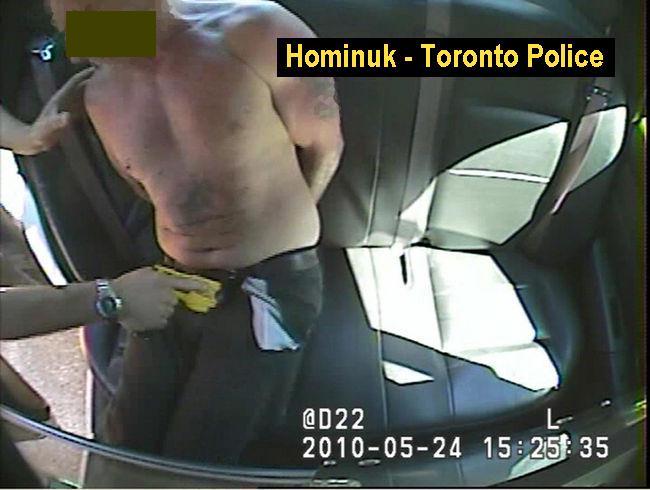
Merseyside, Manchester County Court, U.K.: RESTRICTIVE: A British court found that police officers acted unlawfully and negligently in using a Taser to send electric current into a man's body for 11 seconds, with the result that he suffered cardiac arrest. The incident occurred at a hotel when police were summoned to break up a fight involving a group of men late at night. The man was subjected to the Taser twice in the dart mode during the incident, but the judgment was based on the second application, which the court found was too long at 11 seconds. The first application of the Taser was ruled lawful. The negligence finding was based on an alleged delay in summoning medical assistance when the officers knew or should have known of the potential risks of cardiac arrest after the use of the Taser. The plaintiff claims to now suffer memory loss and to be unable to run his business. The ruling established liability, but further proceedings will determine the amount of damages to be awarded. James McCarthy v. Merseyside Police, Manchester County Court, U.K., Nov. 3, 2015. News article.
Northern Ireland (U.K.), Queen's Bench: An 8-year-old child challenged a decision by police to introduce Tasers in Northern Ireland. Under Article 2 of the European Convention on Human Rights [the right to life], her lawyers argued that children are especially vulnerable to the use of Tasers. The argument was rejected because "no factual situation had been suggested which raised any material risk that the child would be exposed" to the use of a Taser. "As a consequence, she was not a victim and had no standing to bring the human rights challenge." Moreover, the Northern Ireland Policing Board has no authority to prevent a Chief Constable from procuring and deploying Tasers and that "it was not in breach of any duty imposed by the Police (Northern Ireland) Act 2000." JR1's Application and in a Matter of the Decision of the Northern Ireland Policing Board [2011] NIQB 5. Keywords: juvenile.
TASER® is a registered trademark of
TASER International, Inc. [NASDAQ: TASR]
Nomenclature: Tasered and Tasering are the ways some courts and journalists have described the application of the weapon; others have written tase, tased or taze. For reasons of consistency, AELE uses the word Taser plus a suffix when describing a deployment.
Revised: 8-6-19